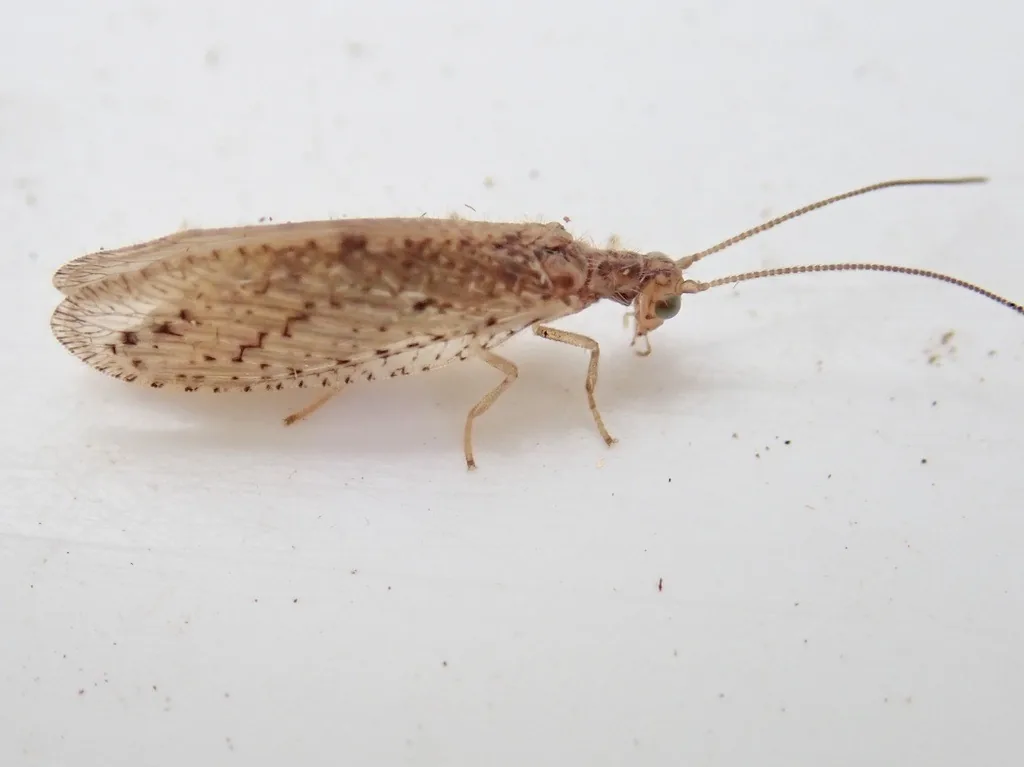
How to identify it
- Adults are soft-bodied with two pairs of hairy, see-through wings held like a roof over the body, mostly brown, and 1/5 to 2/5 inch long.[1]
- They have long, slender antennae.[1]
- Larvae are flattened, tapered at the tail and alligator-like, cream to gray with two brown or reddish stripes, and have paired, tubelike mouthparts that curve inward.[1]
- Eggs are tiny, gray, pink or whitish, laid singly near prey or tucked around buds and bark.[1]
Look-alikes
| Look-alike | How to tell them apart |
|---|---|
| Green lacewings | Color isn't reliable; brown lacewings are about half as long in California, and their larvae wag their heads side to side while hunting.[1] |
| Syrphid fly eggs | Both eggs are similar, but a brown lacewing egg has a short projecting knob at one end that syrphid eggs lack.[1] |
Where it lives
Brown lacewings are widespread; Hemerobius stigma ranges across most of North America and is the most common brown lacewing on conifers. In California they're common near the coast.[2][1]
Biology and life cycle
They grow through egg, three larval stages, pupa in a loose silk cocoon, and adult.[1][2]
They become active earlier in spring than green lacewings, and adults and eggs tolerate cold.[2]
Hemerobius pacificus adults live about 10 weeks, and females lay about 600 to 700 eggs.[1]
They are active mostly from dusk to dawn and in overcast weather, so you see adults at porch lights.[1]
Damage and signs
Health risk
UC IPM and Cornell describe them only as predators of small insects and mites; neither mentions people.[1][2]
Control
Prevention
Broad-spectrum insecticides kill brown lacewings along with the pests.[2]
Biological control
They respond to conservation: avoid spraying when lacewings are active and keep trees or windbreaks along edges.[2]
To check for them in spring, tap foliage over a sheet; adults drop and play dead for a short time.[2]
Common questions
- What is the small brown lacewing at my porch light?
- Brown lacewings fly mostly from dusk to dawn and are often seen at lights at night.[1]
- Is it a green lacewing that turned brown?
- Possibly; some green lacewings are brown or turn brown in winter. Whether the crossveins along the wing's front edge are forked (Y-shaped) reliably separates the two groups.[1]
- When are brown lacewings active?
- Earlier than green lacewings: Hemerobius stigma adults can be active by March in Wisconsin.[2]
Sources
- University of California Statewide IPM Program, “Brown Lacewings (Natural Enemies Gallery).” ipm.ucanr.edu/natural-enemies/brown-lacewings/ (accessed 2026-10-06)
- Cornell University College of Agriculture and Life Sciences, “Biological Control: A Guide to Natural Enemies in North America: Hemerobius species (Brown Lacewings).” biocontrol.entomology.cornell.edu/predators/Hemerobius.php (accessed 2026-10-06)
- iNaturalist, “Hemerobius taxon page (order and family).” www.inaturalist.org/taxa/118994 (accessed 2026-10-06)