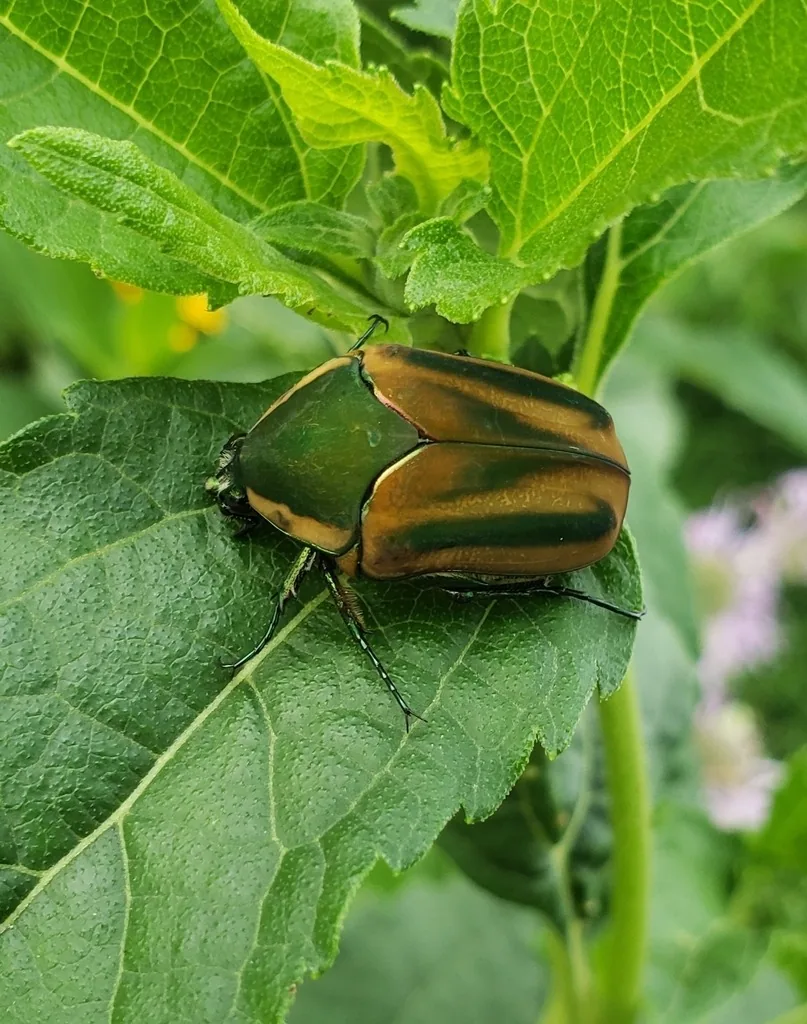
How to identify it
- Adults are about 3/4 inch to 1 inch long and about 1/2 inch wide, with a green back and a bright, iridescent greenish-gold underside.[2][1]
- The wing covers range from solid green to green with bronze or tan streaks, edged with a bronze-to-yellow band.[3][1][2]
- Grubs are cream-colored with tan heads and reach about 2 inches long; they crawl on their backs with their short legs in the air.[2][1][3]
- Adults fly by day, buzzing loudly about 2 to 3 feet above the lawn and often circling the same patches of grass.[3]
Look-alikes
| Look-alike | How to tell them apart |
|---|---|
| Japanese beetle | Japanese beetle grubs usually cause more turf injury; green June beetle grubs mostly eat decaying organic matter and are considered a nuisance pest.[3] |
| May and June beetles (Phyllophaga) | Green June beetles are often just called June beetles or June bugs, but their metallic green color and upside-down-crawling grubs set them apart.[2][1] |
| Masked chafers | Masked chafer grubs do more turf damage; green June beetle grubs live in vertical burrows 10 to 12 inches deep and are much larger.[3] |
Where it lives
A native scarab that turns up every summer in lawns, gardens and fruit plantings in states such as North Carolina, Kentucky and Ohio.[3][1][2]
Biology and life cycle
There is one generation a year: grubs overwinter deep in the soil, pupate in late spring, and adults emerge in July and August.[1][2]
Mated females lay clusters of 10 to 30 eggs in moist soil rich in organic matter, and the eggs hatch in 10 to 15 days.[1]
Grubs feed mostly on decaying organic matter in thatch and the root zone, and come out at night or after heavy rain, sometimes crossing driveways by the hundreds.[1][3]
Adults have soft, spoon-shaped jaws suited to ripe fruit and oozing sap rather than leaves.[3]
Damage and signs
- Adults chew holes in soft, ripening fruit such as grapes, figs, peaches and apples; in some regions they are called fig-eaters.[1][2]
- In lawns, grubs push up small mounds of loose soil that look like earthworm castings, and their tunneling can uproot young grass seedlings.[1]
- They are most common in older lawns and pastures with high-organic soils or manure-based fertilizers.[1][3]
Health risk
Green June beetles are harmless to humans, and the grubs are even edible.[1]
Control
Prevention
If grubs aren't damaging the turf, no action is needed; they are generally considered a nuisance rather than a serious lawn pest.[1][3]
Reduce thatch, for example with core aeration, and go easy on heavy compost or manure applications, which can draw egg-laying beetles.[3][1]
Keep them out
Protect ripening grapes and other small fruit with netting or row covers whose holes are small enough to keep the beetles out.[2]
Biological control
The blue-winged wasp, Scolia dubia, hunts green June beetle grubs in the soil and lays eggs on them, helping reduce beetle numbers.[2][3]
Pesticides
Unlike other white grubs, these grubs can be controlled with a labeled insecticide applied to the soil surface and not watered in, since the grubs surface and contact it; late summer, while grubs are small, is the best time.[1]
Common questions
- Why are big white grubs crawling across my driveway?
- They are likely green June beetle grubs, which leave their burrows at night or after heavy rain and crawl on their backs across pavement.[3][1]
- Why do green June beetles swarm over one lawn but not the next?
- They seek turf with lots of organic matter, such as thatch, to lay eggs in, which may explain why they concentrate on certain lawns.[3]
- Do green June beetles sting?
- No. They are harmless to people; the large wasps that sometimes patrol the same lawns are blue-winged wasps hunting the grubs.[1][3]
Sources
- NC State Extension, “Green June Beetle in the Landscape (PDIC Factsheet, reviewed May 6, 2023).” content.ces.ncsu.edu/green-june-beetle-1 (accessed 2026-10-06)
- University of Kentucky Entomology, “ENTFACT-227: Green June Beetle on Grapes (revised January 2026).” entomology.mgcafe.uky.edu/ef227 (accessed 2026-10-06)
- Ohio State University Extension, “Big Buzzing Green June Beetles are Cruising Ohio Lawns (Buckeye Yard & Garden onLine, July 5, 2024).” bygl.osu.edu/node/2388 (accessed 2026-10-06)
- iNaturalist, “Cotinis nitida taxon page (order and family).” www.inaturalist.org/taxa/118538 (accessed 2026-10-06)