The short answer
- Beetles at the porch light: turn exterior lights off or leave them on for shorter periods, and switch to yellow or amber bulbs. University of Georgia Extension says spraying the house is the least effective option, because hundreds more arrive the next night.[13][14]
- Green beetles on ripe fruit: pick fruit as it ripens, clean up fallen fruit, cover ripening fruit with fine netting, screen or fruit bags, and catch adults in a jug trap baited with fruit juice and water.[8][9][7]
- Stop the next generation of fruit beetles by spreading out or removing piles of manure, grass clippings, leaves and compost near fruit trees, where their grubs live.[8][9]
- Brown June bugs: control is rarely needed unless your area has a history of damage. Their grubs, not the adults, are what hurt lawns, and the lawn grub guide covers checking and treating them.[1][2]
- Ten-lined June beetles: Washington State University says they seem to cause few problems in home gardens in western Washington. Their grubs feed deep in sandy soil, where insecticides are hard to deliver.[12][11]
June bug profiles
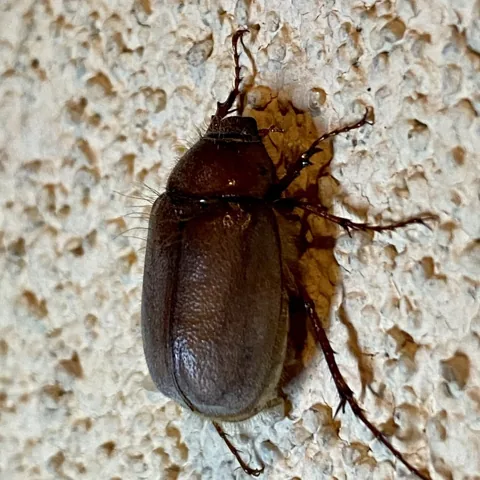 May and June Beetles
Phyllophaga species
May and June beetles, or June bugs, are native scarab beetles in the genus Phyllophaga. The adults buzz around porch lights on early summer nights, while their C-shaped grubs feed on roots, mostly in turf.
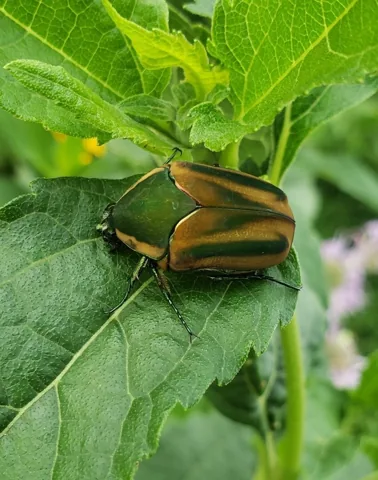 Green June Beetle
Cotinis nitida
Green June beetles are large, metallic green scarabs that cruise a few feet above lawns on summer days with a loud buzz. They are harmless to people; the adults damage ripe fruit, and their oversized grubs burrow in lawns rich in organic matter.
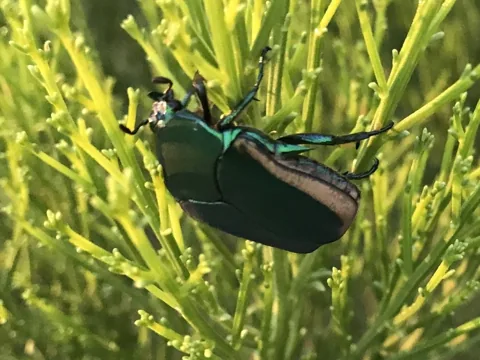 Figeater Beetle
Cotinis mutabilis (green fruit beetle, figeater)
The figeater is a large metallic green beetle drawn to ripe fruit; its grubs live in compost and manure piles.
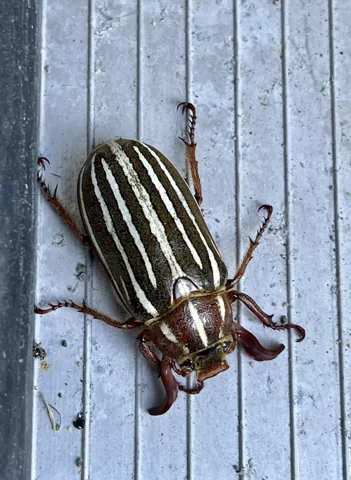 Ten-lined June Beetle
Polyphylla decemlineata
The ten-lined June beetle is a big, striped scarab of the western U.S. and Canada. Males fly to lights on summer nights and the beetles can hiss loudly when disturbed, but Colorado State calls them harmless. In yards the grubs rarely cause noticeable injury, though in some orchards and new poplar plantings they kill trees.
Which June bug do you have?
All of these are scarab beetles: stout, oval beetles with clubbed antennae whose tip segments fan open like a feather. Their larvae are cream-colored, C-shaped white grubs with three pairs of legs that live in the soil. The kind you have decides whether anything needs doing, so start here.[3][4][1]
- May and June beetles (Phyllophaga): brown, reddish brown or nearly black, with no spots or stripes, 1/2 to 1 inch long. They fly at night, come to lights and are clumsy fliers that hit windows and cling to screens. Missouri counts more than 400 species north of Mexico, and they are hard to tell apart.[1][2][3]
- Green June beetle (Cotinis nitida): about an inch long, dull metallic green with bronze to yellow edges and a shiny green-gold underside. It flies by day, low over lawns, with a loud buzz Missouri compares to a bumblebee, though it still comes to lights after dark. UC IPM calls it the eastern green June beetle.[6][7][4][8]
- Figeater, or green fruit beetle (Cotinis mutabilis): the western look-alike, also called the western green June beetle. UC IPM gives 3/4 to 1-1/3 inches and Arizona Extension 1.25 inches. UC IPM says it is virtually identical to the green June beetle, which in California is reported only in the south, and that the figeater has a short horn on its face.[8][9]
- Ten-lined June beetle (Polyphylla decemlineata): a large western beetle with ten stripes on its wing covers, also called the watermelon beetle or hissing beetle. Males have large, plate-like antennae. It lives in sandy soils west of the Rocky Mountains and near their eastern slopes.[10][11]
- Japanese beetle: smaller, coppery and green, with 12 tufts of white hair around the edge of the abdomen that no other coppery-green beetle has. UC IPM says it is not established in California, and suspected finds there should be reported to the county agricultural commissioner. It has its own guide.[8]
Are June bugs harmful?
Not to people. Missouri Department of Conservation says May beetles chew plants but cannot hurt people, and NC State Extension calls green June beetles harmless to humans. Whatever harm they do is to plants: May and June beetle adults occasionally chew holes in tree leaves, green June beetles and figeaters eat ripe fruit, and the grubs of several kinds feed on roots.[3][6][5][1][2]
Missouri also notes that entomologists avoid the name "June bug" for these beetles, since a true bug is a different group of insects, and that in some regions "June bug" means a mayfly. A brown beetle indoors near a lamp came in from the yard: its larvae live in the soil outside.[3][1]
June bugs at porch lights and windows
May and June beetles fly after dusk in late spring and early summer and head for lights, crash-landing on porches and clinging to screens and door frames. Wisconsin gives late May and early June for its species. Ten-lined June beetle males come to lights from June through September, while the females fly poorly and rarely do. The beetles hitting the glass are drawn by the light; University of Georgia Extension says they are not trying to break in.[1][3][5][10][13]
Spraying doesn't fix this. University of Georgia Extension says an aerosol might kill a few on any given night, but hundreds more come back the next night. Changing the light works better.[13]
- Keep exterior lights off when you don't need them, and don't leave them on for long stretches.[13]
- Use yellow bulbs. University of Georgia Extension says soft yellow lights are the least attractive to most insects, and that LEDs filtered to yellow or amber draw fewer flying insects; some are sold as bug lights for May and June beetles. NPIC recommends yellow or sodium vapor bulbs outdoors for the same reason.[13][14]
- If you are replacing old bulbs anyway, a field experiment by University of Bristol researchers found household LEDs attracted significantly fewer insects than incandescent and compact fluorescent bulbs, with no difference between cool-white and warm-white LEDs. Most of the insects in that study were flies, not beetles.[15]
- Remember the windows. University of Georgia Extension says light shining out through windows attracts insects as well as outdoor fixtures do.[13]
Green June beetles and figeaters on fruit
The green beetles are the June bugs that cost gardeners fruit. Adults chew soft, ripening fruit and gather on it in groups. UC IPM lists apricots, caneberries, figs, grapes, peaches and plums; Arizona adds tomatoes; NC State mentions apples and says some places call the beetles fig-eaters. They are drawn to ripe and fermenting fruit and to the smell of manure, and can fly a long way to reach it.[8][9][6][4]
Timing differs by species and place. NC State and Kentucky give July and August for green June beetle adults, and Missouri says they emerge in June. UC IPM says figeater adults can be around from late spring through early fall. Kentucky says grapes that ripen during the peak of the flight suffer most, as berries soften and sugar rises, and that numbers swing a lot from year to year.[6][7][4][8]
- Harvest early. Arizona says that when the beetles start feeding, the fruit is ripening and it's time to pick as much as you can. UC IPM also suggests early-ripening varieties and getting rid of fallen fruit.[9][8]
- Cover the fruit. Kentucky suggests netting or row covers with holes small enough to keep the adults out; Arizona says ordinary bird netting isn't fine enough and suggests window screen or floating row cover. Put covers on only as the fruit ripens, since they also keep pollinators off the flowers.[7][9]
- Bag individual fruit. Arizona says small fruit bags make a barrier on each piece, which is a lot of work but almost removes the need for pesticides.[9]
- Trap adults. Put several inches of a 1:1 mix of fruit juice and water (UC IPM uses grape or peach juice, Arizona grape or apple) in a 1-gallon jug and fit a funnel of wire mesh or window screen into the opening, wide end up. Beetles crawl in and can't get out. Arizona hangs one or two per tree and empties live beetles into a bucket of soapy water. UC IPM says managing the grubs' breeding sites does more to reduce numbers than trapping.[8][9]
Clean up where the fruit beetle grubs live
Figeater grubs don't damage plants or fruit. They live in and eat decaying organic matter, and UC IPM says females lay eggs just under the surface of compost piles, lawn clippings, organic mulch and manure. Arizona says the grubs overwinter in horse manure, compost piles and soils rich in organic matter. Take that away from near the fruit trees and you cut next year's adults.[8][9]
Green June beetles breed the same way in the East. NC State says females lay eggs in moist, organic soil and the beetle is most common in older lawns and pastures with high organic content or manure fertilizer. Missouri finds adults on and near compost heaps.[6][4]
- Thinly spread or remove piles of compost, grass clippings, leaves and manure near fruit trees.[8][9]
- Compost in screened bins, or turn piles often to speed decay and expose the grubs, then crush them or leave them for birds.[8][9]
- Arizona notes that poultry given access to these areas reduce grub numbers.[9]
Should you spray the adults?
Sources differ, and for fruit mostly say no. UC IPM recommends no insecticide for figeaters and says to manage the grubs instead. Arizona says spraying adults isn't recommended because the fruit is ripe or nearly so and residue would stay on it. Kentucky says the products that work best on green June beetles in grapes carry pre-harvest intervals that rule them out in the last days before harvest, when the beetles are actually on the fruit, and warns against harming pollinators.[8][9][7]
For leaves rather than fruit, Wisconsin says several contact insecticides, including carbaryl, cyfluthrin and lambda-cyhalothrin, will control adult May and June beetles, though it adds that their leaf feeding is infrequent and local. NC State says carbaryl can protect the foliage of plants green June beetles attack, but because the adults are strong fliers that appear suddenly, protecting fruit and leaves takes diligence. If you spray, follow the label, including its waiting period before harvest.[1][6][9]
The grubs: when June bugs damage the lawn
May and June beetle grubs feed on the roots of grasses, trees and shrubs. Utah State says they eat organic matter at first and second-year grubs do most of the damage. Heavily damaged turf turns yellow and brown, feels spongy and peels back from the soil, and skunks, raccoons and birds may tear it up digging for grubs. The life cycle is long, and sources give different lengths: Wisconsin says three years for most of its species and two for one, Utah State says two to three years for some species, and Missouri says grubs spend one to four years underground depending on species.[2][1][3]
That long cycle is why Wisconsin says control is rarely warranted unless there is a history of damage, and even then not every year. Healthy, well-watered and fed turf tolerates grubs better. Get the grub identified before treating, because Japanese beetle and other grubs live in lawns too. NC State's Lee County office also notes that milky spore works only on Japanese beetle grubs. Thresholds, preventive versus curative timing, nematodes and how to water products in are covered in the lawn grub guide.[1][5]
Green June beetle grubs are different. NC State says they feed mostly on decaying organic matter, push up small mounds of soil in lawns, crawl on their backs and sometimes turn up by the hundreds on sidewalks and driveways. If there is no sign of turf damage from their tunneling, NC State says no action is needed. It also says carbaryl applied to the soil surface works against them (other white grubs aren't affected) and should not be watered in, and that large numbers of dead grubs smell as they decay.[6][7]
Ten-lined June beetles
Ten-lined June beetle grubs feed on the roots of shrubs and trees, mostly in sandy soil. Washington State University lists almonds, apples, cherries, poplars, prunes, walnuts and stone fruit among the plants the grubs feed on, and its Puyallup center says plants are sometimes killed and the beetle has become a serious pest in Christmas tree plantations, but that it seems to cause few problems in home garden plantings in western Washington. In California orchards, heavy infestations have been found only on sandy soils.[10][11][12]
They are hard to control. A University of California report says the grubs can be anywhere from 2 inches to 5 feet below the surface, and that while they are easy to kill in the lab, getting insecticide to them in the ground is the problem. Development takes multiple years: about two in a California almond study, two or three seasons in California and up to four in northern sites by WSU's account. Adults the homeowner sees at the light are mostly males looking for females, which stay near the ground.[12][10]
Natural enemies
Skunks, moles, crows and grackles dig out June beetle grubs, and birds, bats and frogs eat the adults. Scoliid wasps dig into the soil to lay eggs on the grubs; Kentucky names Scolia dubia as a wasp that kills green June beetle grubs and reduces adult emergence. Arizona suggests tolerating skunks digging in lawns and compost, since the cosmetic damage stops worse damage from the grubs.[3][7][9]
Next steps
These pages pick up where this one stops.[1]
- Grubs in the lawn: the lawn grub guide covers how to check, thresholds and treatment timing.[1][2]
- A beetle you can't place: the May and June beetle, green June beetle, figeater and ten-lined June beetle profiles, the garden beetles guide, and the cockroach look-alikes guide for brown beetles indoors.[3][8]
- Coppery-green beetles skeletonizing leaves: the Japanese beetle guide.[8]
Common questions
- Do June bugs bite?
- No. Missouri Department of Conservation says May beetles cannot hurt people, NC State's Lee County office says they are not dangerous to people, and NC State calls green June beetles harmless to humans.[3][5][6]
- Why do June bugs come to my porch light?
- The adults fly at night and are attracted to lights. Turning lights off, shortening how long they're on and using yellow or amber bulbs all reduce the number that show up.[1][3][13][14]
- Will spraying around the house get rid of June bugs?
- Not for long. University of Georgia Extension says a spray might kill a few one night, but hundreds more fly in the next night, and changing the lighting works better.[13]
- What kills the green beetles eating my figs and peaches?
- UC IPM recommends no insecticide for figeaters. Pick fruit early, cover or bag ripening fruit, trap adults in a jug baited with fruit juice and water, and remove the compost, clippings and manure piles where the grubs grow.[8][9]
- Are the big grubs on my driveway June bug grubs?
- Probably green June beetle grubs. NC State says they crawl on their backs at night and homeowners sometimes find hundreds or thousands on sidewalks and driveways. They mostly eat decaying organic matter, and if the lawn shows no damage from their tunneling, no treatment is needed.[6][7]
- Does milky spore work on June bug grubs?
- No. NC State's Lee County Extension office says milky spore works only on Japanese beetle grubs.[5]
Photo credits
- May and June Beetles: (c) Elliott Gordon, some rights reserved (CC BY) — via iNaturalist, CC BY 4.0
- Green June Beetle: Jack, public domain (CC0), via iNaturalist
- Figeater Beetle: (c) CK2AZ, some rights reserved (CC BY) — via iNaturalist, CC BY 4.0
- Ten-lined June Beetle: (c) bcislander, some rights reserved (CC BY) — via iNaturalist, CC BY 4.0
Sources
- University of Wisconsin-Madison Extension, “May/June Beetles (P. J. Liesch).” hort.extension.wisc.edu/articles/mayjune-beetles/ (accessed 2026-11-10)
- Utah State University Extension, “May/June Beetles (turf IPM).” extension.usu.edu/planthealth/ipm/notes_orn/list-turf/ar_may-june-beetles (accessed 2026-11-10)
- Missouri Department of Conservation, “May Beetles (June Bugs).” mdc.mo.gov/discover-nature/field-guide/may-beetles-june-bugs (accessed 2026-11-10)
- Missouri Department of Conservation, “Green June Beetle.” mdc.mo.gov/discover-nature/field-guide/green-june-beetle (accessed 2026-11-10)
- N.C. Cooperative Extension, Lee County Center, “May-June Beetles (M. Daughtry).” lee.ces.ncsu.edu/2021/05/may-june-beetles (accessed 2026-11-10)
- NC State Extension, “Green June Beetle in the Landscape.” content.ces.ncsu.edu/green-june-beetle-1 (accessed 2026-11-10)
- University of Kentucky Entomology, “ENTFact-227: Green June Beetle on Grapes (R. Bessin).” entomology.mgcafe.uky.edu/ef227 (accessed 2026-11-10)
- University of California Statewide IPM Program, “Green Fruit Beetle.” ipm.ucanr.edu/PMG/GARDEN/FRUIT/PESTS/grfruitbeetle.html (accessed 2026-11-10)
- University of Arizona Cooperative Extension, “Backyard Gardener #5: Green Fruit Beetles (J. Schalau).” extension.arizona.edu/sites/extension.arizona.edu/files/attachment/GreenFruitBeetles.pdf (accessed 2026-11-10)
- Washington State University Extension, “FS272E: Tenlined June Beetle (Rodstrom and Brown).” wpcdn.web.wsu.edu/wp-ecommerce/uploads/sites/2/product-4217-sku-FS272E.pdf (accessed 2026-11-10)
- Washington State University Puyallup Research and Extension Center, “PLS-5: June Beetles (A. L. Antonelli).” wpcdn.web.wsu.edu/wp-puyallup/uploads/sites/408/2015/02/PLS-5-June-Beetles.pdf (accessed 2026-11-10)
- University of California Cooperative Extension, “Tenlined June Beetle Attacking Almond Roots: A Past Problem Returns (Johnson and others), UC Plant Protection Quarterly 13(1), 2003.” class.ucanr.edu/sites/default/files/2011-10/123925.pdf (accessed 2026-11-10)
- University of Georgia Cooperative Extension, “Don't be bugged by insects seeing the light (P. Pugliese).” fieldreport.caes.uga.edu/news/dont-be-bugged-by-insects-seeing-the-light/ (accessed 2026-11-10)
- National Pesticide Information Center, “Spiders.” npic.orst.edu/pest/spiders.html (accessed 2026-11-10)
- Ecology and Evolution, abstract via PubMed, “Wakefield and others 2016, Experimentally comparing the attractiveness of domestic lights to insects: Do LEDs attract fewer insects than conventional light types?.” pubmed.ncbi.nlm.nih.gov/27878075/ (accessed 2026-11-10)