The short answer
- Check the back. Beetles have hard, shell-like wing covers that meet in a straight line down the middle of the back. Adult cockroaches have thin, leathery or membranous wings, or no wings at all.[1][8][5]
- Look for the head. From above, a cockroach's head is hidden under a shield-like plate (the pronotum). A ground beetle's head sticks out in front, and it is smaller than the section behind it.[3][5]
- Watch how it moves. Cockroaches run on long, spiny legs. Crickets have big hind legs for jumping. Giant water bugs have grabbing front legs and flat, oar-like hind legs for swimming.[3][18][10]
- Common look-alikes: ground beetles, giant water bugs, May and June beetles, the palo verde root borer in Arizona, darkling beetles in the West, field and camel crickets, and wood cockroaches, which are real roaches that don't infest homes.[5][9][11][13][16][18][4]
- If it is a cockroach, the species matters, because German cockroaches breed indoors and the larger roaches mostly come in from outside. A sticky trap will catch one so you can identify it.[1][2]
Look-alike and cockroach profiles
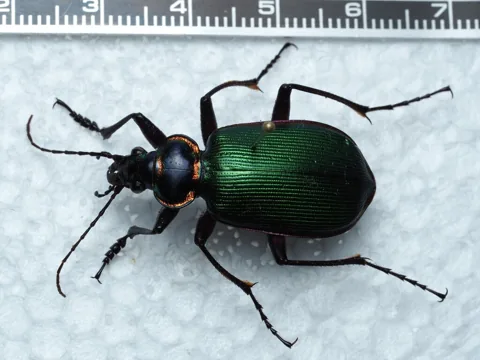 Ground Beetles
Family Carabidae (e.g., Calosoma scrutator, the fiery searcher)
Ground beetles are one of the largest groups of beetles in North America. They sometimes crawl indoors under doors or through small openings, but they prefer to live outside where prey is common, and outdoors they are valuable predators of garden pests.
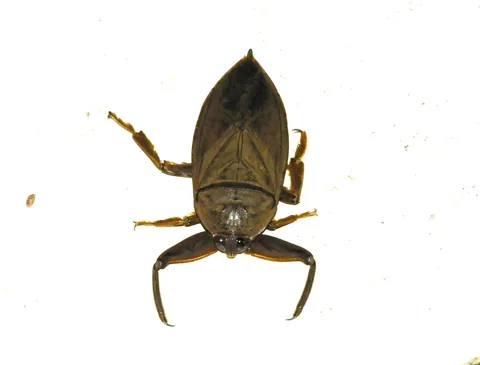 Giant Water Bugs
Belostomatidae (Lethocerus, Abedus, Belostoma)
Giant water bugs are large, flattened aquatic predators also called toe-biters and electric light bugs. On summer nights adults leave the water to find mates and fly to lights, so they turn up on sidewalks and in pools; if handled or stepped on, they can give an extremely painful bite.
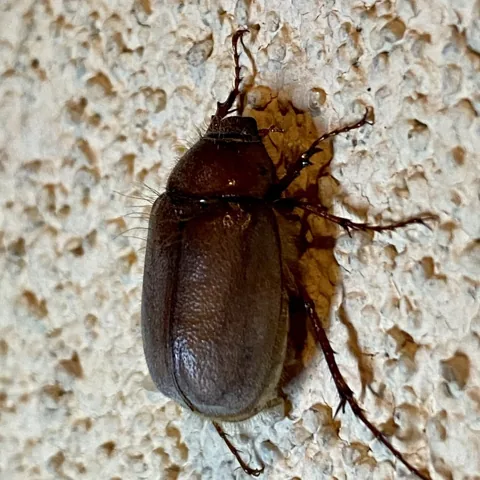 May and June Beetles
Phyllophaga species
May and June beetles, or June bugs, are native scarab beetles in the genus Phyllophaga. The adults buzz around porch lights on early summer nights, while their C-shaped grubs feed on roots, mostly in turf.
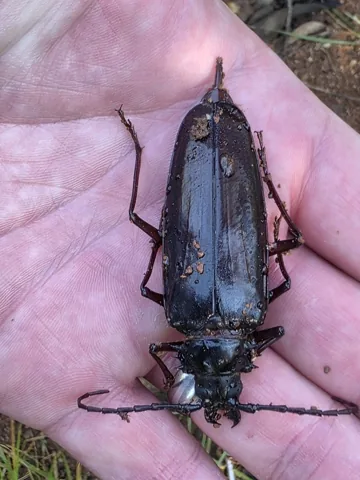 Palo Verde Root Borer
Derobrachus hovorei (formerly included in D. geminatus)
The palo verde root borer is a huge longhorned beetle that emerges with the summer monsoon in the desert Southwest; its grubs spend years feeding on the roots of palo verde and other trees, but University of Arizona entomologists say it is often wrongly blamed for trees that die from stress.
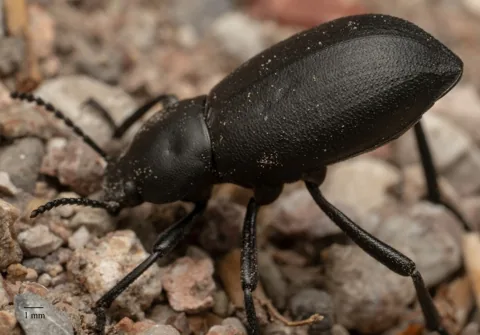 Darkling Beetles (Stink Beetles)
Tenebrionidae; this profile centers on Eleodes species (stink or pinacate beetles)
Darkling beetles (family Tenebrionidae) are one of the largest beetle families, and most are dull black or brown ground-dwelling scavengers. The ones homeowners in the West notice most are stink beetles, also called pinacate beetles, in the genus Eleodes: slow, flightless black beetles that tip up into a headstand and give off a foul-smelling spray when bothered.
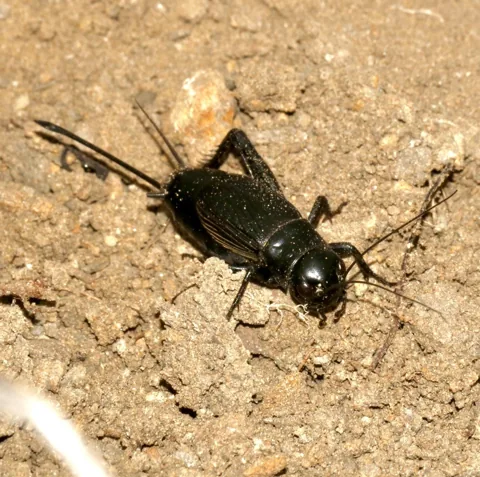 Field Crickets
Gryllus species (e.g., G. pennsylvanicus)
Field crickets are several species in the genus Gryllus that live outdoors in fields, pastures, roadsides and yards. They come into homes most often in late summer and fall, when cooler nights and outdoor lights draw them toward buildings.
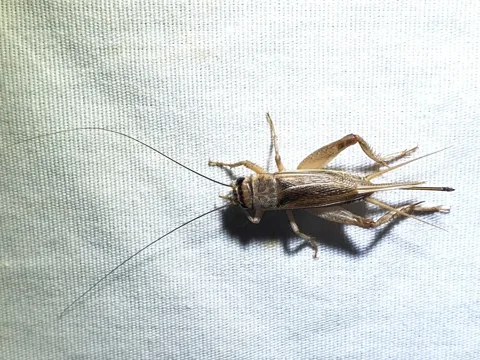 House Cricket
Acheta domesticus
The house cricket is a light brown cricket that is common outdoors, strongly attracted to light and often found inside houses, especially in late summer and fall.
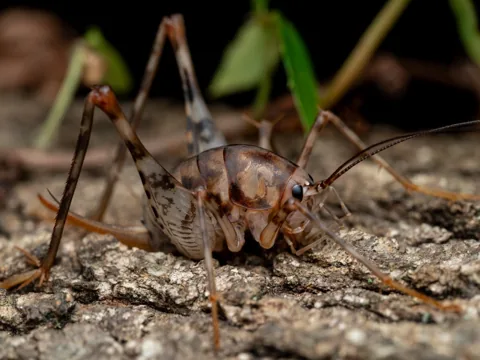 Camel Cricket
Rhaphidophoridae (shown: Tachycines asynamorus)
Camel crickets, also called cave crickets, are humpbacked, wingless crickets that live in cool, damp, dark places and often turn up in basements, crawl spaces and garages. They are a nuisance, not a danger.
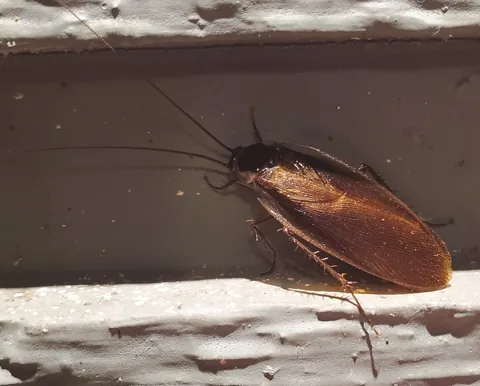 Wood Cockroaches
Parcoblatta species (e.g., P. pennsylvanica)
Wood cockroaches are native species of forest leaf litter, logs and other damp places full of decaying material. They come indoors only by accident, dry out and die within days, and don't feed or breed inside, so they are a nuisance only.
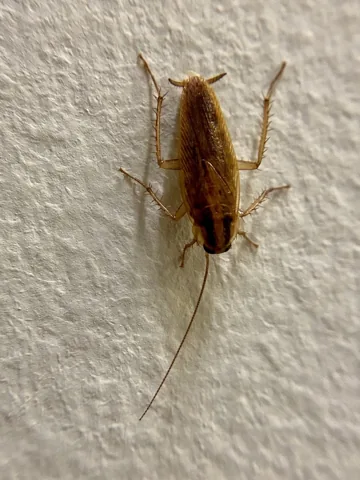 German Cockroach
Blattella germanica
The German cockroach is the most common cockroach living indoors in California and perhaps worldwide, especially in apartment buildings, and it has the fastest reproductive cycle of the common pest cockroaches. Penn State and Kentucky call it the most common cockroach in homes, apartments and other buildings, and Kentucky says it does not live outdoors.
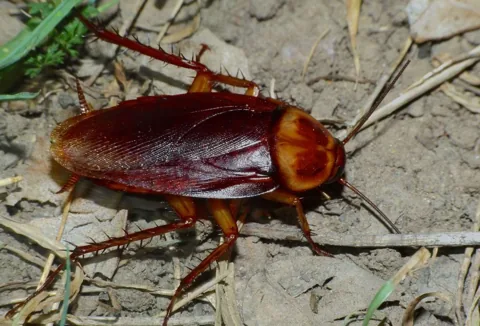 American Cockroach
Periplaneta americana
The American cockroach is the largest of the common pest cockroaches. It prefers warm, humid places and readily lives outdoors, in sewers, storm drains and water meter boxes, coming indoors to forage. Kentucky, Penn State and Minnesota all describe it as the largest cockroach commonly found in buildings.
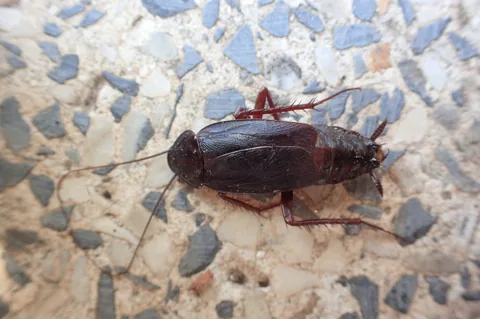 Oriental Cockroach
Blatta orientalis
The oriental cockroach, often called a water bug and sometimes a black beetle, lives in cool, dark, damp places such as basements, crawl spaces, drains and water meter boxes. It usually lives outdoors or in those damp spots and wanders into buildings at night, mostly staying at ground level.
How to tell a cockroach from a look-alike
Cockroaches are broad, flattened insects with long antennae and a prominent, shield-shaped plate behind the head called the pronotum. Seen from above, that plate hides the head. Their legs are long and spiny, and they move fast. Cockroaches can be brown, black, tan, reddish orange or pale green, and most have wings, though in some species the wings are short and useless.[1][3]
Some people confuse cockroaches with beetles, but adult cockroaches have membranous wings and lack the thick, hardened forewings that beetles have. On a beetle, those hard wing covers meet in a straight line down the back. Kentucky Extension puts it this way for ground beetles: beetles have hardened front wings, while roaches have leathery wings or none, and roaches have a hood that hides the head from above.[1][8][5]
Nicknames add to the confusion. UC IPM notes that the Oriental cockroach is sometimes called a water bug or black beetle, and Texas A&M Extension says American cockroaches are also called waterbugs or palmetto bugs. A bug someone calls a 'water bug' may be a roach or a true giant water bug, so look at the insect, not the name.[1][3]
- Hard wing covers meeting in a straight line, head visible from above: a beetle (ground beetle, June beetle, darkling beetle, palo verde root borer).[8][5]
- Oval and flattened, with thick front legs built for grabbing and oar-like hind legs, often found near water or under lights: a giant water bug.[10]
- Long antennae, large hind legs that jump, and long feelers at the rear end: a cricket.[18][19]
- Flattened, head hidden under the pronotum, long spiny running legs and long thin antennae: a cockroach. Next, decide which kind (see below).[3]
Ground beetles
Kentucky Extension notes that ground beetles can be confused with roaches such as the Oriental cockroach, since both are shiny and very dark. Most are shiny black (some are metallic), with ridged wing covers, a head smaller than the thorax, threadlike antennae and prominent jaws. They run quickly when disturbed.[5]
Most are 1/4 to 3/4 inch long by Missouri Department of Conservation's measure, though some North American species reach 2 inches; UC IPM gives most species as about 1/8 to 1 inch. They hide under rocks, logs, leaf litter and mulch by day and hunt at night, and some fly to lights. They wander indoors by crawling through small openings or under doors but generally don't stay, since their prey is outside.[8][6][5][7]
Ground beetles are beneficial predators of caterpillars, slugs, snails and other insects, so no control is needed outdoors. Some release a bad smell or chemicals that can irritate sensitive skin, and larger ones may bite, so Washington State University advises against handling them bare-handed. Indoors, sweep or vacuum them up, or carry them back outside, and seal gaps around doors, windows and the foundation. Kentucky Extension also suggests clearing log piles, mulch and debris from beside the foundation.[8][7][5]
Giant water bugs (toe-biters, electric light bugs)
Giant water bugs are among the largest insects in the US: up to 2 1/2 inches long according to Mississippi State Extension, or to about 2 inches according to Missouri Department of Conservation. They're brownish, with an oval, flattened body, clawlike front legs for grabbing prey and long, oar-like hind legs for swimming.[9][10]
They live in ponds, lakes and slow streams, but adults fly at night and are drawn to lights, which is why they turn up on sidewalks, at lit tennis courts and in swimming pools.[9][10]
Unlike cockroaches, giant water bugs can deliver a very painful bite with their piercing mouthparts. Mississippi State Extension says the pain is short-lived with no lasting effects, and bites are rare because people seldom handle them. Don't pick one up or poke it with a bare foot; Missouri Department of Conservation suggests lifting one out of a pool with a net.[9][10]
May and June beetles
May and June beetles (June bugs) are 1/2 to 1 inch long and range from light brown or reddish brown to almost black. They're active after dusk in late spring and early summer, fly to lights, and are clumsy fliers that bump into windows and cling to screens. That's usually how they end up indoors.[11][12]
Like other beetles, they have shell-like wing covers that meet in a straight line down the back, which a cockroach doesn't. The beetles themselves don't damage the house; their larvae are the white grubs that feed on lawn and plant roots.[8][11][12]
Palo verde root borer (Arizona and the desert Southwest)
This is a huge beetle, about 3 inches long by University of Arizona Pinal County Extension's description and 3 to 3 1/2 inches by the Arizona-Sonora Desert Museum's, black to dark brown, with long, segmented antennae. The Desert Museum says adults look like a large cockroach. Pinal County Extension is blunt: they are not cockroaches. Look for the collar of spines behind the head.[13][14]
Adults appear in early summer and through the monsoon season, mostly in June and July, flying in the evening and drawn to lights. They rarely enter homes and are often found dead on porches or under windows where a light was left on. Pinal County Extension says they can bite if a finger, toe or nose gets close to the head, but they are otherwise harmless.[13][15]
Sources differ on whether the adults eat. University of Arizona sources say they don't feed and live only a few weeks to about a month, while the Desert Museum says adults may take nectar or feed on fruit. The grubs feed on the roots of palo verde and many other broadleaf trees for years (up to three by University of Arizona News, three or more by Pinal County Extension, two to four by the Desert Museum); University of Arizona experts say the beetle is often wrongly blamed for killing trees that are already stressed.[15][13][14]
Darkling beetles (stink beetles, pinacate beetles)
In the West, black darkling beetles of the genus Eleodes are a common sight. UC Davis's Bohart Museum describes the California species as 1 to 2 inches long; University of Arizona Extension gives pinacate beetles as 0.4 to 1.4 inches. They are black and slow-moving and can't fly, because their wing covers are fused.[16][17]
When disturbed, they stand on their heads and can release a bad-smelling fluid that may irritate skin and eyes, so keep your distance from the tip of the abdomen. They feed on decaying plant matter. To keep them, and other large insects, out of the house, University of Arizona Extension recommends weather stripping, caulking around windows and doors and keeping screens in repair.[16][17]
Crickets: field, house and camel crickets
Crickets have antennae as long as their body or longer and large hind legs for jumping, and adult females have a sword-like egg-laying tube at the tip of the abdomen. Males chirp by rubbing their wings together, though not every kind of cricket makes sound. Field crickets are dark brown to black, 1/2 to 3/4 inch long by Minnesota Extension's figures or 1/2 inch to over an inch by Clemson's; house crickets are light yellowish-brown with three dark bands on the head. Both are strongly attracted to light and come indoors mostly in late summer and fall.[18][19]
Camel crickets (cave crickets) are tan, humpbacked and wingless, about 3/4 inch long, with long legs that make them look spider-like. They don't chirp. They like cool, damp, dark places, so they turn up in basements, crawlspaces and garages.[18][20]
Do crickets breed indoors? Minnesota Extension says crickets that come in rarely lay eggs there and normally die by autumn or early winter. Clemson Extension says house crickets can spend their whole lives inside buildings and lay many eggs there. Either way, sealing gaps, cutting back weeds near the foundation, reducing outdoor lights and drying damp areas are the main fixes, and sticky traps catch camel crickets well.[18][19]
Wood cockroaches: a real roach that won't infest your home
Wood cockroaches are native roaches that live outdoors in leaf litter, under logs and loose bark and in woodpiles, where they help break down dead plant material. They have the classic roach shape, so they are cockroaches, not look-alikes, but they don't behave like house pests. Males are up to 1 inch long with long wings and can fly to porch lights; females are up to 3/4 inch with short wings that leave the end of the abdomen exposed.[4]
They get in through gaps around windows and doors and on firewood. Indoors they dry out and die within a few days, and they don't feed or breed inside, so Penn State Extension says pesticides are not necessary or recommended. Bring in only as much firewood as you'll burn in a few hours, move woodpiles away from the house, seal cracks and turn off lights that draw the flying males.[2][4]
Penn State notes that wood cockroaches can be mistaken for pest species: American cockroaches are much larger (up to 2 inches) and reddish-brown, and Oriental cockroaches are dark brown to nearly black, with wingless females and short-winged males. If you can't tell, a county extension office can identify it.[4]
If it is a cockroach
Identify the species before you treat, because the right approach depends on it. Some cockroaches live outdoors and only wander inside (American, Oriental and Turkestan); others, like the German and brownbanded cockroaches, live and breed entirely indoors. A cockroach sticky trap is an easy way to catch one for identification.[1]
A small, light brown roach about 1/2 inch long with two dark stripes on the shield behind the head is a German cockroach, the most common roach inside homes and apartments. It doesn't occur outdoors; it usually comes in with grocery bags, beverage cartons or furniture, or travels between apartments through shared walls. If you see cockroaches during the day, it usually means there are a lot of them around.[2][3]
Our cockroach identification guide covers each species, and the treatment guides explain baits, traps and sealing entry points for the indoor German cockroach and for the larger outdoor roaches.[1]
Common questions
- What bug looks like a cockroach but isn't?
- Ground beetles are the most common one. Others include giant water bugs, May and June beetles, darkling beetles, crickets and, in Arizona, the palo verde root borer. Beetles have hard wing covers that meet in a straight line down the back, which cockroaches don't.[5][1][8]
- How can I tell a beetle from a cockroach?
- Look from above. A beetle has hard, shell-like wing covers meeting down the middle and its head is visible. A cockroach has leathery or thin wings (or none), and its head is hidden under a shield-like plate.[1][5][3]
- Is a water bug the same as a cockroach?
- Not always. 'Water bug' is a nickname for the Oriental and American cockroaches, but true giant water bugs are aquatic insects with grabbing front legs and swimming hind legs that fly to lights in summer. Giant water bugs can give a very painful bite if handled.[1][3][10][9]
- Can a wood roach infest my house?
- No. Wood cockroaches come in by accident, can't survive long indoors and don't breed inside. Penn State Extension says pesticides aren't needed.[4]
- What is the giant cockroach-looking beetle in Arizona?
- Most likely a palo verde root borer, a beetle about 3 inches long that flies to lights in early summer and monsoon season. It has long antennae and spines behind the head and is harmless apart from a possible bite if handled.[13][14][15]
- Do ground beetles bite?
- Larger ground beetles may bite, and some release irritating chemicals, so Washington State University advises not handling them bare-handed. They are beneficial outdoors and generally don't stay indoors.[7][5]
Photo credits
- Ground Beetles: Brighton Lee, public domain (CC0), via iNaturalist
- Giant Water Bugs: (c) Francisco Farriols Sarabia, some rights reserved (CC BY) — via iNaturalist, CC BY 4.0
- May and June Beetles: (c) Elliott Gordon, some rights reserved (CC BY) — via iNaturalist, CC BY 4.0
- Palo Verde Root Borer: Brian Dickerson, public domain (CC0), via iNaturalist
- Darkling Beetles (Stink Beetles): Jesse Rorabaugh, public domain (CC0), via iNaturalist
- Field Crickets: (c) Dustin Snider, some rights reserved (CC BY) — via iNaturalist, CC BY 4.0
- House Cricket: (c) Bob Miller, some rights reserved (CC BY) — via iNaturalist, CC BY 4.0
- Camel Cricket: (c) Zachary Dankowicz, some rights reserved (CC BY) — via iNaturalist, CC BY 4.0
- Wood Cockroaches: (c) Whitney Mattila, some rights reserved (CC BY) — via iNaturalist, CC BY 4.0
- German Cockroach: (c) Sandra H Statner, some rights reserved (CC BY) — via iNaturalist, CC BY 4.0
- American Cockroach: (c) Steve Kerr, some rights reserved (CC BY) — via iNaturalist, CC BY 4.0
- Oriental Cockroach: (c) Jorge Íñiguez, some rights reserved (CC BY) — via iNaturalist, CC BY 4.0
Sources
- University of California Statewide IPM Program, “Pest Notes: Cockroaches (Home and Landscape).” ipm.ucanr.edu/home-and-landscape/cockroaches/ (accessed 2026-11-10)
- University of Kentucky Entomology, “ENTFACT-614: Cockroach Elimination in Homes and Apartments.” entomology.mgcafe.uky.edu/ef614 (accessed 2026-11-10)
- Texas A&M AgriLife Extension, “Cockroaches: Biology and Management, ENTO-037.” extensionentomology.tamu.edu/wp-content/uploads/sites/3/2017/12/Cockroach-Biol-and-Mngmt_ENTO-037_2017.pdf (accessed 2026-11-10)
- Penn State Extension, “Wood Cockroaches (M. J. Skvarla; updated January 2026).” extension.psu.edu/wood-cockroaches (accessed 2026-11-10)
- University of Kentucky Entomology, “ENTFACT-706: Ground Beetles (S. Bailey).” entomology.ca.uky.edu/files/ef706.pdf (accessed 2026-11-10)
- University of California Statewide IPM Program, “Predaceous Ground Beetles (Natural Enemies Gallery).” ipm.ucanr.edu/natural-enemies/predaceous-ground-beetles/ (accessed 2026-11-10)
- Washington State University Extension, “Predaceous ground beetles (Carabids), Pestsense.” pestsense.cahnrs.wsu.edu/fact-sheet/predaceous-ground-beetles-carabids/ (accessed 2026-11-10)
- Missouri Department of Conservation, “Ground Beetles (Carabids) (Field Guide).” mdc.mo.gov/discover-nature/field-guide/ground-beetles (accessed 2026-11-10)
- Mississippi State University Extension Service, “Giant Water Bug, Bug's Eye View Vol. 10, No. 08 (B. Layton).” extension.msstate.edu/newsletters/bugs-eye-view/2024/giant-water-bug-vol-10-no-08 (accessed 2026-11-10)
- Missouri Department of Conservation, “Giant Water Bugs (Field Guide).” mdc.mo.gov/discover-nature/field-guide/giant-water-bugs (accessed 2026-11-10)
- University of Wisconsin-Madison Extension, Wisconsin Horticulture, “May/June Beetles.” hort.extension.wisc.edu/articles/mayjune-beetles/ (accessed 2026-11-10)
- Utah State University Extension, “May/June Beetles (IPM).” extension.usu.edu/planthealth/ipm/notes_orn/list-turf/ar_may-june-beetles (accessed 2026-11-10)
- University of Arizona Cooperative Extension, Pinal County, “Pinal County Gardening Newsletter, July 2019: Palo Verde Root Borers.” extension.arizona.edu/sites/extension.arizona.edu/files/attachment/july-2019.pdf (accessed 2026-11-10)
- Arizona-Sonora Desert Museum, “Animal Fact Sheet: Palo Verde Root Borer Beetle.” desertmuseum.org/kids/oz/long-fact-sheets/Palo%20Vere%20Grub.php (accessed 2026-11-10)
- University of Arizona News, “Bug Bonanza: 7 Big, Colorful Critters to Try to Spot This Monsoon Season.” news.arizona.edu/news/bug-bonanza-7-big-colorful-critters-try-spot-monsoon-season (accessed 2026-11-10)
- Bohart Museum of Entomology, UC Davis, “Information No. 033: Darkling Beetles.” bohart.ucdavis.edu/sites/g/files/dgvnsk4616/files/media/documents/note_33_darkling_beetle.pdf (accessed 2026-11-10)
- University of Arizona Cooperative Extension, Yavapai County, “Backyard Gardener #55: Pinacate Beetle (J. Schalau).” www.extension.arizona.edu/sites/extension.arizona.edu/files/barnesm/PinacateBeetle.pdf (accessed 2026-11-10)
- University of Minnesota Extension, “Crickets.” extension.umn.edu/garden-and-home/home-maintenance/household-insects/crickets (accessed 2026-11-10)
- Clemson Cooperative Extension Home & Garden Information Center, “House and Field Crickets, HGIC 2425.” hgic.clemson.edu/factsheet/house-and-field-crickets/ (accessed 2026-11-10)
- NC State Extension, “Camel Crickets.” content.ces.ncsu.edu/camel-crickets (accessed 2026-11-10)