The short answer
- Small (about 1/2 to 5/8 inch), light brown, with two dark stripes behind the head, in the kitchen or bathroom: German cockroach, the common indoor breeder.[3][10][2]
- Similar size but with two pale bands across the wings and body, hiding high on walls, in furniture or away from water: brown-banded cockroach, the other indoor breeder.[1][6][2]
- Large (about 1 1/2 to 2 inches), reddish brown, with a pale yellow band around the shield behind the head: American cockroach, the one often called a waterbug or palmetto bug. It usually comes in from sewers, drains or outdoors.[9][8][2]
- About 1 inch, shiny black or very dark brown, with short wings, slow-moving, near drains and basements: Oriental cockroach.[1][5][2]
- A German look-alike that flies to lit windows at dusk in the Southeast: Asian cockroach. A brownish roach about 1 inch long that flies to porch lights in wooded areas and dies indoors within days: wood cockroach.[14][19][7][2]
Cockroach profiles
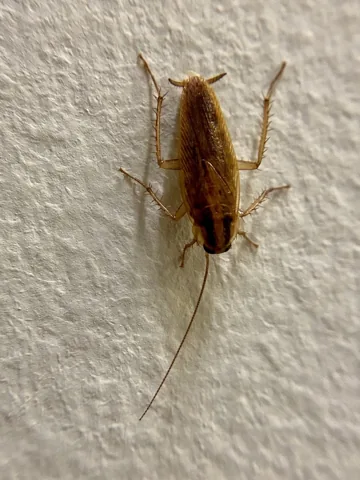 German Cockroach
Blattella germanica
The German cockroach is the most common cockroach living indoors in California and perhaps worldwide, especially in apartment buildings, and it has the fastest reproductive cycle of the common pest cockroaches. Penn State and Kentucky call it the most common cockroach in homes, apartments and other buildings, and Kentucky says it does not live outdoors.
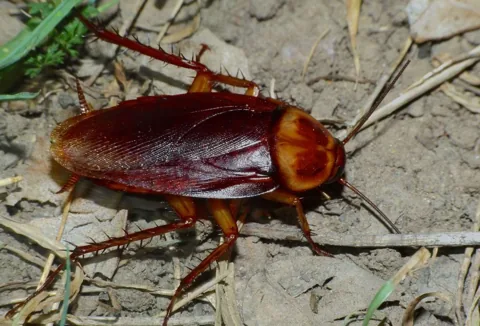 American Cockroach
Periplaneta americana
The American cockroach is the largest of the common pest cockroaches. It prefers warm, humid places and readily lives outdoors, in sewers, storm drains and water meter boxes, coming indoors to forage. Kentucky, Penn State and Minnesota all describe it as the largest cockroach commonly found in buildings.
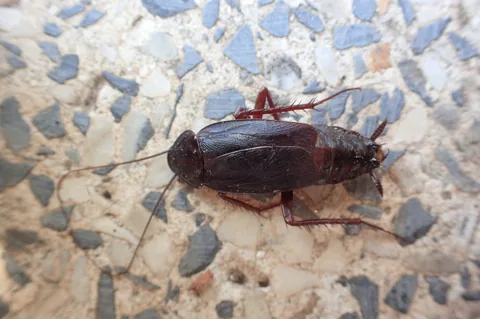 Oriental Cockroach
Blatta orientalis
The oriental cockroach, often called a water bug and sometimes a black beetle, lives in cool, dark, damp places such as basements, crawl spaces, drains and water meter boxes. It usually lives outdoors or in those damp spots and wanders into buildings at night, mostly staying at ground level.
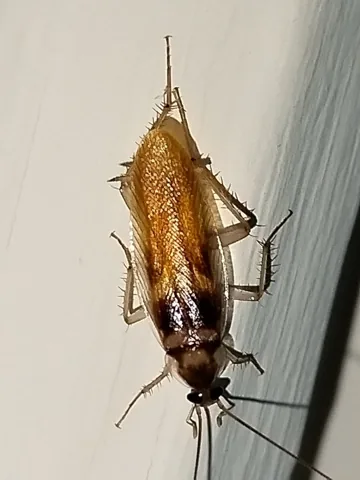 Brownbanded Cockroach
Supella longipalpa
The brownbanded cockroach is a small indoor species that prefers warmer, drier spots than the German cockroach. It hides around appliances, behind wall decorations, in furniture and often near the ceiling, rather than mainly in kitchens and bathrooms.
 Smokybrown Cockroach
Periplaneta fuliginosa (now also placed in Validiblatta)
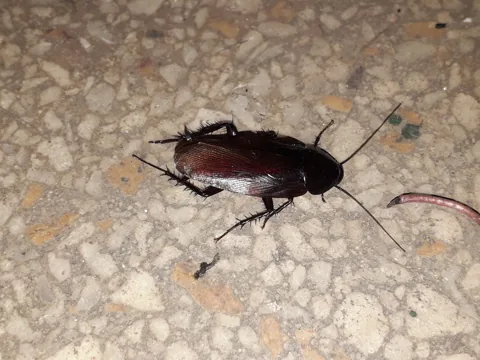
The smokybrown cockroach is a large, dark, winged roach of the humid South. It is the most common cockroach in suburban Southern neighborhoods with mature hardwood trees, where it lives in tree holes, attics, crawl spaces and sheds and comes out at night.
 Australian Cockroach
Periplaneta australasiae (Validiblatta australasiae)
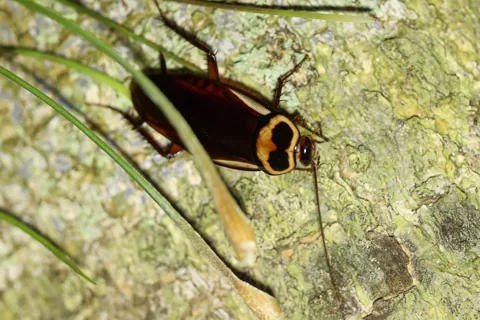
The Australian cockroach is a large, winged roach that lives mostly outdoors in warm, damp places and sometimes wanders indoors. It looks a lot like the American cockroach but has pale yellow 'shoulders' on its wings and, unusually for a cockroach, eats plants.
 Turkestan Cockroach
Blatta lateralis (Periplaneta lateralis, Shelfordella lateralis)
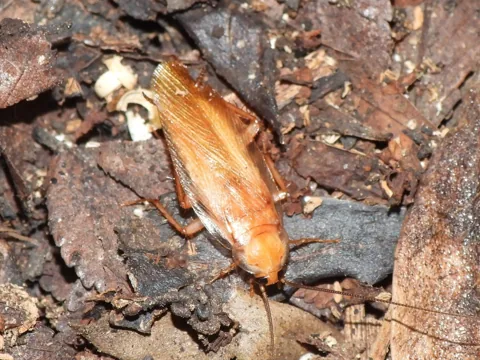
The Turkestan cockroach is an invasive species that lives mostly outdoors, in water meter boxes, cracks between concrete blocks, compost, leaf litter, potted plants and sewers. In urban areas of the Southwest it is rapidly replacing the Oriental cockroach.
 Asian Cockroach
Blattella asahinai
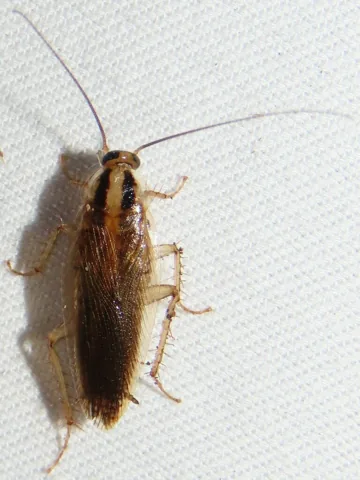
The Asian cockroach is a close relative of the German cockroach that lives outdoors in leaf litter, mulch and grassy areas. It flies well and is drawn to lights at dusk, so it shows up indoors in the evening, but treating inside the house doesn't control it.
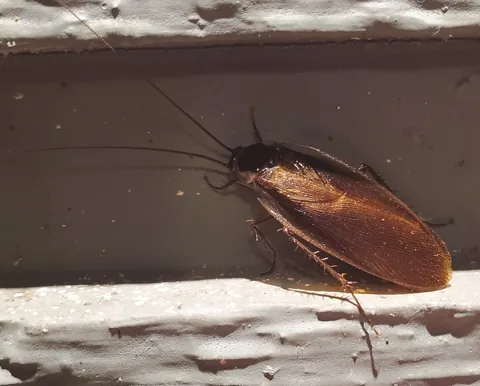 Wood Cockroaches
Parcoblatta species (e.g., P. pennsylvanica)
Wood cockroaches are native species of forest leaf litter, logs and other damp places full of decaying material. They come indoors only by accident, dry out and die within days, and don't feed or breed inside, so they are a nuisance only.
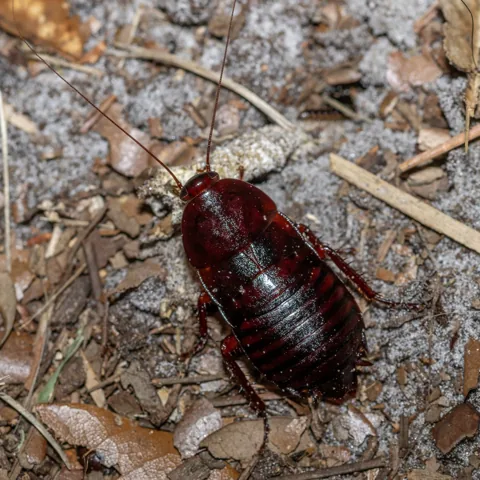 Florida Woods Cockroach
Eurycotis floridana
The Florida woods cockroach is a big, wingless roach of the coastal Southeast and one of the insects called palmetto bugs. It lives outdoors in palms, hollow trees and leaf litter and only occasionally turns up in garages, storage rooms and similar buildings.
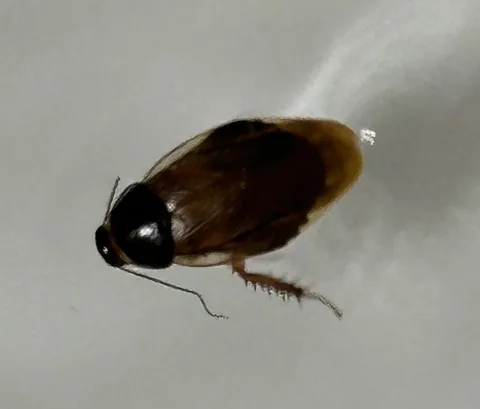 Surinam Cockroach
Pycnoscelus surinamensis
The Surinam cockroach is a burrowing roach that lives in loose soil and feeds mostly on plants and roots. Outside the warm Southeast it arrives in the soil of potted plants and turns up in greenhouses, malls and indoor plantings.
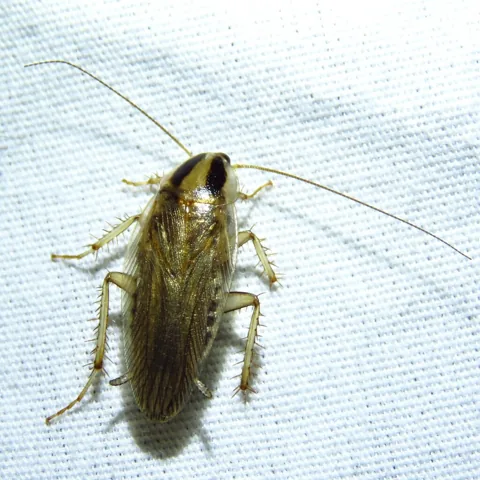 Field Cockroach
Blattella vaga
The field cockroach is a small outdoor cockroach that feeds on decaying plant material in leaf litter and garden debris. It is easily mistaken for the German cockroach, but it usually comes indoors only when it is hot or dry outside.
Indoor breeders and outdoor invaders
UC IPM sorts pest cockroaches into two groups. German and brownbanded cockroaches live and breed entirely indoors. American, Oriental and Turkestan cockroaches live outdoors and can temporarily invade.[1]
Texas A&M adds the smokybrown cockroach to the outdoor group: American, Oriental and smokybrown roaches live mostly outdoors or in nonfood areas of buildings and move indoors in search of food or water.[9]
Wood cockroaches are accidental invaders. Penn State says they don't breed indoors and die within a few days of dehydration, and Kentucky says they cannot survive indoors.[7][2]
German cockroach (Blattella germanica)
The most common cockroach in homes, restaurants and hotels, and the one most worth identifying correctly. It lives only in buildings and does not occur outdoors.[8][2][1]
- Size and markings: adults are 1/2 to 5/8 inch long, tan to light brown, with two dark parallel stripes on the shield behind the head (the pronotum). They have full wings but do not fly.[3][10][8]
- Babies (nymphs): smaller and darker, without wings. Kentucky describes a tan stripe down the middle of the back; Texas A&M says nymphs have two dark stripes running down the thorax and abdomen.[2][9]
- Where: kitchens and bathrooms, in cracks near sinks, toilets, stoves, refrigerators and dishwashers, and inside cabinets and warm appliances. Adults can hide in a crack 1/16 inch wide.[2][1][8]
- Egg case: light brown, purse-shaped and about 1/4 inch long. The female carries it until it is about to hatch (UC IPM: until 1 to 2 days before).[3][1][9]
- Eggs per case: sources give about 30 to 48. Penn State says up to 48, usually 30 to 48; Rutgers about 40; Texas A&M 30 to 40 nymphs; UC IPM about 30.[3][8][9][1]
- Cases per female: four to eight in her lifetime (Penn State), or 5 to 8 holding 200 to 250 eggs in total (Rutgers).[3][8]
- Egg to adult: eggs take 14 to 35 days and the nymphs 6 to 31 weeks (Penn State); Texas A&M gives 50 to 60 days for a nymph at average indoor temperatures, and Rutgers and Texas A&M put a full generation at about 100 days.[3][9][8]
- Food: almost anything, especially starches, sweets, grease and meat, plus pet food and garbage.[3][8]
- How serious: high. UC IPM calls it the fastest-reproducing pest cockroach, with one female and her offspring able to produce over 30,000 roaches in a year; Penn State's figure is over 10,000, assuming two generations.[1][3]
American cockroach (Periplaneta americana)
The largest cockroach commonly found indoors, also called a waterbug or palmetto bug. It is more common in commercial buildings and sewers than in homes.[2][9][16]
- Size and markings: 1 1/2 to 2 inches long, reddish brown, with a pale yellow band around the edge of the pronotum. Both sexes have wings that reach or pass the tip of the abdomen.[11][8][2][4]
- Flight: Kentucky and Rutgers say adults seldom fly, though they can in hot, humid weather; Texas A&M notes they can glide.[2][8][11]
- Babies: wingless; young nymphs are grayish brown and turn reddish brown after the first few molts.[9][4]
- Where: sewers, storm drains, steam tunnels, basements, crawl spaces, floor drains and water meter boxes, and outdoors under bark and leaf litter in humid areas. They come up into ground floors through drains and damaged pipes.[1][2][11][4]
- Egg case: about 5/16 to 3/8 inch, brown when laid and black within 1 to 2 days. The female carries it for a day (Penn State) to about 6 days (UC IPM), then drops it or glues it to a protected surface.[4][1]
- Eggs per case: about 12 (UC IPM) to 14 to 16 (Penn State, Rutgers). Rutgers says a female produces about 10 cases with about 150 eggs in her lifetime; Penn State says she usually produces one case a week.[1][4][8]
- Egg to adult: slow. Eggs take 29 to 58 days and nymphs 160 to 971 days (Penn State); Texas A&M gives an average of 600 days to adulthood.[4][9]
- Food: a wide range, with a preference for decaying organic matter; adults can go two or three months without food but only about a month without water.[4]
- How serious: usually an invader from outside or from sewers rather than an indoor breeder in homes. Because it travels through sewers it can carry bacteria such as Salmonella.[1][2]
Oriental cockroach (Blatta orientalis)
Sometimes called a water bug or black beetle. It likes cooler, damper places than the other pest species and is common around single-family homes with woodpiles, ivy and ground cover.[1][5]
- Size and markings: about 1 to 1 1/4 inches, shiny black to very dark brown. Females have only small wing pads; males' wings cover part of the abdomen (Kentucky: about half; Penn State: about three-quarters). Neither sex flies.[2][5][12][1]
- Where: basements, crawl spaces, sewers and floor drains indoors, and under leaves, mulch, stones and debris outside. It stays near ground level, moves slowly and can't climb smooth surfaces, so it gets trapped in sinks and tubs.[2][5][12][1]
- Egg case: dark red-brown, about 3/8 inch. The female carries it for about 30 hours, then drops it near food without gluing it down.[1][5]
- Eggs per case: about 16. Penn State says a female produces an average of 8 cases; Rutgers says about 18 cases, about 280 eggs in all.[5][8]
- Egg to adult: eggs hatch in about 60 days at room temperature (Penn State); development averages 575 to 600 days (Texas A&M), and UC IPM says the nymph stage can take 1 to 2 years or more.[5][9][1]
- Food: garbage, filth and decaying organic matter. Adults are seasonal, peaking in late spring and early summer.[5][2][8]
- How serious: an outdoor and sewer species that invades ground floors. Each female and her offspring can produce nearly 200 roaches in a year, far fewer than the German cockroach.[1][5]
Brown-banded cockroach (Supella longipalpa)
Far less common than the German cockroach but an indoor breeder, and its hiding places are different enough that the usual kitchen treatments miss it.[2][6][1]
- Size and markings: about 1/2 inch. Instead of the German's two stripes it has two light bands across the wings and abdomen, and Kentucky notes a dark bell-shaped pattern behind the head. Males are golden tan and fly readily when disturbed; females are darker, with short wings, and can't fly.[1][2][6][8]
- Babies: the yellow bands are more pronounced on nymphs than on adults.[13]
- Where: warm, dry spots away from water: upper walls and ceilings, behind picture frames, inside furniture, clocks, light switch plates and electronics.[6][2][13][1]
- Egg case: about 1/4 inch, light brown. The female carries it for about 30 hours and then glues it under furniture, on ceilings or in closets, sometimes in clusters.[1][6][2]
- Eggs per case: about 13 on average (Penn State) to about 18 (Rutgers). Both put it at about 14 cases per female.[6][8]
- Egg to adult: eggs take 37 to 103 days depending on temperature and nymphs 8 to 31 weeks (Penn State); Rutgers gives about 210 days egg to egg.[6][8]
- Food: starchy materials, including the glue on stamps, envelopes and old book bindings.[1][6]
- How serious: a true infestation, about 600 descendants per female per year. UC IPM says it is especially hard to control with baits, and Penn State says control aimed at other cockroaches won't work on it.[1][6]
Smokybrown cockroach (Periplaneta fuliginosa)
A large outdoor roach of the humid South, common around homes in Texas and now found in Tennessee. It flies and comes to lights.[9][17]
- Size and markings: 1 1/4 to 1 1/2 inches (UT gives 1 to 1.5), uniformly shiny dark brown to black with no pattern, and wings that reach past the abdomen in both sexes.[9][17][1]
- Babies: young nymphs are black with white bands across the body and white-tipped antennae; older nymphs are reddish brown.[9][17][1]
- Where: moist, sheltered spots outdoors: mulch, ground cover, tree holes, palm fronds, woodpiles, gutters, soffits and eaves. Indoors it turns up in attics, kitchens, bathrooms and near entry points.[9][17][1]
- Egg case: dark brown to black, about 3/8 to 0.6 inch. UC IPM says the female carries it for about 1 day before dropping it.[1][17]
- Eggs per case: sources differ. UT gives about 26 eggs; UC IPM says 40 to 45 nymphs hatch from one case. Eggs hatch in 24 to 70 days depending on temperature.[17][1]
- Egg to adult: about 1 to 2 years (UT); Texas A&M gives an average of 600 days.[17][9]
- Food: UT notes it feeds on animal feces, which is why it is treated as a public health pest.[17]
- How serious: an outdoor invader. Control means clearing leaf litter and debris near the house, sealing entry points and treating the outside, with gel bait where roaches are seen.[17][9]
Australian cockroach (Periplaneta australasiae)
A tropical roach that resembles the American cockroach. UC IPM says it turns up in greenhouses, animal rearing facilities and zoos, and NC State covers it as a pest of indoor plantings.[1][18]
- Size and markings: about 1 inch, dark brown, with pale yellow to orange bands along the outer edges of the front wings and a pale band around the pronotum.[18][1]
- Where: warm, humid places, often greenhouses and interiorscapes. It can feed on seedlings and tender foliage as well as starchy foods.[18][1]
- Egg case: brown, about 3/8 inch, carried a few days and then glued in a crack or crevice. Females produce 20 to 30 cases in a 4- to 6-month life.[18]
- Eggs per case: usually 12 to 24 nymphs hatch, after 40 days to 3 months.[18]
- Egg to adult: about a year (NC State); UC IPM says the life cycle is similar to the American cockroach's.[18][1]
Turkestan cockroach (Blatta lateralis)
An invasive outdoor roach in California and the Southwest that is replacing the Oriental cockroach in many warm, dry areas. It is also sold as a feeder insect for reptiles.[1][15][9]
- Males: 1/2 to 7/8 inch, slender, brownish yellow with yellowish wings edged in cream. They are often mistaken for small American cockroaches and fly or glide to lights.[9][1][15]
- Females: about 1 inch, shiny dark reddish brown with short wings, like an Oriental cockroach but with cream-colored markings behind the head and at the edges of the wings.[1][9]
- Babies: dark brown to black with reddish heads, thoraxes and legs.[1]
- Where: water meter boxes, cracks in concrete, sidewalk expansion joints, compost, leaf litter, potted plants and sewers.[1][9]
- Breeding: similar to the Oriental cockroach, but females mature faster and lay more eggs in their lives. Our sources don't give per-case egg counts.[1]
- How serious: mainly outdoors, though Texas A&M says it can become a significant indoor pest in some places. Males are seen indoors more often than females.[15]
Asian cockroach (Blattella asahinai)
Introduced to Florida by 1986 and since spread through the Southeast. It looks almost exactly like a German cockroach but behaves like an outdoor insect.[14][19][20]
- Looks: for practical purposes identical to the German cockroach; even experts struggle to tell dead specimens apart.[14][9]
- Behavior: it lives outdoors in leaf litter, mulch and grassy areas and flies well. At dusk adults fly toward light-colored walls and lit windows, and they become a nuisance when they fly into homes.[14][19][20]
- Egg case: carried for about 19 days and dropped near hatching. Females average 3.7 cases with 37.5 offspring each.[14]
- Egg to adult: in the studies Texas A&M cites, nymph development took 67.8 days for females and 65.7 days for males.[14]
- Food: it has been seen feeding on crops such as lettuce, cabbage, roses and strawberries.[14]
- How serious: a seasonal nuisance in early spring and summer. Because only a few enter at night, indoor insecticide treatments have been ineffective; scatter (granular) baits used outdoors have given successful control.[14][19]
Pennsylvania wood cockroach and other wood roaches (Parcoblatta)
Wood cockroaches are the brown roaches that show up in houses in wooded settings, especially in spring and summer. Penn State does not consider them pests: outdoors they break down dead plant material.[7][2]
- Size and markings: males about 1 inch with long wings covering the abdomen; females about 3/4 inch, wider, with short wings. Some species have a pale outer wing edge.[8][7][2]
- Behavior: males fly well and come to lights at night, which is how many get inside. Others ride in on firewood or collect in clogged gutters.[7][2][8]
- Where: under loose bark, in woodpiles, stumps, hollow trees, leaf litter and under stones.[7][2][8]
- Egg case: laid outdoors in summer and hatches in about a month. A Pennsylvania wood cockroach case holds up to 36 eggs, and a female can produce 30 cases in her life.[7][8]
- Egg to adult: nymphs overwinter and mature the next spring, sometimes taking up to two years; Rutgers gives about 11 months egg to egg.[7][8]
- How serious: low. They rarely breed indoors and die within a few days inside. Exclusion, not spraying, is the fix.[8][7][2]
Florida woods cockroach (Eurycotis floridana)
A Florida roach that is also called the palmetto bug. Its defensive secretion is made mostly of (E)-2-hexenal, (E)-2-hexenol and (E)-2-hexenoic acid.[23][21]
- Where: in a north-central Florida study of Florida woods and smokybrown cockroaches, adults were mostly in palms in fall and in hardwood trees with tree holes in spring. The researchers linked fall home invasions to how many roaches live near the house, not to more movement.[22]
- Egg case: its egg cases had some of the thickest walls of 7 species measured in a 2025 study.[24]
- How serious: an outdoor species. Trapping and baiting the nearby harborage reduced populations in that study.[22]
Surinam cockroach (Pycnoscelus surinamensis)
A burrowing roach of the Southeast, from North Carolina to Texas and Florida, that often arrives in the soil of potted plants and can be a nuisance in greenhouses, zoos and botanical gardens.[8]
- Size and markings: 3/4 to 1 inch, brown, with a dark brown to black pronotum and short antennae. Nymphs look like Oriental cockroach nymphs but have dull, rough rear segments.[8]
- Reproduction: only females occur in the United States, and they reproduce without mating. Each egg case holds 14 to 48 eggs, and the young hatch inside the mother.[8]
- Lab work by Roth and Stay describes two strains, one that reproduces without males and one that needs them; females incubate their eggs inside a brood sac.[25]
- Food and damage: plant material, which can damage plants.[8]
- Control: remove infested potted plants or use cockroach bait; outdoors in the South, clear leaf litter, landscape timbers and firewood.[8]
Is it a German or an American cockroach?
- Size: a German adult is 1/2 to 5/8 inch; an American adult is 1 1/2 to 2 inches.[3][8][11]
- Markings: German has two dark stripes running back from the head. American has a pale yellow band around the edge of the shield behind the head.[2][8]
- Where you see it: Germans cluster in kitchens and bathrooms near food and warmth. Americans come from basements, floor drains and sewers, usually on the ground floor.[2][1]
- Egg case: a German female carries her case until it is about to hatch. An American female drops or glues hers within about a week (a day to about 6 days).[1][4]
- If a small roach looks German but you live in the Southeast and it flew in toward a light, it may be an Asian cockroach.[14][9]
Baby cockroaches and egg cases
Baby cockroaches are nymphs. They look like small adults without full wings and live in the same places, often in even smaller cracks.[1][3][16]
An egg case (ootheca) is a hard, bean- or purse-shaped capsule. Its size and whether the female carries it help with identification:[16][3][7][1]
- German: light brown, about 1/4 inch, carried by the female until it hatches.[1][3]
- Brown-banded: light brown, about 1/4 inch, glued under furniture, on ceilings or in closets.[1][2]
- American: about 3/8 inch, brown turning black, dropped or glued in protected places.[1][4]
- Oriental: dark red-brown, about 3/8 inch, dropped near food.[1][5]
- Smokybrown: dark brown to black, about 3/8 inch or larger.[1][17]
- Remove any egg cases you find and vacuum cracks: vacuuming removes roaches, shed skins and egg cases.[1]
Infestation or a stray?
- Species first: German or brown-banded roaches indoors mean they are breeding in the building. American, Oriental, Turkestan, smokybrown and wood roaches are usually coming in from outside.[1][9][7]
- Daytime sightings: roaches out during the day usually means a lot of them.[9][8]
- Signs: look for droppings (dark spots or smears), shed skins and egg cases in hiding places.[1]
- Sticky traps: set them where floors meet walls and near suspected hiding places, check them for several days, and see where the most roaches turn up. UC IPM says many are caught in the first 24 hours.[1][9]
- Large roaches such as American and smokybrown cockroaches often come in through poorly sealed doors, roof soffits or floor drains, and wood roaches come to porch lights; wood roaches die indoors within a few days.[9][7]
Next steps
- German cockroaches: clean up food and water, seal hiding places, and use gel baits or bait stations in many small placements where roaches hide. Avoid foggers, which don't reach the cracks where they breed.[1][2][10]
- Brown-banded cockroaches: treat wherever they are found throughout the home, not just the kitchen and bathroom, and trap to find them first.[8][6][1]
- American, Oriental and smokybrown cockroaches: keep drain traps filled with water, seal door thresholds and screen soffits, and clear compost, mulch and debris near the foundation. UC IPM suggests a 6- to 12-inch gravel strip around the building.[9][1][17]
- Wood cockroaches: bring in only as much firewood as you'll burn in a few hours, move woodpiles away from the house, and seal gaps around doors and windows.[7][2]
- Dusts such as boric acid go lightly into voids and cracks, never in the open or on counters.[9][2][1]
Common questions
- How many eggs does a German cockroach lay?
- Each egg case holds about 30 to 48 eggs depending on the source, and a female produces about 4 to 8 cases in her life. Rutgers puts her lifetime total at 200 to 250 eggs.[3][8][1]
- What is a palmetto bug?
- It is a nickname, not a species. Texas A&M uses it for the American cockroach, and it is also used for the Florida woods cockroach.[9][23]
- Is a wood roach the same as a cockroach?
- Wood roaches are cockroaches (Parcoblatta species), but they live outdoors, don't breed indoors and die within a few days inside, so they don't cause infestations.[7][2][8]
- What does a cockroach egg case look like?
- A small, hard, brown, bean-shaped capsule, about 1/4 inch for German and brown-banded roaches and about 3/8 inch for American, Oriental and smokybrown roaches.[16][1]
Photo credits
- German Cockroach: (c) Sandra H Statner, some rights reserved (CC BY) — via iNaturalist, CC BY 4.0
- American Cockroach: (c) Steve Kerr, some rights reserved (CC BY) — via iNaturalist, CC BY 4.0
- Oriental Cockroach: (c) Jorge Íñiguez, some rights reserved (CC BY) — via iNaturalist, CC BY 4.0
- Brownbanded Cockroach: Sinaloa Silvestre, public domain (CC0), via iNaturalist
- Smokybrown Cockroach: (c) Eduardo Luis Beltrocco, some rights reserved (CC BY) — via iNaturalist, CC BY 4.0
- Australian Cockroach: (c) Tom Field, some rights reserved (CC BY) — via iNaturalist, CC BY 4.0
- Turkestan Cockroach: (c) Sam Kieschnick, some rights reserved (CC BY) — via iNaturalist, CC BY 4.0
- Asian Cockroach: kcthetc1, public domain (CC0), via iNaturalist
- Wood Cockroaches: (c) Whitney Mattila, some rights reserved (CC BY) — via iNaturalist, CC BY 4.0
- Florida Woods Cockroach: (c) Dan Vickers, some rights reserved (CC BY) — via iNaturalist, CC BY 4.0
- Surinam Cockroach: (c) Ashwin Srinivasan, some rights reserved (CC BY) — via iNaturalist, CC BY 4.0
- Field Cockroach: (c) Annika Lindqvist, some rights reserved (CC BY) — via iNaturalist, CC BY 4.0
Sources
- University of California Statewide IPM Program, “Pest Notes: Cockroaches, UC ANR Publication 7467 (Home and Landscape).” ipm.ucanr.edu/home-and-landscape/cockroaches/ (accessed 2026-11-10)
- University of Kentucky Entomology, “ENTFACT-614: Cockroach Elimination in Homes and Apartments.” entomology.mgcafe.uky.edu/ef614 (accessed 2026-11-10)
- Penn State Extension, “German Cockroaches.” extension.psu.edu/german-cockroaches (accessed 2026-11-10)
- Penn State Extension, “American Cockroaches.” extension.psu.edu/american-cockroaches (accessed 2026-11-10)
- Penn State Extension, “Oriental Cockroaches.” extension.psu.edu/oriental-cockroaches (accessed 2026-11-10)
- Penn State Extension, “Brown-banded Cockroaches.” extension.psu.edu/brown-banded-cockroaches (accessed 2026-11-10)
- Penn State Extension, “Wood Cockroaches.” extension.psu.edu/wood-cockroaches (accessed 2026-11-10)
- Rutgers Cooperative Extension, “FS1327: Cockroach Species in New Jersey and Their Control Strategies.” extension.rutgers.edu/fs1327 (accessed 2026-11-10)
- Texas A&M AgriLife Extension, “ENTO-037: Cockroach Biology and Management (2017).” extensionentomology.tamu.edu/wp-content/uploads/sites/3/2017/12/Cockroach-Biol-and-Mngmt_ENTO-037_2017.pdf (accessed 2026-11-10)
- Texas A&M Urban and Structural Entomology Program, “German Cockroach, Blattella germanica.” urbanentomology.tamu.edu/urban-pests/cockroaches/german/ (accessed 2026-11-10)
- Texas A&M Urban and Structural Entomology Program, “American Cockroach, Periplaneta americana.” urbanentomology.tamu.edu/urban-pests/cockroaches/american/ (accessed 2026-11-10)
- Texas A&M Urban and Structural Entomology Program, “Oriental Cockroach.” urbanentomology.tamu.edu/urban-pests/cockroaches/oriental/ (accessed 2026-11-10)
- Texas A&M Urban and Structural Entomology Program, “Brown Banded Cockroach, Supella longipalpa.” urbanentomology.tamu.edu/urban-pests/cockroaches/brown-banded/ (accessed 2026-11-10)
- Texas A&M Urban and Structural Entomology Program, “Asian Cockroach, Blattella asahinai.” urbanentomology.tamu.edu/urban-pests/cockroaches/asian/ (accessed 2026-11-10)
- Texas A&M AgriLife Extension, Insects in the City, “The Turkestan Cockroach: An Emerging Pest in Texas (June 26, 2024).” citybugs.tamu.edu/2024/06/26/the-turkestan-cockroach-an-emerging-pest-in-texas/ (accessed 2026-11-10)
- The Connecticut Agricultural Experiment Station, “Cockroaches (Order Blattodea) fact sheet.” portal.ct.gov/-/media/CAES/DOCUMENTS/Publications/Fact_Sheets/Entomology/Cockroaches_Blattodea.pdf (accessed 2026-11-10)
- University of Tennessee Entomology and Plant Pathology, “The Smokybrown Cockroach, Insec(tc)ure Vol. 3 Issue 10/11 (October 21, 2022).” epp.tennessee.edu/wp-content/uploads/sites/267/2023/11/2022-10SmokybrownV3I10.pdf (accessed 2026-11-10)
- NC State Extension, “Australian Cockroach in Interiorscapes.” content.ces.ncsu.edu/australian-cockroach (accessed 2026-11-10)
- Journal of Economic Entomology, abstract via PubMed, “Matos and Schal 2016, Laboratory and field evaluation of Zyrox Fly Granular Bait against Asian and German cockroaches.” pubmed.ncbi.nlm.nih.gov/27122494/ (accessed 2026-11-10)
- Journal of Insect Science, abstract via PubMed, “Peterson, Appel and Hu 2019, Instar determination of Blattella asahinai.” pubmed.ncbi.nlm.nih.gov/31587065/ (accessed 2026-11-10)
- Insect Biochemistry and Molecular Biology, abstract via PubMed, “Farine et al. 2000, Production, regeneration and biochemical precursors of the major components of the defensive secretion of Eurycotis floridana.” pubmed.ncbi.nlm.nih.gov/10844252/ (accessed 2026-11-10)
- Journal of Economic Entomology (USDA-ARS authors), abstract via PubMed, “Brenner and Pierce 1991, Seasonality of peridomestic cockroaches: mobility, winter reduction, and effect of traps and baits.” pubmed.ncbi.nlm.nih.gov/1787218/ (accessed 2026-11-10)
- Archives of Virology, abstract via PubMed, “Padilla-Rodriguez, Rosario and Breitbart 2013, Novel cyclovirus discovered in the Florida woods cockroach Eurycotis floridana.” pubmed.ncbi.nlm.nih.gov/23358613/ (accessed 2026-11-10)
- Journal of Insect Science, abstract via PubMed, “Smith, Fadamiro and Appel 2025, Host range of the oothecal parasitoid Aprostocetus hagenowii.” pubmed.ncbi.nlm.nih.gov/39846896/ (accessed 2026-11-10)
- Psyche: A Journal of Entomology 69(4), “Roth and Stay 1962, A comparative study of oocyte development in false ovoviviparous cockroaches.” archive.org/download/biostor-223184/biostor-223184.pdf (accessed 2026-11-10)