The short answer
- Confirm the species first. Kentucky says brown-banded roaches lack the two dark stripes of the German cockroach and instead have a dark bell-shaped mark behind the head and two yellowish bands across the wings. They turn up in bedrooms, closets and living areas, high on walls and inside furniture.[2][6]
- Survey the whole house with sticky traps. Penn State recommends ten or more trap sites for one week, on floors, shelves and in drawers, and says to direct treatment to the places where the traps catch roaches.[4]
- Put bait where the traps show they live, not only along the kitchen floor. Rutgers says to treat as you would for German cockroaches but extend it outside the kitchen and bathroom wherever activity is seen.[3][4]
- Expect baits to work less well than on German roaches. UC IPM says brown-banded cockroaches are especially difficult to control with baits, and a 2025 University of California, Riverside study found they survived 3.3 to 10.2 times longer than German cockroaches on most gel baits tested.[1][9]
- Skip sprays and foggers. Penn State says residual sprays and aerosol foggers are of little value against this roach and can scatter it, making control harder and longer.[4][13]
Cockroach profiles
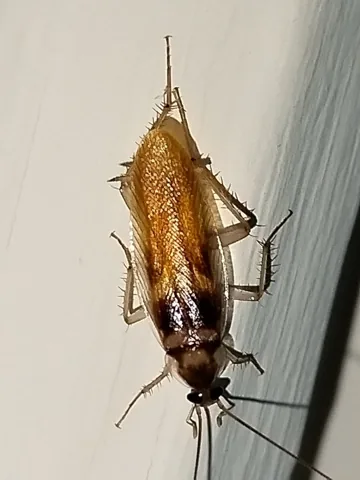 Brownbanded Cockroach
Supella longipalpa
The brownbanded cockroach is a small indoor species that prefers warmer, drier spots than the German cockroach. It hides around appliances, behind wall decorations, in furniture and often near the ceiling, rather than mainly in kitchens and bathrooms.
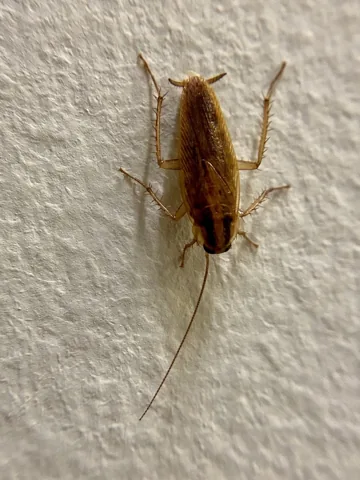 German Cockroach
Blattella germanica
The German cockroach is the most common cockroach living indoors in California and perhaps worldwide, especially in apartment buildings, and it has the fastest reproductive cycle of the common pest cockroaches. Penn State and Kentucky call it the most common cockroach in homes, apartments and other buildings, and Kentucky says it does not live outdoors.
Step 1: Make sure it's a brown-banded cockroach
The two small indoor roaches look alike at a glance, and the plans differ, so check before you treat. Penn State calls accurate identification paramount. Catch one on a sticky trap and compare it with these marks, or with the types of cockroaches guide.[4]
- Size: about 1/2 inch, per Penn State, Minnesota and UC IPM. Texas A&M gives 1/2 to 5/8 inch. Rutgers says it's similar in size to the German cockroach.[4][6][1][5][3]
- Bands, not stripes: German cockroaches have two dark stripes running lengthwise behind the head. Brown-banded roaches have a dark bell-shaped mark there and two pale bands running across the body (Kentucky, Utah State). Texas A&M says the bands are more pronounced on nymphs than on adults, and Cornell's New York State IPM chart says the same.[2][7][5][8]
- Males and females look different: Minnesota describes the male as golden brown and narrow, with wings reaching past the tip of the abdomen, and the female as dark chestnut brown and teardrop-shaped, with wings that don't cover the abdomen. Rutgers says only adult males fly.[6][3]
- Where you find it: Minnesota says the two species are rarely found together. A small roach behind a picture frame, inside a dresser or on a bedroom ceiling points to brown-banded; one under the kitchen sink points to German.[6][2]
Step 2: Know where they hide (high, warm and dry)
UC IPM says this roach prefers about 80°F, 5 to 10 degrees warmer than the German cockroach likes. Rutgers says it needs less moisture than the German cockroach and favors constantly warm spots such as near water heaters. Cornell's IPM program says it can live for several weeks with very little water, which is why it can live in rooms far from sinks.[1][3][8]
Penn State, Kentucky, Texas A&M and Minnesota list the same kinds of hiding places. Check these with a flashlight before you set traps or bait.[4][2][5][6]
- High places: upper walls of cabinets and closets, ceilings in dark or dimly lit rooms, and behind picture frames and wall decorations (Penn State, Kentucky, Texas A&M).[4][2][5]
- Furniture: inside dressers, beneath tables and chairs, inside upholstered furniture and in hollow furniture legs (Penn State, Texas A&M, UC IPM).[4][5][1]
- Warm electrical spots: refrigerator motor housings, clocks, radios and light switch plates (Penn State); Minnesota adds televisions and refrigerators, and UC IPM says crevices in or near electrical appliances.[4][6][1]
- Clutter and paper: UC IPM lists accumulations of clutter, and Minnesota says they hide among books.[1][6]
Step 3: Find and remove the egg capsules
Unlike the German cockroach, which carries its egg case until shortly before it hatches, the brown-banded female sticks hers to a surface. Penn State says she carries each capsule for about 30 hours, then fastens it to walls, ceilings or protected hidden spots. Kentucky describes them as pea-sized and attached to hidden surfaces such as the undersides of dressers and tables. UC IPM says they are light brown, about 1/4 inch long, sometimes glued together in large clusters.[4][2][1]
Sources give different egg numbers. Penn State says a female produces about 14 capsules averaging 13 eggs each. Rutgers also gives 14 capsules but about 18 eggs each, and about 250 eggs in a lifetime. Penn State says the egg stage lasts 37 to 103 days depending on temperature, and UC IPM says the eggs incubate for several weeks.[4][3][1]
Cornell's IPM brochure notes that roach eggs aren't affected by pesticides, so removing capsules by hand matters. UC IPM says to look for them under furniture, in refrigerator and other appliance motors and in boxes, and to remove any you find. Utah State recommends vacuuming roaches and egg cases with a HEPA-filter vacuum; Cornell says to seal the vacuum bag inside another bag and throw both away.[8][1][7]
Step 4: Trap the whole house, not just the kitchen
Penn State's survey method: place sticky traps against a wall or in a corner of a floor, a shelf or a drawer, use ten or more trap sites, and run them for one week. That usually gives enough information to aim treatment at the places where roaches were caught.[4]
For this roach, put some of those traps where it lives: closet and cabinet shelves, dresser drawers, behind furniture and near warm appliances, in bedrooms and living rooms as well as the kitchen. Cornell's IPM brochure suggests drawing a simple map of each room, dating the traps, checking them weekly and writing down where and how many roaches you catch, then setting more traps later to judge progress.[4][8]
The sticky traps guide covers trap types and basic placement. A 2022 lab study comparing three trap models found brown-banded roaches were caught by all of them, with no trap suited to one species in particular, though trap models differed in how many roaches they caught.[1][11]
Step 5: Bait where the traps say they live
The sources disagree on how well baits work here, and both views are worth knowing. Penn State says baiting is an effective way to control or eliminate brown-banded cockroaches when the bait is applied where they harbor. UC IPM says they are especially difficult to control with baits.[4][1]
Recent lab work backs the UC caution. In a 2025 University of California, Riverside study of six gel baits, brown-banded cockroaches survived 3.3 to 10.2 times longer than German cockroaches on most of them, and the authors predicted two of the baits would fail in the field. They put the gap down to the gels being less palatable to brown-banded roaches, which have different food and moisture needs. An earlier North Carolina State study found that the baits most attractive to German cockroaches were also the most attractive to brown-banded nymphs and adults, so a bait's appeal does carry over to some degree.[9][10]
- Placement: put bait in the hiding places from Step 2 that your traps confirmed, such as cabinet and closet shelves, drawers and under furniture. Penn State says baits give a high level of control when applied to the areas where cockroaches harbor.[4]
- Gel or stations: Kentucky says gel from a syringe lets you place many small pea-sized dabs in cracks, corners and edges, and that roaches find bait while foraging rather than from a distance, so more placements mean more roaches find it. Kentucky also says a bait station placed behind or beneath an infested appliance draws out roaches living inside it.[2]
- Remove competing food: UC IPM says removing other food greatly improves baits. Brown-banded roaches prefer starchy foods such as stamp and envelope glue (UC IPM), and Penn State lists paste, starch, book bindings, draperies and wallpaper among what they eat, so store paper goods and snacks away and keep food in sealed containers.[1][4]
- Active ingredients: Penn State lists baits containing hydramethylnon, fipronil, sulfluramid, boric acid or abamectin. Follow the label for every product.[4]
- If roaches are still showing up on traps after 2 to 3 weeks, Texas A&M says to try a bait with a different active ingredient; the gel bait guide covers rotation and bait aversion. The UC Riverside results suggest some gels are simply eaten less by this species.[12][9]
Step 6: Dust the hollow spaces lightly
Penn State says boric acid, silica aerogel and diatomaceous earth dusts add control. Apply them lightly, since heavy deposits may repel roaches, into cracks and crevices of dressers, closet shelves, ceiling light fixtures, valances above windows, hollow legs of chairs and tables, and wall or floor cracks throughout the house.[4]
Step 7: Clear clutter and seal cracks in every room
Penn State says brown-banded cockroaches can hide in many places too small for larger species and that caulking cracks, crevices and gaps around ducts and molding is needed in bedrooms, bathrooms, dining rooms and other rooms, not just the kitchen.[4]
Cornell's IPM brochure lists the same kind of whole-house cleanup: vacuum drapes and furniture, especially under cushions and in crevices; empty and clean bookshelves and shake out the books; and check closets, desks, clocks, radios, stereos, computers and televisions, anywhere warm and dark. UC IPM adds clutter to the list of favored hiding places.[8][1]
Why sprays and bug bombs make it worse
Penn State says residual sprays and aerosol foggers are of little value against brown-banded cockroaches and may scatter them, making control difficult and lengthy. NPIC says fogger mist falls on exposed surfaces and doesn't reach the voids, cracks and crevices where pests hide. For a roach that lives inside furniture and electronics, that leaves most of the population untouched.[4][13]
How long it takes
Cornell's IPM brochure says to allow about two weeks to see results from baits, and UC IPM says an effective bait program may take 7 days or longer. Because Penn State puts the egg stage at 37 to 103 days and pesticides don't affect eggs, young roaches can keep hatching from capsules you missed for weeks after the adults are gone. Keep the traps out and keep checking.[8][1][4]
Prevention: Penn State says it's hard to stop roaches arriving in boxes, grocery bags and suitcases, but sanitation keeps them from becoming a serious problem. UC IPM's advice to check under furniture and inside appliances for glued egg cases applies to anything secondhand you bring home.[4][1]
When to call a professional
UC IPM says serious indoor infestations and other large or complex cockroach problems often need professional help, though in some cases you can manage cockroaches yourself. Penn State notes that professionals have bait formulations not sold to the public, such as flowable granular baits. If you hire someone, ask them to treat the bedrooms, closets and furniture where your traps caught roaches, not just the kitchen.[1][4][3]
Common questions
- Why do I find small roaches in the bedroom but not the kitchen?
- That pattern fits the brown-banded cockroach. Kentucky says it is often found in rooms other than kitchens and bathrooms, and UC IPM says it isn't usually tied to food preparation areas. It prefers warmer, drier spots than the German cockroach.[2][1]
- What do brown-banded cockroach eggs look like?
- Light brown capsules about 1/4 inch long (UC IPM), pea-sized according to Kentucky, glued to the undersides of furniture, ceilings, walls and closet shelves, sometimes in clusters. Penn State gives about 13 eggs per capsule and Rutgers about 18.[1][2][4][3]
- Will German cockroach gel bait kill brown-banded cockroaches?
- It can, but less reliably. UC IPM says this species is especially difficult to control with baits, and a 2025 UC Riverside lab study found brown-banded roaches survived 3.3 to 10.2 times longer than German roaches on most gel baits tested. Penn State still lists baiting as effective when the bait goes where the roaches hide.[1][9][4]
- Do brown-banded cockroaches fly?
- Only adult males. Rutgers says only adult males fly, Penn State says males fly readily when disturbed, and UC IPM says they are more likely to fly above 85°F. Females can't fly.[3][4][1]
Photo credits
- Brownbanded Cockroach: Sinaloa Silvestre, public domain (CC0), via iNaturalist
- German Cockroach: (c) Sandra H Statner, some rights reserved (CC BY) — via iNaturalist, CC BY 4.0
Sources
- University of California Statewide IPM Program, “Pest Notes: Cockroaches (Publication 7467).” ipm.ucanr.edu/home-and-landscape/cockroaches/ (accessed 2026-11-10)
- University of Kentucky Entomology, “ENTFACT-614: Cockroach Elimination in Homes and Apartments.” entomology.mgcafe.uky.edu/ef614 (accessed 2026-11-10)
- Rutgers Cooperative Extension, “FS1327: Cockroach Species in New Jersey and Their Control Strategies.” extension.rutgers.edu/fs1327 (accessed 2026-11-10)
- Penn State Extension, “Brown-banded Cockroaches.” extension.psu.edu/brown-banded-cockroaches (accessed 2026-11-10)
- Texas A&M Urban and Structural Entomology Program, “Brown Banded Cockroach, Supella longipalpa.” urbanentomology.tamu.edu/urban-pests/cockroaches/brown-banded/ (accessed 2026-11-10)
- University of Minnesota Extension, “Cockroaches.” extension.umn.edu/garden-and-home/home-maintenance/household-insects/cockroaches (accessed 2026-11-10)
- Utah State University Extension, “Brown Banded Cockroach (School IPM).” extension.usu.edu/planthealth/ipm/structural-pest-id-guide/brown-banded-cockroach (accessed 2026-11-10)
- New York State IPM Program, Cornell Cooperative Extension, “Found a Cockroach? (Saw a GAZILLION?) IPM No. 602.” ecommons.cornell.edu/server/api/core/bitstreams/8994c68c-161a-4979-8fdc-75151b569cec/content (accessed 2026-11-10)
- Lum et al., University of California, Riverside, “Differential toxicological responses of brownbanded and German cockroaches to commercial gel baits (J Med Entomol 2025;62(5):1221-1228).” pubmed.ncbi.nlm.nih.gov/40578800/ (accessed 2026-11-10)
- Nalyanya et al., North Carolina State University, “Attractiveness of insecticide baits for cockroach control: laboratory and field studies (J Econ Entomol 2001;94(3):686-693).” pubmed.ncbi.nlm.nih.gov/11425024/ (accessed 2026-11-10)
- Drago et al., “Evaluation of the effectiveness of three sticky traps to monitor four species of cockroaches with simulated use tests (Ann Ig 2022;34(1):97-106).” pubmed.ncbi.nlm.nih.gov/33779674/ (accessed 2026-11-10)
- Texas A&M AgriLife Extension, “ENTO-037: Cockroaches: Biology and Management.” extensionentomology.tamu.edu/wp-content/uploads/sites/3/2017/12/Cockroach-Biol-and-Mngmt_ENTO-037_2017.pdf (accessed 2026-11-10)
- National Pesticide Information Center, “Total Release Foggers.” www.npic.orst.edu/ingred/ptype/fogger.html (accessed 2026-11-10)