The short answer
- Put out many small, pea-sized dabs in cracks, corners and edges near where roaches hide, not a few big globs.[2][4][7]
- Don't spray insecticides or cleaning products on or around the bait. They can make it repellent or ineffective.[2][4][3][7]
- Give it time: a roach that eats bait usually dies within 1 to 3 days, and the infestation should drop substantially within a few weeks.[2][1]
- Clean up other food while you bait; when roaches have plenty else to eat, baits take longer to work.[1][7]
- If one bait hasn't brought the numbers down in 2 to 3 weeks, Texas A&M says to switch to a bait with a different active ingredient.[7]
Cockroaches these baits are used on
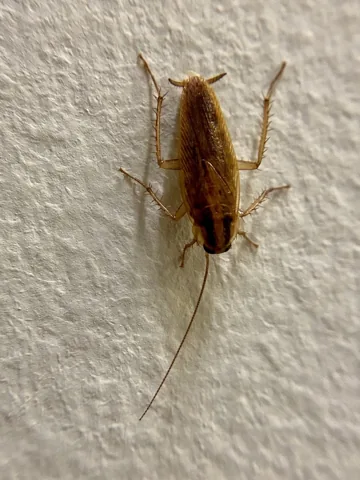 German Cockroach
Blattella germanica
The German cockroach is the most common cockroach living indoors in California and perhaps worldwide, especially in apartment buildings, and it has the fastest reproductive cycle of the common pest cockroaches. Penn State and Kentucky call it the most common cockroach in homes, apartments and other buildings, and Kentucky says it does not live outdoors.
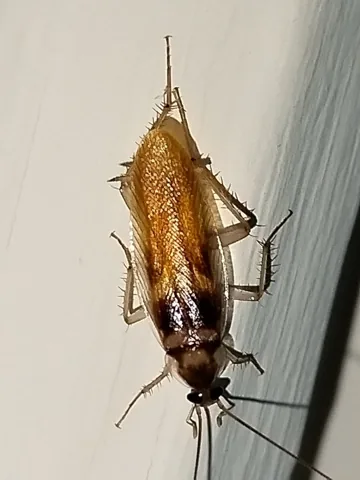 Brownbanded Cockroach
Supella longipalpa
The brownbanded cockroach is a small indoor species that prefers warmer, drier spots than the German cockroach. It hides around appliances, behind wall decorations, in furniture and often near the ceiling, rather than mainly in kitchens and bathrooms.
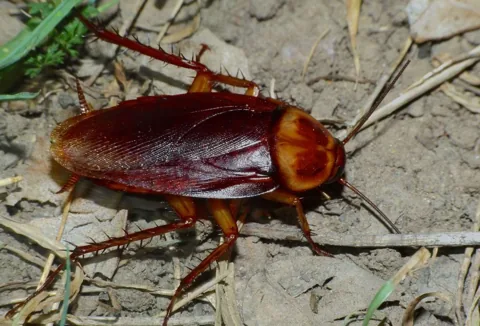 American Cockroach
Periplaneta americana
The American cockroach is the largest of the common pest cockroaches. It prefers warm, humid places and readily lives outdoors, in sewers, storm drains and water meter boxes, coming indoors to forage. Kentucky, Penn State and Minnesota all describe it as the largest cockroach commonly found in buildings.
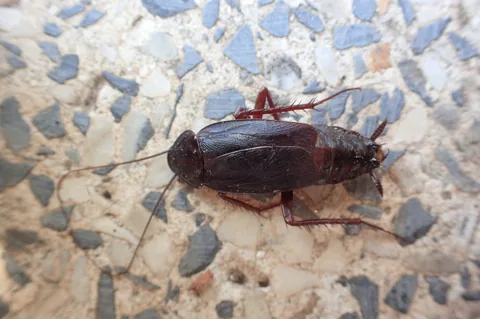 Oriental Cockroach
Blatta orientalis
The oriental cockroach, often called a water bug and sometimes a black beetle, lives in cool, dark, damp places such as basements, crawl spaces, drains and water meter boxes. It usually lives outdoors or in those damp spots and wanders into buildings at night, mostly staying at ground level.
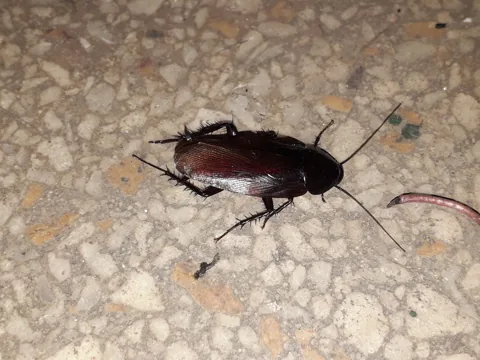 Smokybrown Cockroach
Periplaneta fuliginosa (now also placed in Validiblatta)
The smokybrown cockroach is a large, dark, winged roach of the humid South. It is the most common cockroach in suburban Southern neighborhoods with mature hardwood trees, where it lives in tree holes, attics, crawl spaces and sheds and comes out at night.
How baits work
Baits are the primary pesticides for cockroaches, and they give better control than sprays.[1][7][9]
The slow action is useful. An exposed roach has time to return to its hiding place, and roaches that never touched the bait can die from eating traces of the insecticide in the droppings and spit of those that did.[2][1][7]
Bait active ingredients listed by UC IPM include abamectin, boric acid, fipronil, hydramethylnon, indoxacarb, clothianidin and imidacloprid, and some of these products are sold only to licensed professionals. Penn State names hydramethylnon, fipronil, boric acid and abamectin baits among those that give a high level of control where cockroaches hide.[1][8]
Not every roach takes bait equally. Brownbanded cockroaches are especially hard to control with baits, and females carrying egg cases feed very little and avoid open spaces.[1]
Where to put bait
- For German cockroaches: under and around sinks and toilets; behind refrigerators, dishwashers and stoves; near trash containers; and inside cabinets and storage areas.[2][7]
- Rutgers says that in the kitchen the warm areas around the stove and refrigerator usually hold the most German cockroaches, and in the bathroom they gather around the sink, toilet, and tub or shower.[9]
- Bait wherever you see roaches or their droppings. The droppings carry an aggregation pheromone; look for them under kitchen counters, behind drawers and at the backs of cabinets.[1][2]
- Plastic bait stations belong flush against the corners and edges of cabinets and countertops, the paths roaches travel; stations set away from edges work far less well. A broom handle can slide them into the wall-floor joint behind a stove or refrigerator.[2][7]
- Texas A&M says to use enough stations to treat each infested room, with at least one station within 1 to 2 feet of every place you suspect roaches are hiding.[7]
- A station set behind or under an infested appliance, such as a toaster oven, can draw out the roaches living inside it.[2]
- Outdoors, bait in water meter and valve boxes, drains, wood piles, around planters and under concrete slabs.[1]
- Labels keep gel away from food-contact surfaces, electrical equipment, hot surfaces, direct sunlight and areas that get washed routinely, and limit it to places children and pets can't easily reach.[3][4][9]
How much bait to use
Follow your product's label. One EPA-stamped consumer gel label (indoxacarb, EPA Reg. No. 100-1504) calls for 1 to 3 spots per 10 linear feet or square yard for light to moderate infestations and 3 to 5 spots for heavy ones, each spot about 1/4 inch across or the size of a pea. A bead should be less than 1/8 inch wide and about 2 inches long.[3]
A fipronil gel label (EPA Reg. No. 92028-4) gives the same 1 to 3 spots per 10 linear feet or square yard for light to moderate infestations and 3 to 5 for heavy ones, with each spot about 1/4 inch across.[4]
Expect to need more placements than you'd guess. Kentucky notes that more than a dozen may be needed just for the corners and edges of the cabinet under a kitchen sink, about a whole box of ready-to-use stations, and that bigger infestations need more placements and periodic refills.[2]
Many small placements beat a few large ones: they let more roaches feed at once and give faster control.[3][4][2][7]
Don't overdo a single spot, either. Texas A&M says to keep placements small enough that the bait isn't easily seen and doesn't drip.[7]
Keeping bait attractive
- Don't put gel where a residual insecticide was recently sprayed, and never spray over gel. One label says spraying may make the bait repellent; another says it renders the bait ineffective.[4][3][7]
- Keep cleaning sprays off bait placements, too; they can discourage roaches from taking the bait.[2]
- Keep dusts away from bait stations as well. Texas A&M says cockroaches avoid baits contaminated by nearby dusts or sprays, and both Texas A&M and Penn State say heavy dust deposits repel roaches.[7][8]
- Gel stays palatable while it's visibly present, but deposits harden over time. Check placements and reapply when the bait is gone; one label recommends an inspection a month after the first treatment.[4][1][7]
- Gel sticks to surfaces that aren't greasy or dusty, and it can stain fabrics and porous surfaces.[4]
- Wipe up a misplaced dab with a damp paper towel while it's wet, or scrape it off with a putty knife once it dries.[3][4][7]
Bait aversion and rotation
German cockroaches adapt to baits. Baits became a popular, highly effective tool in the early 1980s, but within a few years some populations had developed physiological or behavioral resistance to them.[5]
The best-known case is glucose aversion. A population collected in Florida in 1989 rejected glucose, a feeding stimulant in baits, so every glucose-containing bait failed against it, even though the roaches had no metabolic resistance to the insecticide.[5]
NPIC says some cockroaches have become resistant to certain pesticides or averse to certain baits and gels. If a bait isn't working, NPIC suggests switching brands, since roaches may be avoiding the flavor or other ingredients.[10]
Texas A&M frames the switch differently: if a bait hasn't controlled the population within 2 to 3 weeks, change to a bait with a new active ingredient, and switch active ingredients regularly so you don't create resistant cockroaches. Its advice for professionals is to rotate both baits and sprays once or twice a year, moving between insecticides with different modes of action.[7]
Product labels carry resistance-management directions. The indoxacarb gel label (IRAC Group 22A) says to rotate it with products from different groups that control the same pests.[3]
In a Purdue field study in apartments, rotating products reduced selection pressure and worked when the insecticides used had little or no resistance in the population. Resistance to one active ingredient sometimes carried over to others.[6]
Why sprays and foggers work against baits
Sprays give quick knockdown but no long-term control, and they can repel cockroaches and scatter them to other parts of a building. Cockroaches have also become resistant to many of the insecticides in common sprays and aerosols.[1][8][10]
Extension services agree on this. Penn State says residual sprays and aerosol foggers do little against German cockroaches and may scatter them, Rutgers says most over-the-counter sprays and aerosols don't work, and Texas A&M says sprays are not nearly as effective as baits for getting rid of German cockroaches and that pyrethroids are highly repellent to them.[8][9][7]
In the Purdue study, a spray mixture failed to cut cockroach numbers and seemed to push roaches into apartments that hadn't been infested; the researchers urged treating as many apartments as possible in infested buildings.[6][10]
Foggers seldom reach the cracks and voids where roaches spend their time, their ingredients tend to be repellent, and they have caused injuries and house fires when pilot lights or cigarettes weren't put out.[2][11][7][9]
NPIC adds that foggers deposit mist on exposed surfaces only, may not work on pests that hide such as cockroaches, can drive pests deeper into hiding, and are a fire and explosion hazard; using more foggers than the label says doesn't work better and raises the risk.[11]
With sanitation, exclusion and the right baits and dusts, sprays shouldn't be necessary.[1]
What to do alongside baiting
- Clean up spills and food waste, don't leave dishes, utensils or pet food out overnight, keep loose food in tight containers and don't let garbage pile up.[2][7][9]
- Texas A&M explains why: when food and water are scarce, roaches have to search farther each night, and good sanitation puts them under stress and makes baits work better.[7]
- Vacuum cracks and crevices to remove food, roaches, shed skins and egg cases; a vacuum with a HEPA filter keeps allergens from blowing back into the air.[1][7]
- NPIC suggests vacuuming cracks and crevices at least weekly to remove food, and sealing the vacuum bag in another bag promptly or freezing it to kill the roaches inside.[10]
- Set sticky traps in several places and check them regularly to find where roaches concentrate and whether the baiting is working.[1][9][10]
- How often to check traps varies by source. UC IPM says regularly, NPIC says daily, and Penn State says a week of trapping at ten or more sites usually tells you enough to plan control. Texas A&M notes that traps alone won't control an established infestation.[1][10][8][7]
- In dry, enclosed voids under cabinets and appliances, a light film of boric acid dust adds slow but long-lasting control.[1][2][7][8]
- Boric acid is low in toxicity to adults but can be a hazard to children, Penn State says, so keep dusts where children and pets can't reach them and away from food. Texas A&M says not to apply dusts in the open or on countertops and shelves.[8][7]
- Seal cracks and crevices around cabinets, backsplashes, pipes and wires with caulk, screening or copper mesh. NPIC notes that cracks 3/8 inch or smaller are enough for cockroaches to hide in.[10][2]
When to call a professional
Used correctly, store-bought baits can give results comparable to professional treatment, and householders can often eliminate cockroaches themselves.[2]
In apartments, cockroaches travel between units through shared walls and ceilings, which is why building-wide treatment matters.[2][6][10]
NPIC's advice for apartment dwellers is to work with neighbors and the landlord, since nobody can eliminate the problem alone.[10]
If you hire a company, the technician should inspect on every visit and put insecticides into cracks and secluded areas rather than along baseboards and other exposed surfaces. Done correctly, clearing cockroaches from a single-family home shouldn't take a full year of monthly service.[2]
Common questions
- How long do cockroach gel baits take to work?
- A roach usually dies 1 to 3 days after eating bait, and the population should drop substantially within a few weeks, according to Kentucky. UC IPM says a bait program may take 7 days or longer to show fewer cockroaches. Texas A&M says to switch to a different active ingredient if a bait hasn't worked within 2 to 3 weeks.[2][1][7]
- Are gel baits safe around children and pets?
- Kentucky Entomology calls them minimal hazard to children and pets, with virtually no odor, but labels still require placing gel where children and pets can't easily reach it.[2][3][4][9]
- Do I have to empty my kitchen cabinets first?
- Usually not; baiting doesn't require emptying cabinets or covering food-preparation surfaces. Just keep gel off any surface that food touches.[2][3]
- Should I set off a bug bomb with the baits?
- No. Kentucky, Rutgers and Texas A&M all say total-release foggers don't control cockroaches because the mist doesn't reach the cracks where they hide, and NPIC says fogger ingredients can repel pests deeper into hiding. Repellent sprays near bait also keep roaches from eating it.[2][9][7][11][4]
Photo credits
- German Cockroach: (c) Sandra H Statner, some rights reserved (CC BY) — via iNaturalist, CC BY 4.0
- Brownbanded Cockroach: Sinaloa Silvestre, public domain (CC0), via iNaturalist
- American Cockroach: (c) Steve Kerr, some rights reserved (CC BY) — via iNaturalist, CC BY 4.0
- Oriental Cockroach: (c) Jorge Íñiguez, some rights reserved (CC BY) — via iNaturalist, CC BY 4.0
- Smokybrown Cockroach: (c) Eduardo Luis Beltrocco, some rights reserved (CC BY) — via iNaturalist, CC BY 4.0
Sources
- University of California Statewide IPM Program, “Pest Notes: Cockroaches, UC ANR Publication 7467 (Home and Landscape).” ipm.ucanr.edu/home-and-landscape/cockroaches/ (accessed 2026-11-10)
- University of Kentucky Entomology, “ENTFACT-614: Cockroach Elimination in Homes and Apartments (revised March 2026).” entomology.mgcafe.uky.edu/ef614 (accessed 2026-11-10)
- U.S. EPA Pesticide Product Label System, “Indoxacarb Cockroach Gel label, EPA Reg. No. 100-1504 (EPA-stamped, Aug. 23, 2019).” www3.epa.gov/pesticides/chem_search/ppls/000100-01504-20190823.pdf (accessed 2026-11-10)
- U.S. EPA Pesticide Product Label System, “Nouvel Sales Fipronil Roach Bait Gel label, EPA Reg. No. 92028-4 (EPA-stamped, Notification, June 26, 2026).” www3.epa.gov/pesticides/chem_search/ppls/092028-00004-20260626.pdf (accessed 2026-11-10)
- Frontiers in Cellular Neuroscience, via PubMed Central, “Wada-Katsumata et al. (2018), Changes in the Peripheral Chemosensory System Drive Adaptive Shifts in Food Preferences in Insects, Frontiers in Cellular Neuroscience 12:281.” pmc.ncbi.nlm.nih.gov/articles/PMC6123360/ (accessed 2026-11-10)
- Scientific Reports, via PubMed Central, “Fardisi et al. (2019), Rapid evolutionary responses to insecticide resistance management interventions by the German cockroach (Blattella germanica L.), Scientific Reports 9:8292.” pmc.ncbi.nlm.nih.gov/articles/PMC6549143/ (accessed 2026-11-10)
- Texas A&M AgriLife Extension, “ENTO-037: Cockroaches: Biology and Management.” extensionentomology.tamu.edu/wp-content/uploads/sites/3/2017/12/Cockroach-Biol-and-Mngmt_ENTO-037_2017.pdf (accessed 2026-11-10)
- Penn State Extension, “German Cockroaches.” extension.psu.edu/german-cockroaches (accessed 2026-11-10)
- Rutgers Cooperative Extension, “FS1327: Cockroach Species in New Jersey and Their Control Strategies.” extension.rutgers.edu/fs1327 (accessed 2026-11-10)
- National Pesticide Information Center (Oregon State University and U.S. EPA), “Cockroaches.” npic.orst.edu/pest/roach.html (accessed 2026-11-10)
- National Pesticide Information Center (Oregon State University and U.S. EPA), “Total Release Foggers.” npic.orst.edu/ingred/ptype/fogger.html (accessed 2026-11-10)