The short answer
- Confirm it is a German cockroach: about 1/2 to 5/8 inch, light brown, with two dark stripes on the shield behind the head, living in the kitchen or bathroom.[3][2]
- Put out sticky traps for a few days to find where most roaches are, and keep counting them so you know whether treatment is working.[1][3]
- Clean up food, grease and crumbs, fix leaks and get rid of cardboard and clutter. Baits work best when roaches have little else to eat.[1][4][2]
- Apply many pea-sized dabs of gel bait in cracks, corners and cabinet edges near where roaches hide. Keep sprays and dusts away from the bait.[2][4]
- Skip bug bombs and general baseboard spraying. In a field study, foggers did not reduce German cockroach numbers while gel baits did.[11][2][1]
- If the bait isn't working within 2 to 3 weeks, switch to a bait with a different active ingredient.[4]
Cockroach profiles
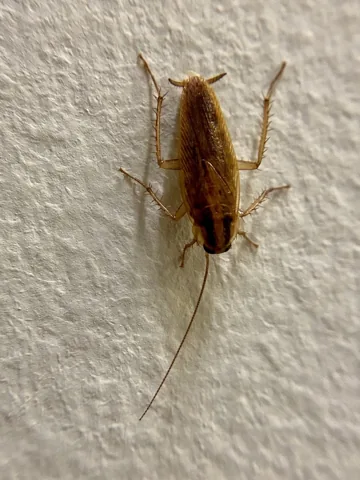 German Cockroach
Blattella germanica
The German cockroach is the most common cockroach living indoors in California and perhaps worldwide, especially in apartment buildings, and it has the fastest reproductive cycle of the common pest cockroaches. Penn State and Kentucky call it the most common cockroach in homes, apartments and other buildings, and Kentucky says it does not live outdoors.
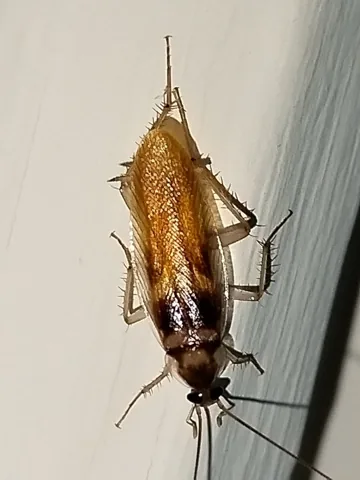 Brownbanded Cockroach
Supella longipalpa
The brownbanded cockroach is a small indoor species that prefers warmer, drier spots than the German cockroach. It hides around appliances, behind wall decorations, in furniture and often near the ceiling, rather than mainly in kitchens and bathrooms.
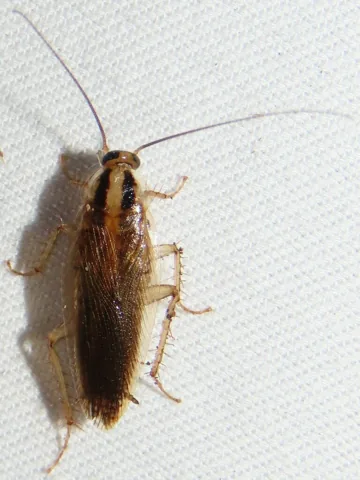 Asian Cockroach
Blattella asahinai
The Asian cockroach is a close relative of the German cockroach that lives outdoors in leaf litter, mulch and grassy areas. It flies well and is drawn to lights at dusk, so it shows up indoors in the evening, but treating inside the house doesn't control it.
Why German cockroaches are hard to get rid of
German cockroaches live only in buildings and reproduce quickly: Kentucky says a single mated female can produce thousands of new cockroaches in less than a year. Females carry their egg case until it is about to hatch, and UC IPM notes that females carrying egg cases feed very little and avoid open spaces, so a bait may not reach them right away.[2][6][3][1]
They spend most of their time hidden in cracks and crevices, and UC IPM says adults can hide in a crack 1/16 inch wide. Kentucky's advice is to find and treat these harborages rather than spray baseboards and countertops; if key harborages are missed, the problem is likely to continue.[2][1]
Many German cockroach populations are also resistant to common insecticides. UC IPM notes resistance to many of the insecticides in common sprays and aerosols, and a Purdue field study notes that resistance has been a barrier to cockroach control since the 1950s.[1][13]
Step 1: Inspect and set sticky traps
Start with a bright flashlight. Look in cracks, under counters and appliances, around water heaters, behind loose molding, under shelf liners, and inside boxes and stacks of cardboard. A small mirror on a long handle helps in tight spots.[1][7][2]
Signs of where they live: dark pepper-like droppings or smears, shed skins, egg cases, and live or dead roaches. Roaches gather around their droppings, so these spots are where traps and bait go.[1][2][7]
- Where to put traps: against the wall where floor meets wall, in corners, inside cabinets and drawers, and behind or under the stove, refrigerator and other large appliances.[1][3][7]
- How many and how long: Penn State says a week of trapping at ten or more sites usually gives enough information. UC IPM says to check daily for several days, and many roaches are caught within the first 24 hours.[3][1]
- Number and date each trap and write down the count. Comparing counts before and after treatment is how you tell whether the plan is working.[1][7]
- Traps help find and reduce roaches but are not enough on their own for an established infestation.[4][7]
Step 2: Take away food, water and hiding places
Sanitation does not eliminate an infestation by itself, but it makes everything else work better. Texas A&M says scarce food forces roaches to forage farther each night and increases the effectiveness of baits; UC IPM says baits take longer when roaches have other food.[4][1][2]
- Food: store it in sealed glass, metal or plastic containers; wipe up crumbs and spills right away; clean under the stove and refrigerator; and don't leave dishes, utensils or pet food out overnight.[1][7][2]
- Trash: use cans with tight lids and liners, empty them often, and clean out liquid that collects under the bag.[1][7]
- Water: fix dripping faucets and leaking pipes, add ventilation where condensation builds up, and empty and clean refrigerator drip pans.[1][4][7]
- Clutter: get rid of piles of paper bags, cardboard, newspapers and boxes, which give roaches places to hide.[2][1][7]
- Vacuum: vacuuming removes roaches, shed skins, egg cases and crumbs. Use a vacuum with a HEPA filter, because roach droppings and skins can trigger allergies and asthma, and seal and discard the bag.[1][4][7]
- Seal: caulk gaps around sinks, plumbing, cabinets and kitchen backsplashes, and seal pipe and wire openings with caulk, foam or copper mesh.[4][2][7]
Step 3: Bait the right way
Baits are the main insecticide for German cockroaches. Roaches eat a slow-acting insecticide mixed with food and go back to their hiding places to die, and roaches that never touched the bait can die from contact with the droppings and saliva of those that did.[1][2][4]
Kentucky names fipronil, indoxacarb, dinotefuran, abamectin and hydramethylnon as effective bait ingredients, and says that with correct placement homeowners can get results comparable to professional treatment.[2]
- Many small dabs beat a few big ones. Kentucky describes pea-sized dabs and says more than a dozen placements may be needed just for the cabinets under a kitchen sink; larger infestations need more.[2][4][5]
- Place bait where roaches live, not in the open: cracks and corners, along cabinet edges, under sinks, behind the refrigerator, stove and dishwasher, near trash cans, and next to droppings.[2][1][4]
- Bait stations go flush against corners and edges, with at least one station within 1 to 2 feet of every suspected hiding place.[2][4]
- Keep bait clean. Don't spray or dust near it, and don't wipe it with cleaners. Contaminated bait is avoided; EPA also lists grease, crumbs and trash as reasons baits fail.[4][7]
- Check and refill. Large infestations may need bait replenished as it is eaten, and gels harden over time. Scrape off old dried bait and put down fresh. In lab tests, roaches ate less of aged gel bait than fresh, though in the lab all baits aged longer than 24 hours, up to 6 months, still killed more than 93% of roaches.[2][1][4][17]
- Brown-banded cockroaches are harder to control with bait, so confirm the species if results are poor.[1]
Bait aversion, resistance and rotating baits
Some German cockroach populations have glucose aversion: they reject foods containing glucose, even at low levels, which keeps them from eating a lethal dose of glucose-based bait. A 2023 North Carolina State study found that baits containing glucose or sucrose also left glucose in the droppings of roaches that ate them, and glucose-averse young nymphs then avoided those droppings.[16]
Resistance to the insecticide itself also matters. In roaches collected from apartments where bug bombs had failed, resistance to cypermethrin (a common fogger ingredient) was about 202 times that of a susceptible lab strain, compared with about 14 times for fipronil, a common bait ingredient.[12]
- If roaches keep showing up on traps after 2 to 3 weeks of baiting, switch to a bait with a different active ingredient. Texas A&M recommends switching active ingredients regularly to avoid creating resistant populations.[4]
- Rotate between insecticides with different modes of action. In its tips for professionals, Texas A&M suggests rotating baits and sprays once or twice a year in apartments treated regularly.[4]
- In a Purdue field study, single-ingredient treatments eliminated cockroaches when starting resistance was low, and rotations worked when they used insecticides with no or low resistance. Mixture products containing thiamethoxam plus lambda-cyhalothrin were ineffective and highly repellent.[13]
- Avoid repellent products around baits. Pyrethroids are highly repellent to German cockroaches; Texas A&M says baits and nonrepellent insecticides such as boric acid may improve control in difficult cases.[4]
Insect growth regulators (IGRs)
IGRs such as hydroprene and pyriproxyfen mimic insect hormones. They rarely kill adults, but they can stop eggs from hatching, nymphs from maturing and adults from reproducing. NPIC lists cockroaches among the pests IGRs can control.[8][9][15]
Because adults keep living until they die naturally, an IGR is a partner to bait, not a replacement. In a public-housing study, the IPM program that cut German cockroach counts used vacuuming, baits and IGR devices.[8][10]
Purdue lab work on hydroprene found that exposed roaches become sterile adults with twisted wings, and that populations began to decline at about the point when roughly 80% of adults showed twisted wings. Twisted-wing adults are the sign of hydroprene exposure that the researchers counted.[15]
Dusts for voids and hidden cracks
Boric acid dust kills roaches that walk through it and swallow it while grooming. It is not repellent in a light film and lasts a very long time if it stays dry, but it is slow: UC IPM says 7 days or more for a significant effect.[2][1]
Use it where bait can't go and people won't touch it: wall voids around plumbing, under the refrigerator, stove and dishwasher, behind kick panels, and in cracks along cabinet edges.[2][1][4]
- Apply a film barely visible to the eye with a bulb or bellows duster. Roaches avoid heavy piles, and a spoon always puts down too much.[2][4][1]
- Never dust countertops, open shelves or other food surfaces, and wipe up stray powder with a damp cloth. Don't put boric acid into electronics.[2][4]
- If a deposit gets wet and cakes, clean it up and reapply. Keep dust well away from bait placements.[1][4]
Why sprays and bug bombs backfire
Total-release foggers send insecticide into the air, where it settles on floors and counters. Very little gets into the cracks and voids where German cockroaches spend their time, and the ingredients tend to be repellent, so roaches scatter deeper into walls.[2][1][4]
North Carolina State researchers tested foggers in infested homes. Foggers failed to reduce cockroach populations, while similarly priced gel baits caused significant declines. Pesticide residues on kitchen surfaces after foggers were set off had a median increase of 85 times over baseline.[11]
A follow-up study tied the failure to pyrethroid resistance: foggers killed susceptible sentinel roaches but not the apartment roaches, and over 96% of screened roaches carried at least one copy of a mutation known to make them resistant to pyrethroids.[12]
Sprays give a quick, temporary knockdown but not long-term control, and they can drive roaches to other parts of the building. Spraying near baits also contaminates them. Foggers can also be a fire hazard near pilot lights and other flames.[1][3][4][2]
Apartments and multi-unit buildings
In apartments, German cockroaches move between units through shared walls, ceilings, pipes and wires, so a clean apartment can still be reinfested. In a Rutgers survey of about 1,500 low-income apartments in New Jersey, 36% had cockroaches, and nearly all were German cockroaches.[2][4][6]
- Seal pipe and wire openings under sinks and behind appliances with caulk, foam or copper mesh to slow movement between units.[2][7]
- Bring in fewer roaches: inspect grocery bags, beverage cartons, furniture, appliances and boxes, and open boxes outside when possible.[2][1][7]
- Push for building-wide treatment. In a New Jersey housing complex, a community-wide IPM program cut cockroach counts per apartment by 88% at 7 weeks, eliminated 85% of infestations by 7 months, and lowered pyrethroid residues in kitchens and bedrooms.[14]
- Monthly baseboard spraying is not a substitute. In a Virginia Tech public-housing study, monthly spray and dust treatments had little if any effect over a year, while IPM with vacuuming, baits, IGRs and sticky traps cut average catches from 24.7 to 3.9 roaches per unit by month 4.[10]
How long it takes
- A roach that eats bait usually dies within 1 to 3 days, and a substantial drop in the infestation should show within a few weeks.[2]
- UC IPM says a bait program may take 7 days or longer to show results, and boric acid 7 days or more.[1]
- If trap counts are not falling after 2 to 3 weeks, change baits rather than adding sprays.[4]
- In apartment studies, counts were down 88% at 7 weeks in one and stayed under 5 roaches per unit from month 4 onward in another. Keep trapping after the roaches seem gone, and rebait if counts climb.[14][10][1]
- Kentucky says it should not take a full year to eliminate cockroaches from a single-family home if treatment is done correctly.[2]
When to call a professional
UC IPM says serious indoor infestations and other large or complex cockroach problems often require professional pest control. Kentucky says householders can often eliminate the problem themselves with the steps above, and some people simply prefer to hire a professional.[1][2]
- A good technician inspects on every visit and puts insecticide into cracks and hiding places, not along baseboards and other exposed surfaces.[2]
- Ask how they will use sticky traps to measure results, and whether they use baits, vacuuming, low-risk products and an IPM approach.[7][1]
- Be wary of open-ended contracts. Kentucky notes some companies sell a full year of service, but control shouldn't take that long in a single-family home, and products used correctly seldom need reapplying month after month once roaches are gone.[2]
Common questions
- What kills German cockroaches the fastest?
- Sprays kill the roaches they hit quickly, but they don't give long-term control. Baits are slower but end infestations: roaches that eat bait usually die within 1 to 3 days, and numbers should fall substantially within a few weeks.[1][2]
- Do bug bombs work on German cockroaches?
- No. In a North Carolina State study in infested homes, foggers did not reduce cockroach numbers while gel baits did, and foggers left large pesticide residues on kitchen surfaces.[11][2]
- Why are cockroaches not eating my bait?
- Common reasons are competing food, bait contaminated by sprays or cleaners, old dried-out bait, or a population that has learned to avoid the bait's sugar. Clean up food, put down fresh bait, and switch to a product with a different active ingredient if the problem continues.[7][4][16][1][17]
- Does boric acid work on German cockroaches?
- Yes, as a light dust in voids and cracks where roaches walk. It is slow, taking 7 days or more for a significant effect, and roaches avoid heavy piles.[1][2][4]
- Can you get rid of German cockroaches yourself?
- Often, yes. Kentucky says homeowners using baits correctly can get results comparable to professional treatment. Serious infestations, especially in multi-unit buildings, often need a professional.[2][1]
Photo credits
- German Cockroach: (c) Sandra H Statner, some rights reserved (CC BY) — via iNaturalist, CC BY 4.0
- Brownbanded Cockroach: Sinaloa Silvestre, public domain (CC0), via iNaturalist
- Asian Cockroach: kcthetc1, public domain (CC0), via iNaturalist
Sources
- University of California Statewide IPM Program, “Pest Notes: Cockroaches, UC ANR Publication 7467 (Home and Landscape).” ipm.ucanr.edu/home-and-landscape/cockroaches/ (accessed 2026-11-10)
- University of Kentucky Entomology, “ENTFACT-614: Cockroach Elimination in Homes and Apartments.” entomology.mgcafe.uky.edu/ef614 (accessed 2026-11-10)
- Penn State Extension, “German Cockroaches.” extension.psu.edu/german-cockroaches (accessed 2026-11-10)
- Texas A&M AgriLife Extension, “ENTO-037: Cockroach Biology and Management (2017).” extensionentomology.tamu.edu/wp-content/uploads/sites/3/2017/12/Cockroach-Biol-and-Mngmt_ENTO-037_2017.pdf (accessed 2026-11-10)
- Texas A&M Urban and Structural Entomology Program, “German Cockroach, Blattella germanica.” urbanentomology.tamu.edu/urban-pests/cockroaches/german/ (accessed 2026-11-10)
- Rutgers Cooperative Extension, “FS1327: Cockroach Species in New Jersey and Their Control Strategies.” extension.rutgers.edu/fs1327 (accessed 2026-11-10)
- U.S. Environmental Protection Agency, “Module 6: Managing Cockroaches in Child Care Centers (Integrated Pest Management for Child Care Settings).” www.epa.gov/sites/default/files/documents/Module06.pdf (accessed 2026-11-10)
- National Pesticide Information Center (Oregon State University and EPA), “Insect Growth Regulators (IGRs).” npic.orst.edu/ingred/ptype/igr.html (accessed 2026-11-10)
- National Pesticide Information Center (Oregon State University and EPA), “Pyriproxyfen General Fact Sheet.” npic.orst.edu/factsheets/pyriprogen.html (accessed 2026-11-10)
- Journal of Economic Entomology, abstract via PubMed, “Miller and Meek 2004, Cost and efficacy comparison of integrated pest management strategies with monthly spray insecticide applications for German cockroach control in public housing.” pubmed.ncbi.nlm.nih.gov/15154482/ (accessed 2026-11-10)
- BMC Public Health, abstract via PubMed, “DeVries et al. 2019, Exposure risks and ineffectiveness of total release foggers (TRFs) used for cockroach control in residential settings.” pubmed.ncbi.nlm.nih.gov/30686267/ (accessed 2026-11-10)
- Journal of Economic Entomology, abstract via PubMed, “DeVries et al. 2019, Pervasive resistance to pyrethroids in German cockroaches related to lack of efficacy of total release foggers.” pubmed.ncbi.nlm.nih.gov/31121031/ (accessed 2026-11-10)
- Scientific Reports, abstract via PubMed, “Fardisi et al. 2019, Rapid evolutionary responses to insecticide resistance management interventions by the German cockroach.” pubmed.ncbi.nlm.nih.gov/31165746/ (accessed 2026-11-10)
- Journal of Economic Entomology, abstract via PubMed, “Zha et al. 2018, Pest prevalence and evaluation of community-wide integrated pest management for reducing cockroach infestations and indoor insecticide residues.” pubmed.ncbi.nlm.nih.gov/29361010/ (accessed 2026-11-10)
- Journal of Economic Entomology, abstract via PubMed, “Reid and Bennett 1994, Hydroprene effects on the dynamics of laboratory populations of the German cockroach.” pubmed.ncbi.nlm.nih.gov/7836613/ (accessed 2026-11-10)
- Journal of Economic Entomology, abstract via PubMed, “McPherson et al. 2023, Glucose- and disaccharide-containing baits impede secondary mortality in glucose-averse German cockroaches.” pubmed.ncbi.nlm.nih.gov/36888567/ (accessed 2026-11-10)
- Journal of Economic Entomology, abstract via PubMed, “Lucero, Gaire and DeVries 2025, Effects of age and environmental conditions on cockroach gel bait performance.” pubmed.ncbi.nlm.nih.gov/40577664/ (accessed 2026-11-10)