The short answer
- You don't have an infestation. Penn State says wood cockroaches come indoors by accident, don't feed or reproduce inside, and dry out and die within a few days. Iowa State says they don't harm the house, furnishings or the people in it.[1][2][5]
- Pick up and discard the ones you find. Minnesota and Iowa State both say stray wood roaches indoors only need to be physically removed and discarded.[3][2]
- Stop the source: turn off or limit porch lights when the males are flying, bring firewood in only when you're about to burn it, move woodpiles and rotting logs away from the house, clean out gutters, and seal gaps around doors, windows and screens.[1][2][3][4][6]
- Skip indoor baits, sprays and dusts. Penn State says pesticides are not necessary or recommended, and Iowa State says the sprays and dusts that work on household cockroaches are of very limited benefit against wood roaches.[1][2]
Cockroach profiles
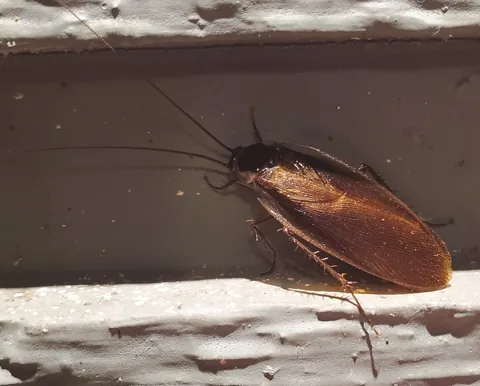 Wood Cockroaches
Parcoblatta species (e.g., P. pennsylvanica)
Wood cockroaches are native species of forest leaf litter, logs and other damp places full of decaying material. They come indoors only by accident, dry out and die within days, and don't feed or breed inside, so they are a nuisance only.
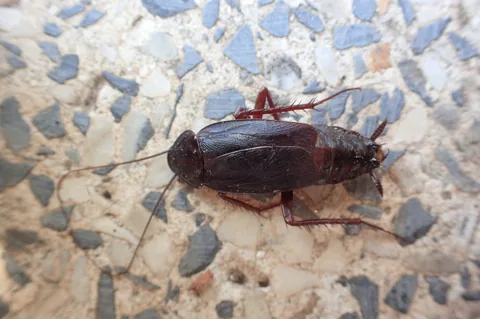 Oriental Cockroach
Blatta orientalis
The oriental cockroach, often called a water bug and sometimes a black beetle, lives in cool, dark, damp places such as basements, crawl spaces, drains and water meter boxes. It usually lives outdoors or in those damp spots and wanders into buildings at night, mostly staying at ground level.
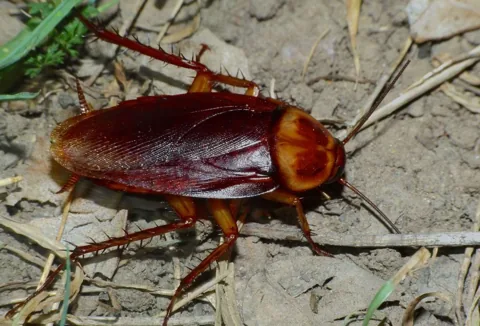 American Cockroach
Periplaneta americana
The American cockroach is the largest of the common pest cockroaches. It prefers warm, humid places and readily lives outdoors, in sewers, storm drains and water meter boxes, coming indoors to forage. Kentucky, Penn State and Minnesota all describe it as the largest cockroach commonly found in buildings.
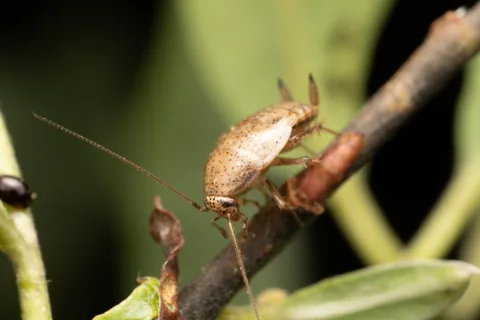 Tawny cockroach
Ectobius pallidus
The tawny cockroach, Ectobius pallidus, which the Connecticut Agricultural Experiment Station calls the spotted Mediterranean cockroach, is a small European woodland cockroach introduced to North America. It occasionally wanders into homes in New England, but it does not breed indoors.
Is it a wood cockroach?
Wood cockroaches have the usual roach shape: flat, oval, spiny legs and long antennae. Look for a pale, cream-colored or see-through stripe along the outer edge of the shield behind the head, which in adults runs onto the front of the wings. Iowa State says adults and large nymphs can be recognized by it; Penn State and Kentucky say only some species have pale edges.[2][1][4]
Males and females look different. Males have long wings that cover the abdomen and can fly. Females are wider, more reddish, with short wings that leave the end of the abdomen showing. Nymphs have no wings and are reddish brown to dark brown.[1][5][3]
- Male size: Penn State and Rutgers give up to or about 1 inch, Minnesota 1 inch, and the Connecticut Agricultural Experiment Station about 3/4 inch. Iowa State gives a range of 3/4 to 1 1/4 inch for wood roaches in general.[1][5][3][6][2]
- Female size: Penn State and Rutgers give up to or about 3/4 inch; Minnesota gives about 1/2 inch.[1][5][3]
- Color: Penn State says light brown to nearly black. Iowa State says adults, especially males, look tan because of their wings, and Connecticut describes the males as golden brown.[1][2][6]
- Behavior: Iowa State says wood roaches indoors are not secretive. They move around in daylight as well as at night, are less likely to run and hide when approached, and wander the house without gathering in one place.[2]
Wood roach or a pest roach?
The roaches it gets mixed up with are the Oriental and American cockroaches. Minnesota says female and young wood roaches can be confused with the Oriental cockroach, which lacks the light bands near the head. Penn State notes Oriental cockroaches are dark brown to nearly black, and American cockroaches are much larger, up to 2 inches, and reddish brown.[3][1]
Iowa State says wood roaches look much like American roaches but are slightly smaller and paler. If you can't tell, Penn State suggests asking your county extension office.[2][1]
- Where and when: wood roaches turn up in spring and summer in homes in wooded settings, often in bathrooms or near lights. German cockroaches, by contrast, don't live outdoors at all, so finding them means they are living in the building.[4][6]
- In Connecticut and along the New England coast, the tawny or spotted Mediterranean cockroach (Ectobius pallidus) is another forest roach that occasionally gets indoors and doesn't breed there. It is 1/4 to 1/2 inch long, pale cream with small brown spots.[6]
Why they show up indoors
Wood roaches live in damp places full of decaying plant material, such as leaf litter, fallen logs, loose bark, woodpiles and stumps, where they feed on rotting plant matter. They get indoors in a few ways.[1][5][4]
- Porch lights and lit windows: males fly well and come to lights at night. Kentucky says both sexes are attracted to lights. Connecticut says the bathrooms of homes draw them because of higher humidity and a nightlight.[1][5][4][6]
- Firewood: Rutgers says they are usually brought indoors with firewood, and Kentucky says they come in on firewood during winter.[5][4]
- Gaps: they crawl in through cracks in the foundation and around windows, doors, vents and utility openings.[1][4]
- Gutters and crawl spaces: Kentucky says large numbers are sometimes found in rain gutters and crawl spaces, and Penn State says they can collect in clogged gutters.[4][1]
- Cedar shake roofs: Penn State says buildings with cedar shake shingles in wooded areas sometimes have wood roaches living under the shingles, which mimic their natural habitat.[1]
Why it's mostly males, and why late spring
Wood roach females have short wings and can't fly, and the long-winged males fly to find them. In lab work with two Parcoblatta species collected in North Carolina, females released a sex pheromone during the dark period that males preferred, and later work identified that pheromone in the broad wood cockroach.[7][8]
Sources disagree on the females. Connecticut says they are wingless and never enter homes, while Penn State describes short, non-functional wings. Kentucky says both sexes are attracted to lights, and Minnesota and Penn State explain how to tell wood roach females from Oriental cockroaches.[6][4][1][5]
- Iowa State puts the male flight season at late May through June. Kentucky says they are an annoyance in spring and summer, and Connecticut says they are found inside during the summer.[2][4][6]
- Life cycle: eggs are laid in summer and hatch in about a month. Nymphs overwinter and become adults the next spring, though some stay nymphs for up to two years. Rutgers gives about 11 months from egg to egg for the Pennsylvania wood cockroach.[1][5]
- A Pennsylvania wood cockroach egg case holds up to 36 eggs, and a female can produce 30 cases with a total of 1050 eggs in her lifetime. Rutgers says adults live about 6 months; Penn State says adults live many months and sometimes up to two years.[5][1]
Keep them out
Exclusion is the main fix. Penn State calls it the best control because wood roaches are accidental invaders, and Connecticut says making sure windows and screens fit and have no rips or holes will keep them from getting in.[1][6]
- Lights: turn porch lights off at night, or limit them in late May and June when males are flying.[1][2]
- Doors and windows: make doors and windows close tightly, fit tight screens, and add sweeps or brushes on the bottoms of doors.[2][4][1]
- Cracks: caulk cracks in the foundation and around doors and windows, including the garage door, and seal openings where pipes and wires pass through walls with caulk, foam or copper mesh.[1][5][4]
- Gutters: keep gutters clear. Penn State says wood roaches can collect in clogged gutters, and Kentucky says large numbers are sometimes found in them.[1][4]
Firewood, logs and the yard
Wood roaches breed outdoors, and Iowa State says moving or changing a breeding site near the house might help. Penn State calls them important decomposers outdoors, so the aim is distance from the house, not wiping them out.[1][3][2]
- Store firewood outdoors until you're ready to burn it, and bring in only as much as you can burn in a few hours.[2][1]
- Move woodpiles and piles of debris farther from the house, and remove decayed and fallen logs close to the building.[1][2][3]
- Don't spray the firewood. Iowa State says applying insecticide directly to firewood does no good and is discouraged.[2]
- For a cedar shake roof under trees, Penn State says replacing the roof with a different material, or trimming or removing trees so the roof gets more sun and stays warm and dry, may be the only long-term solutions.[1]
Why indoor baits and sprays aren't needed
Wood roaches don't live, feed or breed indoors. Penn State says they die within a few days from drying out, so there is no indoor population for a bait or spray to control, and it says pesticides are not necessary or recommended.[1][2]
Iowa State says the sprays and dusts used with success against household cockroaches are of very limited benefit against wood roaches. Rutgers says interior treatment is rarely needed.[2][5]
If you want to know how many are getting in and where, Rutgers suggests sticky traps along baseboards to detect and catch them.[5]
Outdoor sprays: where sources differ
Penn State says pesticides aren't necessary for wood roaches at all. Other extension services allow an outdoor treatment when large numbers keep getting in.[1][2][3][5]
- Iowa State calls an outdoor barrier treatment around windows, doors and the foundation, or around the firewood pile, a last resort that may reduce the number that get indoors.[2]
- Minnesota says if larger numbers are entering, treat the outside of the building, particularly around doors and windows, with a residual insecticide such as permethrin, bifenthrin or cyfluthrin.[3]
- Rutgers says exterior treatments to foundations, around doors and windows, porches, patios and other areas where outside lights are located may help control their numbers.[5]
- If you do spray, follow the product label. The perimeter spray guide covers how to treat around a foundation without overspraying.[5]
Where to go next
If the roach you found doesn't match a wood roach, or you're finding small roaches and nymphs in the kitchen, it's probably a pest species that does live indoors. The types of cockroaches guide helps sort it out.[4][5]
Common questions
- Do wood cockroaches infest houses?
- No. They come in by accident, don't feed or breed indoors, and die within a few days because the house is too dry for them.[1][4][2]
- Why do I keep finding big brown roaches in May and June?
- In wooded areas that is likely the male wood roach flight season. Males fly at night and are attracted to lights, and Iowa State puts their flights in late May through June. Limiting porch lights then may help.[2][1]
- Should I use roach bait or bug spray inside?
- No. There is no indoor population for bait or spray to work on. Penn State says pesticides aren't necessary or recommended, and Iowa State says household roach sprays and dusts do very little against wood roaches. Pick up and discard the strays.[1][2][3]
- Are wood roaches harmful?
- Iowa State says they don't harm the house structure, furnishings or occupants. Outdoors they are decomposers that break down dead plant material.[2][1]
- Can they come in on firewood?
- Yes. They live under loose bark in woodpiles, and Rutgers says firewood is the usual way they get indoors. Keep firewood outside until you burn it, bring in only a few hours' worth, and don't spray the wood.[5][1][2]
Photo credits
- Wood Cockroaches: (c) Whitney Mattila, some rights reserved (CC BY) — via iNaturalist, CC BY 4.0
- Oriental Cockroach: (c) Jorge Íñiguez, some rights reserved (CC BY) — via iNaturalist, CC BY 4.0
- American Cockroach: (c) Steve Kerr, some rights reserved (CC BY) — via iNaturalist, CC BY 4.0
- Tawny cockroach: (c) Jack Forrester, some rights reserved (CC BY) — via iNaturalist, CC BY 4.0
Sources
- Penn State Extension, “Wood Cockroaches (M. J. Skvarla; updated January 2026).” extension.psu.edu/wood-cockroaches (accessed 2026-11-10)
- Iowa State University Extension and Outreach, Yard and Garden, “Wood Cockroach.” yardandgarden.extension.iastate.edu/encyclopedia/wood-cockroach (accessed 2026-11-10)
- University of Minnesota Extension, “Cockroaches.” extension.umn.edu/insects-infest-homes/cockroaches (accessed 2026-11-10)
- University of Kentucky Entomology, “ENTFACT-614: Cockroach Elimination in Homes and Apartments.” entomology.mgcafe.uky.edu/ef614 (accessed 2026-11-10)
- Rutgers Cooperative Extension, “FS1327: Cockroach Species in New Jersey and Their Control Strategies.” extension.rutgers.edu/fs1327 (accessed 2026-11-10)
- The Connecticut Agricultural Experiment Station, “Cockroaches (Order Blattodea) fact sheet.” portal.ct.gov/-/media/CAES/DOCUMENTS/Publications/Fact_Sheets/Entomology/Cockroaches_Blattodea.pdf (accessed 2026-11-10)
- Journal of Chemical Ecology, abstract via PubMed, “Gemeno and others 2003, Behavioral and electrophysiological evidence for volatile sex pheromones in Parcoblatta wood cockroaches.” pubmed.ncbi.nlm.nih.gov/12647852/ (accessed 2026-11-10)
- Proceedings of the National Academy of Sciences, abstract via PubMed, “Eliyahu and others 2012, Unusual macrocyclic lactone sex pheromone of Parcoblatta lata.” pubmed.ncbi.nlm.nih.gov/22184232/ (accessed 2026-11-10)