The short answer
- Check which roach you have. American (1 1/2 to 2 inches, reddish brown, pale edge behind the head), Oriental (about 1 to 1 1/4 inches, nearly black, short wings) and smokybrown (about 1 to 1 1/2 inches, uniformly dark brown) are outdoor roaches that wander in. German cockroaches never live outdoors and need a different plan.[6][4][7][8][1][2]
- Block the way in: door sweeps and weather stripping, sealed gaps around pipes, screened vents, and water kept in floor-drain traps.[1][9][3]
- Make the ground next to the house drier and barer: keep organic mulch, leaves, ivy, firewood and lumber away from the foundation, and fix leaks.[9][1][7]
- Use granular cockroach bait outdoors in mulch beds and along the foundation, and large-roach bait stations or gel bait indoors where roaches show up.[3][9][1]
- A perimeter spray can help when roaches keep coming in, but on its own it wears off faster than a plan that also removes outdoor hiding places.[9][7][12]
- Skip bug bombs and indoor baseboard spraying. A roach or two that wandered in from outside does not call for treating the whole house.[6][1]
Large cockroach profiles
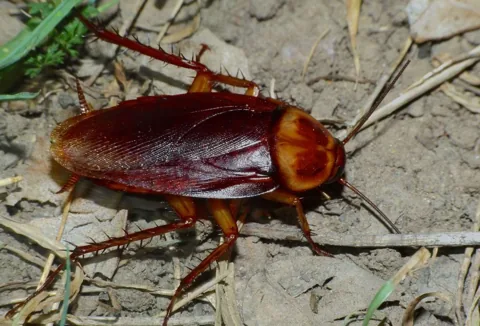 American Cockroach
Periplaneta americana
The American cockroach is the largest of the common pest cockroaches. It prefers warm, humid places and readily lives outdoors, in sewers, storm drains and water meter boxes, coming indoors to forage. Kentucky, Penn State and Minnesota all describe it as the largest cockroach commonly found in buildings.
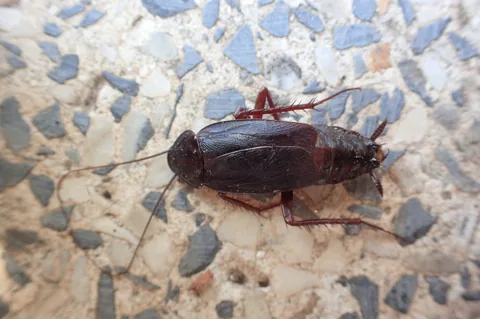 Oriental Cockroach
Blatta orientalis
The oriental cockroach, often called a water bug and sometimes a black beetle, lives in cool, dark, damp places such as basements, crawl spaces, drains and water meter boxes. It usually lives outdoors or in those damp spots and wanders into buildings at night, mostly staying at ground level.
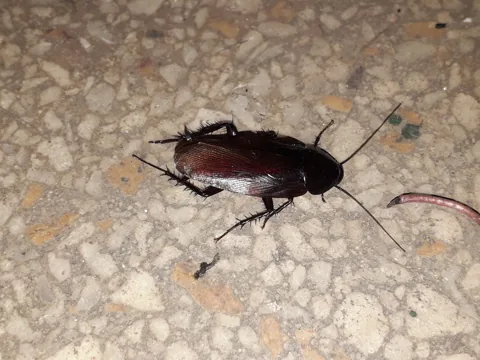 Smokybrown Cockroach
Periplaneta fuliginosa (now also placed in Validiblatta)
The smokybrown cockroach is a large, dark, winged roach of the humid South. It is the most common cockroach in suburban Southern neighborhoods with mature hardwood trees, where it lives in tree holes, attics, crawl spaces and sheds and comes out at night.
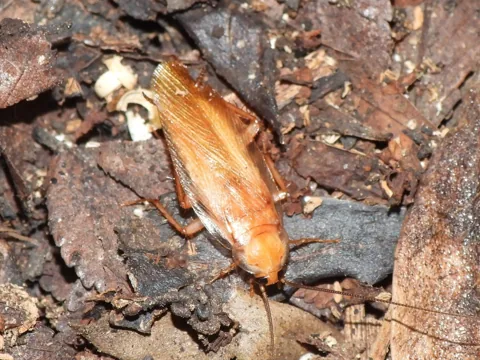 Turkestan Cockroach
Blatta lateralis (Periplaneta lateralis, Shelfordella lateralis)
The Turkestan cockroach is an invasive species that lives mostly outdoors, in water meter boxes, cracks between concrete blocks, compost, leaf litter, potted plants and sewers. In urban areas of the Southwest it is rapidly replacing the Oriental cockroach.
Which roach is it?
These three are often lumped together as large roaches, palmetto bugs or water bugs. Texas A&M says American cockroaches are also called waterbugs or palmetto bugs, and Penn State and Rutgers say the Oriental cockroach is called a water bug because it lives in damp places.[9][3][5][7]
Getting the name right matters because the treatment differs. Mississippi State notes that methods for German cockroaches differ considerably from those for smokybrown and other large roaches, and Kentucky says the German cockroach does not occur outdoors at all. If your roach is small, tan and has two dark stripes behind the head, use the German cockroach guide instead.[9][2]
- American cockroach: the largest of the common house roaches, 1 1/2 to 2 inches long, reddish brown with a light yellow band around the edge of the shield behind the head. Both sexes have full wings; Texas A&M says adults seldom fly but can glide.[4][5][6][1]
- Oriental cockroach: about 1 to 1 1/4 inches, very dark brown to nearly black with a greasy sheen. Males have wings covering about three quarters of the abdomen; females have only small wing pads. They do not fly and can't climb smooth vertical surfaces.[7][2][3][1]
- Smokybrown cockroach: about 1 to 1 1/2 inches, shiny dark brown to mahogany with no color pattern, and the dark area behind the head is uniform. Female wings reach the tip of the abdomen, which separates it from the short-winged Oriental cockroach. Smokybrowns are attracted to lights.[8][1][9]
- Turkestan cockroach: in the West and Southwest, UC IPM says this newer invader is displacing the Oriental cockroach in warm, dry parts of California, and Texas A&M calls it one of the most common outdoor roaches in El Paso. UC IPM groups it with Oriental and American cockroaches when outdoor harborages need treatment.[1][3]
One roach indoors: a stray or an infestation?
Mississippi State describes one of the most common situations with large roaches: they breed outside and occasionally invade the home but do not have an established indoor population. Kentucky adds that American cockroaches multiply more slowly than German cockroaches.[9][2]
UC IPM says indoor chemical control is warranted only if the cockroach population is established, not for an incidental intruder or two. For a single roach that came in under a door or up a drain, the fix is closing that route, not treating the house.[1]
That said, American cockroaches can breed indoors when conditions suit them, usually in damp basements, crawl spaces, pipe chases and floor drains. Set sticky traps for a week before deciding. If traps keep catching roaches in the same damp areas, those gathering spots are what to find and treat.[10][2][6][7]
Where they come from
American cockroaches are among the most common roaches in sewer systems. Texas A&M says they move through sewer pipes and enter kitchens and bathrooms through drainage pipes, and UC IPM says they forage from sewers into ground floors especially where pipes are damaged, screens are missing or drain water traps are faulty.[3][4][1]
Their source can be far from where you see them. Rutgers says breeding areas are often in city sewer lines or damaged or abandoned plumbing hundreds of feet away, and Kentucky says American cockroaches often travel long distances from where they gather, so long-term relief means finding and treating those areas.[5][2]
Oriental cockroaches stay low. Penn State says they are usually at or below ground level indoors and seldom on walls, in high cupboards or on upper floors. UC IPM finds them in water meter boxes, drains, garages and basements, most often at houses surrounded by woodpiles, ivy and ground cover, and Penn State notes that in dry spells many move indoors, apparently looking for humidity.[7][1]
Smokybrown cockroaches dry out more easily than many other roaches, so they live in moist, protected outdoor spots: mulch, ground cover, tree holes, woodpiles, decks, landscape timbers and debris-filled gutters, plus soffits and attic eaves. Indoors they turn up in kitchens, bathrooms, attics and around entry points.[8][3][1]
Step 1: Close off drains and plumbing
American and Oriental cockroaches both use floor drains as common ways into buildings. Texas A&M's advice is to keep the P-traps filled with water so they form a barrier between the sewer and the house.[3]
- Keep water in the traps of floor drains and of sinks and tubs that are rarely used.[3]
- Repair damaged drain pipes and replace missing drain screens. UC IPM notes that Oriental cockroaches sometimes end up trapped in sinks or tubs after climbing up through damaged drain pipes.[1]
- Seal openings where pipes come through floors and walls, especially under sinks. EPA notes that cockroaches come up from basements and sewers through these gaps; caulk, foam sealant, steel wool or copper mesh all work.[11][9]
- In homes over crawl spaces, Penn State cites research showing Oriental cockroaches often move into the house along plumbing, up through the floor from the crawl space.[7]
Step 2: Seal doors, windows and vents
Mississippi State calls exclusion the most effective tactic for preventing indoor invasions by large roaches. Because their bodies are flat, even adults can crawl under a poorly sealed door.[9]
- Install door sweeps on exterior doors, and seal the rest of the door edges with weather stripping, foam strips or spring metal strips. Check the threshold seal under each door.[9][1][3][10]
- Make sure window screens are undamaged and fit tightly, and caulk gaps around windows and door and window frames.[9][2][7]
- Check that soffit vents and other attic vents fit tightly and are screened. Texas A&M says American and smokybrown cockroaches often get in through poorly sealed doors, roof soffits and floor drains.[9][3]
- Seal gaps around utility lines, vents and other openings in the outside walls. Kentucky lists gaps around windows, doors, vents and utility openings, and firewood, as entry routes for American and Oriental cockroaches.[2][1]
Step 3: Dry out and clear the ground next to the house
Outdoors, these roaches look for dark, moist places close to decaying organic matter. Texas A&M lists compost piles, ground cover, hollow trees, mulch, old stumps, palm fronds, woodpiles, sewer manholes and underground water meters. Mississippi State says sanitation for large roaches should be focused on the area right around the home.[3][9]
Moisture is their weak point. Penn State says American cockroach adults can survive two or three months without food but only about a month without water, and Oriental cockroaches without water die within two weeks. Large numbers of Oriental cockroaches sometimes gather around leaks in basements and crawl spaces.[6][7]
- Mulch: Mississippi State says organic mulch ideally should not be used within 3 to 4 feet of the foundation; use lava rock or pea gravel there instead. UC IPM suggests a gravel strip about 6 to 12 inches wide around the building to reduce moisture.[9][1]
- Leaves and plants: rake leaves and pine needles, trim shrubs back from the house for light and air, and don't let ivy, vines or dense ground cover grow against the walls.[9][1][10]
- Firewood, lumber and junk: move stacks of firewood and lumber, boxes and debris piles away from the building. Kentucky notes roaches can also be carried in with firewood.[9][1][2][10]
- Food outside: keep garbage and recycling bins tightly covered, store pet food in roach-proof containers, clean up spilled food where pets eat, and don't store unrinsed cans or bottles.[9][10][1]
- Water: fix leaks in basements and crawl spaces, and clean out debris-filled gutters, which smokybrown cockroaches use.[7][8]
- In the South, Mississippi State advises against planting palm trees close to the house because they shelter large roaches.[9]
Step 4: Use sticky traps to see where they get in
Sticky traps show where roaches are coming from and whether your changes are working. Penn State says to put traps against a wall or in a corner, and that a week of trapping at enough sites usually gives enough information.[6][7][1]
For outdoor roaches, place traps near exterior doors and along walls in utility rooms. Texas A&M says traps there help monitor and give some control, especially for outdoor species. Rutgers recommends sticky traps for American cockroaches both to map where they are and to remove them.[1][3][5]
Check the traps daily until you can tell where most roaches are being caught. That is where to concentrate sealing and bait.[1]
Step 5: Bait outdoors first, then indoors
Baits are the main insecticide for large roaches too, but the format differs from German cockroach baiting. Mississippi State says granular baits and bait stations designed for large roaches are more useful than gel alone, and that bait stations made for German cockroaches are too small for them.[9]
- Outdoors: scatter granular cockroach bait in ground covers, mulched beds and around the outside of the foundation. Texas A&M says granular cricket and cockroach baits work well outdoors, and Rutgers suggests a granular bait around the exterior for Oriental cockroaches.[3][9][5]
- Bait the hiding spots: UC IPM suggests placing baits and bait stations in water meter and valve boxes, woodpiles, around planters, in drains and under concrete slabs. It also notes research showing gel bait in bait stations and in-ground utility ports can manage outdoor roaches.[1]
- Use the right granules. Mississippi State lists boric acid, hydramethylnon, indoxacarb and imidacloprid as granular bait ingredients, and warns that fire ant baits usually don't work on cockroaches. UC IPM says boric acid is not recommended outdoors because it is toxic to plants.[9][1]
- Indoors: in living areas, use childproof bait stations made for large roaches, or put gel or paste bait where children and pets can't reach it, in the areas where roaches hide. Granular bait indoors belongs only in non-living areas such as basements, attics, storage rooms and wall voids.[9][6][1]
- More bait types are not always better. In Auburn University trials around houses, a two-bait combination (pellets plus gel) reduced smokybrown cockroaches no more than a single bait, and a targeted spray was significantly less effective than the two-bait combination.[13]
- Sanitation still matters. In a field study of bait stations against American cockroaches in homes, houses with good sanitation saw trap catches fall faster, and in houses with poor sanitation the bait's effect did not last to 12 weeks.[14]
Step 6: Perimeter sprays, if you need them
Mississippi State says outdoor perimeter sprays are especially useful for large roaches, and Penn State says a continuous perimeter barrier may help reduce Oriental cockroaches coming in. Use only products labeled for this, and follow the label on where they may go: many allow the lower exterior wall, around doors and windows, and a band of ground around the house.[9][7]
Texas A&M suggests spraying suspected harborages and entry points such as building perimeters, doors, soffits and water meter boxes. Mississippi State adds that roaches hide in the cracks of overlapping siding, and most labels also allow crawl spaces and areas under porches. UC IPM says treating harborages may be needed when Oriental, Turkestan or American cockroaches are numerous and moving inside.[3][9][1]
A spray alone has limits. In an Auburn University study around houses, a label-rate perimeter spray controlled smokybrown cockroaches for about 30 days, while an integrated program with sanitation, landscape management and reduced insecticide use lasted about 60 days. The spray did not reduce roaches outside the treated zone, which the researchers linked to reinvasion, and cutting the outdoor population also cut the number of roaches inside the houses.[12][8]
A perimeter spray for roaches does not protect a house from termites; Mississippi State notes these treatments are not intended for termite control.[9]
What to skip indoors
Penn State says residual sprays and aerosol foggers inside a building are of little value against American and Oriental cockroaches, and may scatter them and make control slower. UC IPM advises avoiding foggers and bombs, which can be hazardous and repel roaches into other areas without killing them.[6][7][1]
Mississippi State treats indoor sprays only as a supplement for large roaches, around doorways and other entry points, along baseboards and behind appliances. If you use boric acid or another dust in wall voids and cracks, Penn State says to apply it lightly, keep it out of wet or damp spots, and keep it away from children, pets and food.[9][6][7]
When to call a professional
If trap counts stay high after you have sealed entry points, cleared the foundation and baited, look for a source you missed, such as a crawl space, a damaged drain line or a sewer connection. UC IPM says serious infestations often need a licensed professional.[1][5][2]
Mississippi State says professional service for large roaches usually means outdoor perimeter treatments, often with granular baits and targeted treatment of entry and shelter points. EPA lists inspection and monitoring, vacuuming, drain cleaning and an IPM approach among the services a good company should offer.[9][11]
Common questions
- Are palmetto bugs and water bugs the same as cockroaches?
- Yes. Palmetto bug and waterbug are common names for the American cockroach, and the Oriental cockroach is also called a water bug. Both are large roaches that live mostly outdoors.[3][5][7]
- Does one big cockroach in the house mean I have an infestation?
- Often not. Large roaches commonly breed outside and wander in without an indoor population. UC IPM says indoor insecticide treatment isn't warranted for an incidental intruder or two; seal the route and set sticky traps to check.[9][1]
- Can cockroaches come up through the drain?
- Yes. American cockroaches travel through sewer pipes into kitchens and bathrooms, and American and Oriental cockroaches commonly enter through floor drains. Keep drain traps filled with water and fix damaged pipes.[4][3][1]
- Why do I see more Oriental cockroaches in spring and early summer?
- Penn State says the Oriental cockroach has a seasonal cycle, with adult numbers peaking in late spring or early summer and dropping by late summer.[7]
- Do bug bombs work on American cockroaches?
- No. Penn State says foggers inside a building are of little value against American cockroaches and can scatter them. Focus on drains, sealing and baits.[6][1]
Photo credits
- American Cockroach: (c) Steve Kerr, some rights reserved (CC BY) — via iNaturalist, CC BY 4.0
- Oriental Cockroach: (c) Jorge Íñiguez, some rights reserved (CC BY) — via iNaturalist, CC BY 4.0
- Smokybrown Cockroach: (c) Eduardo Luis Beltrocco, some rights reserved (CC BY) — via iNaturalist, CC BY 4.0
- Turkestan Cockroach: (c) Sam Kieschnick, some rights reserved (CC BY) — via iNaturalist, CC BY 4.0
Sources
- University of California Statewide IPM Program, “Pest Notes: Cockroaches, UC ANR Publication 7467 (Home and Landscape).” ipm.ucanr.edu/home-and-landscape/cockroaches/ (accessed 2026-11-10)
- University of Kentucky Entomology, “ENTFACT-614: Cockroach Elimination in Homes and Apartments.” entomology.mgcafe.uky.edu/ef614 (accessed 2026-11-10)
- Texas A&M AgriLife Extension, “ENTO-037: Cockroach Biology and Management (2017).” extensionentomology.tamu.edu/wp-content/uploads/sites/3/2017/12/Cockroach-Biol-and-Mngmt_ENTO-037_2017.pdf (accessed 2026-11-10)
- Texas A&M Urban and Structural Entomology Program, “American Cockroach, Periplaneta americana.” urbanentomology.tamu.edu/urban-pests/cockroaches/american/ (accessed 2026-11-10)
- Rutgers Cooperative Extension, “FS1327: Cockroach Species in New Jersey and Their Control Strategies.” extension.rutgers.edu/fs1327 (accessed 2026-11-10)
- Penn State Extension, “American Cockroaches.” extension.psu.edu/american-cockroaches (accessed 2026-11-10)
- Penn State Extension, “Oriental Cockroaches.” extension.psu.edu/oriental-cockroaches (accessed 2026-11-10)
- University of Tennessee Entomology and Plant Pathology, “The Smokybrown Cockroach, Insec(tc)ure Vol. 3 Issue 10/11 (October 21, 2022).” epp.tennessee.edu/wp-content/uploads/sites/267/2023/11/2022-10SmokybrownV3I10.pdf (accessed 2026-11-10)
- Mississippi State University Extension Service, “Publication 3346: Control Cockroaches in and Around Your Home.” extension.msstate.edu/sites/default/files/document/2026-01/P3346_web.pdf (accessed 2026-11-10)
- Mississippi State University Extension Service, “Bug's Eye View: American Cockroach, Vol. 5, No. 25 (2019).” extension.msstate.edu/newsletters/bugs-eye-view/2019/american-cockroach-vol-5-no-25 (accessed 2026-11-10)
- U.S. Environmental Protection Agency, “Module 6: Managing Cockroaches in Child Care Centers (Integrated Pest Management for Child Care Settings).” www.epa.gov/sites/default/files/documents/Module06.pdf (accessed 2026-11-10)
- Journal of Economic Entomology, abstract via PubMed, “Smith et al. 1995, Comparative effectiveness of an integrated pest management system and an insecticidal perimeter spray for control of smokybrown cockroaches.” pubmed.ncbi.nlm.nih.gov/7657900/ (accessed 2026-11-10)
- Journal of Economic Entomology, abstract via PubMed, “Smith et al. 1997, Evaluation of methods of insecticide application for control of smokybrown cockroaches.” pubmed.ncbi.nlm.nih.gov/9374599/ (accessed 2026-11-10)
- Journal of Vector Ecology, abstract via PubMed, “Lee and Lee 2000, Influence of sanitary conditions on the field performance of chlorpyrifos-based baits against American cockroaches.” pubmed.ncbi.nlm.nih.gov/11217220/ (accessed 2026-11-10)