The short answer
- Seal the bottom of the big door. NC State says to install weather-stripping along the bottom of house and garage doors so that it fits tightly against the threshold, and UC IPM says entrances to garages should fit tightly. House mice can squeeze under gaps 1/4 inch tall.[1][17][18]
- Change the lights. Minnesota Extension says to turn off unnecessary lights at night or use less attractive yellow lights instead of white, neon or mercury vapor lights, and Kentucky says yellow or sodium vapor bulbs draw fewer of the night-flying insects that in turn attract spiders.[2][4]
- Get boxes off the floor. UC IPM says to store seasonal items in boxes that can be taped shut and placed off the floor away from walls, and NC State gives the same advice for camel crickets.[5][1]
- Wear gloves when you clean up. UC IPM says to wear gloves when cleaning up clutter in garages and other storage areas to avoid accidental black widow bites.[5]
Profiles of common garage pests
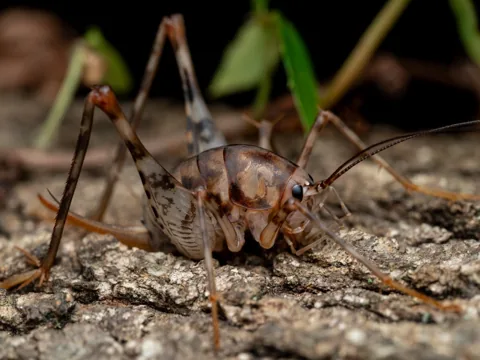 Camel Cricket
Rhaphidophoridae (shown: Tachycines asynamorus)
Camel crickets, also called cave crickets, are humpbacked, wingless crickets that live in cool, damp, dark places and often turn up in basements, crawl spaces and garages. They are a nuisance, not a danger.
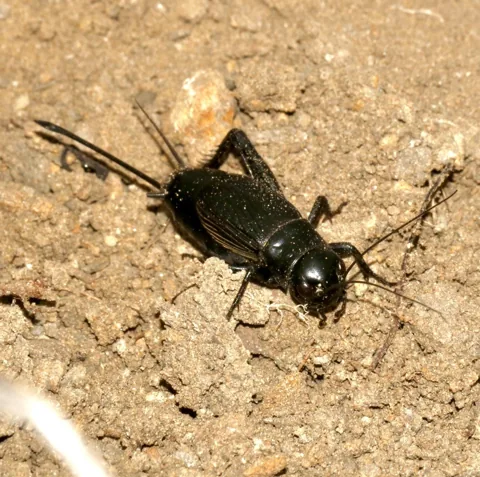 Field Crickets
Gryllus species (e.g., G. pennsylvanicus)
Field crickets are several species in the genus Gryllus that live outdoors in fields, pastures, roadsides and yards. They come into homes most often in late summer and fall, when cooler nights and outdoor lights draw them toward buildings.
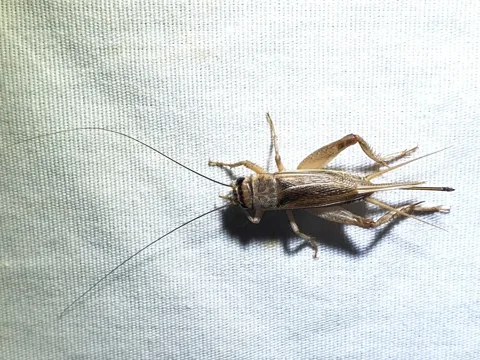 House Cricket
Acheta domesticus
The house cricket is a light brown cricket that is common outdoors, strongly attracted to light and often found inside houses, especially in late summer and fall.
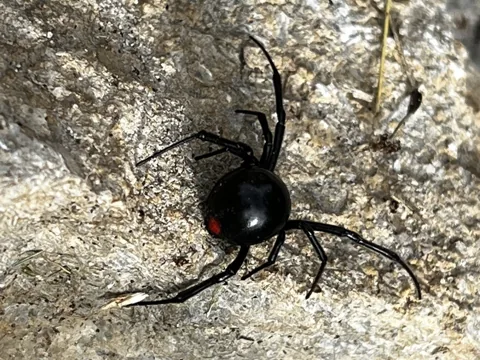 Southern Black Widow
Latrodectus mactans
Black widows are shy, web-building spiders with a neurotoxic venom; they live throughout North America and are most common in the southern and western United States. The southern black widow is found throughout states such as South Carolina.
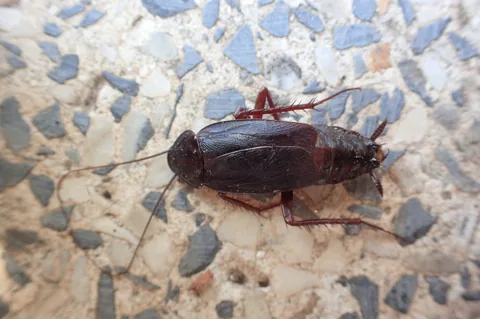 Oriental Cockroach
Blatta orientalis
The oriental cockroach, often called a water bug and sometimes a black beetle, lives in cool, dark, damp places such as basements, crawl spaces, drains and water meter boxes. It usually lives outdoors or in those damp spots and wanders into buildings at night, mostly staying at ground level.
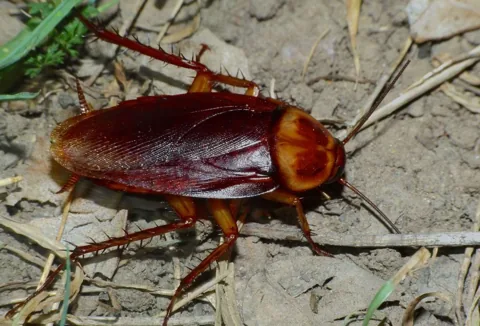 American Cockroach
Periplaneta americana
The American cockroach is the largest of the common pest cockroaches. It prefers warm, humid places and readily lives outdoors, in sewers, storm drains and water meter boxes, coming indoors to forage. Kentucky, Penn State and Minnesota all describe it as the largest cockroach commonly found in buildings.
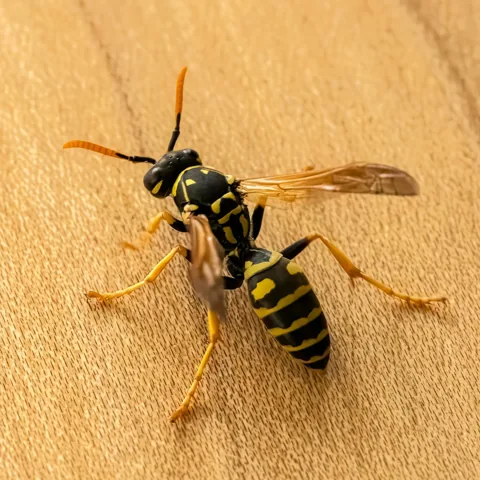 European Paper Wasp
Polistes dominula
Paper wasps hang open, umbrella-shaped paper nests under eaves and in sheltered spots; they are much less defensive than yellowjackets and rarely sting unless a nest is disturbed.
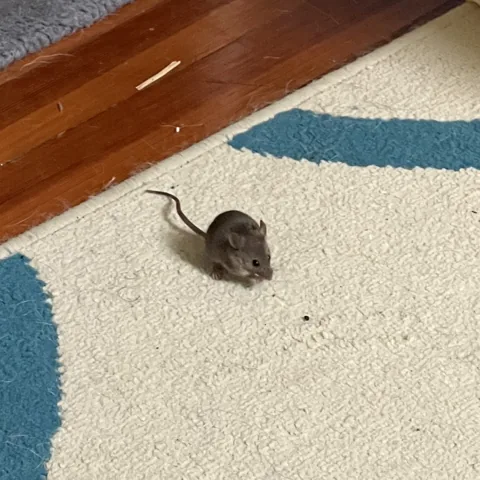 House Mouse
Mus musculus
The house mouse is a small, adaptable rodent that lives close to people in homes, schools and food businesses, eating and contaminating food, gnawing wiring and carrying disease.
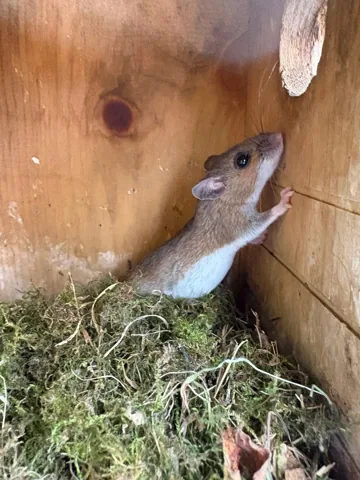 Deer Mouse
Peromyscus species (shown: P. maniculatus)
The deer mouse is a wild mouse with a white belly and a furred, two-toned tail that sometimes moves into cabins, sheds and homes. In the United States it spreads the most common hantavirus that causes hantavirus pulmonary syndrome (HPS), a severe and potentially deadly lung disease, so the droppings and nests it leaves need careful cleanup.
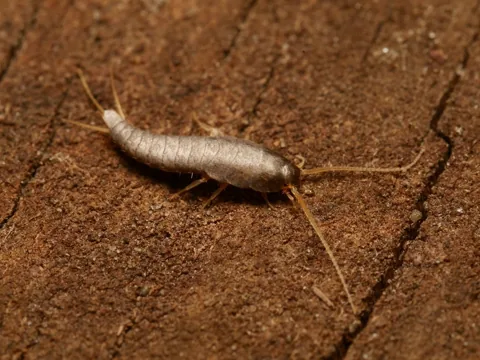 Silverfish
Lepisma saccharinum
Silverfish are nocturnal, wingless insects that hide by day and graze at night on paper, book bindings, starch in clothing and dry foods, preferring damp, warm places such as laundry rooms.
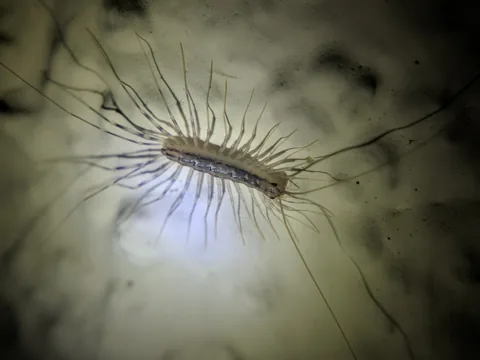 House Centipede
Scutigera coleoptrata
House centipedes are fast, long-legged predators that live in damp parts of buildings and feed on silverfish, cockroaches, carpet beetle larvae and other small arthropods; they are largely harmless.
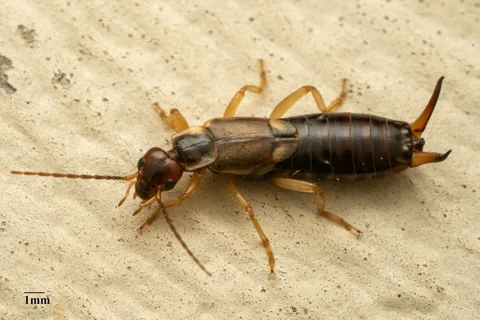 European Earwig
Forficula auricularia
The European earwig, introduced from Europe in the early 1900s, is a familiar garden insect that feeds at night and hides in dark, moist places by day; it damages seedlings and soft fruit but also eats aphids. Clemson says it is the most common earwig pest around homes, and Minnesota says it was first noticed there in the early 1990s.
Why bugs end up in the garage
Many garage pests are outdoor animals that wandered in under the door, and many of them die there. Kentucky says most millipedes and centipedes die shortly after entering a structure because of the lack of moisture, and Minnesota Extension says crickets that enter buildings do not usually lay eggs inside. UC IPM says earwigs eventually die indoors because there is little for them to eat.[22][2][24]
What keeps them coming is a short list of conditions: a door that doesn't seal, lights left on at night, mulch, firewood and debris against the foundation, damp corners, and stacks of cardboard on the floor. Kentucky says spiders prefer quiet, undisturbed areas such as closets, garages, basements and attics, and that reducing clutter makes those areas less attractive.[4][22][1]
Crickets
Minnesota Extension lists the field cricket, the camel cricket and the house cricket as the crickets most often found in homes. Camel crickets and field crickets are easy to tell apart, and they come in for different reasons.[2]
- Camel crickets: Minnesota Extension describes them as tan and humpbacked, about 3/4 inch long, with no wings. NC State says they don't chirp and are drawn to cool, moist or humid areas; they often invade storage buildings, crawlspaces, basements and garages. Minnesota Extension says camel crickets are not attracted to light.[2][1]
- Field crickets: Minnesota Extension gives a 1/2- to 3/4-inch body, dark brown to black, and says they are strongly attracted to light; it says crickets come in especially in late summer and fall. NC State says that if you hear chirping indoors, you likely have field crickets.[2][1]
- Damage: NC State says camel crickets are mostly a nuisance but can damage garments and linens packed in boxes in a garage or basement if the problem goes unchecked. Clemson says house and field crickets indoors can feed on fabrics, leather and fur, especially items soiled with food, beverages or perspiration.[1][3]
- Catching them: NC State suggests sticky boards like those used for cockroaches and mice, and Minnesota Extension says camel crickets especially are attracted to sticky traps. Clemson says vacuuming removes crickets indoors.[1][2][3]
- Spraying: the sources differ. Minnesota Extension says pesticides are generally not effective or necessary indoors. Clemson says to use chemicals indoors only when a large infestation is present, applied to cracks and crevices, and that crawl spaces, garages and basements may need a treatment too. NC State says any chemical control should focus first on outdoor barrier treatments. The crickets guide covers the details.[2][3][1]
Spiders, including black widows
Garages suit spiders because they are quiet and full of insects that come in under the door. UC IPM says spiders that might injure people, black widows for example, generally spend most of their time hidden outside homes in woodpiles or in clutter in the garage.[6]
- Black widows: UC IPM says that in garages they usually make webs by doors, near vents, and in other places where insects may pass by. Kentucky says that when black widows are found in homes, they are usually spotted in vestibules and garages, or at times sheds and outbuildings.[5][4]
- How to recognize one: UC IPM describes the adult female as shiny jet black all over her body and legs, except for a red pattern on the underside of the abdomen that in perfect specimens looks like an hourglass. It says the hourglass varies and on rare occasions is absent. Widow spiders make irregular, untidy cobwebs.[5]
- Bites are uncommon. UC IPM says bites from black widow spiders are quite rare, even where the spiders are very common. Wear gloves when sorting boxes, firewood or garden gear. The black widow guide covers symptoms and when to get care.[5]
- Brown widows: UC IPM says black widows are common in garages but brown widows are not.[5]
- Removing webs and spiders: Kentucky says a vacuum cleaner or broom removes spiders, webs and egg sacs, and UC IPM says vacuuming works well because their soft bodies usually don't survive it.[4][5]
- If you're in brown recluse country, Kentucky says to look closely at boxes of stored items, and that glue traps are an effective way to find hidden infestations. The brown recluse guide covers this.[4]
Cockroaches
The roaches that turn up in garages are usually the large outdoor species, not the German cockroach of kitchens. UC IPM says the Oriental cockroach lives in cool, dark, damp places like garages, basements, water meter boxes and drains, and that at night it may migrate into buildings in search of food, water or mates.[7]
- Oriental cockroach: Kentucky describes it as shiny black or dark brown and about 1 inch long as an adult. Penn State says it is sluggish and is usually at or below ground level indoors, and that in periods of drought there may be considerable movement into structures, apparently in search of higher humidity.[8][9]
- American cockroach: Kentucky says it is the largest cockroach commonly found in dwellings, about 1 1/2 inches long when fully grown, and that in warmer months it can be found outdoors in yards and around trash containers.[8]
- Keeping them out: UC IPM recommends door sweeps and weather stripping around doors and windows, sealing cracks and other openings, and placing traps near exterior doors to catch invading outdoor species. Kentucky says American, Oriental and wood cockroaches get in through gaps around windows, doors, vents and utility openings, and in firewood. The American and Oriental cockroach guide covers baits and outdoor treatment.[7][8]
Wasp nests
Garage eaves and door frames are the kind of sheltered spots paper wasps pick. Kentucky says they build their umbrella-shaped nests in protected spots such as under eaves, gutters and ledges, or in attics, barns or sheds, and Clemson lists window and door frames, roof overhangs and attic rafters. Penn State says European paper wasps nest in enclosed spaces such as eaves, attics and wall voids, so people may not know a nest is there until they disturb it.[10][12][13]
- How much of a threat they are: UC IPM says paper wasps are much less defensive than yellowjackets and rarely sting humans, and Clemson says they will sting if they feel threatened or provoked. UC IPM says yellowjackets sometimes nest in wall and ceiling voids of houses.[11][12]
- Prevention: Penn State says to repair holes in walls, caulk cracks in soffits and eaves, and screen vents and louvers. Clemson says to screen openings or vents if wasps keep nesting in attic areas or other voids.[13][12]
- Removal: Kentucky warns that folk remedies such as dousing nests with gasoline or a garden hose seldom work and can result in multiple stings. Penn State says treatments should be made at night when the workers and queen are on the nest. Kentucky adds that a nest away from frequently used areas can be left alone, since in states with cold winters the colonies die off naturally once the weather turns cold. The wasp nest removal guide walks through the steps.[10][13]
Mice and rats
Mice need very little room to get under a garage door. UC IPM says house mice can squeeze under gaps 1/4 inch tall and through openings 3/8 inch wide, and CDC says mice can fit through a hole the width of a pencil. UC IPM's rat notes list rat nests in cluttered garages among the signs of an infestation.[18][14][19]
- Doors: NPIC says to install door sweeps and weather stripping to keep mice from crawling under doors. UC IPM says to keep side doors to the garage closed, especially at night when deer mice and other rodents are most active.[16][17]
- Food: NPIC says uncovered garbage, pet food and birdseed can attract mice, and says to store them in jars, tin boxes or durable plastic. CDC says to keep grains and animal feed in thick plastic or metal containers with tight lids. A bag of birdseed or dog food on the garage floor is an open invitation.[16][14]
- Nesting material: NPIC says to remove materials mice may use for nesting or shelter, including cardboard boxes and newspapers. It also says to check unused cars for signs of mice, since they can damage wires and other parts.[16]
- Cleanup: CDC says not to vacuum or sweep rodent urine, droppings or nesting material. Wear rubber or plastic gloves, spray the area with a bleach solution or an EPA-registered disinfectant until very wet, then clean it up. The guide to keeping mice and rats out of cars and garages covers sealing, trapping and nests in engine bays.[15]
Silverfish, centipedes and earwigs
These three need moisture, so finding them in numbers usually points to a damp corner, a leak, or mulch and debris piled against the outside wall.[21][22][25]
- Silverfish: NC State says they prefer cool, damp areas and are often found where rarely used items are stored. It recommends keeping items you want to store for long periods in airtight plastic bags or sealable containers, and getting rid of old newspapers, books and boxes. UC IPM says insecticides won't work unless you also remove the moisture, food and hiding places.[21][20]
- House centipedes: Kentucky describes them as about an inch long, grayish-brown to yellowish-brown with three dark bands and up to 15 pairs of long, banded legs. They hunt other arthropods, including cockroaches, crickets, pillbugs and silverfish. On bites the sources differ: Penn State calls them harmless, while Kentucky says some centipedes can inflict a painful bite but none are broadly dangerous to humans. Penn State says large numbers may point to another pest problem.[22][23]
- Millipedes: Kentucky says they can be seen in large congregations, sometimes indoors in basements and garages, and that mulch and plants close to the home are thought to create the moist conditions they like.[22]
- Earwigs: Clemson says they may be found in areas with moisture problems around doors, windows and garages, and suggests moving woodpiles, stepping stones, wet outdoor mats and debris away from the foundation. UC IPM says indoor pesticides won't prevent earwigs from entering and aren't recommended.[25][24]
Door seals and other ways in
The big door is the main gap, but it isn't the only one. Kentucky says gaps under doors are a common entry point for spiders and suggests paying particular attention to door thresholds, garage and crawl space entrances, foundation vents, and the bottom edge of siding.[4]
- Bottom seal on the main door: weather-stripping that fits tightly against the threshold, per NC State. If the edges get gnawed, UC IPM says the edges of doors and windows may need to be covered with metal to stop it.[1][18]
- Side and house doors: door sweeps and weather stripping, as UC IPM recommends for cockroaches and NPIC for mice. Kentucky suggests door sweeps or weather stripping for gaps under exterior doors and windows to keep centipedes and millipedes out.[7][16][22]
- Cracks and pipe openings: CDC says to fill small holes with steel wool and hold it in place with caulk or spray foam, and to seal outbuildings and garages as well as the house. UC IPM says to seal openings larger than 1/4 inch, since mice will gnaw to enlarge them.[14][17]
- Outside the wall: NC State says to keep ground cover and mulch at least 12 inches or more away from the foundation, and Kentucky says moving firewood, stacked items and debris away from the foundation helps reduce spider migration indoors.[1][4]
- The pest-proofing guide covers the rest of the house.[1][14]
Outdoor lights over the garage door
A light over the garage door at night pulls in flying insects, and then the things that eat them. Kentucky says yellow or sodium vapor bulbs at outside entrances are less attractive than conventional bulbs to night-flying insects, which in turn attract spiders.[4]
- Minnesota Extension says to reduce outside lighting to avoid attracting field crickets and house crickets, and to turn off unnecessary lights or use yellow lights instead of white, neon or mercury vapor lights. Clemson gives the same advice for doors and windows, and UC IPM says to replace white outdoor lights with yellow ones, which are less attractive to earwigs.[2][3][24]
- Not all white LEDs are alike. In a peer-reviewed field test near Los Angeles, Longcore and colleagues found that LED lamps tuned against published attraction curves for honeybees and moths drew fewer arthropods than store-bought LED or compact fluorescent lamps of similar color temperature. They note that ultraviolet and blue light are usually the most attractive to arthropods, though attraction varies between insect groups.[26]
Storage that doesn't feed or hide pests
Most of what draws pests into a garage is stored there: boxes on the floor, open bags of food, and piles nobody moves for months. NC State says camel crickets can damage stored garments and linens packed in boxes in a garage, and UC IPM lists clutter among the places black widows hide.[1][6]
- Get boxes off the floor and away from the walls. UC IPM recommends this for seasonal items such as sports gear, camping gear, winter clothes and holiday decorations, in boxes that can be taped shut, and NC State recommends the same in garages for camel crickets.[5][1]
- Bag what you'll reach into. UC IPM suggests keeping gardening clothes and gloves in bags closed with zipper-locks or twist ties so spiders can't move in.[5]
- Use sealed containers for anything an animal could eat: pet food, birdseed, grain and animal feed, per NPIC and CDC.[16][14]
- Use plastic bins or sealable containers for long-term storage. NC State says this for silverfish, and NPIC lists cardboard boxes and newspapers among the materials mice use for nesting.[21][16]
- Keep firewood out of the garage if you can. Kentucky says Oriental, American and wood cockroaches can come in with firewood, and that brown recluses and black widows live in woodpiles outdoors.[8][4]
- Clean the corners. Kentucky says reducing clutter makes garages less attractive to spiders, and UC IPM says to sweep and vacuum regularly and to vacuum up spiders along with their webs.[4][6]
Common questions
- Why are there so many crickets in my garage?
- If they're tan, humpbacked and silent, they're camel crickets looking for cool, damp shelter; NC State says they often invade garages and basements. If they're dark and chirping, they're field crickets, which Minnesota Extension says are strongly attracted to light. Seal the door bottom, dry out damp corners and change or switch off the outside lights.[1][2]
- Are black widows common in garages?
- They can be. UC IPM says black widows are common in garages, where they usually web near doors and vents, and Kentucky says garages and vestibules are where they're usually seen when they turn up in homes. UC IPM also says bites are quite rare. Wear gloves when moving stored items.[5][4]
- What color outdoor light attracts the fewest bugs?
- Extension services in Minnesota, Kentucky, South Carolina and California all suggest yellow bulbs (Kentucky and Clemson also name sodium vapor) over white ones. A peer-reviewed study notes that ultraviolet and blue light are usually the most attractive to arthropods, and found that LEDs tuned to attract fewer insects drew fewer than ordinary LEDs of similar color temperature.[2][4][3][24][26]
- Should I spray insecticide in the garage?
- Usually that's not the first step. Minnesota Extension says pesticides are generally not effective or necessary for crickets indoors, UC IPM says indoor pesticides aren't recommended for earwigs, and UC IPM says insecticides won't control silverfish unless you also remove the moisture, food and hiding places. Clemson allows crack-and-crevice treatment in garages for a large cricket infestation. Sealing gaps and clearing clutter comes first.[2][24][20][3]
Photo credits
- Camel Cricket: (c) Zachary Dankowicz, some rights reserved (CC BY) — via iNaturalist, CC BY 4.0
- Field Crickets: (c) Dustin Snider, some rights reserved (CC BY) — via iNaturalist, CC BY 4.0
- House Cricket: (c) Bob Miller, some rights reserved (CC BY) — via iNaturalist, CC BY 4.0
- Southern Black Widow: Carol Spence, public domain (CC0), via iNaturalist
- Oriental Cockroach: (c) Jorge Íñiguez, some rights reserved (CC BY) — via iNaturalist, CC BY 4.0
- American Cockroach: (c) Steve Kerr, some rights reserved (CC BY) — via iNaturalist, CC BY 4.0
- European Paper Wasp: (c) Andrew McKinlay, some rights reserved (CC BY) — via iNaturalist, CC BY 4.0
- House Mouse: (c) Carrie Seltzer, some rights reserved (CC BY) — via iNaturalist, CC BY 4.0
- Deer Mouse: (c) Derek Duplessis, some rights reserved (CC BY) — via iNaturalist, CC BY 4.0
- Silverfish: (c) Alexis Tinker-Tsavalas, some rights reserved (CC BY) — via iNaturalist, CC BY 4.0
- House Centipede: Danijel Ostović, public domain (CC0), via iNaturalist
- European Earwig: Jesse Rorabaugh, public domain (CC0), via iNaturalist
Sources
- NC State Extension, “Camel Crickets.” content.ces.ncsu.edu/camel-crickets (accessed 2026-11-10)
- University of Minnesota Extension, “Crickets.” extension.umn.edu/garden-and-home/home-maintenance/household-insects/crickets (accessed 2026-11-10)
- Clemson Cooperative Extension Home & Garden Information Center, “House and Field Crickets, HGIC 2425.” hgic.clemson.edu/factsheet/house-and-field-crickets/ (accessed 2026-11-10)
- University of Kentucky Entomology, “Eliminating Spiders Around Homes and Buildings (ENTFACT-623).” entomology.mgcafe.uky.edu/ef623 (accessed 2026-11-10)
- UC Statewide Integrated Pest Management Program, “Pest Notes: Widow Spiders and Their Relatives, UC ANR Publication 74149.” ipm.ucanr.edu/home-and-landscape/widow-spiders-and-their-relatives/ (accessed 2026-11-10)
- UC Statewide Integrated Pest Management Program, “Pest Notes: Spiders, UC ANR Publication 7442.” ipm.ucanr.edu/home-and-landscape/spiders/ (accessed 2026-11-10)
- UC Statewide Integrated Pest Management Program, “Cockroaches.” ipm.ucanr.edu/home-and-landscape/cockroaches/ (accessed 2026-11-10)
- University of Kentucky Entomology, “ENTFACT-614: Cockroach Elimination in Homes and Apartments.” entomology.mgcafe.uky.edu/ef614 (accessed 2026-11-10)
- Penn State Extension, “Oriental Cockroaches.” extension.psu.edu/oriental-cockroaches (accessed 2026-11-10)
- University of Kentucky Entomology, “ENTFACT-620: Controlling Wasps, Hornets, and Yellowjackets.” entomology.mgcafe.uky.edu/ef620 (accessed 2026-11-10)
- UC Statewide Integrated Pest Management Program, “Pest Notes: Yellowjackets and Other Social Wasps, UC ANR Publication 7450.” ipm.ucanr.edu/home-and-landscape/yellowjackets-and-other-social-wasps/ (accessed 2026-11-10)
- Clemson Cooperative Extension Home & Garden Information Center, “Paper Wasps (HGIC 2481).” hgic.clemson.edu/factsheet/paper-wasps/ (accessed 2026-11-10)
- Penn State Extension, “European Paper Wasp.” extension.psu.edu/european-paper-wasp (accessed 2026-11-10)
- Centers for Disease Control and Prevention, “Seal Up to Prevent Rodent Infestations.” www.cdc.gov/healthy-pets/rodent-control/seal-up.html (accessed 2026-11-10)
- Centers for Disease Control and Prevention, “Clean Up After Rodents.” www.cdc.gov/healthy-pets/rodent-control/clean-up.html (accessed 2026-11-10)
- National Pesticide Information Center, “Mice.” npic.orst.edu/pest/mice.html (accessed 2026-11-10)
- UC Statewide Integrated Pest Management Program, “Pest Notes: Deer Mouse.” ipm.ucanr.edu/legacy_assets/PDF/PESTNOTES/pndeermouse.pdf (accessed 2026-11-10)
- UC Statewide Integrated Pest Management Program, “Pest Notes: House Mouse, Publication 7483.” ipm.ucanr.edu/legacy_assets/PDF/PESTNOTES/pnhousemouse.pdf (accessed 2026-11-10)
- UC Statewide Integrated Pest Management Program, “Pest Notes: Rats.” ipm.ucanr.edu/home-and-landscape/rats/ (accessed 2026-11-10)
- UC Statewide Integrated Pest Management Program, “Silverfish and Firebrats.” ipm.ucanr.edu/home-and-landscape/silverfish-and-firebrats/ (accessed 2026-11-10)
- NC State Extension, “Silverfish and Firebrats.” content.ces.ncsu.edu/silverfish-and-firebrats (accessed 2026-11-10)
- University of Kentucky Entomology, “ENTFACT-645: Centipedes and Millipedes in and Around the Home.” entomology.mgcafe.uky.edu/ef645 (accessed 2026-11-10)
- Penn State Extension, “House Centipedes.” extension.psu.edu/house-centipedes (accessed 2026-11-10)
- UC Statewide Integrated Pest Management Program, “Earwigs (Pest Notes 74102).” ipm.ucanr.edu/home-and-landscape/earwigs/ (accessed 2026-11-10)
- Clemson Cooperative Extension Home & Garden Information Center, “Earwigs (HGIC 2421).” hgic.clemson.edu/factsheet/earwigs/ (accessed 2026-11-10)
- Philosophical Transactions of the Royal Society B (peer-reviewed), “Tuning the white light spectrum of light emitting diode lamps to reduce attraction of nocturnal arthropods (Longcore et al., Philos Trans R Soc Lond B Biol Sci 2015;370:20140125; PMID 25780237).” pubmed.ncbi.nlm.nih.gov/25780237/ (accessed 2026-11-10)