The short answer
- Seal cracks in the foundation and gaps around windows and doors, and fit tight window screens and door sweeps.[1][5][9]
- Use yellow or sodium vapor bulbs at outside doors, or point fixtures away from the house, so fewer night-flying insects gather where spiders can catch them.[5][9][1]
- Move firewood, stacked items and debris away from the foundation, and trim shrubs, vines and branches that touch the house.[5][1]
- Vacuum or sweep up spiders, webs and egg sacs indoors, and cut clutter in closets, basements, garages and attics.[5][9][1]
- Put flat sticky traps along baseboards and in corners, out of reach of children and pets, to see where spiders are and how many.[9][6]
- Skip routine indoor spraying: it gives only temporary control unless the cleanup and sealing are done too.[1][9][7]
- If traps or a specialist confirm brown recluses, or widows keep turning up, a professional pest control company is the sensible next step.[5][6]
- Not sure what you have? Check our types of spiders in homes guide first. Most spiders found in homes are harmless.[9][4]
Spiders people find in houses
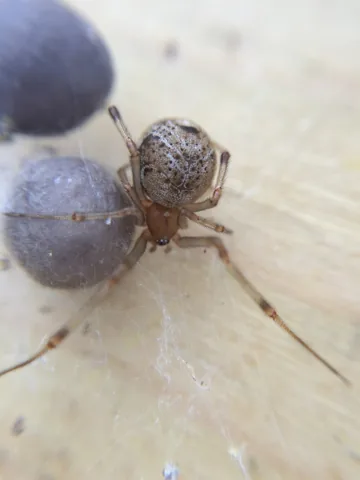 Common House Spider
Parasteatoda tepidariorum
The common house spider is a cobweb weaver found through most of the world. It builds its tangled webs in the corners of walls and windows, along floor joists and in basements, barns and crawl spaces.
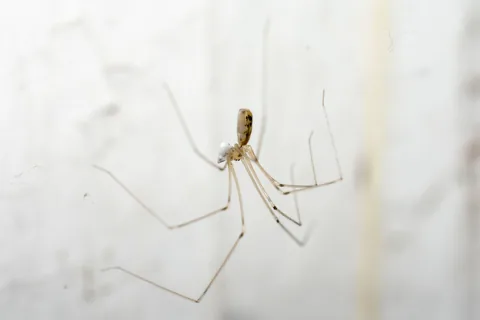 Longbodied Cellar Spider
Pholcus phalangioides
The longbodied cellar spider is the most common cellar spider in the United States: a small, pale spider with extremely long legs that lives in buildings all year. Penn State says it isn't known to be harmful in any way; its main offense is messy webbing.
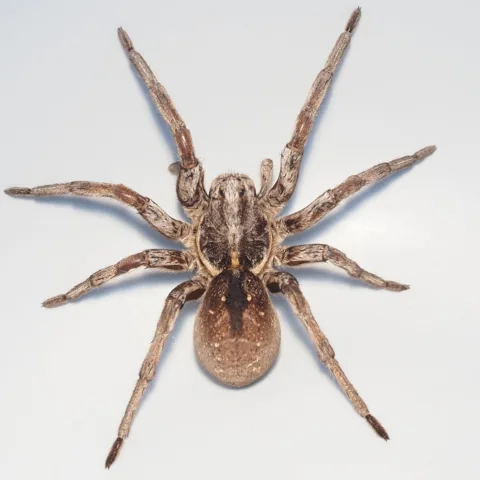 Carolina Wolf Spider
Hogna carolinensis
Wolf spiders are large hunting spiders that don't use webs; they wander into homes by accident, especially males searching for mates, and they don't persist indoors.
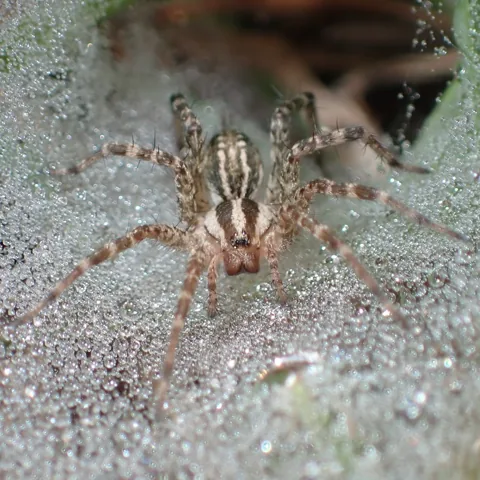 Grass Spiders (Funnel Weavers)
Agelenopsis species
Grass spiders are common funnel weavers whose flat, sheet-like webs with a funnel off to one side show up in lawns, ground covers and shrubs. They are fast and shy, often wander indoors in fall, and are considered beneficial.
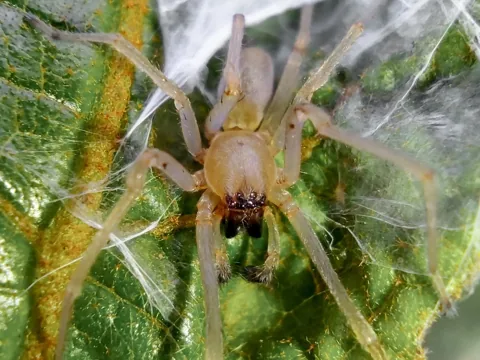 Yellow Sac Spider
Cheiracanthium species (shown: C. inclusum)
Yellow sac spiders are small, pale hunting spiders that rest by day in silk sacs in the corners of walls and ceilings, under siding or among leaves, and come out at night to hunt instead of building a web.
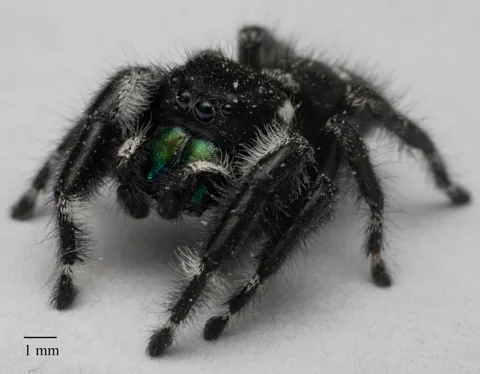 Bold Jumping Spider
Phidippus audax
Jumping spiders are compact, day-active hunters that build no web; they stalk prey by sight and pounce from a short distance. They live on plants, bark and walls and only occasionally wander indoors.
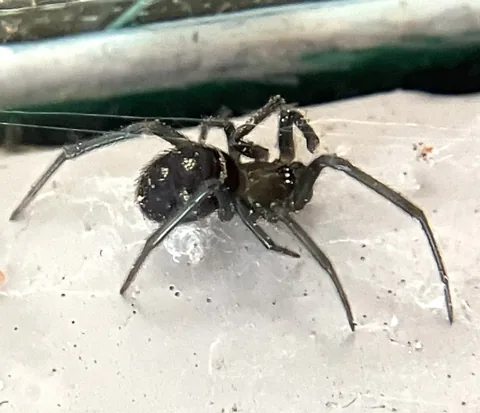 False Widow Spiders
Steatoda species (mainly S. grossa; also S. triangulosa)
False widows are Steatoda cobweb spiders, close relatives of black widows with the same round-bellied shape. The false black widow, Steatoda grossa, is common in homes and often mistaken for a black widow; its bite can hurt but is usually much milder.
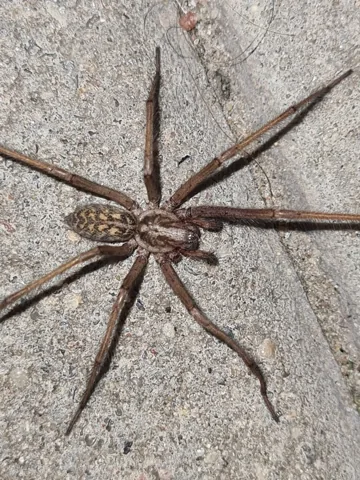 Giant House Spider
Eratigena atrica (formerly Tegenaria gigantea and T. duellica)
The giant house spider is one of the largest spiders in the Pacific Northwest, with a leg span that can reach 4 inches. It is common in and around homes west of the Cascades and is often mistaken for the hobo spider, but its bite is not known to threaten people.
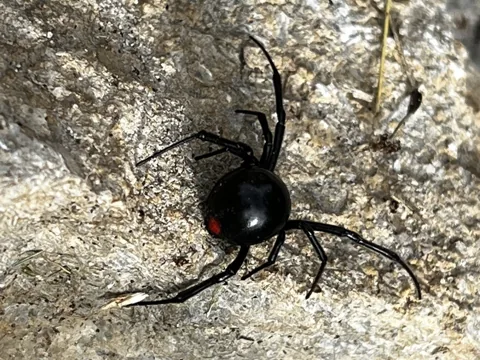 Southern Black Widow
Latrodectus mactans
Black widows are shy, web-building spiders with a neurotoxic venom; they live throughout North America and are most common in the southern and western United States. The southern black widow is found throughout states such as South Carolina.
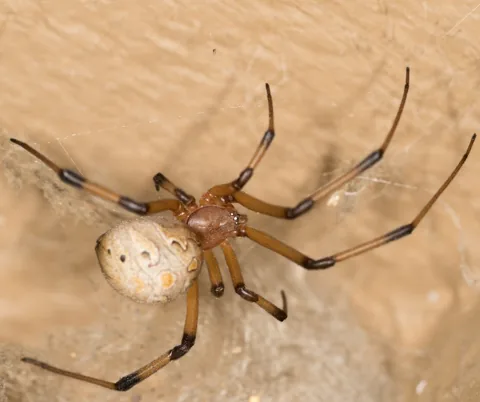 Brown Widow
Latrodectus geometricus
The brown widow is a non-native widow spider. It was found only in Florida for decades, then in the 2000s turned up from Texas along the Gulf Coast and up the Atlantic coast and became common around homes and parks in Southern California.
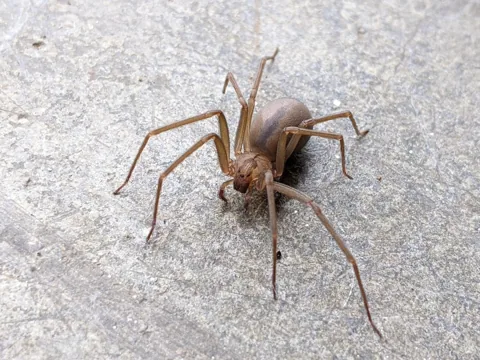 Brown Recluse
Loxosceles reclusa
The brown recluse is a secretive spider of the south-central and Midwestern United States whose bite can occasionally cause serious wounds; it is widely over-reported outside its range. The Illinois Department of Public Health says it occurs in roughly the southeastern quarter of the country and that bites are uncommon even where the spider is common.
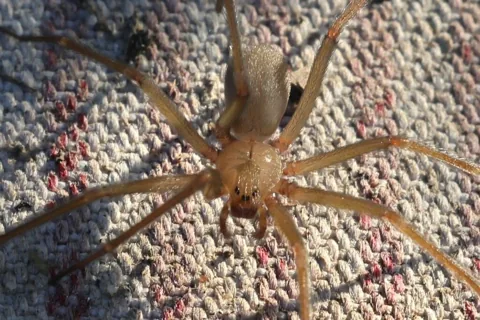 Desert Recluse
Loxosceles deserta
The desert recluse is the most common recluse spider in California and the one most likely behind a true recluse find there. It is native to the desert Southwest, lives mainly outdoors in native vegetation and is seldom found indoors.
Why spiders end up in your house
Kentucky's extension entomologists describe most spiders in homes and buildings as accidental invaders that came in around doors, windows or other openings. Houses in wooded areas, or with naturalized or landscaped foundations, get more of them because the surroundings are ideal spider habitat.[4]
Spiders follow food. UC IPM says the more insects there are inside a building, the more likely it is to have spiders living there, and Colorado State suggests controlling the other insects in the house to take away their food supply.[1][7]
Many are carried in. UC IPM lists plants, firewood and boxes as common ways spiders get indoors.[1]
- Fall: Colorado State says funnel weavers are the most common spiders in homes there, usually turning up in early fall as temperatures cool. Connecticut's Agricultural Experiment Station says wolf spiders also move into buildings in fall as it gets colder.[7][8]
- Wandering males: large hunting spiders found in homes or garages are often mature male wolf spiders searching for females, and new developments may be invaded by wolf spiders that lost their outdoor habitat.[1]
- Identify before you treat. NPIC advises identifying the spider before choosing a strategy, and UC IPM says to confirm you actually have recluses before trying to control them. Our types of spiders in homes guide covers identification, and your county extension office can help.[9][2]
Step 1: Seal the gaps they walk through
Spiders usually get in through cracks and crevices around the foundation, doors and windows. Sealing those gaps and making sure doors and windows fit tightly keeps out spiders and the insects they eat.[9][1]
Connecticut's experiment station points out that the same work makes a house more energy efficient and also keeps out rats and mice.[8]
- Doors: gaps under doors are a common entry point. Install door sweeps on exterior doors.[5][6]
- Screens: fit tight window screens, and check window and door screens for good seals.[5][1]
- Vents and utility lines: screen vents, and seal around utility penetrations such as pipes and wires.[8][6]
- Siding and roofline: for brown recluses, Kentucky lists the bottom edge of siding and the places where eaves and soffits meet the walls among common entry points.[6]
- Indoors: caulk cracks along baseboards and around doors.[7]
- Attached garage: seal cracks around the door into the house and the holes where electrical conduit or plumbing passes through.[2]
Step 2: Change the outdoor lighting
Lights draw night-flying insects, and the insects draw spiders. UC IPM recommends keeping fixtures off the house and away from windows and doorways where you can.[1][3]
Kentucky, NPIC and Utah State all suggest yellow or sodium vapor bulbs at outside entrances, because they attract fewer insects than standard bulbs. Utah State notes that black widows wait in their webs for prey, so cutting the insects at the lights helps keep widows away too.[5][9][10]
Step 3: Clear the strip around the foundation
Large numbers of spiders often gather on the outside of buildings. Taking away their hiding places next to the walls cuts down how many end up moving indoors.[5][1]
- Move firewood, building materials, stacked items and debris away from the foundation. Stack woodpiles away from the house and wear gloves when you pick up wood.[5][6][3]
- Keep the area next to the foundation free of trash, leaf litter and heavy vegetation. Colorado State also lists compost and rocks as spider shelter to remove near the house.[1][7]
- Trim shrubs, vines and tree limbs touching the house. Kentucky notes they give spiders shelter and a bridge onto the building, and NPIC suggests leaving enough space for sun and air to get between plants and walls.[5][9]
- Keep grass cut short near the house.[9]
- Knock webs off walls, eaves, patio furniture and decks with a broom, vacuum or a hard spray from a hose, and repeat regularly.[1][9][3]
Step 4: Vacuum webs and egg sacs and cut the clutter
Kentucky calls routine, thorough house cleaning the best way to eliminate spiders and discourage their return. A vacuum or broom removes spiders, webs and egg sacs, and getting the egg sacs matters because each one can hold hundreds of young spiders.[5]
UC IPM says vacuuming works as control, not just cleanup, because spiders' soft bodies usually don't survive the trip through the hose. A web with dust on it is an old one; spiders keep the webs they are using clean.[1][3]
- Vacuum or sweep windows, corners of rooms, storage areas, basements and other seldom-used spaces on a regular schedule.[1][3]
- Reduce clutter in closets, garages, basements and attics. Spiders prefer quiet, undisturbed places.[5][1]
- In storage areas, keep boxes off the floor and away from walls, and tape them shut so spiders can't move in. Wear gloves when you clean out cluttered storage.[1][9][3]
- Control humidity in basements, attics and other dark areas. Connecticut's experiment station says a dehumidifier and fixing leaks discourage both spiders and their prey.[9][8]
- Deal with the insects spiders feed on, since fewer insects means less reason for spiders to stay.[7][9]
- For a single spider, put a jar or glass over it, slide stiff paper underneath and carry it outside. UC IPM notes it's just as easy, and less toxic, to crush or vacuum it as to spray it.[1][8]
Step 5: Use sticky traps to see what you have
Cardboard sticky traps show where spiders travel and how many you have, without insecticide. NPIC suggests placing them along baseboards and under furniture, out of reach of children and pets.[9][2][1]
Kentucky's brown recluse fact sheet gives the most detailed advice. Flat glue traps without a raised edge work best, and the more you set out the better: dozens spread through a home will show where spiders are most abundant.[6]
- Place traps in corners, along baseboards and wall-floor junctures, and behind furniture and clutter where spiders travel.[6][9]
- Traps catch many wandering males, which are the spiders most likely to end up in shoes or bedding.[6]
- Count new catches over time to judge whether the problem is shrinking.[6]
- If insecticides will be used, set traps out first, since some products make spiders active and they wander into the traps.[6]
- Cockroach and rodent sticky traps along baseboards also work, according to Colorado State.[7]
Why indoor sprays do so little
UC IPM says insecticides will not give long-term control of spiders and that spraying is difficult unless you actually see the spider and hit it. Spraying gives only temporary control unless it goes along with housekeeping.[1]
NPIC says residual pesticides indoors may help control the insects spiders eat but may not provide long-term spider control. Colorado State says chemical control is not the most effective approach unless it is paired with the cleanup and exclusion steps above.[9][7]
Egg sacs shed most products. UC IPM reports that in a 2016 study, water-based insecticides sprayed on brown widow egg sacs had no significant effect on the eggs, while petroleum-based products got through the silk.[3]
- Perimeter barrier sprays: sources differ. Kentucky says barrier sprays with bifenthrin, cyfluthrin, deltamethrin or lambda-cyhalothrin around doors, vents, crawl space entrances and the bottom edge of siding are effective but may need repeating monthly or every other month in warm weather. UC IPM says insecticides should not generally be used against spiders outdoors. Our perimeter spray guide covers the label rules.[5][1]
- Dusts: Kentucky recommends silica gel, cyfluthrin or deltamethrin dusts for recluse and widow infestations, applied as a barely visible film with a bellows duster into cracks, attics, crawl spaces and wall voids. UC IPM says silica aerogel dust with pyrethrins can give lasting protection in cracks, attics and wall voids, but says it can be applied only by professional pest control applicators.[5][6][1]
- Foggers: total-release foggers (bug bombs) are seldom effective against brown recluses and black widows, and Kentucky says to consider them only for spaces you can't otherwise reach, such as attics.[5][6]
- If you do use a product, read the label before you buy and try a lower-toxicity product first.[9]
If you have brown recluses
Confirm it first. Many harmless brown spiders are mistaken for the brown recluse. The most reliable feature is six eyes in three pairs, which needs a good hand lens to see, so Kentucky advises having a specimen confirmed by an entomologist or knowledgeable pest control firm.[6][2]
Where you live matters. UC IPM says there are no brown recluse populations in California, with fewer than 20 verified specimens collected in the state over several decades. Colorado State calls the brown recluse rare in Colorado, and Utah State says it is not found in Utah.[2][7][10]
Kentucky says brown recluses are hard to eradicate because almost any dark, undisturbed spot can hide them, and recommends professional treatment because of that and the health risk. Infestations range from one or a few spiders to several hundred. Adult females stay hidden more than males and are less likely to be caught in glue traps, so elimination often requires insecticides as well.[6]
- Inspect with a bright flashlight: crevices, corners and wall-floor junctures behind clutter, closets, under and behind beds and furniture, inside shoes and stored boxes, above suspended ceilings, and along joists, sills and rafters in basements, crawl spaces and attics.[6][5]
- Set out dozens of flat glue traps and keep them out to track progress.[6]
- Move beds away from walls, remove bed skirts and ruffles, and take stored items out from under the bed.[2][6]
- Keep clothes and shoes off the floor, or shake them out before putting them on.[2][6][11]
- Store seldom-used clothing, gloves, boots and gear in tightly closed plastic bags or bins, especially in garages.[2][6]
- Wear long sleeves and gloves when sorting through boxes or stored materials.[6][5]
- Bites are uncommon even where recluses are plentiful. Kentucky notes it is quite common to live in a heavily infested building and never be bitten. Most bites happen when a spider is trapped against bare skin.[6]
If you have black widows or other widow spiders
Widows are mainly outdoor and garage spiders. UC IPM says black widows usually nest outside around the home in holes, crevices and clutter, and that most homes don't have enough insects for them to survive indoors. In garages they build near doors and vents, where insects pass.[3][1]
UC IPM also says it isn't practical to eliminate widows completely. Spiderlings disperse on the wind on silk lines and keep landing on your property, so removing them is a job to repeat through the year.[3]
- Hunt at night: widows are nocturnal, so search with a flashlight and crush them or treat the spider directly with an aerosol insecticide.[3][10]
- Check outdoor objects with sheltered lips and openings: plastic playhouses and toys, picnic tables, lawn chairs, trash can handles and plant pots.[3]
- Brown widows favor the undersides of plastic patio furniture and their egg sacs are covered in small bumps of silk, which confirms them even when you don't see the spider.[3]
- Keep gardening gloves and clothes in sealed bags, and tape seasonal storage boxes shut and keep them off the floor, away from walls.[3]
- Wear gloves when you reach into woodpiles, stacked materials or rarely moved items.[3][11][5]
- False widows (Steatoda) are common in homes and are involved in more bites than true widows. UC IPM says their venom is mild and bites resemble a yellowjacket sting.[3]
When to call a professional
Kentucky says recluse and widow infestations often take specialized skills and equipment to eradicate, and that in those cases it makes sense to hire a professional pest control company.[5][6]
- A brown recluse has been confirmed and traps keep catching them.[6]
- Widows keep showing up in a garage, shed or around play areas despite cleanup.[5][3]
- You can't identify the spider. Ask your county extension office, or have an entomologist or knowledgeable pest control firm look at a specimen.[9][6]
If someone is bitten
Keep the person calm and call Poison Control at 1-800-222-1222. Wash the bite with soap and water, apply a cold, damp cloth or ice pack, and raise the area if you can.[9][11]
Black widow: seek medical attention right away. A cold pack eases the pain, and an antivenom is available for severe cases.[3][5]
Brown recluse: apply ice, elevate the area and seek medical attention. Kentucky says most bites stay localized and heal within 3 weeks; UC IPM says about 10% cause moderate or greater tissue damage.[6][2]
Catch the spider if you can do it safely, so an expert can identify it for the doctor. Many wounds blamed on spiders turn out to be something else, including MRSA and other infections.[5][8][2][11]
When to leave spiders alone
Spiders are mostly beneficial because they eat insects and other pests, and Utah State lists tolerance alongside exclusion, cleaning and less clutter among the best control methods.[1][4][10]
Connecticut's Agricultural Experiment Station calls cellar spiders excellent at controlling pests in buildings and a natural alternative to pesticides in basements, cellars and bathrooms. To keep corners tidy without killing them, tap the switched-off vacuum nozzle on the web so the spider leaves, then vacuum the web.[8]
In the garden, NPIC notes spiders can help control plant-eating pests, and most don't damage garden plants. A spray of water removes them from plants before harvest.[9]
- Cellar spiders: the belief that they are highly venomous is a myth. Their mouthparts are too small to pierce human skin.[8]
- Jumping spiders: most have mouthparts too small to pierce skin, and they flee from danger.[8]
- Orb weavers and garden spiders: harmless, and they rarely come indoors, though they often build on outside walls.[4][7]
Common questions
- What is the fastest way to get rid of spiders in my house?
- Vacuum the spiders, webs and egg sacs you can see, then seal gaps around doors, windows and utility lines so new ones can't walk in. Vacuuming usually kills spiders outright.[5][1][9]
- Do bug bombs kill spiders?
- They are seldom effective against brown recluses and black widows, because the spiders hide in cracks and voids the fog doesn't reach. Kentucky reserves them for spaces you can't otherwise reach, such as attics.[5][6]
- Why do I see more spiders in the fall?
- As temperatures drop, funnel weavers, wolf spiders and ground spiders move into buildings, and mature males wander looking for mates.[7][8][1]
- Do yellow porch lights really help?
- They help indirectly. Yellow and sodium vapor bulbs attract fewer night-flying insects, so spiders find less to eat near your doors and windows.[5][9][10]
- Should I spray inside for spiders?
- Usually not. UC IPM says sprays give only temporary control and work only if you hit the spider, and NPIC says indoor residual sprays may not provide long-term spider control.[1][9]
- How do I know if I have brown recluses?
- Set out flat glue traps along baseboards and in corners, and have any brown spider you catch checked for the six-eye pattern by an entomologist or your county extension office. Brown recluses don't live in some states, including California and Utah.[6][2][10][9]
- Are cellar spiders (daddy long-legs) dangerous?
- No. Their mouthparts are too small to puncture human skin and their venom is weak. They also catch flies, mosquitoes and other spiders.[8]
Photo credits
- Common House Spider: (c) Erin Lalime, some rights reserved (CC BY) — via iNaturalist, CC BY 4.0
- Longbodied Cellar Spider: (c) Kyle Elshoff, some rights reserved (CC BY) — via iNaturalist, CC BY 4.0
- Carolina Wolf Spider: (c) Russell Pfau, some rights reserved (CC BY) — via iNaturalist, CC BY 4.0
- Grass Spiders (Funnel Weavers): (c) dhasdf, some rights reserved (CC BY) — via iNaturalist, CC BY 4.0
- Yellow Sac Spider: (c) Jhonatan Matheus, some rights reserved (CC BY) — via iNaturalist, CC BY 4.0
- Bold Jumping Spider: Jesse Rorabaugh, public domain (CC0), via iNaturalist
- False Widow Spiders: Ken Kneidel, public domain (CC0), via iNaturalist
- Giant House Spider: (c) Marcin Jasiński, some rights reserved (CC BY) — via iNaturalist, CC BY 4.0
- Southern Black Widow: Carol Spence, public domain (CC0), via iNaturalist
- Brown Widow: Jesse Rorabaugh, public domain (CC0), via iNaturalist
- Brown Recluse: iamfindingplants, public domain (CC0), via iNaturalist
- Desert Recluse: (c) nmoorhatch, some rights reserved (CC BY) — via iNaturalist, CC BY 4.0
Sources
- University of California Statewide IPM Program, “Pest Notes: Spiders (UC ANR Publication 7442).” ipm.ucanr.edu/home-and-landscape/spiders/ (accessed 2026-11-10)
- University of California Statewide IPM Program, “Pest Notes: Brown Recluse and Other Recluse Spiders.” ipm.ucanr.edu/home-and-landscape/brown-recluse-and-other-recluse-spiders/ (accessed 2026-11-10)
- University of California Statewide IPM Program, “Pest Notes: Widow Spiders and Their Relatives.” ipm.ucanr.edu/home-and-landscape/widow-spiders-and-their-relatives/ (accessed 2026-11-10)
- University of Kentucky Entomology, “Common Spiders Found Around Homes and Buildings (ENTFACT-622).” entomology.mgcafe.uky.edu/ef622 (accessed 2026-11-10)
- University of Kentucky Entomology, “Eliminating Spiders Around Homes and Buildings (ENTFACT-623).” entomology.mgcafe.uky.edu/ef623 (accessed 2026-11-10)
- University of Kentucky Entomology, “Brown Recluse Spider (ENTFACT-631).” entomology.mgcafe.uky.edu/ef631 (accessed 2026-11-10)
- Colorado State University, Agricultural Biology, “Spiders in the Home.” agsci.colostate.edu/agbio/ipm-pests/spiders-in-the-home (accessed 2026-11-10)
- The Connecticut Agricultural Experiment Station, “Spiders Found in the House.” portal.ct.gov/-/media/caes/documents/publications/fact_sheets/entomology/spiders_in_the_house.pdf (accessed 2026-11-10)
- National Pesticide Information Center, “Spiders.” npic.orst.edu/pest/spiders.html (accessed 2026-11-10)
- Utah State University Extension, “Utah Pest Press IPM Fact Sheet: Spiders (July 2013).” extension.usu.edu/planthealth/uppdl/files/ezplug/uploads/Spiders_2013PP.pdf (accessed 2026-11-10)
- CDC, National Institute for Occupational Safety and Health, “Venomous Spiders.” www.cdc.gov/niosh/outdoor-workers/about/venomous-spiders.html (accessed 2026-11-10)