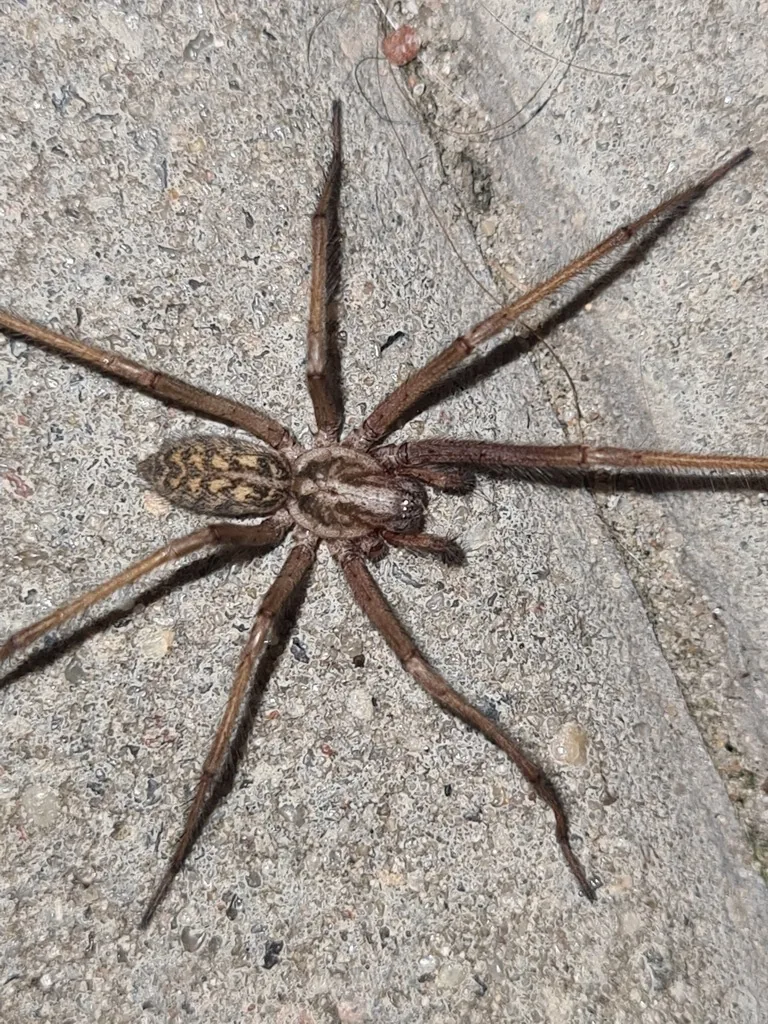
How to identify it
- A large brown to grayish-brown spider; the body is about 1/2 to 1 inch long and large adults can span up to 4 inches with their legs.[1][3]
- Legs and body are somewhat hairy and not shiny, and the abdomen often shows a more or less distinct herringbone pattern.[1][4]
- Color, size and markings vary so much that WSU Extension says none of them is reliable for identification on its own.[1]
- The eight eyes sit in two straight or slightly down-curved rows, unlike the strongly curved rows of grass spiders.[4][5]
- Males have swollen palps near the face that look like a pair of boxing gloves.[3]
- It builds a flat sheet of webbing with a funnel-shaped retreat, usually in dark spots such as garages, basements, woodpiles and gaps between bricks or stones.[1]
Look-alikes
| Look-alike | How to tell them apart |
|---|---|
| Hobo spider | Hobo spiders (Eratigena agrestis) are smaller, with leg spans of about 1 to 1 3/4 inches; under magnification their sternum lacks the paired pale spots of the giant house spider, and dark spots usually appear only on the last pair of leg bases.[4][2] |
| Grass spiders | Native grass spiders have strongly down-curved eye rows and build webs with round funnel entrances in grass and shrubs, while giant house spider funnels are oval and tucked under objects.[4] |
Where it lives
Native to Europe; in North America it is abundant west of the coastal mountains, from southern British Columbia south along the coast to southern Oregon, and in Washington it is not found east of the Cascades.[4][1]
Biology and life cycle
Males and females mature and mate in late summer and early fall. Females stay in their webs while newly mature males wander widely looking for mates.[4][1]
Egg cases are made in fall and early spring inside the web retreat; each can produce over 100 spiderlings, and the eggs hatch the next spring or early summer.[4]
Development from egg to adult takes more than a year; males usually die by early fall, while some females survive the winter.[4]
It is not a strong climber, so indoors it usually turns up on floors or stuck in sinks and bathtubs after going looking for water.[1]
In Seattle it has competitively displaced the hobo spider, and in the Puget Sound region giant house spiders now outnumber hobo spiders.[5][1]
Damage and signs
- Spiders are beneficial predators, but this one can be a nuisance indoors, especially when highly mobile males show up from mid-summer to early fall.[1]
Health risk
Not aggressive and quick to run away. Its bite is not known to pose any threat to humans; if someone is bitten, keep the spider for expert identification and consider medical care.[1][4]
Control
Prevention
Tolerate it where you can: spiders are beneficial predators, and spraying or otherwise controlling them outdoors is neither recommended nor realistic.[1]
Keep them out
Seal or screen openings, keep window and door screens tight, check door sweeps and weather stripping, and caulk gaps around pipes, wires and frames.[1]
Sanitation
Wear gloves when handling firewood, inspect each piece, and bring in only what you'll burn right away.[1]
Traps and physical control
Catch and release spiders outdoors, or remove them with a vacuum, broom or fly swatter.[1]
Glue traps placed in dark, protected corners, such as in the garage, help catch wandering spiders.[1][4]
Pesticides
Pesticides are only a temporary fix unless spiders are kept from getting in, and outdoor spraying is not usually advised.[1]
Giant house spider or hobo spider?
The two are close relatives from Europe that look alike; telling them apart reliably usually takes an expert examining the reproductive structures.[4][5]
Size helps a little: giant house spider adults span about 1 3/8 to 3 3/4 inches, while hobo spiders span about 1 to 1 3/4 inches.[4]
Location helps too. West of the coastal mountains the giant house spider is the common one, while the hobo spider is more common inland, east to Montana, Wyoming and northern Utah.[4]
Hobo spiders were once labeled dangerous, but later research has not shown them to be harmful, so a mix-up between the two is not a medical emergency.[2][5]
Common questions
- Why do I suddenly see big spiders in late summer?
- Male giant house spiders mature in late summer and wander widely looking for females, so they turn up in homes from mid-summer through early fall.[1][4]
- Is the giant house spider dangerous?
- No. It is not aggressive, usually runs away, and its bite is not known to pose a threat to humans.[1]
- Why is there a spider in my bathtub?
- Giant house spiders don't climb well and often end up trapped in sinks and tubs while searching for water.[1]
Sources
- Washington State University Extension, PestSense, “Giant house spider (PestSense fact sheet, reviewed April 25, 2025).” pestsense.cahnrs.wsu.edu/fact-sheet/giant-house-spider/ (accessed 2026-10-06)
- Washington State University Extension, PestSense, “Hobo spider (PestSense fact sheet, reviewed December 22, 2025).” pestsense.cahnrs.wsu.edu/fact-sheet/hobo-spider/ (accessed 2026-10-06)
- Washington State University Extension, “Common Spiders of Washington, EM113E.” wpcdn.web.wsu.edu/wp-ecommerce/uploads/sites/2/product-3454-sku-EM113E.pdf (accessed 2026-10-06)
- Garry Oak Ecosystems Recovery Team (fact sheet hosted by Utah State University Extension), “Tegenaria duellica and Tegenaria agrestis: Giant House and Hobo Spiders (Invasive Species in Garry Oak and Associated Ecosystems in British Columbia, February 2003).” extension.usu.edu/planthealth/uppdl/files/factsheet/InvFS_tegenaria.pdf (accessed 2026-10-06). Identification illustrations by arachnologist Robb Bennett; reprinted by the Utah Plant Pest Diagnostic Lab.
- University of California Statewide IPM Program, “Pest Notes: Hobo Spider, Publication 7488 (November 2015).” ipm.ucanr.edu/legacy_assets/PDF/PESTNOTES/pnhobospider.pdf (accessed 2026-10-06)
- iNaturalist, “Eratigena atrica taxon page (order and family).” www.inaturalist.org/taxa/1446402 (accessed 2026-10-06)