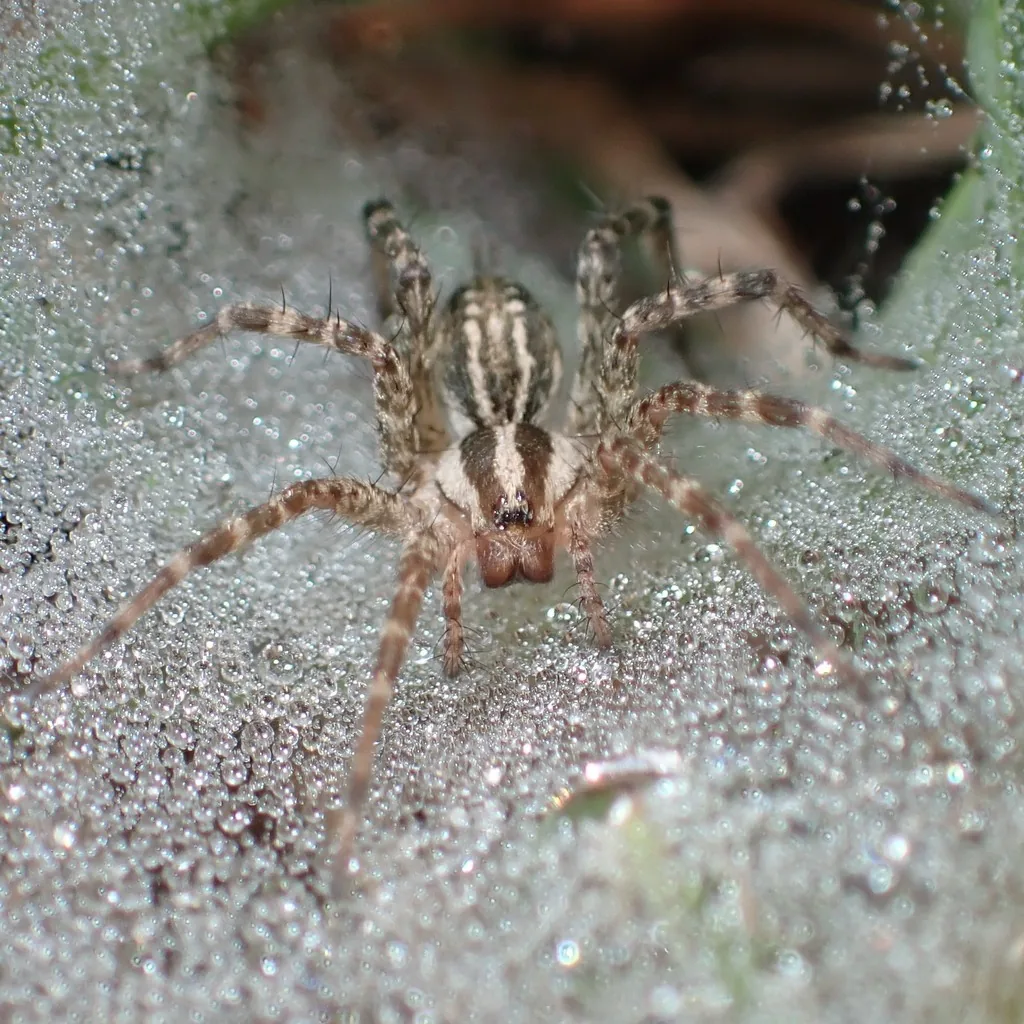
How to identify it
- The web is the best clue: a large, mostly flat, non-sticky sheet with a funnel or tunnel retreat to one side, easiest to see when covered with morning dew.[1][2][4]
- Look for two long spinnerets, finger-like silk tubes sticking out from the tip of the abdomen.[1][2]
- Females are about 3/8 to 3/4 inch long; the front body section is yellow-brown to brown with two darker lengthwise bands.[1]
- The abdomen is usually darker, with a lighter center stripe that can have scalloped edges, and the legs are often faintly banded.[1]
Look-alikes
| Look-alike | How to tell them apart |
|---|---|
| Hobo spider | Another funnel weaver of the Northwest and Intermountain West with a chevron pattern on the abdomen; many funnel weavers look alike, so have an expert confirm identification.[4][3] |
| Wolf spider | Wolf spiders look similar but hunt without webs; grass spiders sit in sheet webs and have long spinnerets at the rear.[2] |
Where it lives
Funnel weavers are widespread, with about 300 species in North America; grass spiders are very common in lawns and landscapes, including in Pennsylvania and Kentucky.[4][1][2]
Biology and life cycle
Webs are built on grass, weeds and ground covers such as ivy and pachysandra, and in fencerows, bushes and brush piles.[1]
Insects that hit the threads above the sheet fall onto it, and the spider rushes out from its funnel to grab them.[1][4]
Females lay a lens-shaped white egg sac in late summer or fall; eggs hatch in spring and spiders mature by late summer.[1]
Adults don't survive the winter, even though many wander into buildings in fall.[1]
Damage and signs
Health risk
They are fast and shy, so bites are rare. Reported bites caused pain, swelling, redness and itching for one to ten days, without serious effects.[1]
Control
Prevention
Spiders should be considered beneficial; outdoors, grass spider webs can simply be left alone.[3]
Keep them out
Seal exterior cracks and crevices, and install tight-fitting door sweeps on all exterior doors.[3]
Sanitation
Reduce hiding spots near the house, such as rocks, logs and other debris around the foundation.[3]
Traps and physical control
Vacuum spiders that come indoors, or catch them in a jar and release them outside.[3][4]
Sticky monitoring traps along walls can catch wandering spiders, especially from August to October.[3]
Common questions
- What are the funnel-shaped webs in my lawn?
- Most likely grass spider webs: flat sheets with a funnel at one side, most visible on dewy mornings.[1][2]
- Is a grass spider a hobo spider?
- Many funnel weavers look alike, and the hobo spider is found mainly in the Pacific Northwest, northern Utah, Wyoming and Colorado, so ask Extension to confirm an identification.[3][4]
Sources
- Penn State Extension, “Grass Spiders (updated September 8, 2025).” extension.psu.edu/grass-spiders (accessed 2026-10-06)
- University of Kentucky Entomology, “ENTFACT-622: Common Spiders Found Around Homes and Buildings.” entomology.mgcafe.uky.edu/ef622 (accessed 2026-10-06)
- Utah State University Extension, “Hobo and Grass Spiders (IPM for nuisance pests).” extension.usu.edu/planthealth/ipm/notes_nuisance/hobo-grass-spiders (accessed 2026-10-06)
- University of California Statewide IPM Program, “Spiders (Pest Notes, Home and Landscape).” ipm.ucanr.edu/home-and-landscape/spiders/ (accessed 2026-10-06)
- iNaturalist, “Agelenopsis taxon page (order and family).” www.inaturalist.org/taxa/82116 (accessed 2026-10-06)