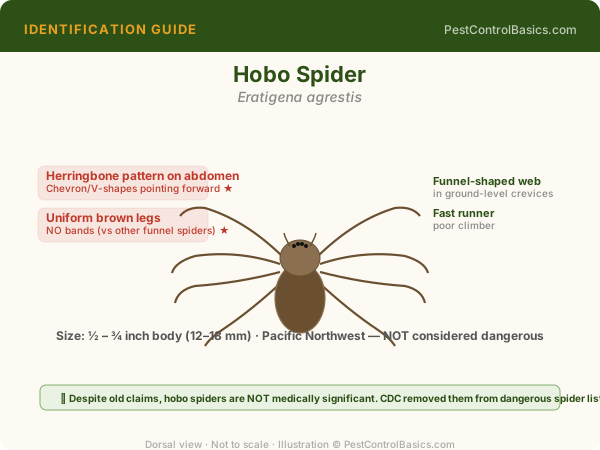
❓ Common Questions About 🕷️ Hobo Spider
How do I confirm I actually have this pest (not something similar)?
The most reliable confirmation is a physical specimen — capture one and compare to reference images on this page. For cryptic pests (bed bugs, termites), look for secondary signs: frass, shed skins, mud tubes, or bites with a specific pattern. When uncertain, a professional inspection is faster than months of misidentification.
Can I treat this myself or do I need a professional?
DIY is effective for small, accessible infestations caught early. Professionals are worth the cost when: the infestation is inside wall voids or structural elements, multiple rooms are affected, you have health-risk pests (hantavirus, venomous species), or DIY has already failed twice.
How long until the infestation is completely gone?
Expect 3–8 weeks for most infestations with proper treatment. Insects with dormant life stages (pupae, eggs) extend the timeline because those stages are impervious to most insecticides. Follow-up treatments at 2 and 4 weeks catch each new cohort as they emerge.
What's the most common mistake people make treating this pest?
Treating only the visible pest population while ignoring the harborage site, entry point, or breeding location. Killing adults provides temporary relief but the population rebuilds from hidden egg cases, pupae, or new arrivals through unaddressed entry points.
Most household spiders don't justify treatment
The majority of spiders encountered indoors — cobweb spiders, cellar spiders (daddy long-legs), funnel weavers, jumping spiders, wolf spiders — are not medically significant. They're nuisance pests at most and ecologically useful as predators of other insects. Treatment that aims at general spider control is often unnecessary and produces collateral effects on beneficial insects. The species worth specific attention in most U.S. regions are black widows and brown recluse — both can produce medically significant bites, both are reclusive and don't actively seek human contact, and both can be managed through targeted exclusion and habitat modification rather than broadcast spraying. Treatment justified by 'I don't like spiders' is reasonable as a homeowner preference but isn't an entomological necessity in most cases.
Reading pesticide labels: what most homeowners miss
The pesticide label is the most important document in any pest control decision, and it's the document most people skim. Under FIFRA (the federal law that governs pesticide registration), the label is legally binding — using a product inconsistent with its label is a violation, regardless of intent. The label has several sections that homeowners should read fully before purchase, not after: the use sites (where it can legally be applied), the target pests (some products legal indoors are not for the specific pest), the mixing rate (overdosing wastes product without improving efficacy and increases drift risk; underdosing accelerates resistance), the PPE requirements (some require respirators, not just gloves), and the re-entry interval (how long until the treated area is safe for people and pets). The signal word — Caution, Warning, Danger — indicates acute toxicity but not chronic risk; that's elsewhere on the label. Reading labels well prevents nearly every common DIY misapplication.
Exclusion and habitat reduction for spiders
Spiders enter homes seeking either food (other insects) or shelter. Reducing both reduces spider populations more durably than recurring spray. Sealing entry points — window screens in good repair, weatherstripping at door bottoms, caulking gaps in exterior walls — keeps the broader spider population outside. Indoor habitat reduction: eliminate cluttered storage areas where spiders can build undisturbed webs, vacuum corners and ceiling junctions regularly, and reduce ambient insect populations (since spiders follow their prey). Outdoor habitat that supports spider populations near the structure — stacked firewood against the house, dense ivy or shrubs on exterior walls, accumulated yard debris — can be moved or cleared. These changes are durable and reduce the need for spider-specific treatment to occasional cleanup.
Identifying medically significant spiders
Black widows (in their range) are identifiable by a shiny black body with a distinctive red hourglass on the underside of the abdomen — only adult females are medically significant. They build messy, irregular webs in undisturbed locations: woodpiles, sheds, basement corners, under outdoor furniture, in garage clutter. Brown recluse spiders (in their range, mostly south-central U.S.) have a violin-shaped marking on the back of the cephalothorax and only six eyes (most spiders have eight). They hide in undisturbed indoor areas — stored boxes, shoes left in closets, behind picture frames. Both species are non-aggressive and bite only when pressed against skin (rolled in clothing, pressed when reaching into stored items). The vast majority of suspected bites of either species are misidentifications — wound culture and physician evaluation is usually the right step rather than self-diagnosis.
How resistance develops and how to slow it down
Pesticide resistance is now common enough across major pest categories — cockroaches, bedbugs, mosquitoes, certain ant species, some flies — that treatment recommendations have shifted to account for it. Resistance develops through repeated exposure to a single active ingredient class; the surviving population reproduces, and over generations the population shifts toward resistance. Slowing resistance development requires rotating active ingredient classes (not just brands), using full label rates rather than reduced rates, and avoiding routine prophylactic spraying when it isn't needed. The EPA mode-of-action (MoA) classification on product labels helps with rotation: alternating between products in different MoA classes is more effective than alternating brand names within the same class. For homeowners, the practical translation is: don't use the same product month after month; if you're spraying regularly, rotate among at least two unrelated chemistries; and don't spray when monitoring suggests no active population.
Identifying dangerous spiders: brown recluse and black widow specifics
The two North American spider species with medically significant venom are black widow (Latrodectus species, multiple regional varieties) and brown recluse (Loxosceles reclusa, with related species in the southern U.S.). Both are commonly misidentified, leading to unnecessary alarm about harmless species and missed identification of actual specimens. Black widows are identifiable by the distinctive red hourglass on the underside of a glossy black abdomen in adult females; the body is roughly the size of a US dime including legs, and the spider is typically found in undisturbed locations like garages, sheds, basement corners, and outdoor stone walls. Brown recluse spiders have a violin-shaped dark marking on the cephalothorax, six eyes arranged in three pairs (most spiders have eight), uniform light brown coloration without complex patterns, and are found in undisturbed indoor areas particularly in the south-central states; many spider species are mistakenly identified as brown recluse. Photograph any candidate specimen before destroying it; local extension offices and online identification forums can confirm or deny identity quickly, which matters because medical management of confirmed bites differs from the wait-and-see approach appropriate for most spider bites.
The role of caulk, sealant, and exclusion in long-term pest control
Sealing entry points is the most underrated pest control activity in residential settings, partly because it produces no immediate visible result and partly because it feels like home repair rather than pest control. The yield is substantial: a thoroughly sealed structure with appropriate exterior caulking, intact weatherstripping, sealed utility penetrations, and screen integrity has dramatically lower pest pressure than the same structure without those interventions. Specific high-yield targets include gaps around dryer vents, electrical and plumbing penetrations through exterior walls, gaps where siding meets foundation, mortar joints in older brick, weep holes in newer brick (which should be screened, not sealed), garage door bottom seals (where rodents commonly enter), and the gap above door thresholds where many ants and small insects pass. Materials matter: silicone-based caulk for moisture areas, polyurethane sealant for foundation cracks, copper mesh for rodent exclusion at utility penetrations (steel wool degrades), and 1/4-inch hardware cloth for larger openings. A weekend of methodical sealing in spring or fall — when activity is moderate and weather permits exterior work — produces lasting reduction that no single treatment matches.
Spider control without insecticide: physical exclusion that works
Spider populations in homes respond strongly to non-chemical interventions, and many homeowners find that targeted physical exclusion produces better results than chemical treatment. The high-yield interventions: vacuum existing webs and visible spiders weekly during peak season (typically late summer to fall, when spiders are most visible), which both removes individuals and disrupts the conditions that support web maintenance; reduce exterior lighting or convert to yellow 'bug light' bulbs (which attract fewer insects, reducing the food supply that draws spiders); seal gaps around windows, doors, and utility penetrations with appropriate weatherstripping and caulk; trim vegetation away from the structure to eliminate access bridges; declutter basements, garages, and storage areas to reduce harborage. These interventions address the underlying drivers of spider populations — insect prey availability and harborage availability — rather than just killing individuals, producing more durable reduction. Chemical treatment of spiders is generally less effective than against most insects because spiders walk on relatively few surfaces (mostly the points where they anchor webs) and don't pick up residue from broad-coverage applications.
Webbing identification: reading what spider activity looks like
Spider webbing varies by species in ways that are diagnostically useful when inspecting a property. Funnel weavers produce dense, sheet-like webs in corners and against walls, with a tunnel retreat at one end where the spider waits. Cellar spiders produce loose, irregular webs in protected corners of basements, garages, and ceilings, and individuals often hang inverted from the web. Cobweb spiders, including black widows, produce tangled, irregular webs in concealed locations — wood piles, garden sheds, outdoor furniture undersides, basement corners — and the web structure is messy by design rather than from neglect. Orb weavers produce the familiar circular webs in vegetation and open spaces, typically outdoors. Reading the webbing in an inspection tells you which species are present without necessarily seeing the spiders themselves, which is useful both for risk assessment (only a few species are medically significant in residential settings) and for treatment planning (different species respond to different control approaches). The presence of abandoned webbing also indicates historical activity that may have shifted to a different microhabitat, which can direct subsequent inspection effort more productively than treating each visible web as a separate problem.
Why product instructions are often suboptimal in practice
Pesticide labels are legal documents written to satisfy regulatory requirements, not field guides written to maximize success in a specific home. The instructions cover the broadest reasonable use case, which means they're rarely tuned for the specific construction type, climate, or pest pressure you're dealing with. A label might call for application every six weeks because that's what the registration data supports across a wide range of conditions, but the actual reapplication interval that matches the residual life of the active ingredient in your specific application context could be shorter or longer. This is not an invitation to ignore label directions — doing so is illegal and frequently dangerous — but it does mean that following the label is the floor, not the ceiling, of good practice. Knowledgeable users overlay the label with conditions-aware judgment: shorter re-treatment intervals during heavy rain or high humidity, denser application in known harborage, and supplementary monitoring after treatment to verify that the work actually performed as expected. The label tells you what's permitted; experience tells you what's optimal within that envelope.
Brown recluse harborage: the specific places to look
Brown recluse spiders inhabit a specific range of microhabitats that are worth knowing if you live in their native range — broadly, the central and southern United States. They prefer undisturbed, dry, dark locations: behind boxes in storage rooms, in stored clothing and linens, in shoes that haven't been worn, inside cardboard boxes in attics and basements, behind picture frames on infrequently-used walls, in seldom-opened cabinets, and inside infrequently-moved furniture. They actively avoid disturbed areas, which is why properties with regular human traffic in storage spaces have lower recluse populations than properties where storage areas are left undisturbed for months at a time. The practical implications for management are specific: rotating storage so nothing sits untouched for long periods, sealing stored clothing in plastic bins rather than cardboard boxes, shaking out shoes that have been stored, and using glue boards in known harborage locations to monitor population levels. Sprays are largely ineffective for recluse populations because the spiders don't traverse open treated surfaces; they're effective only when applied directly to harborage. Most successful recluse management programs are exclusion and inspection programs with insecticide as a minor component, not the other way around.