HomePest LibraryBlack Widow Spider
⚠ Venomous — Medical Risk

Black Widow Spider

Latrodectus mactans, L. hesperus, L. variolus

The most venomous spider in North America by toxicity — but rarely fatal with modern medical care. The red hourglass marking on the underside of the abdomen is the definitive ID. Found in every U.S. state. Knows exactly where to hide — and there's a strategy to find and eliminate them.

Venom Toxicity15× more toxic than rattlesnake
U.S. Fatalities/YearRare — <1 with treatment
U.S. RangeAll 48 contiguous states
Best ControlCimeXa desiccant dust
Black Widow — Quick ID
BodyShiny black, globe-shaped abdomen
Size1.5 inches legspan (female)
MarkingRed/orange hourglass — underside only
Web typeMessy, irregular, low to ground
MaleSmaller, tan/brown — not dangerous
EggsPapery tan sac — 200–400 eggs
Active whenNight; hides during day
Bites humans?When disturbed in harborage
📐 FIELD GUIDE ILLUSTRATION
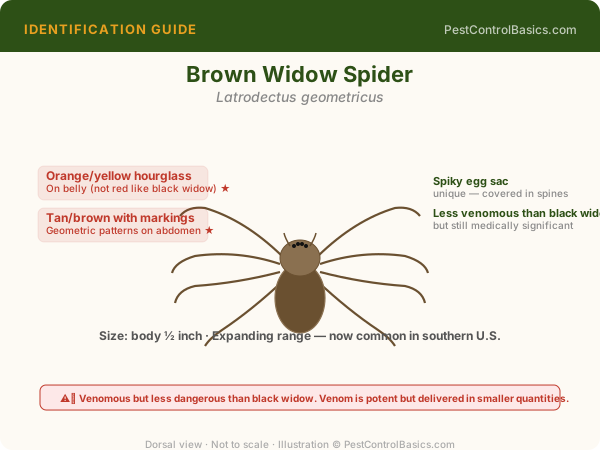
Brown Widow (Latrodectus geometricus) identification illustration with labeled anatomical features — PestControlBasics.com

Original illustration by PestControlBasics.com. Use anatomical labels above to confirm your identification.

Identification

DG
Derek Giordano
Certified Pest Control Operator · Former Business Owner
Derek ran his own pest control company in Florida for several years, servicing thousands of regular customers. All content is based on hands-on field experience and current EPA & university extension guidelines.
⚠ Don't Rely on Color Alone

Juvenile black widows and males have different coloration — tan, brown, or gray with various markings. Only adult females have the classic shiny black + red hourglass appearance. If you find a tan or brown spider in a black widow habitat, don't assume it's harmless — treat any spider in a protected, ground-level web location with appropriate caution.

The Three U.S. Black Widow Species

Southern Black Widow
Latrodectus mactans
Classic complete hourglass. Southeast and south-central U.S. Most common species in human-associated habitats — outhouses, garages, barns.
Western Black Widow
Latrodectus hesperus
Complete or broken hourglass. West Coast, Southwest, western plains. The species responsible for most western U.S. envenomations.
Northern Black Widow
Latrodectus variolus
Broken hourglass — two separate red spots. Northeast and upper Midwest. Row of red spots along top of abdomen. Less common in homes than southern species.
Brown Widow
Latrodectus geometricus
Not black — tan/brown with orange hourglass. Spiky tan egg sacs are the key ID. Florida and Southeast. Less venomous than black widow but medically significant.
Habitat

Where black widows live — and why bites happen

Black widows are not aggressive — they bite defensively when pressed against skin in their harborage. Understanding where they hide explains when bites happen and how to prevent them.

🚗
Garages & Carports
Under shelves, behind stored items, inside old boxes. Among the most common black widow habitats in the U.S.
🪓
Woodpiles & Lumber
Inside stacked firewood — wear gloves when handling firewood. Check before grabbing.
🏠
Outbuildings & Sheds
Dark, dry, undisturbed corners. Under workbenches. In tool handles and protective gear stored long-term.
🌿
Garden & Yard
Under rocks, landscape timber, patio furniture bases, and low deck boards. Avoid bare hand contact in these areas.
🪟
Crawlspaces
Dark, low-humidity crawlspaces. Common throughout the foundation perimeter. CimeXa dust is ideal here.
🔧
Utility Meters & Boxes
Outdoor utility boxes are prime black widow habitat — dark, rarely disturbed. Tap the cover before opening.
💡 Most Bites Are Preventable

The vast majority of black widow bites occur when someone reaches into a dark space without looking — grabbing firewood, putting on shoes or gloves left outdoors, or reaching under a shelf. Simple habit changes prevent nearly all bites: shake out gloves and shoes before wearing, use a flashlight before reaching into dark spaces, and wear leather gloves for outdoor work around potential habitats.

Venom & First Aid

What happens after a black widow bite

Black widow venom is a neurotoxin (alpha-latrotoxin) that causes massive release of neurotransmitters, leading to continuous muscle contractions. This produces the hallmark symptom complex called latrodectism.

Initial bite: Often described as a pinprick — may be painless initially. Two small fang marks may be visible. The bite site may become slightly red and swollen.

30–60 minutes later: Muscle cramps and pain begin, often starting at the bite site and spreading. The classic symptom is severe abdominal rigidity and cramping — often misdiagnosed as appendicitis.

Full syndrome (1–3 hours): Severe muscle pain (especially back, chest, abdomen), sweating, nausea, headache, increased blood pressure, and anxiety. Symptoms peak at 8–12 hours.

Who is most at risk: Children, elderly, and people with heart conditions face the highest risk of serious complications. Healthy adults rarely experience life-threatening effects — fatalities are extremely rare with modern medical care.

📞 Seek Medical Care for Any Confirmed Black Widow Bite

Even if symptoms are mild initially, go to an emergency room or call Poison Control (1-800-222-1222). Antivenom (Antivenin Latrodectus mactans) is available and effective. Pain management with opioids or benzodiazepines is often needed. Do not apply ice, cut the bite, or try to suck out venom — these do not help and can cause additional harm.

Control

How to eliminate black widows effectively

Why sprays fail: Spiders are not insects. They don't groom themselves the way insects do, so they don't pick up residual insecticide from treated surfaces. A spider can walk across a freshly sprayed surface and be unaffected. Contact kill requires a direct hit on the spider.

CimeXa desiccant dust — the right tool: CimeXa (amorphous engineered silica) works physically rather than chemically. It damages the spider's cuticle and causes dehydration and death within 24 hours of contact. Spiders cannot avoid this or develop resistance. Apply with a puffer bulb to cracks, under shelves, into wall voids, along baseboards in garages, and in crawlspaces. One application lasts months.

Physical removal: In areas you can see clearly, a vacuum cleaner with extension nozzle is extremely effective — immediately sucks up spider and web. Empty the canister into an outdoor trash bag immediately.

Glue board traps: Placed along garage walls and in crawlspace corners catch and confirm black widow activity. Monitor weekly.

Habitat reduction: Move firewood away from the structure. Clear clutter and stored items from garage floors — anything that creates dark, protected ground-level harborage. Seal gaps that allow black widow access to living areas.

✓ The CimeXa Application Protocol

Apply CimeXa as a thin, even dust layer — not a thick pile. Use a puffer or Pest Pistol duster to blow dust into: wall voids through outlet boxes, under garage shelving, in crawlspace corners, under patio furniture, and in any dark gap at ground level. A light application that settles into a fine coating on surfaces is far more effective than a heavy deposit. Wear a dust mask during application.

Not sure? AI Bug ID → Find a Pro →
🧪 Recommended Treatment Products
Bifenthrin Deltamethrin Diatomaceous Earth Peppermint Oil Formulation Guide
Full product guides with mixing rates and safety info. → Browse All 130 Pesticide Guides

Related Resources

📚 Full Pest Library🧪 DIY vs. Pro Quiz💰 Cost Guide🌿 IPM Guide🔍 Find a Pro
🔗 Related Pests
Spiders Wolf Spider Hobo Spider Cellar Spider Jumping Spider
Compare similar pests to confirm your identification. → Use our ID Flowchart
🔮
Reviewed by Derek GiordanoContent on PestControlBasics.com is developed with input from certified pest management professionals and cross-referenced against EPA, CDC, and university extension guidance. Last reviewed: April 2026.
📚 Sources: EPA Termite Guide · NPMA Termite Info
Published: Jan 1, 2025 · Updated: Apr 7, 2026

Brown recluse and black widow: identification and risk reduction

The two medically-significant spider species in much of the U.S. — brown recluse (Loxosceles reclusa) and black widow (Latrodectus species) — have specific identification features and risk profiles worth knowing. Brown recluse: small (under 1/2 inch body length), uniform tan to brown color, characteristic dark violin-shaped mark on the cephalothorax, six eyes arranged in three pairs (most spiders have eight), prefers dark undisturbed harborage (closets, basements, garage corners, behind stored items). Range is limited to the south-central U.S.; reports outside the established range are usually misidentified. Black widow: females glossy black with red hourglass marking on the underside of the abdomen, builds messy irregular webs in protected locations (woodpiles, sheds, outdoor furniture). Risk reduction for both: reducing harborage clutter, wearing gloves when handling stored items, shaking out shoes and clothing left in unused areas, and routine inspection of areas where these spiders prefer to live. Bites should be evaluated medically; both species have specific treatment considerations beyond standard first aid.

Pest pressure as a property value signal — and how to address it before listing

Pest issues directly affect property valuation in several documented ways: termite damage is a standard inspection finding that can derail closings or require significant credits; rodent activity in attics and crawlspaces flags during inspections and creates buyer concerns about hidden damage; visible cockroach or bedbug activity raises the question of what else has been neglected. Sellers who address pest issues before listing — ideally with documentation of treatment and a clean follow-up inspection — preserve more value than those who try to negotiate around buyer-discovered issues. The investment is typically modest relative to the price impact: a pre-listing inspection by a licensed pest control company runs a few hundred dollars in most markets, and resolving common findings (rodent exclusion, ant treatment, wasp nest removal) is rarely a significant expense. The value preservation comes from removing inspection findings as negotiation leverage, not from any single repair.

Identifying dangerous spiders: brown recluse and black widow specifics

The two North American spider species with medically significant venom are black widow (Latrodectus species, multiple regional varieties) and brown recluse (Loxosceles reclusa, with related species in the southern U.S.). Both are commonly misidentified, leading to unnecessary alarm about harmless species and missed identification of actual specimens. Black widows are identifiable by the distinctive red hourglass on the underside of a glossy black abdomen in adult females; the body is roughly the size of a US dime including legs, and the spider is typically found in undisturbed locations like garages, sheds, basement corners, and outdoor stone walls. Brown recluse spiders have a violin-shaped dark marking on the cephalothorax, six eyes arranged in three pairs (most spiders have eight), uniform light brown coloration without complex patterns, and are found in undisturbed indoor areas particularly in the south-central states; many spider species are mistakenly identified as brown recluse. Photograph any candidate specimen before destroying it; local extension offices and online identification forums can confirm or deny identity quickly, which matters because medical management of confirmed bites differs from the wait-and-see approach appropriate for most spider bites.

The role of caulk, sealant, and exclusion in long-term pest control

Sealing entry points is the most underrated pest control activity in residential settings, partly because it produces no immediate visible result and partly because it feels like home repair rather than pest control. The yield is substantial: a thoroughly sealed structure with appropriate exterior caulking, intact weatherstripping, sealed utility penetrations, and screen integrity has dramatically lower pest pressure than the same structure without those interventions. Specific high-yield targets include gaps around dryer vents, electrical and plumbing penetrations through exterior walls, gaps where siding meets foundation, mortar joints in older brick, weep holes in newer brick (which should be screened, not sealed), garage door bottom seals (where rodents commonly enter), and the gap above door thresholds where many ants and small insects pass. Materials matter: silicone-based caulk for moisture areas, polyurethane sealant for foundation cracks, copper mesh for rodent exclusion at utility penetrations (steel wool degrades), and 1/4-inch hardware cloth for larger openings. A weekend of methodical sealing in spring or fall — when activity is moderate and weather permits exterior work — produces lasting reduction that no single treatment matches.

Spider control without insecticide: physical exclusion that works

Spider populations in homes respond strongly to non-chemical interventions, and many homeowners find that targeted physical exclusion produces better results than chemical treatment. The high-yield interventions: vacuum existing webs and visible spiders weekly during peak season (typically late summer to fall, when spiders are most visible), which both removes individuals and disrupts the conditions that support web maintenance; reduce exterior lighting or convert to yellow 'bug light' bulbs (which attract fewer insects, reducing the food supply that draws spiders); seal gaps around windows, doors, and utility penetrations with appropriate weatherstripping and caulk; trim vegetation away from the structure to eliminate access bridges; declutter basements, garages, and storage areas to reduce harborage. These interventions address the underlying drivers of spider populations — insect prey availability and harborage availability — rather than just killing individuals, producing more durable reduction. Chemical treatment of spiders is generally less effective than against most insects because spiders walk on relatively few surfaces (mostly the points where they anchor webs) and don't pick up residue from broad-coverage applications.

Brown recluse harborage: the specific places to look

Brown recluse spiders inhabit a specific range of microhabitats that are worth knowing if you live in their native range — broadly, the central and southern United States. They prefer undisturbed, dry, dark locations: behind boxes in storage rooms, in stored clothing and linens, in shoes that haven't been worn, inside cardboard boxes in attics and basements, behind picture frames on infrequently-used walls, in seldom-opened cabinets, and inside infrequently-moved furniture. They actively avoid disturbed areas, which is why properties with regular human traffic in storage spaces have lower recluse populations than properties where storage areas are left undisturbed for months at a time. The practical implications for management are specific: rotating storage so nothing sits untouched for long periods, sealing stored clothing in plastic bins rather than cardboard boxes, shaking out shoes that have been stored, and using glue boards in known harborage locations to monitor population levels. Sprays are largely ineffective for recluse populations because the spiders don't traverse open treated surfaces; they're effective only when applied directly to harborage. Most successful recluse management programs are exclusion and inspection programs with insecticide as a minor component, not the other way around.

The role of inspection in long-term cost reduction

An inspection is the cheapest tool in pest management, and homeowners systematically underspend on it. The economics are unambiguous: an annual or semiannual inspection costs a small fraction of what any moderate treatment costs, and it catches problems while they're still cheap to address. Termite damage detected in its first season requires perimeter treatment; the same damage discovered three years later may require structural repairs running into five figures. Rodent activity detected through droppings before nesting establishes requires sealing and a few traps; the same activity discovered after a multi-generation infestation has set up in wall voids requires removal, exclusion, sanitation, and sometimes drywall work. The pattern repeats across nearly every pest category. Even households that don't engage a regular pest service should treat the annual inspection as a baseline expense — equivalent to the way they probably treat HVAC tune-ups, gutter cleaning, or smoke detector battery changes. The marginal cost of one trained set of eyes on the property each year is one of the most defensible expenses in home maintenance.

Webbing identification: reading what spider activity looks like

Spider webbing varies by species in ways that are diagnostically useful when inspecting a property. Funnel weavers produce dense, sheet-like webs in corners and against walls, with a tunnel retreat at one end where the spider waits. Cellar spiders produce loose, irregular webs in protected corners of basements, garages, and ceilings, and individuals often hang inverted from the web. Cobweb spiders, including black widows, produce tangled, irregular webs in concealed locations — wood piles, garden sheds, outdoor furniture undersides, basement corners — and the web structure is messy by design rather than from neglect. Orb weavers produce the familiar circular webs in vegetation and open spaces, typically outdoors. Reading the webbing in an inspection tells you which species are present without necessarily seeing the spiders themselves, which is useful both for risk assessment (only a few species are medically significant in residential settings) and for treatment planning (different species respond to different control approaches). The presence of abandoned webbing also indicates historical activity that may have shifted to a different microhabitat, which can direct subsequent inspection effort more productively than treating each visible web as a separate problem.

🗺️ US Distribution — Black Widow Spider

image/svg+xml
Common Occasional Not Present
States Present
19
Occasional
11
Primary Region
Southern & Western US
📊 Source: University extension services, USDA, CDC vector data, and published entomological surveys.