❓ Common Questions About 🕷️ Jumping Spider
How do I confirm I actually have this pest (not something similar)?
The most reliable confirmation is a physical specimen — capture one and compare to reference images on this page. For cryptic pests (bed bugs, termites), look for secondary signs: frass, shed skins, mud tubes, or bites with a specific pattern. When uncertain, a professional inspection is faster than months of misidentification.
Can I treat this myself or do I need a professional?
DIY is effective for small, accessible infestations caught early. Professionals are worth the cost when: the infestation is inside wall voids or structural elements, multiple rooms are affected, you have health-risk pests (hantavirus, venomous species), or DIY has already failed twice.
How long until the infestation is completely gone?
Expect 3–8 weeks for most infestations with proper treatment. Insects with dormant life stages (pupae, eggs) extend the timeline because those stages are impervious to most insecticides. Follow-up treatments at 2 and 4 weeks catch each new cohort as they emerge.
What's the most common mistake people make treating this pest?
Treating only the visible pest population while ignoring the harborage site, entry point, or breeding location. Killing adults provides temporary relief but the population rebuilds from hidden egg cases, pupae, or new arrivals through unaddressed entry points.
Identifying medically significant spiders
Black widows (in their range) are identifiable by a shiny black body with a distinctive red hourglass on the underside of the abdomen — only adult females are medically significant. They build messy, irregular webs in undisturbed locations: woodpiles, sheds, basement corners, under outdoor furniture, in garage clutter. Brown recluse spiders (in their range, mostly south-central U.S.) have a violin-shaped marking on the back of the cephalothorax and only six eyes (most spiders have eight). They hide in undisturbed indoor areas — stored boxes, shoes left in closets, behind picture frames. Both species are non-aggressive and bite only when pressed against skin (rolled in clothing, pressed when reaching into stored items). The vast majority of suspected bites of either species are misidentifications — wound culture and physician evaluation is usually the right step rather than self-diagnosis.
Common DIY mistakes that defeat otherwise correct treatments
Most DIY pest control failures aren't product failures — they're application failures. The recurring patterns we see across reader emails and field experience: treating only where pests are visible rather than where they live (the active surface is rarely the harborage), spraying repellents over residual products and breaking the residual film, applying baits in already-treated areas (the residual kills foragers before they return with bait), overdiluting product because 'less chemical is safer' (it's not — it accelerates resistance), expecting overnight results when the kill curve is two to four weeks for most products, and stopping treatment at the first sign of improvement rather than completing the protocol. Each of these failure modes is independently preventable with attention to the product label and the pest's biology, and avoiding them improves outcomes more than upgrading to a more expensive product.
Most household spiders don't justify treatment
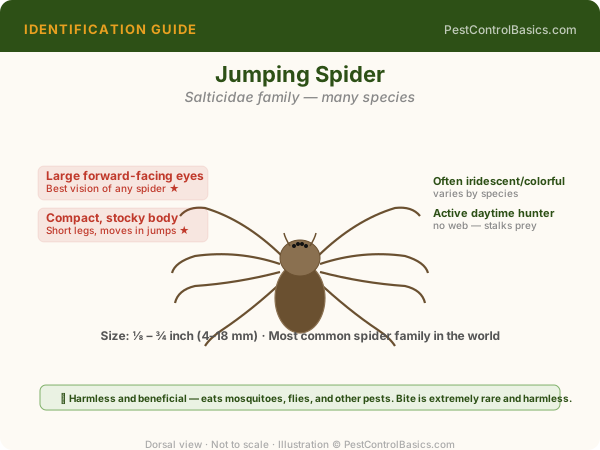
The majority of spiders encountered indoors — cobweb spiders, cellar spiders (daddy long-legs), funnel weavers, jumping spiders, wolf spiders — are not medically significant. They're nuisance pests at most and ecologically useful as predators of other insects. Treatment that aims at general spider control is often unnecessary and produces collateral effects on beneficial insects. The species worth specific attention in most U.S. regions are black widows and brown recluse — both can produce medically significant bites, both are reclusive and don't actively seek human contact, and both can be managed through targeted exclusion and habitat modification rather than broadcast spraying. Treatment justified by 'I don't like spiders' is reasonable as a homeowner preference but isn't an entomological necessity in most cases.
Treatment options for spider hotspots
Where spider populations are concentrated in specific areas and need active reduction, residual pyrethroids (bifenthrin, lambda-cyhalothrin, deltamethrin) applied to harborage areas — corners, eaves, behind shutters, in garage perimeters — provide several weeks of residual. Spider control sprays at retail often use the same actives at similar rates. For garage and shed environments where black widows are a concern, a residual treatment applied at the start of warm season and refreshed mid-season meaningfully reduces population through fall. Direct contact treatment of webs and visible spiders works but doesn't address the broader population. Knockdown aerosols are appropriate for individual spider removal but don't provide ongoing protection.
Exclusion: the single highest-leverage long-term pest control investment
Across virtually every common household pest, exclusion — physically preventing entry — is more cost-effective long-term than recurring treatment. The exclusion targets vary by pest but the principle is consistent: pests don't enter homes randomly, they enter through specific access points, and closing those access points produces durable results. For rodents, gaps larger than 1/4 inch (mice) or 1/2 inch (rats) at the foundation, around utility penetrations, dryer vents, and roof returns are the standard entry points. For occasional invaders (stink bugs, lady beetles, boxelder bugs), window screens and weatherstripping around doors handle most entry. For ants and crawling insects, the foundation seam, threshold gaps, and weep holes in brick veneer are the recurring weak points. A weekend exclusion audit — flashlight, caulk, hardware cloth, expanding foam — produces returns measured in years of reduced treatment costs.
Spider control without insecticide: physical exclusion that works
Spider populations in homes respond strongly to non-chemical interventions, and many homeowners find that targeted physical exclusion produces better results than chemical treatment. The high-yield interventions: vacuum existing webs and visible spiders weekly during peak season (typically late summer to fall, when spiders are most visible), which both removes individuals and disrupts the conditions that support web maintenance; reduce exterior lighting or convert to yellow 'bug light' bulbs (which attract fewer insects, reducing the food supply that draws spiders); seal gaps around windows, doors, and utility penetrations with appropriate weatherstripping and caulk; trim vegetation away from the structure to eliminate access bridges; declutter basements, garages, and storage areas to reduce harborage. These interventions address the underlying drivers of spider populations — insect prey availability and harborage availability — rather than just killing individuals, producing more durable reduction. Chemical treatment of spiders is generally less effective than against most insects because spiders walk on relatively few surfaces (mostly the points where they anchor webs) and don't pick up residue from broad-coverage applications.
How structural moisture issues drive pest problems most homeowners miss
A surprising fraction of pest problems are downstream of moisture issues that go uncorrected because they don't produce obvious damage. Subterranean termites require moist soil contact; correcting drainage and downspouts often reduces termite pressure more than any chemical treatment. Carpenter ants nest in damp or previously-damp wood; the colony moves in only after moisture has softened the substrate. Drain flies, fungus gnats, and springtails are all moisture-driven and resolve when the moisture source resolves. Mold mites and booklice indicate humidity that exceeds about 70%, often in unventilated bathrooms or basements. Even rodent activity correlates with moisture: rodents need accessible water and follow water-supply intrusions to bring themselves into structures. The diagnostic question worth asking on any chronic pest problem: is something wet that shouldn't be? Common offenders are clogged gutters, downspouts that drain near the foundation rather than away from it, condensate lines from HVAC systems and water heaters, slow plumbing leaks under sinks, sweating cold-water pipes in unconditioned spaces, and crawlspaces without adequate vapor barriers. Fixing the underlying moisture issue typically yields permanent improvement that chemical treatment alone cannot match.
Identifying dangerous spiders: brown recluse and black widow specifics
The two North American spider species with medically significant venom are black widow (Latrodectus species, multiple regional varieties) and brown recluse (Loxosceles reclusa, with related species in the southern U.S.). Both are commonly misidentified, leading to unnecessary alarm about harmless species and missed identification of actual specimens. Black widows are identifiable by the distinctive red hourglass on the underside of a glossy black abdomen in adult females; the body is roughly the size of a US dime including legs, and the spider is typically found in undisturbed locations like garages, sheds, basement corners, and outdoor stone walls. Brown recluse spiders have a violin-shaped dark marking on the cephalothorax, six eyes arranged in three pairs (most spiders have eight), uniform light brown coloration without complex patterns, and are found in undisturbed indoor areas particularly in the south-central states; many spider species are mistakenly identified as brown recluse. Photograph any candidate specimen before destroying it; local extension offices and online identification forums can confirm or deny identity quickly, which matters because medical management of confirmed bites differs from the wait-and-see approach appropriate for most spider bites.
Brown recluse harborage: the specific places to look
Brown recluse spiders inhabit a specific range of microhabitats that are worth knowing if you live in their native range — broadly, the central and southern United States. They prefer undisturbed, dry, dark locations: behind boxes in storage rooms, in stored clothing and linens, in shoes that haven't been worn, inside cardboard boxes in attics and basements, behind picture frames on infrequently-used walls, in seldom-opened cabinets, and inside infrequently-moved furniture. They actively avoid disturbed areas, which is why properties with regular human traffic in storage spaces have lower recluse populations than properties where storage areas are left undisturbed for months at a time. The practical implications for management are specific: rotating storage so nothing sits untouched for long periods, sealing stored clothing in plastic bins rather than cardboard boxes, shaking out shoes that have been stored, and using glue boards in known harborage locations to monitor population levels. Sprays are largely ineffective for recluse populations because the spiders don't traverse open treated surfaces; they're effective only when applied directly to harborage. Most successful recluse management programs are exclusion and inspection programs with insecticide as a minor component, not the other way around.
Pest control warranties: reading the fine print before signing
Pest control warranties are not standardized, and the differences between contracts that look superficially similar can be enormous. Termite warranties in particular vary across at least three significant dimensions: whether they cover retreatment only or also include damage repair, whether the damage coverage is capped or unlimited, and whether the warranty is transferable to subsequent owners. A retreatment-only warranty on a property with significant termite pressure is much weaker than a damage-inclusive warranty, and the difference matters most precisely in the situations where the warranty is most likely to be needed. General pest control service agreements often have similar gradations — some include unlimited callbacks during the service period, some include a fixed number, and some charge for any visit outside the regular schedule. Before signing, the question to ask is not whether the contract has a warranty, but exactly what the warranty covers, what triggers a callback at no charge, and what the renewal terms are. Companies rarely volunteer this clearly; reading the document carefully and asking specific questions is on the homeowner.
Webbing identification: reading what spider activity looks like
Spider webbing varies by species in ways that are diagnostically useful when inspecting a property. Funnel weavers produce dense, sheet-like webs in corners and against walls, with a tunnel retreat at one end where the spider waits. Cellar spiders produce loose, irregular webs in protected corners of basements, garages, and ceilings, and individuals often hang inverted from the web. Cobweb spiders, including black widows, produce tangled, irregular webs in concealed locations — wood piles, garden sheds, outdoor furniture undersides, basement corners — and the web structure is messy by design rather than from neglect. Orb weavers produce the familiar circular webs in vegetation and open spaces, typically outdoors. Reading the webbing in an inspection tells you which species are present without necessarily seeing the spiders themselves, which is useful both for risk assessment (only a few species are medically significant in residential settings) and for treatment planning (different species respond to different control approaches). The presence of abandoned webbing also indicates historical activity that may have shifted to a different microhabitat, which can direct subsequent inspection effort more productively than treating each visible web as a separate problem.