How to identify it
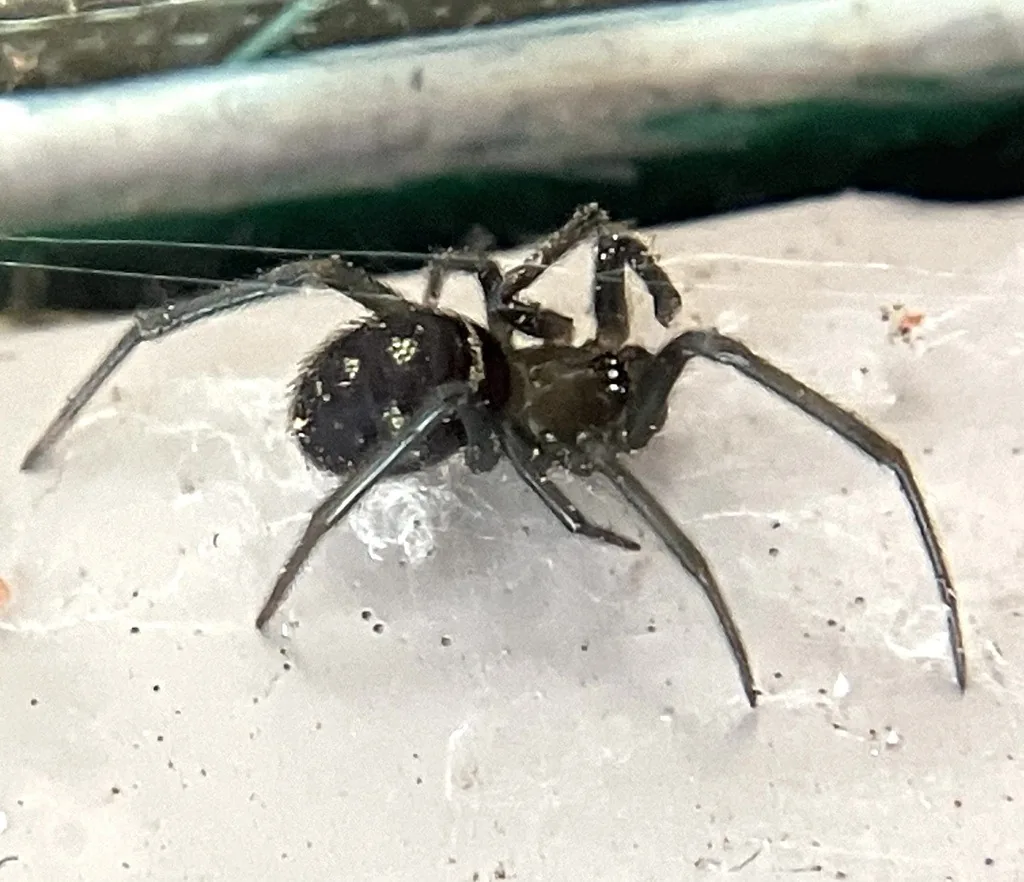
- The false black widow female is about 1/4 to 3/8 inch long, with a rounded abdomen like a black widow's but more oval.[2][1]
- Its abdomen is chocolate brown to purplish black, often with faint pale yellow or grayish markings, and it never has red markings on the belly.[1][2]
- The triangulate cobweb spider is smaller, about 3/16 inch, with a brown abdomen marked by white and yellow roughly triangular spots and yellow legs.[4]
- Like black widows, they hang upside down in tangled, irregular cobwebs.[3][4]
Look-alikes
| Look-alike | How to tell them apart |
|---|---|
| Black widow | Shiny jet black with a red hourglass under the abdomen; the false black widow is brown and never has red coloring.[1] |
| Western black widow | Lives mostly outdoors and in garages, while the false black widow thrives inside homes; false widow spiderlings are dark like their mothers.[1] |
| Brown widow | A mottled tan, brown and gray widow with a distinctive spiky egg sac; false widow egg sacs look like fluffy cotton balls.[1] |
Where it lives
Eight Steatoda species occur in the U.S. The false black widow is found along the Atlantic, Gulf and Pacific coasts and is extremely common in Pacific Coast homes; the triangulate cobweb spider is common in Colorado homes.[2][1][4]
Biology and life cycle
False black widows mate in spring, and females can make three or more egg sacs from May through July, each holding 200 or more eggs.[2]
Females have been reported to live up to six years, while males die soon after mating.[2]
Indoors they favor bathrooms, cupboards and spaces under appliances, furniture and cabinets, and all life stages can be found year-round.[1][2]
They prey on insects and other spiders, including true black widows.[2][4]
Damage and signs
- No damage to structures; the main problem is cobwebs in corners, basements and outbuildings.[4]
Health risk
Bites are mild compared with a black widow's: burning pain and minor local swelling, like a yellowjacket sting, sometimes with nausea or headache lasting up to about 60 hours.[1][2]
Control
Keep them out
Seal cracks and gaps around entrances and foundations, install door sweeps, and move woodpiles, rock piles and brush away from the house.[3][1]
Sanitation
Reduce clutter and keep stored items in sealed boxes off the floor and away from walls; wear gloves when cleaning storage areas.[1][3]
Traps and physical control
Regularly vacuum or sweep spiders and webs from corners, windows and storage areas; their soft bodies usually don't survive vacuuming.[1][3]
Sticky traps in crawl spaces, bathrooms and basements can catch wandering spiders.[3]
Pesticides
Pyrethroid sprays around entry points are a last resort for large numbers; insecticides don't give long-term control, and bug bombs aren't effective.[3][1]
Common questions
- Is a false widow spider dangerous?
- Not usually. Its venom is mild, and a bite typically feels like a wasp sting with some local swelling.[1][2]
- How can I tell a false widow from a black widow?
- Check the color and belly: false widows are brown to purplish with pale markings and no red, while black widows are glossy black with a red hourglass.[1][2]
Sources
- University of California Statewide IPM Program, “Widow Spiders and Their Relatives (Pest Notes, Home and Landscape).” ipm.ucanr.edu/home-and-landscape/widow-spiders-and-their-relatives/ (accessed 2026-10-06)
- Penn State Extension, “False Black Widow Spider (updated September 8, 2025).” extension.psu.edu/false-black-widow-spider (accessed 2026-10-06)
- Montana State University Extension, Schutter Diagnostic Lab, “Cobweb Weavers and False Widows (Steatoda spp.), November 2022.” www.montana.edu/extension/ipm/entomology/resources/fact-sheets/cob-web-weavers.html (accessed 2026-10-06)
- Colorado State University, Department of Agricultural Biology, “Triangulate Cobweb Spider (Colorado Arthropod of Interest).” webdoc.agsci.colostate.edu/bspm/InsectInformation/FactSheets/TriCobweb.pdf (accessed 2026-10-06)
- iNaturalist, “Steatoda grossa taxon page (order and family).” www.inaturalist.org/taxa/61997 (accessed 2026-10-06)