The short answer
- Most garden spiders are beneficial. They eat insects, most can't harm people, and the ones you see out in the open in daylight are unlikely to bite.[9][7][28]
- The yellow garden spider, banded garden spider and Joro spider are large orb weavers that look alarming but are docile. Bites are rare and, if one happens, feel about like a bee or wasp sting.[1][2][4][10]
- Wolf, jumping, crab, lynx and nursery web spiders don't build snare webs; they hunt. Grass spiders build flat sheet webs with a funnel. Harvestmen (daddy longlegs) aren't spiders at all and have no venom.[9][7][17][18][19][22][24]
- Leave spiders alone where you can. If a web is in the way, knock it down or move the spider; outdoor spraying gives no long-term control and kills helpful insects too.[9][10][28]
- Wash any bite with soap and water and use a cold compress. Get medical help for spreading pain, cramps or a worsening sore, which can mean a black widow or brown recluse bite.[31][29][30]
Spiders and relatives in this guide
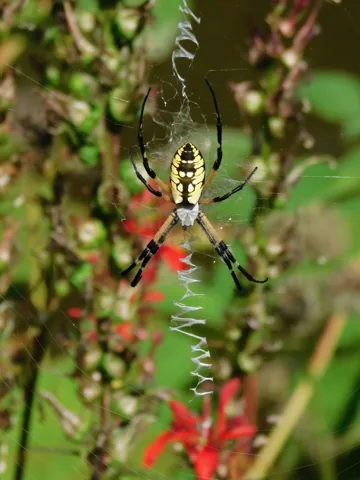 Orb Weaver Spiders (yellow garden spider)
Argiope aurantia
Orb weavers are the spiders that spin classic wheel-shaped webs in gardens and around porches. The best known is the yellow garden spider, a large black-and-yellow spider whose web has a white zigzag down the middle. They eat insects and aren't considered dangerous.
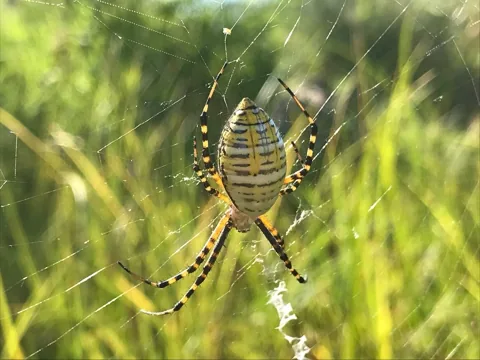 Banded Garden Spider
Argiope trifasciata
The banded garden spider is a large orb weaver with a silvery-yellow abdomen crossed by many thin black bands. Adults hang in big wheel-shaped webs in open, sunny spots from midsummer until the first freeze, catching grasshoppers and other insects.
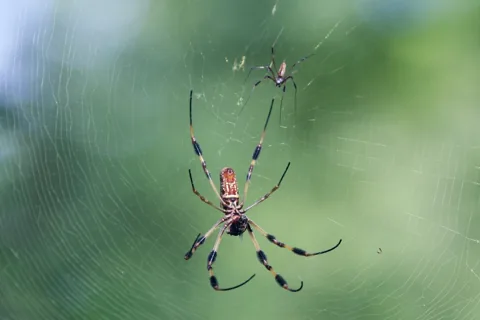 Golden Silk Orb Weaver (banana spider)
Trichonephila clavipes (formerly Nephila clavipes)
The golden silk orb weaver, often called the banana spider, is a large native spider known for its golden webs. It is docile, would rather run than bite, and eats many flying insects.
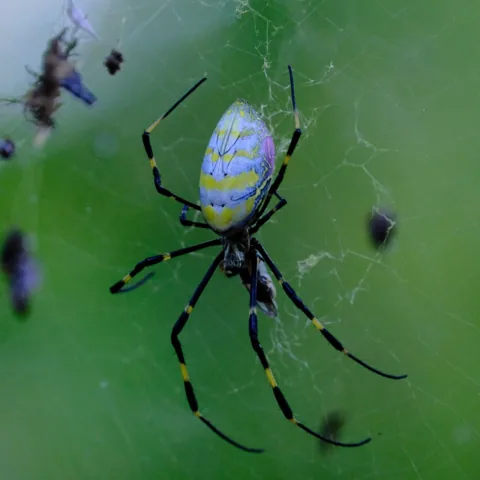 Joro Spider
Trichonephila clavata
The Joro spider is a large, colorful orb weaver from East Asia, first documented in the U.S. in northeast Georgia in 2014. It spins big golden webs outdoors, is timid around people, and isn't considered a threat to people.
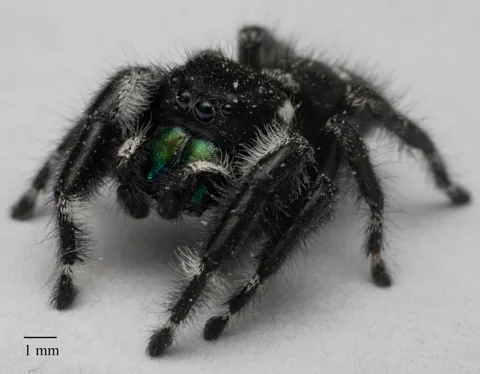 Bold Jumping Spider
Phidippus audax
Jumping spiders are compact, day-active hunters that build no web; they stalk prey by sight and pounce from a short distance. They live on plants, bark and walls and only occasionally wander indoors.
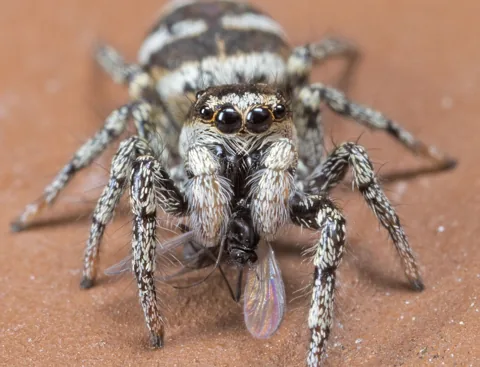 Zebra Jumping Spider
Salticus scenicus
The zebra jumping spider is a small black-and-white striped jumping spider that hunts by day on walls, fences and windows and often comes indoors. It was introduced from Europe and western Asia, and Penn State calls it harmless and beneficial to have around.
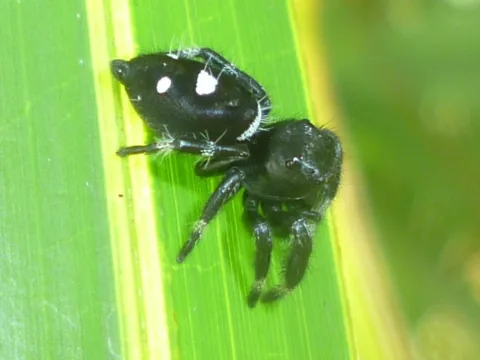 Regal Jumping Spider
Phidippus regius
The regal jumping spider is the largest jumping spider in eastern North America and, apart from two pantropical species, the one most often seen in Florida. It is a harmless, beneficial hunter.
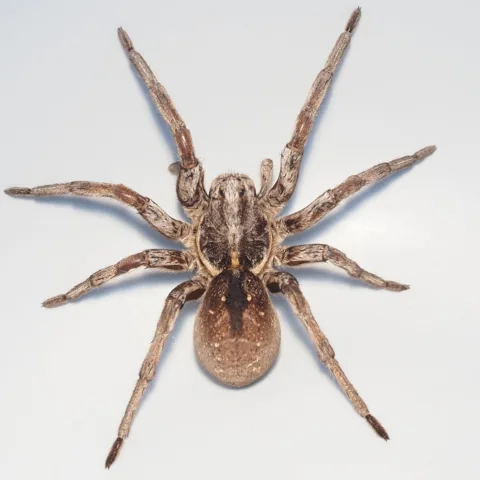 Carolina Wolf Spider
Hogna carolinensis
Wolf spiders are large hunting spiders that don't use webs; they wander into homes by accident, especially males searching for mates, and they don't persist indoors.
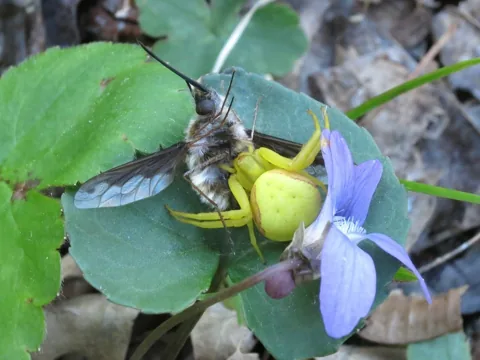 Crab Spiders (e.g., goldenrod crab spider)
Family Thomisidae (e.g., Misumena vatia)
Crab spiders are small hunters that sit still on flowers, leaves or the ground and grab insects that come within reach. They spin no webs, they rarely bite people, and flower crab spiders are some of the most familiar spiders in gardens.
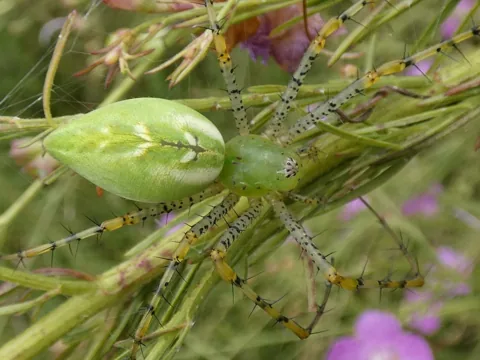 Green Lynx Spider
Peucetia viridans
The green lynx spider is a bright, neon-green hunter with spiny legs that stalks insects on plants instead of building a web. Females guard their egg sacs fiercely, but bites to people are rare and cause only local symptoms.
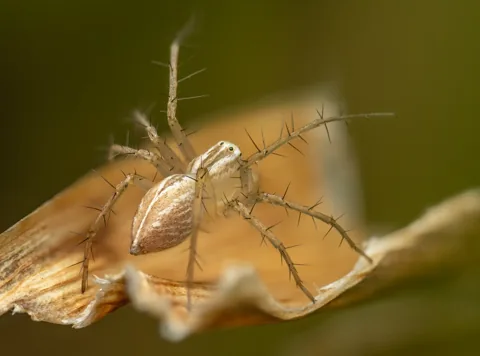 Striped Lynx Spider
Oxyopes salticus
The striped lynx spider is a small, spiny-legged hunting spider of fields, prairies, grasses and gardens. It builds no web; it runs down and jumps on insects.
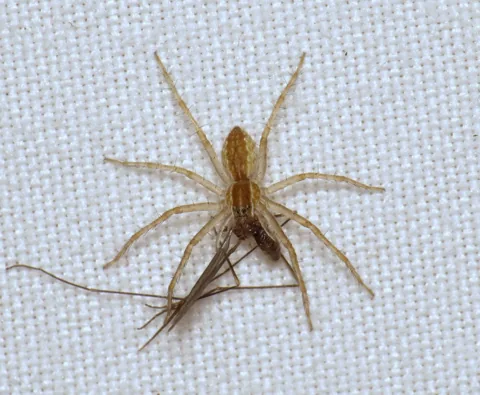 Nursery Web Spider
Pisaurina mira
The nursery web spider (Pisaurina mira) is a long-legged, slender hunting spider of tall grass, shrubs and woodland edges. It doesn't spin a web to catch prey. Its name comes from the leaf tent the female builds and guards around her egg sac. The Missouri Department of Conservation calls nursery web spiders harmless to people and useful predators of garden insects.
 Fishing Spiders
Dolomedes species (e.g., D. tenebrosus, the dark fishing spider)
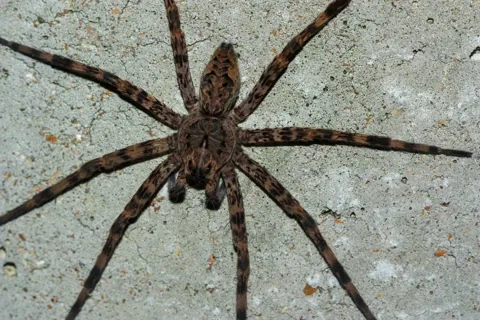
Fishing spiders, genus Dolomedes, are large brown hunting spiders that can run across water and even dive. The dark fishing spider, the species most often found around homes, lives mainly in wooded areas and is harmless despite its size.
 Grass Spiders (Funnel Weavers)
Agelenopsis species
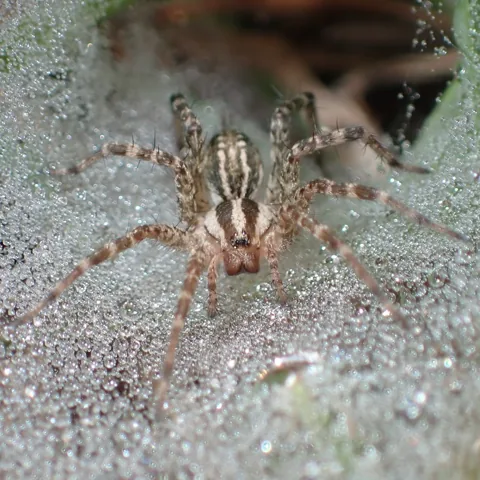
Grass spiders are common funnel weavers whose flat, sheet-like webs with a funnel off to one side show up in lawns, ground covers and shrubs. They are fast and shy, often wander indoors in fall, and are considered beneficial.
 Hobo Spider
Eratigena agrestis
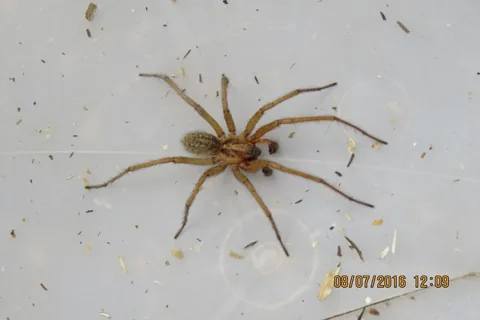
The hobo spider is a European funnel weaver that was labeled potentially toxic in the 1980s. Later research questioned that, and UC IPM says it is no longer considered of probable medical importance.
 Harvestmen (Daddy Longlegs)
Opiliones (e.g., eastern harvestman, Leiobunum vittatum)
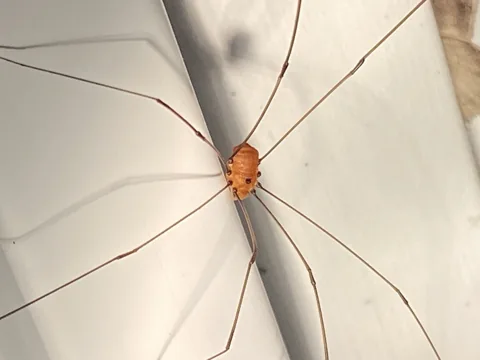
Harvestmen, widely called daddy longlegs, are arachnids related to spiders but are not true spiders. They make no silk, have no venom, and are beneficial predators and scavengers in yards and gardens.
Web builders and hunters: the quickest way to sort them
Some spiders trap prey in webs or snares; others are active hunters that use good vision to stalk or ambush their food. Looking at what the spider is doing (sitting in a web, or running and pouncing) narrows things down fast.[7]
Orb weavers spin the classic wheel-shaped web of spokes and spirals and wait at the hub or in a retreat at the edge. They have poor vision and find prey by feeling vibrations in the web. UC IPM counts about 200 species in North America.[9][7]
Funnel weavers, including grass spiders, spin a flat sheet of silk with a funnel at one side and wait in the funnel. The webs are easiest to see in the morning when they are covered with dew.[9][7][22]
Wolf spiders, jumping spiders, crab spiders and lynx spiders don't spin webs to catch prey. Wolf spiders run prey down on the ground, jumping spiders stalk and pounce, crab spiders wait in ambush on flowers and leaves, and lynx spiders run and leap through foliage.[9][7][18]
Nursery web and fishing spiders are hunters too. They use silk mainly to protect their egg sacs.[19][16]
Orb weavers: yellow garden spider, banded garden spider and relatives
The yellow garden spider (Argiope aurantia, also called the black and yellow garden spider or writing spider) is the big black-and-yellow spider that shows up in gardens and tall weeds in late summer. Its web has a white zigzag band down the center called a stabilimentum. Penn State says it is found throughout most of the United States.[1][3][4]
Size figures vary a little by source. Penn State gives females as 19 to 28 millimeters long and males as 5 to 8 millimeters; NC State says female bodies grow to a little more than one inch; Clemson says females reach up to 1 inch and males are rarely more than ¼ inch; the Missouri Department of Conservation gives ¾ to 1 inch for females and about ¼ inch for males.[1][3][4][5]
The web is large. Penn State says diameters of 50 to 100 centimeters are not uncommon, and the Missouri Department of Conservation says about 2 feet. Clemson notes the webs are often placed near open, sunny areas in vegetation at about knee height.[1][5][4]
Females lay eggs in round, papery brown sacs hung in or near the web in late summer and fall. Estimates of eggs per sac differ: NC State says several hundred to a thousand or more, the Missouri Department of Conservation says egg cases can hold over 1,000 eggs, and Penn State says 500 to 1,000 spiderlings emerge in early spring. Clemson and the Missouri Department of Conservation both say a female can make up to about four egg sacs. There is one generation per year.[3][5][1][4]
The banded garden spider (Argiope trifasciata) is a close relative with thin yellow, white and black bands across the abdomen. Penn State gives females as 15 to 25 millimeters long and says the web is similar to the yellow garden spider's. Clemson says it lays a single egg sac, usually between September and October.[2][4]
Spiny orbweavers (Micrathena) are small woodland orb weavers with pointed spines on the abdomen. The Missouri Department of Conservation says they can turn up around homes and gardens, specialize in tiny flying insects such as mosquitoes, rarely enter houses and are harmless to people.[6][7]
The golden silk orbweaver (banana spider), the most common golden orbweaver in South Carolina, is another big yellow orb weaver with golden silk. Clemson says it has hairy, bottlebrush-like tufts on its leg segments, which separate it from the Joro spider, and that females average 1½ to 2 inches long.[4]
The Joro spider
The Joro spider (Trichonephila clavata) is an orb weaver from East Asia. The first confirmed North American specimens were collected around homes in northeast Georgia in late October and early November 2014. A 2023 study suggests it was likely introduced around 2010. UGA Extension says that by 2022 it had spread about 75 miles in all directions from the first detection, and Clemson reports it in South Carolina and other nearby states.[11][12][10][4]
Adult females are large and colorful. UGA says the body can exceed 1 inch, the abdomen is bright yellow with teal-colored bands, and the black-and-yellow banded legs reach 3 inches long. Clemson points to horizontal silver stripes on the abdomen and a reddish patch underneath as features the golden silk orbweaver lacks. Males are much smaller and drab.[10][4]
Mature females spin golden webs that, according to UGA, may span 10 feet or more, with support strands of 20 feet or longer stretched between treetops. Females lay eggs in the fall in silk-covered masses attached to leaves, bark or structures, and the eggs hatch in April and May. UGA puts the eggs per batch at several hundred to more than 1000; Clemson says each sac holds 400-500 eggs.[10][4]
Joros are timid. UGA reports that even when handled roughly they ran away rather than biting, and Clemson describes the big yellow orb weavers, Joro included, as docile spiders that would rather run than bite.[10][4]
Scientists are still working out its impact. In a 2023 study, the Joro was the most common and abundant species in the authors' orb weaver surveys, with lower native orb weaver diversity near where it has been established longest, though the authors say human population density complicates that result. The same study predicts the most suitable North American habitat lies north of its current range.[12]
UGA's advice for people who tolerate spiders is to remove and kill Joros whose webs are on or next to porches, walkways, decks and doorways, and to leave those on the edges of the yard. It says no one should leave Joro webs around pollinator gardens or beehives. Destroying the web alone doesn't work because the spider rebuilds it quickly.[10]
Jumping spiders
Jumping spiders are compact, often furry spiders with two very large forward-facing eyes. Many are brightly colored or iridescent. They hunt by day in plants or on the ground, stalking and pouncing on prey instead of using a web. UC IPM lists about 300 species in North America.[7][9][13]
The tan jumping spider is a common example in the Missouri Department of Conservation's field guide. It lives on tree bark, fence posts and walls, eats flies, aphids, moths and other spiders, and almost never bites unless pinched; its bite is harmless. Females reach ⅝ inch long.[13]
UC IPM notes that one red and black jumping spider, Phidippus johnsoni, may bite if disturbed, but the bites are usually not serious. Jumping spiders sometimes wander indoors and may overwinter there.[9][7]
Wolf spiders
Wolf spiders are hairy, brown to gray hunting spiders that run down insects on the ground. Look for a straight row of four small eyes below larger ones; at night their eyes shine back in a flashlight beam. Females carry the egg sac attached to the rear of the body, then carry the spiderlings on their backs.[15][9][7]
Sizes range widely. The Missouri Department of Conservation gives ¼ inch to 1 inch depending on species, and Penn State gives 22 to 35 millimeters for females of the large Carolina wolf spider (Hogna carolinensis). Penn State says there are about 240 species in the United States.[15][14]
They live in leaf litter, low vegetation, burrows and under boards, stones and firewood, and they wander indoors by accident. Kentucky Extension calls them common accidental invaders that don't persist indoors.[14][15][7]
Penn State says wolf spiders will bite if mishandled or trapped against the skin, causing pain, redness and perhaps some swelling that generally subsides within 24 hours, with no serious medical consequences noted. The Missouri Department of Conservation says North American wolf spider bites are harmless and the spiders eat many insect pests.[14][15]
Crab spiders and lynx spiders on flowers
Crab spiders hold their front two pairs of legs out to the sides like a crab and can walk in any direction. Many sit in flowers and grab insects that land, often matching the flower's color. UC IPM counts over 200 species in North America, and Kentucky Extension says they rarely enter buildings.[17][9][7]
Flower crab spiders are about ¼ inch long, and the Missouri Department of Conservation lists daisy fleabanes, asters, goldenrods, snapdragons, Queen Anne's lace and marigolds among the flowers where they hunt. They ambush bees, flies and other insects that land on the flower, so it's natural to think of them as bad for pollinators; the Missouri Department of Conservation points out that predators like these help keep the balance of nature.[17]
Lynx spiders are fast, spiny-legged hunters that run and jump after prey in foliage, grasses and flowers. The striped lynx spider is about ¼ inch long; some lynx spiders elsewhere reach about 1 inch, and some are bright green. The Missouri Department of Conservation says lynx spiders have been used against crop pests but also eat bees and other pollinators.[18][9]
Nursery web and fishing spiders
Nursery web spiders are long-legged, slender spiders that often rest on plants with their front legs held together. The name comes from the mother's habit of building a silk tent, often a folded leaf, around her egg sac and standing guard. The Missouri Department of Conservation says they are harmless to people and eat garden pests.[19]
Fishing spiders (Dolomedes) look like large wolf spiders and are related to nursery web spiders. Many live near water and can run on its surface, but the dark fishing spider is often found in wooded areas far from water and sometimes gets into homes. Penn State gives females as 15 to 26 millimeters long.[20][16][7]
You can tell nursery web and fishing spiders from wolf spiders by how they carry eggs: in their jaws, not attached to the rear of the body. Their eight eyes are also all about the same size. Penn State says fishing spiders are shy and rarely bite even when grabbed, and NC State says their venom is not dangerously toxic to people.[19][20][16]
Grass spiders (funnel weavers)
Grass spiders (Agelenopsis) build the flat sheet webs with a funnel at one side that dot lawns and shrub beds, most visible on dewy mornings. The sheet isn't sticky; threads above it knock flying insects down, and the spider dashes out of the funnel to grab them.[21][22][9]
Penn State gives females as 10 to 20 millimeters long, and the Missouri Department of Conservation gives about ½ to ¾ inch. Look for the long spinnerets at the tip of the abdomen and two dark bands running back along the head.[21][22][7]
Grass spiders often come indoors in autumn, but Penn State says the adults don't survive the winter. They are fast and shy, so few people are bitten; reported bites caused pain, swelling, redness and itching lasting one to ten days without serious consequences.[21]
In the West, the hobo spider is a related funnel weaver. Utah State University says the evidence suggests hobo spiders do not cause necrotic lesions in humans.[23]
Harvestmen (daddy longlegs) are not spiders
Harvestmen, often called daddy longlegs, are arachnids related to spiders but in their own order, Opiliones. Their body looks like a single oval, they have two eyes, and they have neither silk glands nor venom glands, so they build no webs and can't bite you.[24][25][26]
Clemson gives the body of most adults as about 1/16 to 1/2 inch long; Ohio State gives 2 to 10 mm. The second pair of legs is usually the longest and is used as a feeler.[24][25][26]
They are omnivores and scavengers that eat aphids and other small soft-bodied insects, dead insects and other organic matter. Ohio State lists aphids, psyllids, beetle larvae, slugs, mites and caterpillars among their prey and calls them beneficial predators in the garden.[25][24][26]
In fall they sometimes gather in large clusters on trees and houses, and Ohio State notes some aggregations include hundreds of individuals. Clemson says the clustering is brief, they rarely get into finished living spaces, and control is rarely necessary.[24][25]
The long-legged cellar spider indoors is also called daddy longlegs, but it is a true spider that builds messy webs in basement corners.[26]
Why spiders are good for the garden
Spiders are predators of insects and other arthropods, and extension services describe them as mostly beneficial. NC State says that because spiders feed mainly on insects, their presence helps rather than harms landscape and garden plants. The National Pesticide Information Center adds that most spiders don't damage garden plants.[9][7][3][28]
The scale is large. A 2017 study estimated that spiders worldwide kill 400-800 million metric tons of prey a year, mostly insects and springtails, and cited exclusion experiments where plant-feeding insects increased after spiders were removed.[27]
Spiders don't pick only pests. Clemson notes they are just as likely to catch a pollinator as a crop pest, and UGA says Joro webs around pollinator gardens and beehives shouldn't be left in place. Spiders themselves feed birds, lizards, shrews and other animals.[4][10][15]
To keep spiders and harvestmen working for you, Ohio State suggests leaving shelter such as rocks, mulch and logs, growing a variety of flowering plants and avoiding broad-spectrum insecticides. Our beneficial insects guide covers the insect predators that work alongside them.[25]
Spider bites: what to expect and what to do
Most spider bites are harmless, according to MedlinePlus, and most spiders can't bite through human skin. Bites usually happen when a spider is trapped or touched.[29][28][31]
For the large outdoor spiders in this guide (garden spiders, the Joro and fishing spiders), Penn State and Clemson compare a bite to a bee or wasp sting. Penn State notes exceptions in people who are sensitive to spider venoms.[1][2][4][20]
First aid: wash the bite with soap and water and apply a cloth dampened with cold water or filled with ice. MedlinePlus suggests ice wrapped in a cloth for 10 minutes on and 10 minutes off, and watching over the next several days for signs of infection such as increasing redness, swelling or pain.[31][29]
Black widow bites need medical help right away. MedlinePlus says that after 15 minutes to 1 hour a dull muscle pain spreads from the bite to the body, often felt most in the chest or abdomen, with cramping. Call the Poison Help line at 1-800-222-1222 for guidance, and bring the spider in a sealed container if you safely can.[30][28]
Brown recluse bites can destroy skin tissue and need professional care, according to CDC's NIOSH. CDC also advises keeping tetanus boosters current, every 10 years, because spider bites can become infected with tetanus.[31]
Severe allergic reactions to insect bites and stings can be life-threatening. MedlinePlus says to call 911 for trouble breathing, swelling anywhere on the face or in the mouth, or throat tightness.[29]
Our bug bite identification guide covers how to tell a spider bite from other bites, and the black widow and brown recluse guides cover those two spiders in detail.[29][31]
Living with garden spiders, or moving them along
Leave them be in the garden, shrub beds and edges of the yard. Where a web is in the way, sweep or hose it off; the National Pesticide Information Center says spraying plants with a hose is often enough to clear spiders before harvest.[9][28][10]
Move or remove the spiders that are truly in the way. UGA suggests wrapping a Joro in its web with a broom, rake or stick, or moving it a good distance away, and concentrating on webs across walkways, doors and decks.[10]
Skip outdoor spraying. UC IPM says insecticides won't provide long-term control and shouldn't generally be used against spiders outdoors. UGA adds that dried residues do little against web spiders, since they don't eat or touch them, and that area-wide yard sprays also kill pollinators and the beneficial insects that keep pests in check.[9][10]
Reduce what draws them to the house. Clean up woodpiles and debris, keep shrubs back from walls, keep the foundation strip clear of leaf litter, and use yellow or sodium vapor bulbs for outdoor lights so fewer insects (and the spiders that eat them) collect there.[28][9][8]
Wear gloves around woodpiles, stacked pots, boards and stones. Kentucky Extension says black widows and brown recluses live outdoors in places like these, and CDC's NIOSH recommends gloves and shaking out clothing, shoes and equipment before use.[8][31]
If spiders are coming inside, our guides to types of spiders in homes and how to get rid of house spiders cover identification indoors, sealing gaps and sticky traps.[8][9]
Common questions
- Are garden spiders poisonous?
- Yellow and banded garden spiders have venom, as nearly all spiders do, but they are not known to be medically important. They rarely bite, and a bite usually feels about like a bee or wasp sting.[1][2][7]
- Should I kill the big yellow spider in my garden?
- There's no need. NC State considers the black and yellow garden spider beneficial and says no control is necessary; it eats insects such as grasshoppers and katydids.[3][5]
- Do Joro spiders bite?
- UGA researchers report Joros ran away rather than biting even when handled roughly. Clemson says a bite from one of the big yellow orb weavers is similar to a bee sting.[10][4]
- Are daddy longlegs venomous?
- No. Harvestmen have no venom glands, so the story that they're deadly but can't bite is a myth on both counts.[24][25][26]
- Why are there so many webs in my lawn in the morning?
- Those flat sheets with a funnel are grass spider webs. They are there all along but show up when dew collects on them.[22][21][9]
- Do spiders eat garden plants?
- No. Spiders feed on insects and other small animals, and most don't damage garden plants. Harvestmen may nibble pollen but are mostly predators and scavengers.[3][28][25]
Photo credits
- Orb Weaver Spiders (yellow garden spider): (c) Michael J. Papay, some rights reserved (CC BY) — via iNaturalist, CC BY 4.0
- Banded Garden Spider: (c) Shalana Gray, some rights reserved (CC BY) — via iNaturalist, CC BY 4.0
- Golden Silk Orb Weaver (banana spider): Dario Taraborelli, public domain (CC0), via iNaturalist
- Joro Spider: (c) Amit Naik, some rights reserved (CC BY) — via iNaturalist, CC BY 4.0
- Bold Jumping Spider: Jesse Rorabaugh, public domain (CC0), via iNaturalist
- Zebra Jumping Spider: Mardon Erbland, public domain (CC0), via iNaturalist
- Regal Jumping Spider: (c) Even Dankowicz, some rights reserved (CC BY) — via iNaturalist, CC BY 4.0
- Carolina Wolf Spider: (c) Russell Pfau, some rights reserved (CC BY) — via iNaturalist, CC BY 4.0
- Crab Spiders (e.g., goldenrod crab spider): (c) Evan M. Raskin, some rights reserved (CC BY) — via iNaturalist, CC BY 4.0
- Green Lynx Spider: kcthetc1, public domain (CC0), via iNaturalist
- Striped Lynx Spider: (c) cesar stastny, some rights reserved (CC BY) — via iNaturalist, CC BY 4.0
- Nursery Web Spider: (c) Nick Block, some rights reserved (CC BY) — via iNaturalist, CC BY 4.0
- Fishing Spiders: (c) Andrew Meeds, some rights reserved (CC BY) — via iNaturalist, CC BY 4.0
- Grass Spiders (Funnel Weavers): (c) dhasdf, some rights reserved (CC BY) — via iNaturalist, CC BY 4.0
- Hobo Spider: Steve Wells, public domain (CC0), via iNaturalist
- Harvestmen (Daddy Longlegs): (c) Mark Eanes, some rights reserved (CC BY) — via iNaturalist, CC BY 4.0
Sources
- Penn State Extension, “Yellow Garden Spider.” extension.psu.edu/yellow-garden-spider (accessed 2026-11-10)
- Penn State Extension, “Banded Garden Spider.” extension.psu.edu/banded-garden-spider (accessed 2026-11-10)
- NC State Extension, “Black and Yellow Garden Spider.” content.ces.ncsu.edu/black-and-yellow-garden-spider (accessed 2026-11-10)
- Clemson Cooperative Extension Home & Garden Information Center, “Big Yellow Spiders in South Carolina.” hgic.clemson.edu/factsheet/big-yellow-spiders-in-south-carolina/ (accessed 2026-11-10)
- Missouri Department of Conservation, “Black-and-Yellow Garden Spider (Field Guide).” mdc.mo.gov/discover-nature/field-guide/black-yellow-garden-spider (accessed 2026-11-10)
- Missouri Department of Conservation, “Spiny Orbweavers (Micrathena Spiders) (Field Guide).” mdc.mo.gov/discover-nature/field-guide/spiny-orbweavers-micrathena-spiders (accessed 2026-11-10)
- University of Kentucky Entomology, “Common Spiders Found Around Homes and Buildings (ENTFACT-622).” entomology.mgcafe.uky.edu/ef622 (accessed 2026-11-10)
- University of Kentucky Entomology, “Eliminating Spiders Around Homes and Buildings (ENTFACT-623).” entomology.mgcafe.uky.edu/ef623 (accessed 2026-11-10)
- University of California Statewide IPM Program, “Pest Notes: Spiders (UC ANR Publication 7442).” ipm.ucanr.edu/home-and-landscape/spiders/ (accessed 2026-11-10)
- University of Georgia Cooperative Extension, “Managing Joro Spiders in the Landscape (Circular 1289).” fieldreport.caes.uga.edu/publications/C1289/managing-joro-spiders-in-the-landscape/ (accessed 2026-11-10)
- PeerJ, abstract via PubMed, “Nephila clavata L Koch, the Joro Spider of East Asia, newly recorded from North America (Hoebeke, Huffmaster and Freeman, PeerJ 2015; PMID 25699210).” pubmed.ncbi.nlm.nih.gov/25699210/ (accessed 2026-11-10)
- Ecology and Evolution, abstract via PubMed, “Veni, vidi, vici? Future spread and ecological impacts of a rapidly expanding invasive predator population (Nelsen and others, Ecol Evol 2023; PMID 38020683).” pubmed.ncbi.nlm.nih.gov/38020683/ (accessed 2026-11-10)
- Missouri Department of Conservation, “Tan Jumping Spider (Field Guide).” mdc.mo.gov/discover-nature/field-guide/tan-jumping-spider (accessed 2026-11-10)
- Penn State Extension, “Wolf Spiders.” extension.psu.edu/wolf-spiders (accessed 2026-11-10)
- Missouri Department of Conservation, “Wolf Spiders (Field Guide).” mdc.mo.gov/discover-nature/field-guide/wolf-spiders (accessed 2026-11-10)
- NC State Extension, “Fishing Spiders and Wolf Spiders.” content.ces.ncsu.edu/fishing-spiders-and-wolf-spiders (accessed 2026-11-10)
- Missouri Department of Conservation, “Flower Crab Spiders (Field Guide).” mdc.mo.gov/discover-nature/field-guide/flower-crab-spiders (accessed 2026-11-10)
- Missouri Department of Conservation, “Lynx Spiders (Field Guide).” mdc.mo.gov/discover-nature/field-guide/lynx-spiders (accessed 2026-11-10)
- Missouri Department of Conservation, “Nursery Web Spiders (Field Guide).” mdc.mo.gov/discover-nature/field-guide/nursery-web-spiders (accessed 2026-11-10)
- Penn State Extension, “Fishing Spider.” extension.psu.edu/fishing-spider (accessed 2026-11-10)
- Penn State Extension, “Grass Spiders.” extension.psu.edu/grass-spiders (accessed 2026-11-10)
- Missouri Department of Conservation, “Grass Spiders (Field Guide).” mdc.mo.gov/discover-nature/field-guide/grass-spiders (accessed 2026-11-10)
- Utah State University Extension, “Hobo and Grass Spiders.” extension.usu.edu/planthealth/ipm/notes_nuisance/hobo-grass-spiders (accessed 2026-11-10)
- Clemson Cooperative Extension Home & Garden Information Center, “Daddy Longlegs (HGIC 2418).” hgic.clemson.edu/factsheet/daddy-longlegs/ (accessed 2026-11-10)
- Ohio State University Extension, “Ohio's Natural Enemies: Harvestmen (also known as daddy longlegs) (ENT-68).” ohioline.osu.edu/factsheet/ent-68 (accessed 2026-11-10)
- Missouri Department of Conservation, “Daddy Longlegs (Harvestmen) (Field Guide).” mdc.mo.gov/discover-nature/field-guide/daddy-longlegs-harvestmen (accessed 2026-11-10)
- The Science of Nature (Naturwissenschaften), abstract via PubMed, “An estimated 400-800 million tons of prey are annually killed by the global spider community (Nyffeler and Birkhofer, Naturwissenschaften 2017; PMID 28289774).” pubmed.ncbi.nlm.nih.gov/28289774/ (accessed 2026-11-10)
- National Pesticide Information Center, “Spiders.” npic.orst.edu/pest/spiders.html (accessed 2026-11-10)
- NIH National Library of Medicine, MedlinePlus, “Insect bites and stings (Medical Encyclopedia).” medlineplus.gov/ency/article/000033.htm (accessed 2026-11-10)
- NIH National Library of Medicine, MedlinePlus, “Black widow spider (Medical Encyclopedia).” medlineplus.gov/ency/article/002858.htm (accessed 2026-11-10)
- CDC, National Institute for Occupational Safety and Health, “Venomous Spiders.” www.cdc.gov/niosh/outdoor-workers/about/venomous-spiders.html (accessed 2026-11-10)