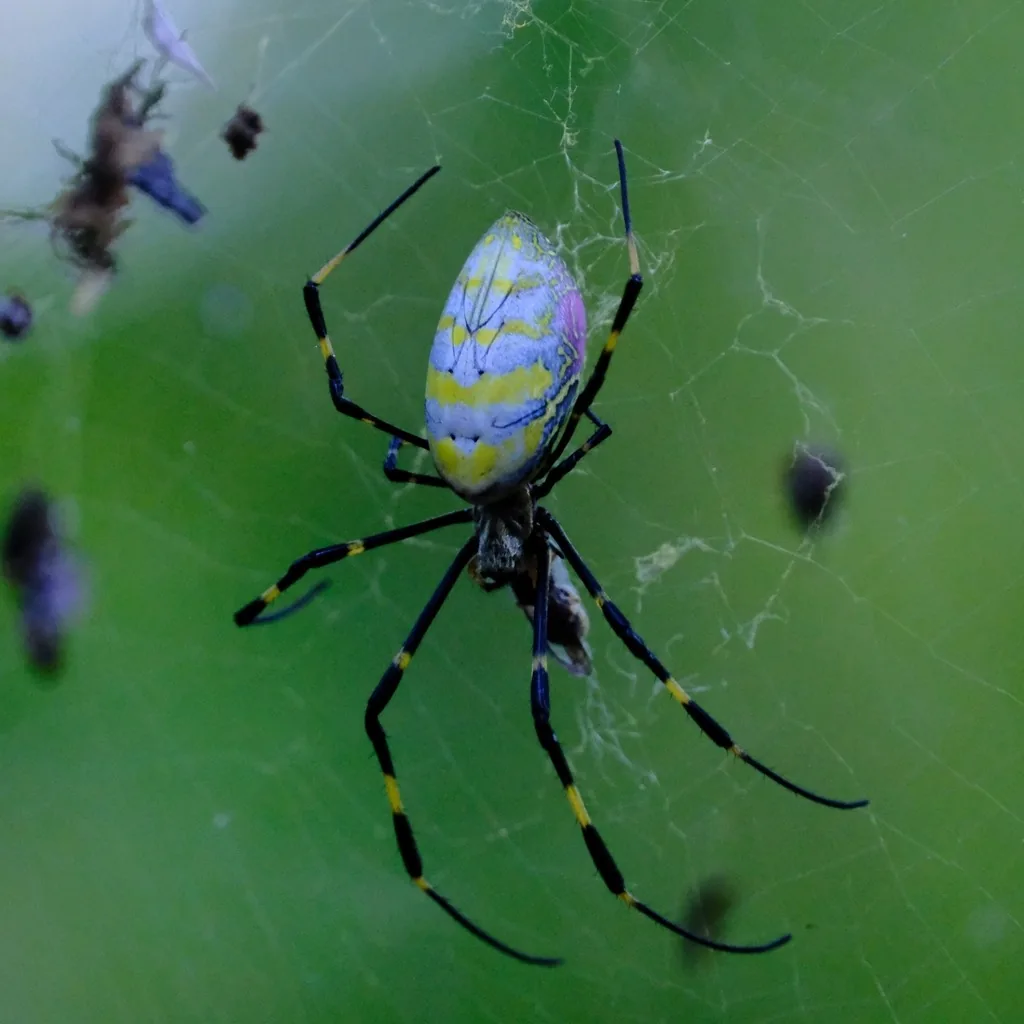
How to identify it
- Adult females are very large, with a body that can exceed 1 inch and black-and-yellow banded legs up to 3 inches long.[1]
- From above, the female has a silvery-white front body section and a bright yellow abdomen crossed by teal or bluish bands.[1][4]
- The underside is checkered black and white or yellow-white, with red splotches near the tail end.[1][4]
- Males are much smaller, slender and drab brown, yellow and black, and are often not recognized as the same species.[1]
- Mature females spin strong, sticky golden webs that can span 10 feet or more, with support lines reaching 20 feet between treetops.[1][4]
Look-alikes
| Look-alike | How to tell them apart |
|---|---|
| Golden silk orbweaver (banana spider) | A native relative with golden webs, but its abdomen lacks the Joro's silvery cross stripes, and its legs have hairy bottlebrush tufts.[3][4] |
| Yellow garden spider | Smaller, with a black-and-yellow patterned abdomen, and it often adds a thick white zigzag to its web; adult Joros never do.[3][4] |
Where it lives
Native to East Asia, it was first found in northeast Georgia in 2014 and had spread about 75 miles in all directions by 2022. Extension specialists expect it to spread through the Southeast and much of the eastern U.S.[1][4]
Biology and life cycle
There is one generation a year: eggs overwinter, hatch in April and May, and spiders mature in August and September.[1]
In fall, females lay several hundred to more than 1,000 eggs in fuzzy, off-white masses attached to leaves, tree bark or structures such as deck slats.[1][3]
Young spiders spread by ballooning, releasing silk that carries them on air currents; the adults also hitch rides on cars and trucks.[4][2]
They catch many insects, including brown marmorated stink bugs, but also bees and other beneficial insects.[4][2][1]
Damage and signs
- No damage to homes; the main complaint is large, sticky webs across porches, walkways, decks and doorways.[1]
Health risk
Joro spiders are timid and run away rather than bite. Their venom isn't potent; reported bites cause only redness and localized pain without medical treatment.[1][2][4]
Control
Prevention
Extension specialists suggest leaving Joros alone at the edges of the yard and in shrub beds, and removing only those near walkways, doors, decks and porches.[1]
Traps and physical control
Wrap the spider up in its web with a broom, rake or stick and step on it; just knocking down the web doesn't work because they rebuild quickly.[1]
Remove webs near beehives and pollinator or flower gardens, and break up egg masses found in fall if numbers become unmanageable.[1][4]
Pesticides
Pyrethroids such as cypermethrin, lambda-cyhalothrin and bifenthrin kill spiders sprayed directly, but dried residues do little against web spiders.[1][4]
Avoid area-wide sprays and fogging, which kill pollinators and natural enemies; scale insects have increased after such treatments.[1][4]
Common questions
- Are Joro spiders dangerous?
- No. They are shy, rarely bite even when handled, and their fangs don't easily pierce skin. Bites that do occur cause only redness and local pain.[4][1]
- Should I spray my yard for Joro spiders?
- UGA Extension advises against broad sprays. Remove the spiders in your way by hand, and leave those in out-of-the-way spots alone.[1]
- How do I tell a Joro spider from a golden silk orbweaver?
- Look at the abdomen and legs: the Joro has silvery cross stripes on a yellow abdomen, while the golden silk orbweaver has hairy tufts on its legs.[3]
Sources
- University of Georgia Cooperative Extension, “Managing Joro Spiders in the Landscape (Circular 1289, full review August 27, 2026).” fieldreport.caes.uga.edu/publications/C1289/managing-joro-spiders-in-the-landscape/ (accessed 2026-10-06)
- University of Georgia College of Agricultural and Environmental Sciences, “New spiders in north Georgia are hard to miss but pose no threat (October 11, 2018).” fieldreport.caes.uga.edu/news/new-spiders-in-north-georgia-are-hard-to-miss-but-pose-no-threat/ (accessed 2026-10-06)
- Clemson Cooperative Extension, Home & Garden Information Center, “Big Yellow Spiders in South Carolina (HGIC 2503, revised November 20, 2024).” hgic.clemson.edu/factsheet/big-yellow-spiders-in-south-carolina/ (accessed 2026-10-06)
- Rutgers New Jersey Agricultural Experiment Station, Cooperative Extension, “Joro Spider: Description, Behavior, and Contrast with Similar Species (FS1386).” njaes.rutgers.edu/FS1386/ (accessed 2026-10-06)
- iNaturalist, “Trichonephila clavata taxon page (order and family).” www.inaturalist.org/taxa/904334 (accessed 2026-10-06)