Pest profile

Regal Jumping Spider

Phidippus regius · Araneae: Salticidae[2]

The regal jumping spider is the jumping spider Floridians most often meet, and it's harmless and beneficial.[1]

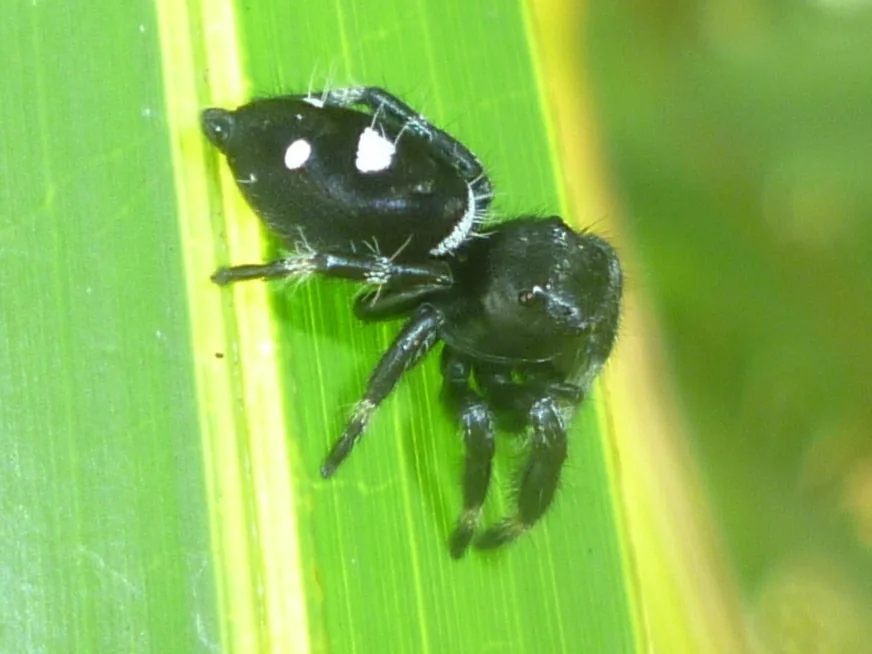
Regal jumping spider male, black with white spots on the abdomen, on a green leaf
Regal jumping spider male, black with white spots on the abdomen, on a green leaf. (c) Even Dankowicz, some rights reserved (CC BY) — via iNaturalist, CC BY 4.0

How to identify it

  • Males are black with a white band, a white triangle and two white spots on the abdomen, and iridescent green-blue-violet fangs.[1]
  • Females average 2/3 inch and are often covered in gray, tan, brown or orange scales.[1]

Look-alikes

Look-alikeHow to tell them apart
Bold jumping spiderIts rear abdominal spots are linear rather than oval.[1]

Where it lives

It's found in the southeastern U.S., the Greater Antilles and the Bahamas, and is most common in peninsular Florida.[1]

US map: public records from 8 states since 1990 (GBIF).

Biology and life cycle

Adults favor palms and palmettos but are often found on building walls.[1]

It hunts by sight and catches prey by jumping on it.[1]

Health risk

It can give a painful bite only if held tightly; the sting fades in a few minutes and needs no treatment.[1]

Control

Biological control

Jumping spiders are harmless, beneficial predators, so there's no need to control them.[1]

Common questions

Is the big jumping spider on my wall dangerous?
No; jumping spiders are harmless and bite only if held tightly.[1]
Why do regal jumping spiders look so different?
Males are black and white; females are often gray, tan or orange.[1]

Sources

  1. University of Florida IFAS Extension (Featured Creatures), “Regal Jumping Spider, Phidippus regius (EENY-152).” edis.ifas.ufl.edu/publication/IN309 (accessed 2026-10-06)
  2. iNaturalist, “Phidippus regius taxon page (order and family).” www.inaturalist.org/taxa/179749 (accessed 2026-10-06)

Updated 2026-10-14. Built from sourced records. Spot an error? Tell us.