On this page
How to identify it
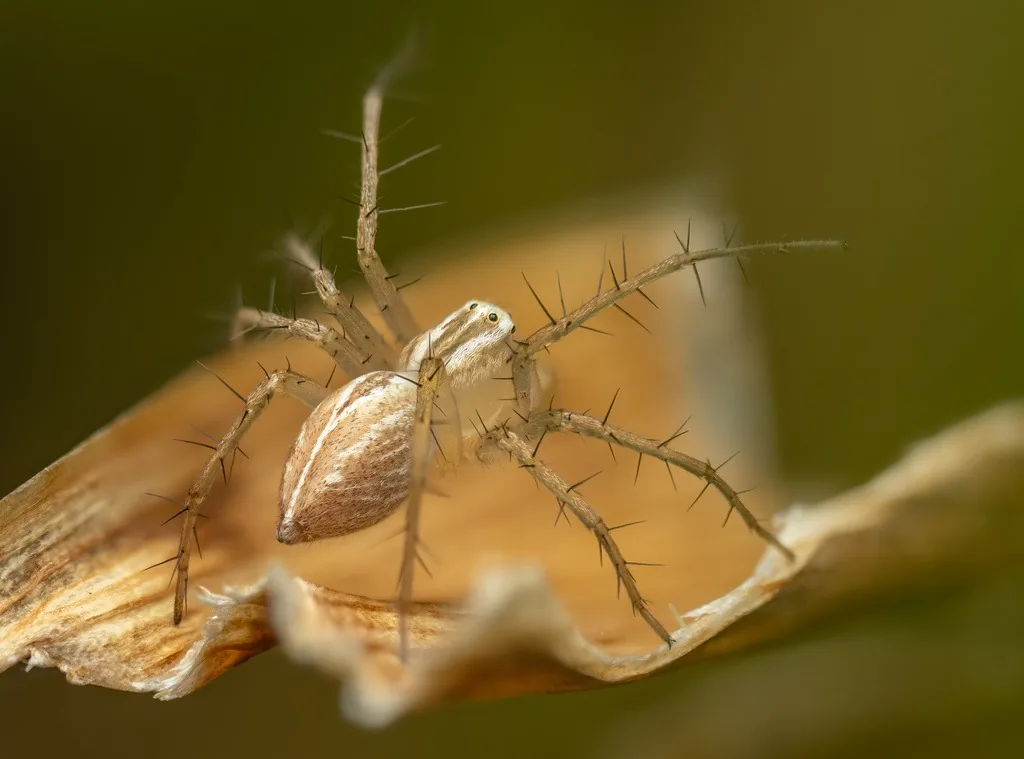
- It is small, about 1/4 inch long (4 to 7 mm), with many long black spines on the legs.[1][2]
- Two thin black lines run from the middle eyes down to the tips of the fangs, and there are thin black lines under the legs.[1]
- Females are pale with brown or white stripes on the body; males are smaller, shinier, with a coppery head and black, club-like palps that look like little boxing gloves.[1][2]
Look-alikes
| Look-alike | How to tell them apart |
|---|---|
| Green lynx spider | Larger, 12 to 16 mm, with a green body and no black face markings.[1] |
| Western lynx spider | Its closest North American relative is browner, with banded legs and no black facial stripes.[1] |
Where it lives
Range accounts differ: UF/IFAS says it is very common in the East and on the Pacific coast but not the Midwest, while MDC calls it Missouri's most common lynx spider and widely distributed in North America.[1][2]
Biology and life cycle
It hunts by waiting in grass and low plants and stalking insects that land nearby, rather than by building a web.[1]
Females lay a flat, white egg sac under a leaf about a week to a month after mating and guard it until spiderlings emerge, about 20 days later.[1]
Damage and signs
- No damage: it is one of the most abundant beneficial spiders in yards, gardens and fields, feeding on many insects including crop pests.[1]
Health risk
Control
Biological control
No control is needed; it is a beneficial generalist predator in gardens and crops.[1]
Common questions
Sources
- University of Florida IFAS Extension (EDIS, Featured Creatures), “Striped Lynx Spider, Oxyopes salticus (EENY-731).” ask.ifas.ufl.edu/publication/IN1259 (accessed 2026-10-16)
- Missouri Department of Conservation, “Lynx Spiders (Field Guide).” mdc.mo.gov/discover-nature/field-guide/lynx-spiders (accessed 2026-10-16)
- iNaturalist, “Oxyopes salticus taxon page (order and family).” www.inaturalist.org/taxa/83844 (accessed 2026-10-06)