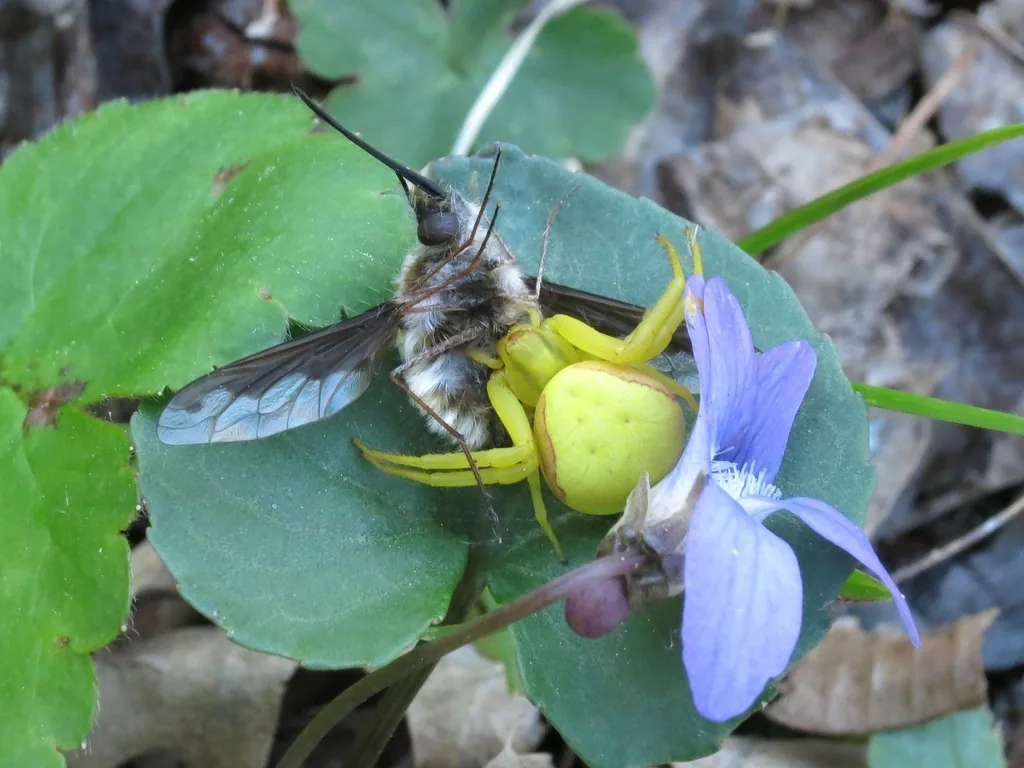
How to identify it
- The first two pairs of legs are enlarged and stick out past the sides of a flattened body, so the spider looks like a tiny crab.[2][1]
- Crab spiders can scuttle in any direction, including sideways.[3]
- The goldenrod crab spider is 1/10 to 1/3 inch long and usually yellow or white, though some are brown.[1]
- Their small eyes sit in two slightly curved rows, the top row often much wider than the lower one.[2]
- Ground crab spiders are a duller group, usually gray and brown, that live on or near the ground and under bark.[4]
Look-alikes
| Look-alike | How to tell them apart |
|---|---|
| Jumping spiders | Jumping spiders also hunt without webs, but they stalk and leap on prey and have a distinctive pair of large middle eyes in the front row.[2] |
| Ground crab spiders (Xysticus) | These are crab spiders too, generally larger than flower crab spiders and dull gray or brown, living on the forest floor and under bark rather than in flowers.[4] |
Where it lives
More than 200 crab spider species live in North America; flower-dwelling kinds are found statewide in Missouri in gardens, prairies, old fields and other grasslands with flowers.[2][3]
Biology and life cycle
They hunt by day and don't build webs; they stalk or wait for insects walking or resting on surfaces.[2]
Goldenrod crab spiders are most common on yellow or white flowers.[1]
Many crab spiders blend in with the flowers they sit on, and unlike web spinners, they have good vision.[3]
When a bee, fly or other insect lands for nectar, the spider seizes it, injects venom and holds it while drinking its body fluids.[3]
In Missouri, egg cases overwinter and spiderlings hatch in spring; adults generally die at the first hard freeze.[3][4]
Damage and signs
Health risk
The goldenrod crab spider does not harm people. Spiders seen out in the open during the day, like crab spiders, are unlikely to bite.[1][2]
Control
Prevention
Outdoors, no control is needed; these small predators help hold down insect numbers.[4][1]
Keep them out
Spiders can be carried in on plants, firewood and boxes; seal cracks and keep window and door screens tight to keep them and their insect prey out.[2]
Traps and physical control
To remove one from indoors, cover it with a jar, slide a piece of paper underneath, and release it outside.[2]
Pesticides
UC IPM advises that insecticides won't give long-term spider control and generally shouldn't be used against spiders outdoors.[2]
Common questions
- Are crab spiders poisonous?
- Like most spiders they use venom on their prey, but the goldenrod crab spider does not harm people.[3][1]
- Why do crab spiders sit on flowers?
- Flowers draw bees, flies and other nectar feeders, and the camouflaged spider waits there to ambush them.[3]
- Do crab spiders make webs?
- No. They are hunters that grab prey directly instead of catching it in a web.[2][3]
Sources
- University of Minnesota Extension, “Goldenrod crab spider (What insect is this?).” apps.extension.umn.edu/garden/diagnose/insect/general-curiosity-insects/relatives/small/goldenrodcrabspider.html (accessed 2026-10-06)
- University of California Statewide IPM Program, “Spiders (Pest Notes, Home and Landscape).” ipm.ucanr.edu/home-and-landscape/spiders/ (accessed 2026-10-06)
- Missouri Department of Conservation, “Flower Crab Spiders (Field Guide, reviewed December 31, 2024).” mdc.mo.gov/discover-nature/field-guide/flower-crab-spiders (accessed 2026-10-06)
- Missouri Department of Conservation, “Ground Crab Spiders (Field Guide).” mdc.mo.gov/discover-nature/field-guide/ground-crab-spiders (accessed 2026-10-06)
- iNaturalist, “Misumena vatia taxon page (order and family).” www.inaturalist.org/taxa/55746 (accessed 2026-10-06)