The short answer
- Confirm it's a recluse first. Most brown spiders people catch are something else, and outside the south-central and Midwestern United States recluses are rare. Look for six eyes in three pairs, or have a specimen checked by an extension office or entomologist.[1][2][3]
- Put out lots of flat sticky traps along baseboards, in corners and behind furniture. Kentucky Extension says dozens throughout a home show where the spiders are concentrated, and Kansas State says the traps also help reduce established populations.[1][3]
- Clear clutter, especially in basements, attics, closets and storage rooms, and store things in tightly closed plastic bins or taped boxes.[3][4][1]
- Pull beds away from walls, take off bed skirts, keep bedding off the floor, and shake out shoes and clothes before putting them on.[2][3][1]
- Expect to need insecticides placed into cracks, voids and attics for a heavy infestation, and Texas A&M recommends hiring a professional. Bug bombs seldom help.[1][4][3]
- If you think you've been bitten, call the Poison Help line (1-800-222-1222) or seek medical care, and bring the spider in a secure container if you can.[6][1]
Recluses and their lookalikes
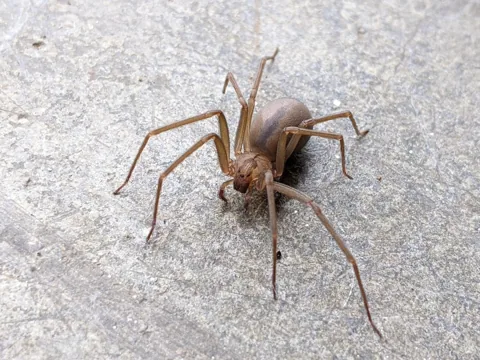 Brown Recluse
Loxosceles reclusa
The brown recluse is a secretive spider of the south-central and Midwestern United States whose bite can occasionally cause serious wounds; it is widely over-reported outside its range. The Illinois Department of Public Health says it occurs in roughly the southeastern quarter of the country and that bites are uncommon even where the spider is common.
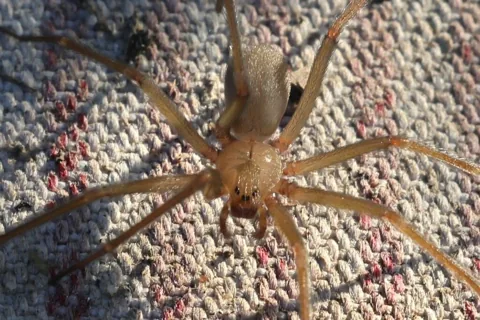 Desert Recluse
Loxosceles deserta
The desert recluse is the most common recluse spider in California and the one most likely behind a true recluse find there. It is native to the desert Southwest, lives mainly outdoors in native vegetation and is seldom found indoors.
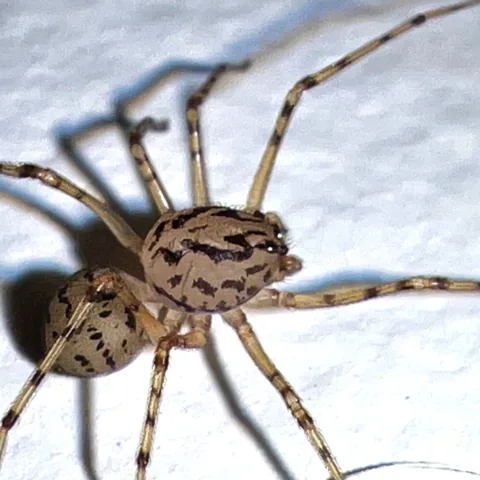 Spitting Spider
Scytodes thoracica
The spitting spider is a slow-moving, spotted spider found in and around buildings. It builds no web; instead it spits a zigzag of silk, glue and venom that pins insects in place.
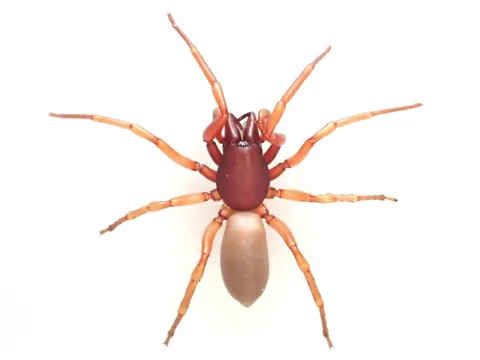 Woodlouse Spider
Dysdera crocata
The woodlouse spider, or woodlouse hunter, is a Mediterranean spider now found around homes across much of North America. It hunts sowbugs and pill bugs in damp places and looks fierce because of its large fangs, but Utah State calls it beneficial.
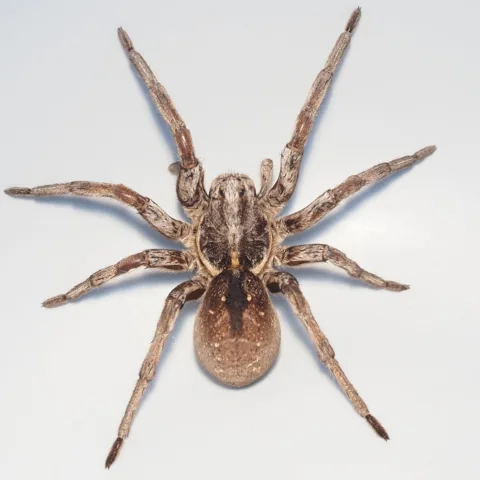 Carolina Wolf Spider
Hogna carolinensis
Wolf spiders are large hunting spiders that don't use webs; they wander into homes by accident, especially males searching for mates, and they don't persist indoors.
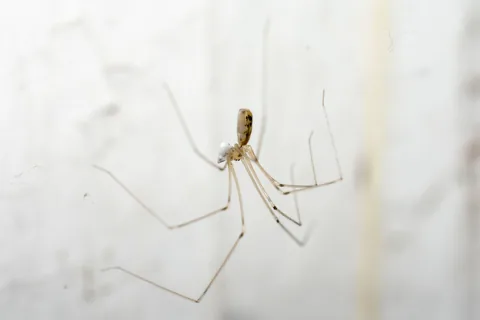 Longbodied Cellar Spider
Pholcus phalangioides
The longbodied cellar spider is the most common cellar spider in the United States: a small, pale spider with extremely long legs that lives in buildings all year. Penn State says it isn't known to be harmful in any way; its main offense is messy webbing.
Step 1: Make sure you have recluses, and where you live matters
The brown recluse lives in the south-central and Midwestern United States. UC IPM describes the range as southeastern Nebraska to southwestern Ohio and south through Texas to north Georgia; Kansas State describes it as Colorado to Ohio and Nebraska and Iowa to the Gulf States. MedlinePlus says it is most common in Missouri, Kansas, Arkansas, Louisiana, eastern Texas and Oklahoma. Other recluse species live in the Southwest and southern California.[2][3][6][1]
Inside that range, recluses can be very common indoors. Kansas State says most homes in its distribution area are infested, and in one 19th-century Kansas house a family collected 2,055 brown recluses in 6 months. More typical infested homes in Missouri and Oklahoma yielded 45 and 30 spiders in the same study.[3][8]
Outside the range, a single spider can arrive in boxes or furniture, but Kentucky says infestations seldom become established. UC IPM says fewer than 20 verified brown recluse specimens have been collected in California over several decades. In Georgia, the spider has been documented in 31 of 159 counties, almost all in the north, and in Florida researchers who checked 220 properties with reported recluse infestations found breeding recluse populations, all of the non-native Mediterranean recluse, at only 19 sites.[1][2][15][18]
For identification, the eyes are the feature to check: six eyes in three pairs arranged in a semicircle, where most spiders have eight. The legs and abdomen are one uniform color with no stripes, bands or spots, and the legs lack obvious spines. UC IPM says the violin mark alone leads to misidentifications. Our types of spiders guide and brown recluse profile show the lookalikes. Kentucky and Kansas State both suggest having a specimen confirmed by an entomologist, the extension office or a knowledgeable pest control firm, and Kentucky says even crushed specimens can usually be identified.[1][2][3]
Other signs help confirm an infestation: Kentucky says the shed skins have a distinctive outstretched look, and egg sacs and skins turn up along joists, sills and rafters and under rolled insulation in garages, attics, basements and crawl spaces. Kansas State says their irregular webs can look like dusty white cobwebs in corners. Webs strung across open walls, ceilings and plants almost always belong to other spiders.[1][3]
Step 2: Use sticky traps to find them and thin them out
Sticky traps (glue boards) are the main monitoring tool in every extension source we used. Kentucky says the best ones for recluses are flat, like thin sticky cardboard without a raised edge, and that the more you use the better: dozens placed throughout a home reveal where spiders are most abundant. Any glue trap works, according to Kansas State, including ones sold for cockroaches or mice.[1][3]
A Missouri lab study of trap shapes agrees. Brown recluses preferred a flat glue trap with no covering over four other designs. Because an open trap is a hazard in homes with children and pets, the authors suggest a covered trap with vertical struts, which the spiders preferred among the covered designs. UC IPM also advises placing traps out of reach of pets and young children.[9][2]
- Place traps in corners and flush against walls along baseboards and wall-floor junctions, especially behind furniture and clutter, where the spiders travel.[1]
- Also set them under furniture, in closets and in attics.[3][4]
- Put traps out before any insecticide treatment. Kentucky says some products make spiders active, and they then wander into traps.[1]
- Check the traps weekly and count new spiders. Kentucky says the number of new catches is how you judge whether eradication is working.[3][1]
- Keep monitoring after the problem seems solved. Kansas State recommends traps checked weekly from March through October to catch reinfestation.[3]
What sticky traps can and can't do
Traps do kill spiders. Kentucky says they can catch large numbers, especially males, which wander more and are the ones more likely to end up in shoes and bedding. Texas A&M says sticky cards provide some control as well as monitoring, and Kansas State says its entomologists found traps can help reduce established populations.[1][4][3]
The gap is the adult females. Kentucky says they stay hidden more than males and are less likely to be caught, which is why elimination often also requires insecticides. Trap counts can also drop for a while without the infestation being gone: Kansas State says brown recluses are inactive from October through March even in buildings with steady temperatures and lighting.[1][3]
Step 3: Take away hiding places
Kansas State's control plan starts with removing clutter, especially in low-traffic areas such as basements, attics and upper rooms, and says the spider may be more common in homes with lots of stored items. Kentucky says less clutter means fewer hiding places and makes treatments work better, and Texas A&M suggests clearing clutter before a pest control professional arrives.[3][1][4]
Lab work by recluse researchers shows what the spiders look for. Brown recluses preferred crevices at least 9 mm wide, set vertically rather than flat, and spaces that already had recluse silk in them.[13]
- Vacuum between boxes and into tight spaces with a wand attachment to pick up spiders and egg sacs, and remove webs inside and out.[3][4]
- Store items in tightly sealed plastic containers, and don't push them close together or against walls. Tape cardboard boxes shut.[3][4][1]
- Wear long sleeves and gloves when sorting boxes or stored materials.[1][7]
- Outside, move firewood, building materials and debris away from the foundation, and check behind shutters and under things lying on the ground.[1]
- Seal gaps under doors, around vents and utility lines, under the bottom edge of siding and where eaves and soffits meet the walls. Kansas State notes that young brown recluses can't balloon on silk the way many spiderlings do, so they get in by crawling or by being carried in.[1][3]
Step 4: Cut down the insects they eat
Texas A&M says a building with many brown recluses usually has plenty of insect prey too, such as crickets, silverfish and cockroaches. Its advice: seal doors well, shield outdoor lights so they don't draw insects, keep up sanitation and regular pest control, and vacuum up dead insects, which recluses will eat. Kansas State says insecticide use that reduces the spiders' prey limits what they have to live on over time.[4][3]
Our guide to pest-proofing your home covers sealing and lighting changes in more detail.[4][1]
Step 5: Protect beds, clothes and shoes while you work on it
Most bites happen at night or while dressing. UC IPM and Texas A&M say people are bitten when they roll over onto a spider in bed, and Kentucky adds bites while putting on clothing a spider has hidden in or while moving stored items. Males and older juveniles roam farther than females, so they're the ones that end up in shoes, clothing and bedding.[2][5][1]
- Move the bed away from the wall, take off bed skirts and ruffles, and remove everything stored under the bed, so nothing gives a spider a path up.[2][1]
- Keep sheets and blankets from touching the floor.[3]
- Hang clothes in the closet rather than leaving them on the floor, and keep shoes off the floor or shake them out before wearing.[3][1]
- Inspect or shake out clothing, shoes, towels and equipment before you use them.[7]
- Store seldom-used clothing and gear in tightly closed plastic bags or bins.[7][1]
Step 6: Insecticides, and why they need to be placed carefully
Sources differ on how much sprays and dusts add. Kentucky says elimination will often require insecticides and lists liquid, aerosol and dust formulations, applied into cracks and hiding places to contact as many spiders as possible. Kansas State says the effectiveness of insecticides against brown recluses has not been proven or tested extensively, that spiders often must be sprayed directly, and that they need to contact a damp, treated surface. UC IPM says pesticide control is difficult unless you see the spider and can spray it, and that crushing it is just as easy and much less toxic.[1][3][2]
Texas A&M says research at Oklahoma State and Texas A&M confirmed brown recluses are hard to kill with most insecticides, and that pyrethroids appeared to give better control than older carbamate and organophosphate products. Kentucky lists cyfluthrin, bifenthrin, deltamethrin and lambda-cyhalothrin as effective ingredients, often found in products for cockroaches and ants.[4][1]
The surface matters. Texas A&M reports that sprays on wood and masonite controlled spiders for only up to seven days, while residues on some vinyl surfaces gave good control up to 60 days. Kansas State's trials found treatments worked better on noncarpeted surfaces than on carpet.[4][3]
Dusts reach the places sprays can't. Kentucky says they work well in cracks along baseboards, sills, joists and rafters, under insulation and in the voids of concrete block foundations, applied as a fine, barely visible layer with a bellows duster because spiders avoid heavy deposits. Texas A&M adds that dusting an entire attic is generally not recommended, since dust can contaminate stored belongings and drift into living areas around light fixtures and vents. Our insecticide dust guide covers safe application.[1][4]
A field test in Brazil on a related recluse species gives a sense of timing: after a microencapsulated lambda-cyhalothrin treatment of two adjoining houses, dead spiders kept turning up at every inspection for 60 days, 297 in all, most of them in the shared attic.[19]
Always follow the product label, and check that a product is legal where you live; Kentucky's fact sheet carries the same warning.[1]
What doesn't work well: bug bombs, fumigation, heat and predators
Bug bombs. Kentucky says total-release foggers are seldom effective against brown recluses and should only be considered for otherwise inaccessible areas. Kansas State says fumigants and aerosols haven't proven effective because they're often applied haphazardly and excessively. Texas A&M says an ultra-low-volume or aerosol treatment alone isn't likely to control spiders, though it can knock down prey and flush spiders onto treated surfaces.[1][3][4]
Whole-house fumigation. Researchers found that a sulfuryl fluoride fumigation aimed at drywood termites, at about 1.7 times the termite dosage, killed adult brown recluses. They note the industry view that fumigation isn't always effective against spiders, partly because egg sacs need a higher dose, and that egg sac control needs more study.[12]
Heat. A lab study predicted that 48°C for 130 minutes would kill all adult brown recluses, which suggests whole-room heat treatment could work, but the authors say field tests are still needed.[11]
Other house spiders. Kentucky notes that cobweb and cellar spiders prey on brown recluses. A survey of 50 Kansas houses found predation or evidence of it in 68% of the houses, but the researcher concluded there was little possibility of using house spiders as biological control.[1][14]
Do insecticides make brown recluses worse?
You may read that spraying increases recluse numbers because the spiders eat insecticide-killed bugs. The research behind that is narrower than the claim. Kansas State reports that recluses fed treated prey did not die from secondary exposure, and in the Brazilian study a related recluse ate 63.3% of the insecticide-killed cockroaches offered in the first 6 hours and none of the spiders died over the next 15 days.[3][19]
But scavenging isn't special to recluses. In a UC Riverside lab test, 99 of 100 spiders from other families also scavenged dead crickets, and the author says media reports that pest treatment would increase brown recluse populations were extrapolations. Kansas State adds that insecticides also reduce live prey. The practical point: dead insects are food, so vacuum them up after any treatment.[10][3][4]
When to call a professional, and what to expect
Kentucky and Texas A&M both say treatment is best done by professionals, given the spiders' hidden habits and the health risk. Texas A&M adds that even professionals find established infestations hard to control, and suggests choosing a company that will take the time to work through the problem with you. Our guide to finding a pest control company lists questions to ask and red flags.[1][4]
A thorough job looks like the program on this page: an inspection with a bright flashlight, sticky cards to map activity, clutter and prey reduction, residual sprays at the foundation, eaves, closets and room edges, and dusts in wall voids and crawl spaces. Kansas State says homeowners still need to stay vigilant afterward because spiders can return from the same sources.[1][4][3]
Part of why it takes time is the spider's biology. UC IPM says recluses can survive 6 to 12 months without food; Kansas State says up to 10 months. They live 2 to 4 years on average by Kentucky's and UC IPM's count, and Kansas State says 2 to 3 more years after reaching adulthood. A female can produce up to five egg sacs, each holding about 40 to 50 eggs by Kentucky's figure or 20 to 50 by Kansas State's. Kentucky describes the sacs as about 1/3 inch across, while Texas A&M gives about 5/8 inch.[2][3][1][5]
Bites: what medical sources say
Bites are uncommon even in heavily infested homes. In the Kansas house with 2,055 spiders, at least 400 of them large enough to bite, nobody living there was envenomated. Kentucky says it is quite common to live in a heavily infested building and never be bitten, and a 2026 Florida study found brown recluses showed negligible bite responses when pinched or pressed, compared with 80% for wolf spiders. NIOSH says a recluse can't bite without counterpressure, as when it's trapped against skin.[8][1][18][7]
A bite may feel like a sharp sting or nothing at all, according to MedlinePlus, with pain developing over the first several hours. Kentucky says redness, swelling and tenderness often show up 3 to 8 hours later. A family physician review says most recluse bites resolve without aggressive treatment and need only wound care and minor debridement; UC IPM says about 10% cause moderate or greater tissue damage. When a wound does develop, healing estimates vary: Kentucky says most bites heal within 3 weeks, Texas A&M says a necrotic wound can take 6 to 8 weeks, and MedlinePlus says a serious ulcer may take many months and leave a deep scar.[6][1][17][2][5]
MedlinePlus says to get emergency care or call poison control (1-800-222-1222) and, until help arrives, to wrap ice in a cloth and apply it 10 minutes on and 10 minutes off, keep the bitten area still, and remove rings and tight clothing. NIOSH adds washing the bite with soap and water and elevating it if possible. UC IPM notes some medical experts prefer cold over ice and a neutral position over elevation. Severe reactions are more common in children, the elderly and people in poor health, according to Kentucky, and MedlinePlus says deaths are more common in children than adults. Bring the spider in a secure container if it can be caught safely.[6][7][2][1]
Many wounds blamed on recluses are something else. Kentucky lists bacterial and fungal infections, diabetic and pressure ulcers and drug-resistant staph among the mimics, and UC IPM cites a study in which 29% of patients presenting with a "spider bite" had MRSA. Several sores at once, repeated sores over weeks, or several people in one household with sores point away from a spider, UC IPM says. Poison center bite reports far outnumber verified spiders in some states: 963 reported bites from 103 Georgia counties over 5 years, and 738 diagnosed by South Carolina physicians in 2004 against 44 verified specimens since 1953. Our bug bite identification guide covers other causes.[1][2][15][16]
Common questions
- What is the fastest way to get rid of brown recluse spiders?
- There isn't a fast one. Sources describe an ongoing program: sticky traps, clutter removal, sealing and targeted insecticides, often by a professional, with weekly trap checks to track progress.[1][3][4]
- Do glue traps work for brown recluses?
- Yes, for monitoring and some control. Flat traps without a raised edge work best, and Kentucky recommends dozens. They catch more males than females, so a heavy infestation usually needs other measures too.[1][9][3]
- Do bug bombs kill brown recluse spiders?
- Seldom. Kentucky says foggers are seldom effective against brown recluses, and Kansas State says fumigants and aerosols haven't proven effective.[1][3]
- How do I keep brown recluses out of my bed?
- Move the bed away from the wall, remove bed skirts and anything stored under the bed, and keep bedding off the floor.[2][3][1]
- Can a brown recluse bite through clothing?
- Kentucky says no: their fangs are very small. Most bites happen when a spider is trapped against bare skin.[1]
- Are there brown recluses in my state?
- They live in the south-central and Midwestern U.S. Outside that range they are rare; UC IPM says California has no brown recluse populations, and studies in Georgia and Florida found recluses far scarcer than reports suggested.[2][1][15][18]
- What should I do if I think a brown recluse bit me?
- Call poison control (1-800-222-1222) or seek medical care, apply a cold cloth or wrapped ice, keep the area still, and bring the spider in a secure container if you caught it.[6][7]
Photo credits
- Brown Recluse: iamfindingplants, public domain (CC0), via iNaturalist
- Desert Recluse: (c) nmoorhatch, some rights reserved (CC BY) — via iNaturalist, CC BY 4.0
- Spitting Spider: (c) Healthy Yards, some rights reserved (CC BY) — via iNaturalist, CC BY 4.0
- Woodlouse Spider: (c) Joss Carr, some rights reserved (CC BY) — via iNaturalist, CC BY 4.0
- Carolina Wolf Spider: (c) Russell Pfau, some rights reserved (CC BY) — via iNaturalist, CC BY 4.0
- Longbodied Cellar Spider: (c) Kyle Elshoff, some rights reserved (CC BY) — via iNaturalist, CC BY 4.0
Sources
- University of Kentucky Entomology, “Brown Recluse Spider, ENTFACT-631.” entomology.mgcafe.uky.edu/ef631 (accessed 2026-11-10)
- University of California Statewide IPM Program, “Pest Notes: Brown Recluse and Other Recluse Spiders.” ipm.ucanr.edu/home-and-landscape/brown-recluse-and-other-recluse-spiders/ (accessed 2026-11-10)
- Kansas State University Research and Extension, “Brown Recluse Spiders, MF3133 (2014).” bookstore.ksre.ksu.edu/pubs/MF3133.pdf (accessed 2026-11-10)
- Texas A&M AgriLife Extension, “Control of Brown Recluse Spiders, ENT-3003.” citybugs.tamu.edu/factsheets/biting-stinging/others/ent-3003/ (accessed 2026-11-10)
- Texas A&M Urban and Structural Entomology Program, “Brown Recluse.” urbanentomology.tamu.edu/urban-pests/spiders/brown-recluse/ (accessed 2026-11-10)
- MedlinePlus, U.S. National Library of Medicine, “Brown recluse spider (Medical Encyclopedia).” medlineplus.gov/ency/article/002859.htm (accessed 2026-11-10)
- CDC, National Institute for Occupational Safety and Health, “Venomous Spiders at Work.” www.cdc.gov/niosh/outdoor-workers/about/venomous-spiders.html (accessed 2026-11-10)
- Journal of Medical Entomology, abstract via PubMed, “Vetter RS, Barger DK. 2002. An infestation of 2,055 brown recluse spiders and no envenomations in a Kansas home. J Med Entomol 39(6):948-951.” pubmed.ncbi.nlm.nih.gov/12495200/ (accessed 2026-11-10)
- Journal of Insect Science, abstract via PubMed, “Parks J, Stoecker WV, Paige RL. 2013. Trap design for the brown recluse spider, Loxosceles reclusa. J Insect Sci 13:57.” pubmed.ncbi.nlm.nih.gov/23909614/ (accessed 2026-11-10)
- Journal of Economic Entomology, abstract via PubMed, “Vetter RS. 2011. Scavenging by spiders and its relationship to pest management of the brown recluse spider. J Econ Entomol 104(3):986-989.” pubmed.ncbi.nlm.nih.gov/21735920/ (accessed 2026-11-10)
- Journal of Economic Entomology, abstract via PubMed, “Cramer KL, Zagar LM. 2016. Heat tolerance of the brown recluse spider: potential for pest control. J Econ Entomol 109(1):284-287.” pubmed.ncbi.nlm.nih.gov/26494707/ (accessed 2026-11-10)
- Journal of Economic Entomology, abstract via PubMed, “Vetter RS et al. 2014. Exposure of brown recluse and brown widow spiders to a commercial sulfuryl fluoride fumigation. J Econ Entomol 107(5):1813-1817.” pubmed.ncbi.nlm.nih.gov/26309271/ (accessed 2026-11-10)
- Journal of Medical Entomology, abstract via PubMed, “Vetter RS, Rust MK. 2008. Refugia preferences by the spiders Loxosceles reclusa and Loxosceles laeta. J Med Entomol 45(1):36-41.” pubmed.ncbi.nlm.nih.gov/18283940/ (accessed 2026-11-10)
- Journal of Economic Entomology, abstract via PubMed, “Sandidge J. 2004. Predation by cosmopolitan spiders upon the medically significant pest species Loxosceles reclusa: limited possibilities for biological control. J Econ Entomol 97(2):230-234.” pubmed.ncbi.nlm.nih.gov/15154440/ (accessed 2026-11-10)
- Journal of Medical Entomology, abstract via PubMed, “Vetter RS et al. 2009. Distribution of the brown recluse spider in Georgia with comparison to poison center reports of envenomations. J Med Entomol 46(1):15-20.” pubmed.ncbi.nlm.nih.gov/19198513/ (accessed 2026-11-10)
- Journal of the American Board of Family Medicine, abstract via PubMed, “Frithsen IL et al. 2007. Reports of envenomation by brown recluse spiders exceed verified specimens of Loxosceles spiders in South Carolina. J Am Board Fam Med 20(5):483-488.” pubmed.ncbi.nlm.nih.gov/17823466/ (accessed 2026-11-10)
- American Family Physician, abstract via PubMed, “Juckett G. 2013. Arthropod bites. Am Fam Physician 88(12):841-847.” pubmed.ncbi.nlm.nih.gov/24364549/ (accessed 2026-11-10)
- Journal of Medical Entomology, abstract via PubMed, “Coticchio LA, Cassill DL. 2026. Recluse spiders: contesting myths on distribution, bite behavior, and medical risk in Florida. J Med Entomol 63(1):tjag004.” pubmed.ncbi.nlm.nih.gov/41649062/ (accessed 2026-11-10)
- Journal of Economic Entomology, abstract via PubMed, “Navarro-Silva MA et al. 2010. Chemical control of Loxosceles intermedia with pyrethroids: field and laboratory evaluation. J Econ Entomol 103(1):166-171.” pubmed.ncbi.nlm.nih.gov/20214382/ (accessed 2026-11-10)