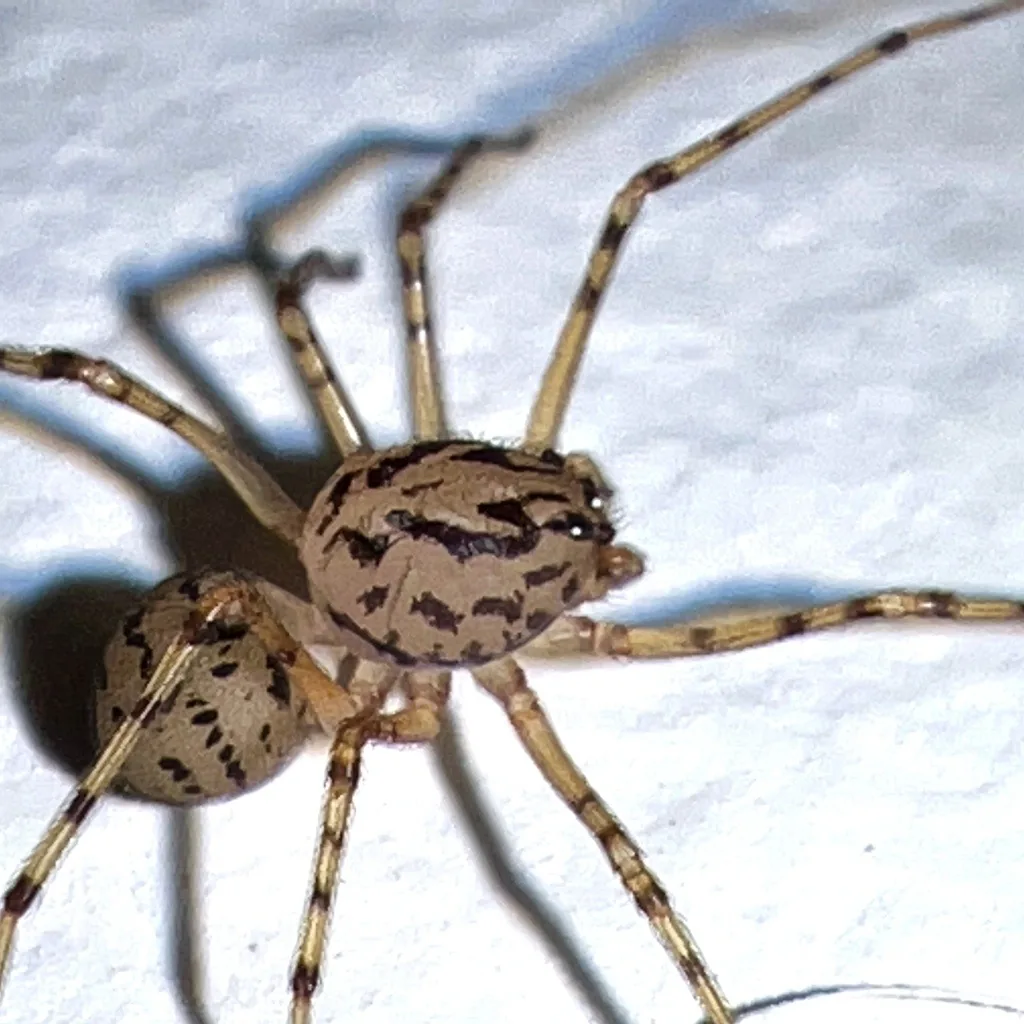
How to identify it
- The body is light brown or yellow with many black marks, and the legs are long and lack large spines.[1]
- The rear of the front body section is swollen into a high dome, which houses the venom and glue glands.[1][2]
- It has six eyes, arranged in three pairs, like a recluse spider.[1][2]
- It walks very slowly, which makes it easy to catch when found indoors.[1]
Look-alikes
| Look-alike | How to tell them apart |
|---|---|
| Brown recluse | Both have six eyes in pairs, but the spitting spider is covered with black spots or lines and has a strongly domed front body section; a recluse has a uniformly colored abdomen.[2] |
| Woodlouse spider | Another six-eyed spider, but its eyes form two groups of three and its body has no markings.[2] |
Where it lives
Found in and around buildings. Illinois lists it as a common native spider, and researchers have collected it at many sites across the southern half of the United States.[1][4]
Biology and life cycle
After creeping close to an insect, it spits a mixture of glue and venom that sticks the prey to the surface it is standing on, then bites it and backs away to wait.[1]
The spit is ejected from openings near the fangs as two zigzag bands, and a full spit takes less than 30 milliseconds.[4]
In lab measurements the spit left the fangs at up to 28.8 meters per second, and its silk strands then shrank by 40 to 60 percent, tightening around the prey.[4]
Adults are present in summer.[1]
Damage and signs
Health risk
Its spit is a tool for catching insects. UC IPM notes that the jaws of most spiders are too small to bite people, and that a spider bite is usually no worse than a bee sting.[4][3]
Control
Keep them out
Seal cracks in the foundation and gaps around windows and doors, and keep screens in good repair to keep out spiders and the insects they eat.[3]
Sanitation
Cut clutter indoors and next to the foundation, and keep stored boxes taped shut, off the floor and away from walls.[3]
Traps and physical control
Remove a spider found indoors by placing a jar over it, sliding paper under the opening and releasing it outside, or simply vacuum it up.[3]
Pesticides
Pesticides aren't generally needed against spiders, and sprays give only temporary control unless paired with regular cleaning.[3]
Common questions
- Does the spitting spider really spit?
- Yes. It sprays insects with a sticky mixture of silk, glue and venom from its fangs, pinning them down before it bites.[1][4]
- Is a spotted six-eyed spider a brown recluse?
- Probably not. Spitting spiders share the recluse's six-eye pattern but are covered with black spots and lines, while recluses have plain abdomens.[2]
Sources
- Illinois Department of Natural Resources, “Spitting Spider, Scytodes thoracica (Wild About Illinois Spiders: Family Scytodidae).” dnr.illinois.gov/education/wildaboutpages/wildaboutinvertebrates/wildaboutspiders/family-scytodidae/waspspittingspider.html (accessed 2026-10-06)
- University of California Statewide IPM Program, “Pest Notes: Brown Recluse and Other Recluse Spiders, Publication 7468 (revised November 2018).” ipm.ucanr.edu/legacy_assets/PDF/PESTNOTES/pnbrownrecluse.pdf (accessed 2026-10-06)
- University of California Statewide IPM Program, “Spiders (Pest Notes, Home and Landscape).” ipm.ucanr.edu/home-and-landscape/spiders/ (accessed 2026-10-06)
- Suter RB, Stratton GE; Journal of Insect Science (PubMed Central), “Spitting Performance Parameters and Their Biomechanical Implications in the Spitting Spider, Scytodes thoracica (Journal of Insect Science 9:62, 2009).” pmc.ncbi.nlm.nih.gov/articles/PMC3011943/ (accessed 2026-10-06)
- iNaturalist, “Scytodes thoracica taxon page (order and family).” www.inaturalist.org/taxa/57450 (accessed 2026-10-06)