On this page
How to identify it
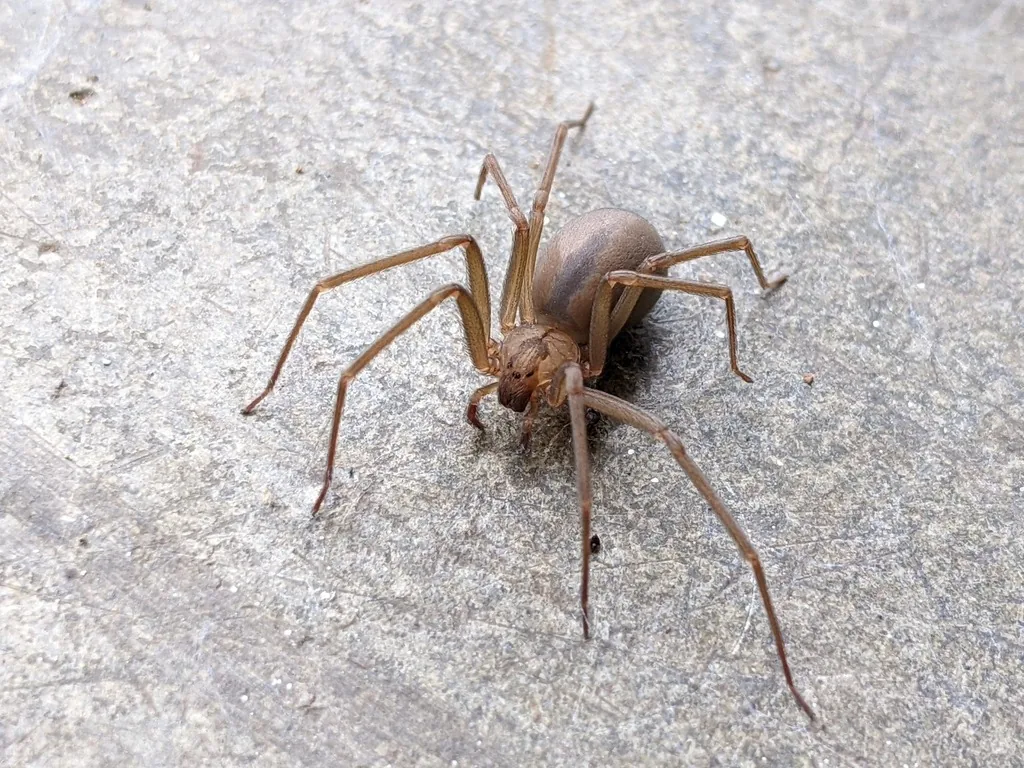
- Six eyes arranged in three pairs (most spiders have eight); this is the most reliable feature and needs a hand lens.[2][1][4][6][5]
- A dark violin-shaped mark on the front body section, with the neck pointing toward the abdomen; consistent in adults but faint in some related species. Illinois public health says the mark develops as the spider grows and is not present in young brown recluses.[1][2][4]
- Uniformly colored abdomen covered with fine hairs and no pattern; uniformly colored legs without spines; body no more than 3/8 inch. Illinois public health adds that the legs are not spiny or banded like those of many spiders it is confused with.[2][4]
- With legs extended, about the size of a U.S. quarter; tan to dark brown. MedlinePlus gives a length of 1/4 to 3/4 inch, while UC says the body is no more than 3/8 inch.[1][5][2]
Look-alikes
| Look-alike | How to tell them apart |
|---|---|
| Wolf spiders and other brown spiders | Have eight eyes, and often banded or spiny legs or patterned abdomens.[1][2][4] |
| Cellar spiders and other 'violin' look-alikes | May have dark marks on the head region but lack the six-eye pattern.[2] |
| Desert recluse | A native recluse of the Sonoran and Mojave deserts in southern California. It has the same six eyes in three pairs, but the violin marking is very faint.[2] |
Where it lives
Found throughout the south-central and Midwestern U.S.; other recluse species occur in the Southwest and southern California. There are no brown recluse populations in California, and recluses are rare outside their native range.[1][2]
Biology and life cycle
It hunts at night without a web and hides by day in dark, undisturbed places, lining retreats with irregular webbing. Illinois public health says females build flat retreat webs, while males roam in search of prey.[1][4]
Egg sacs hold about 40 to 50 eggs; spiders mature in about a year and live 2 to 4 years. Illinois public health says a female needs to mate only once and can produce 150 or more spiderlings in a year.[1][4]
Indoors it hides in clutter, boxes, closets, behind baseboards, in attics, basements and crawl spaces, and survives months without food. Illinois public health adds that they favor wooden surfaces, such as inside furniture, cardboard boxes, wall voids and the framing of crawl spaces, basements and attics.[1][4]
Most homes become infested when recluses hitchhike in on furniture, boxes and other items, not by walking over from another house; they don't balloon on silk the way many spiders do. Illinois public health says one hitchhiking female is enough to start an infestation, while Kentucky says spiders carried outside their native range seldom become established.[4][1]
Males and older juveniles wander farther than females, so they are the ones most likely to end up in shoes, clothing and bedding.[1][4]
Damage and signs
- Shed skins with an outstretched look, found along joists, sills and stored items, help confirm an infestation.[1]
- Numbers vary widely, from one or a few spiders to several hundred, and Illinois public health says hundreds may live in a house without being seen because of their nocturnal, hiding habits.[1][4]
Health risk
Brown recluses aren't aggressive and bite only when pressed against the skin, for example when trapped in clothing or bedding. Illinois public health says the bite is usually painless and many bites cause only redness and swelling, with severe tissue death (necrosis) probably in fewer than 10 percent of cases. In serious cases the venom destroys skin and leaves an ulcer that can take many months to heal. Deaths are extremely rare and mostly in young children. Many other conditions, including Staphylococcus aureus infections, Lyme disease and diabetes, can cause wounds that look like recluse bites.[6][4][5]
Control
Prevention
Inspect furniture and boxes before moving them in from another building. Shake out clothing, shoes, towels and gear before use, wear gloves and long sleeves when handling stored materials, and keep stored clothing in tightly closed plastic bags.[4][6]
Keep them out
Move firewood and debris away from the foundation and seal gaps under doors, around vents and utility lines, and under siding. Illinois public health also suggests sealing around fireplaces, crawl space and attic doors, and where cabinets, counters and baseboards meet walls.[1][4]
Sanitation
Reduce clutter so there are fewer hiding places, and wear gloves and long sleeves when sorting stored boxes. Store items in plastic bags or tubs that seal tightly, and inspect clothing and bedding that hasn't been used for a while before using it.[1][4]
Traps and physical control
Use many flat glue traps along walls, in corners and behind furniture to find where spiders are and to catch them, especially wandering males. Illinois public health says you can't use too many: 50 or more in an average home is not excessive. Kentucky says to set them before applying insecticides.[1][4]
Pesticides
Pesticides should go into cracks and voids where recluses hide, with dusts for wall voids. Spraying baseboards alone fails, and foggers are generally ineffective because the fog can't reach spiders hidden deep inside items and may drive them deeper.[4][1]
When to call a professional
Because they hide in so many places, infestations are difficult to eliminate and treatment is best done by professionals, using dusts and sprays applied into cracks and voids. Illinois public health says elimination can take months, and that complete eradication may be virtually impossible in some buildings short of fumigation.[1][4]
If you think a brown recluse bit you
MedlinePlus says to seek medical care right away: call 911 or the Poison Help line (1-800-222-1222). A bite may not look serious at first but can take time to become severe.[5]
Until help is reached, wash the bite with soap and water, put ice wrapped in a clean cloth on it (10 minutes on, 10 minutes off), keep the area still, and remove rings and other tight jewelry. CDC/NIOSH also suggests elevating the bite area if possible and not trying to remove venom.[5][6]
Bring the spider in a secure container if you safely can, so it can be identified.[5][6]
Illinois public health describes the usual course: redness, swelling and burning within an hour, sometimes a blister, then a hardened lump up to 2 inches across within 24 hours, with healing typically within eight weeks. Skin that turns purplish suggests necrosis, which usually shows up within four days.[4]
CDC/NIOSH advises keeping tetanus boosters up to date (every 10 years), because spider bites can become infected with tetanus spores.[6]
Common questions
- Can a doctor tell a recluse bite by looking at it?
- Not reliably. Illinois public health says many conditions cause similar wounds, so a diagnosis is difficult or impossible without a witnessed bite and a spider identified by someone who knows the species, and bites reported outside the spider's range are especially doubtful.[4]
- Do brown recluses live in California?
- No. Fewer than 20 verified specimens have been collected there in decades; native desert recluses occur in southern desert areas.[2]
- Is a brown recluse bite an emergency?
- MedlinePlus says to get medical treatment right away and to call 911 or Poison Help (1-800-222-1222), because a bite can take time to become severe. Most bites stay mild, but a few cause tissue death.[5][4]
- Can you live with brown recluses and not get bitten?
- Yes. Illinois public health says people can live in a house with thousands of brown recluses without being bitten, because the spiders hide and run rather than bite.[4][1]
Sources
- University of Kentucky Entomology, “ENTFACT-631: Brown Recluse Spider.” entomology.mgcafe.uky.edu/ef631 (accessed 2026-11-11)
- University of California Statewide IPM Program, “Pest Notes: Brown Recluse and Other Recluse Spiders, Publication 7468 (revised November 2018).” ipm.ucanr.edu/legacy_assets/PDF/PESTNOTES/pnbrownrecluse.pdf (accessed 2026-11-11)
- iNaturalist, “Loxosceles reclusa taxon page (order and family).” www.inaturalist.org/taxa/50181 (accessed 2026-11-11)
- Illinois Department of Public Health, “Brown Recluse and Black Widow Spiders.” dph.illinois.gov/topics-services/environmental-health-protection/structural-pest-control/brown-recluse-black-widow-spiders.html (accessed 2026-11-11)
- MedlinePlus, U.S. National Library of Medicine, “Brown recluse spider (Medical Encyclopedia).” medlineplus.gov/ency/article/002859.htm (accessed 2026-11-11)
- CDC, National Institute for Occupational Safety and Health (NIOSH), “Venomous Spiders at Work.” www.cdc.gov/niosh/outdoor-workers/about/venomous-spiders.html (accessed 2026-11-11)