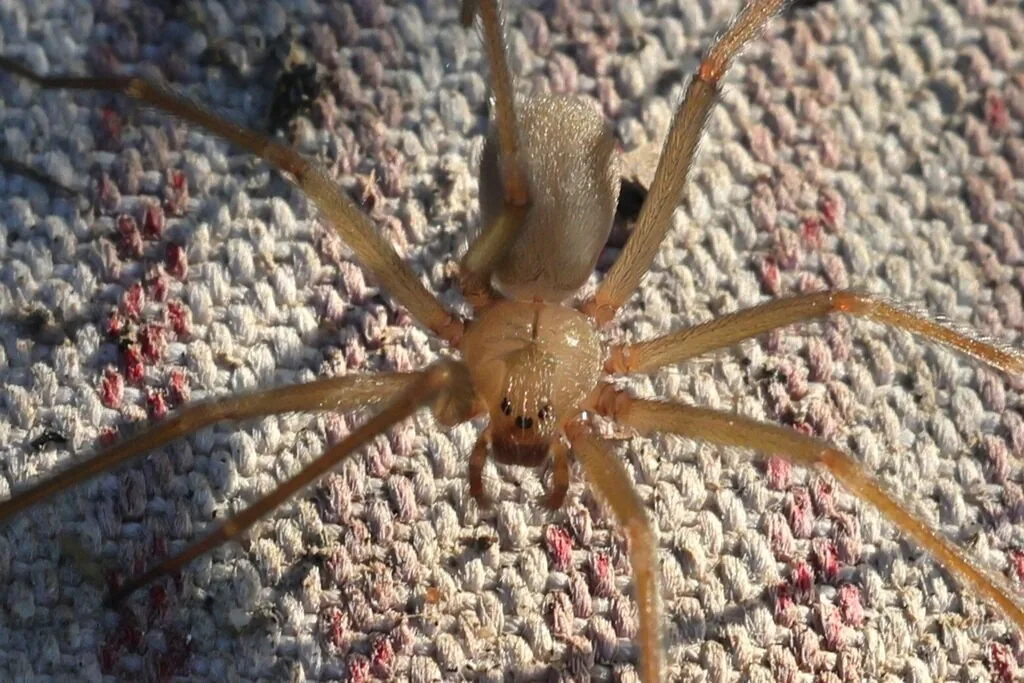
How to identify it
- Recluse spiders have six eyes arranged in three pairs: one pair at the front of the head and one pair on each side, with gaps between them.[1][2]
- The abdomen is covered with fine hairs and is one uniform color, from light beige to dark brown, with no pattern.[1]
- Legs are uniformly colored, covered in fine hairs and lack stout spines.[1]
- The body is 1/4 to 1/2 inch long by Utah State's measure; UC IPM notes recluse bodies are no more than 3/8 inch.[2][1]
- The violin-shaped marking on the head region, so obvious on brown recluses, is very faint to absent on the desert recluse.[1]
Look-alikes
| Look-alike | How to tell them apart |
|---|---|
| Brown recluse | Has a well-defined violin marking and lives in the south-central Midwest, not in the desert Southwest; telling recluse species apart requires an expert with a microscope.[1] |
| Spitting spiders | Share the six-eye pattern but have many black spots or lines and a strongly domed head region.[1] |
| Woodlouse spider | Has six eyes in two groups of three rather than three pairs, and no body markings.[1] |
| Cellar spiders | Some have a violin-like mark on the head, but they have eight eyes and dark markings on the abdomen.[1] |
Where it lives
Found mostly in the Sonoran and Mojave deserts, the foothills of the lower San Joaquin Valley and nearby Mexico; in Utah, only in Washington County.[1][2]
Biology and life cycle
Recluses build small webs that alert them to passing prey, hide in silk retreats by day, and hunt at night.[1]
Desert recluses live outdoors in native vegetation and pack rat dens and feed on small live insects and occasionally larger dead ones.[2]
Around people, recluses shelter under trash cans, plywood, tarps, tires and in storage boxes; 12 desert recluses were once collected under a single doghouse.[1]
Recluse spiders mature in about a year, usually live 2 to 4 years, and can survive 6 to 12 months without food.[1]
Where conditions suit them, recluse populations tend to be dense: if you find one, you usually find many.[1]
Damage and signs
Health risk
UC IPM says the desert recluse's venom is similar to the brown recluse's and should be considered equally potent. A bite can cause a necrotic ulcer that takes several weeks to heal.[1][2]
Control
Prevention
Confirm you actually have desert recluses before attempting control; most suspected recluses turn out to be other spiders.[1]
Move the bed away from the wall, remove bed skirts and items under the bed, shake out clothes and shoes, and store seldom-used gear in sealed bins.[1]
Keep them out
In homes with attached garages, seal cracks around doors and the holes for electrical conduit and plumbing.[1]
Sanitation
Remove outdoor trash and clutter such as woodpiles, boxes, plywood, tires and trash cans, especially next to the house.[1]
Reduce other insects that serve as food, and prune vegetation around buildings to limit habitat.[2]
Traps and physical control
Sticky traps along baseboards, out of reach of children and pets, catch spiders and show how many are present.[1]
Pesticides
Spraying works poorly unless you hit the spider directly; crushing it is just as easy and far less toxic indoors.[1]
Bites and misdiagnosis
If you are bitten or develop symptoms, call a physician or go to an emergency room, and bring the spider for identification if you can.[2]
Most brown recluse bites only cause inflammation; about 10 percent cause moderate or worse tissue damage and scarring.[1]
UC IPM recommends simple first aid for most recluse bites: rest, ice or cold, compression and elevation.[1]
Many wounds blamed on recluses are actually bacterial infections such as MRSA, which need correct diagnosis and treatment.[1]
Multiple sores at once, repeated sores over weeks, or several people affected point away from a spider bite.[1]
Common questions
- Is the desert recluse as dangerous as the brown recluse?
- Its venom is considered equally potent, but it is rarely found indoors, so UC IPM rates it a minor concern.[1][2]
- Does the desert recluse have a violin marking?
- Usually only a very faint one or none at all, so the six-eye pattern is a far better clue than the violin.[1]
- How do I get a spider identified?
- Keep it intact: freeze it, soak it in rubbing alcohol for a few days, then rinse it with water before mailing, since mailing in alcohol is not allowed.[1]
Sources
- University of California Statewide IPM Program, “Pest Notes: Brown Recluse and Other Recluse Spiders, Publication 7468 (revised November 2018).” ipm.ucanr.edu/legacy_assets/PDF/PESTNOTES/pnbrownrecluse.pdf (accessed 2026-10-06)
- Utah State University Extension, Utah Plant Pest Diagnostic Lab, “Desert Recluse Spider (Loxosceles deserta), IPM nuisance pest note.” extension.usu.edu/planthealth/ipm/notes_nuisance/desert-recluse-spider (accessed 2026-10-06)
- iNaturalist, “Loxosceles deserta taxon page (order and family).” www.inaturalist.org/taxa/50182 (accessed 2026-10-06)