How to identify it
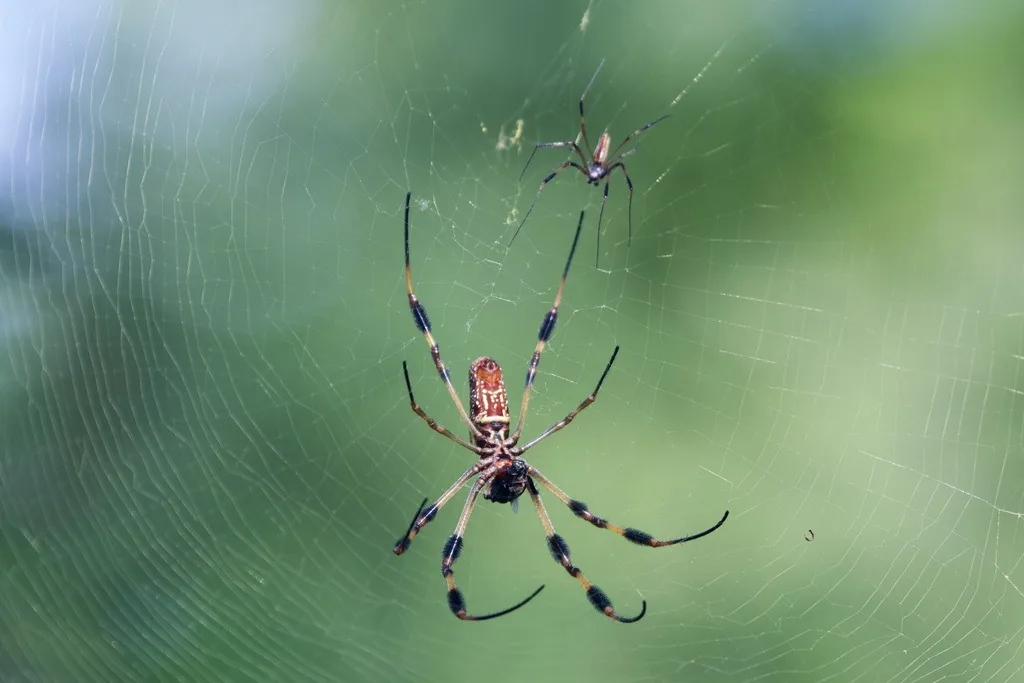
- Females are perhaps the largest orb weavers in North America; UF/IFAS gives a body length of about 1 to 1 1/2 inches (24 to 40 mm).[1]
- With their legs spread wide, females can be larger than a person's palm.[2]
- The front body section is silvery white, and the long, cylindrical abdomen is yellow to dull orange or tan with yellow spots.[1][2]
- The long legs are banded brown and orange, with brushy tufts of hair on some segments that give them a bottlebrush look.[1][2]
- Males are slender, dark brown and only about 1/4 inch long; they are often found in a female's web.[1]
- The large, fine-meshed web has a golden tint, and the spider waits near the top of it rather than the center.[1][2]
Look-alikes
| Look-alike | How to tell them apart |
|---|---|
| Joro spider | The Joro, an invasive Asian relative, also spins golden webs but has horizontal silver stripes on the abdomen and no bottlebrush tufts on its legs.[2] |
| Yellow garden spider | A black-and-yellow garden spider that builds webs in sunny spots at about knee height, usually with a thick white zigzag down the middle.[2] |
Where it lives
Throughout Florida and the Gulf States, north to North Carolina, and south through the West Indies and Central America to Argentina. It is the only species of its genus in the Western Hemisphere.[1]
Biology and life cycle
Webs, often about 3 to 6 feet across, are strung in open woods, at forest edges, across trails and sometimes between utility wires.[1]
Unlike many orb weavers, it keeps and repairs the same web rather than rebuilding it daily.[1]
It catches flies, bees, wasps, small moths and butterflies, beetles and dragonflies.[1]
There is one generation a year in temperate areas. Adult males appear July to September, and most females mature in August.[1]
In fall, females lay at least two egg sacs of several hundred eggs, wrapped in curly yellow silk and tucked under leaves or other cover.[1][2]
To avoid overheating, the spider can point its long body at the sun, and its silvery front section reflects sunlight.[1][2]
Damage and signs
Health risk
It bites only if held or pinched. The bite causes local pain and slight redness that fade quickly, and is milder than a bee sting.[1][2]
Control
Prevention
Where webs aren't in the way, leave them; these spiders catch insects, including some that pester people, pets and crops.[2][3]
Traps and physical control
Remove webs from doorways or paths with a broom or a strong spray of water.[3]
Pesticides
UC IPM advises against routine insecticide use on spiders outdoors because it won't give long-term control.[3]
Common questions
- Why is it called a banana spider?
- Clemson Extension notes that the bright yellow abdomen is likely why people call it a banana spider.[2]
- Is the golden silk orb weaver dangerous?
- No. It is docile and would rather flee than bite. A rare bite is similar to or milder than a bee sting and isn't known to need medical care.[2][1]
- Is it the same as the Joro spider?
- No. They are related, but the golden silk orb weaver is native while the Joro spider is an invasive species from East Asia.[2]
Sources
- University of Florida, UF/IFAS Extension (EDIS), “Golden Silk Spider, Trichonephila clavipes (Linnaeus), EENY-229 (Featured Creatures, revised January 2020).” edis.ifas.ufl.edu/publication/IN467 (accessed 2026-10-06)
- Clemson Cooperative Extension Home and Garden Information Center, “Big Yellow Spiders in South Carolina (HGIC 2503, revised November 20, 2024).” hgic.clemson.edu/factsheet/big-yellow-spiders-in-south-carolina/ (accessed 2026-10-06)
- University of California Statewide IPM Program, “Spiders (Pest Notes, Home and Landscape).” ipm.ucanr.edu/home-and-landscape/spiders/ (accessed 2026-10-06)
- iNaturalist, “Trichonephila clavipes taxon page (order and family).” www.inaturalist.org/taxa/904336 (accessed 2026-10-06)