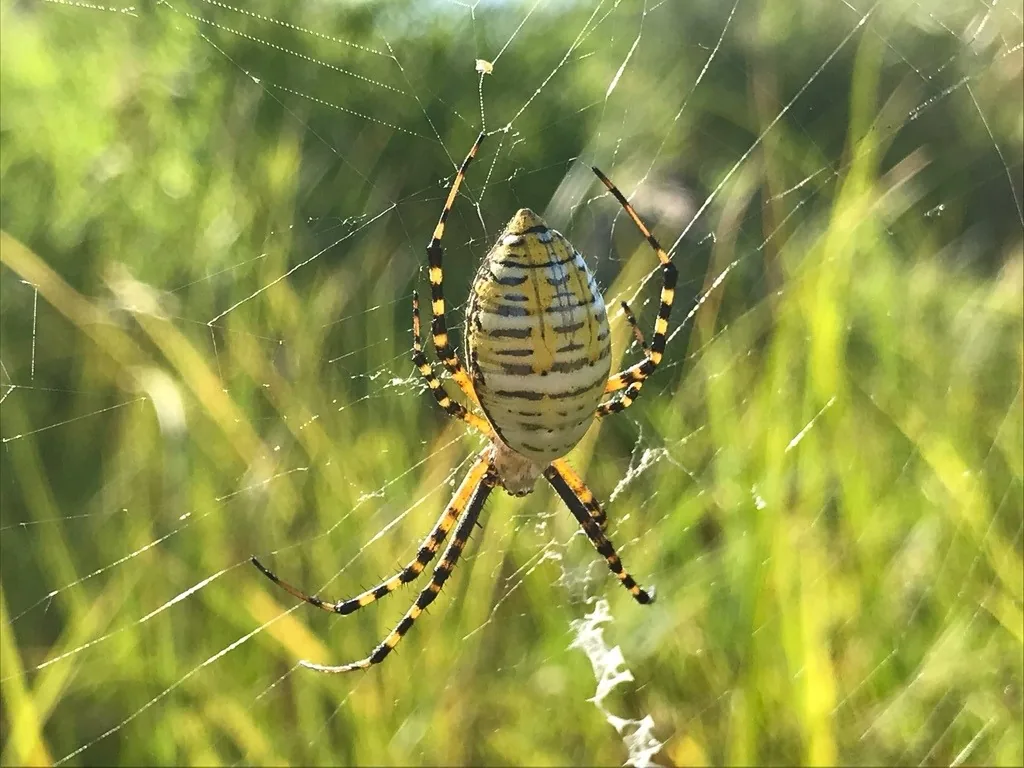
How to identify it
- Females are 15 to 25 mm long, slightly smaller than the yellow garden spider; males are only 4 to 5 mm, with mostly white abdomens.[1]
- The front body section is covered in silvery hairs, and the oval abdomen is pale yellow to silver with many thin black crossbands.[1]
- The legs are pale yellow with darker spots or bands, and the egg sac is shaped like a kettledrum.[1]
Look-alikes
| Look-alike | How to tell them apart |
|---|---|
| Yellow garden spider | Slightly larger, with humps or a notch at the front of the abdomen that the banded garden spider lacks.[1] |
Where it lives
Where the habitat suits it, it's found throughout the United States.[1]
Biology and life cycle
Adults are seen from mid- to late summer until the first freeze; egg sacs of several hundred eggs are laid in early fall, and the young emerge the next spring.[1]
Most webs run east to west, and the spider hangs head-down at the center with its abdomen facing south, which is thought to help it soak up warmth late in the year.[1]
Its web is about the size of the yellow garden spider's, and the zigzag band of silk may be missing or vary in shape.[1]
Damage and signs
- Spiders are beneficial insect eaters, and orb weavers rarely come indoors, though they often live on or near the outside walls of buildings.[2]
Health risk
It isn't known to be medically important; a bite is unlikely unless someone handles a female guarding her egg sac, and would feel no worse than a bee sting for most people.[1]
Control
Prevention
Outdoor lights draw the insects spiders eat, so keep light fixtures off walls and away from windows and doors where you can.[3]
Traps and physical control
Sweep, hose or vacuum unwanted webs off the house; spiders are beneficial, feeding mostly on small insects.[3][2]
Common questions
- Is the yellow, silver and black striped spider in my garden dangerous?
- A banded garden spider isn't known to be medically important and is unlikely to bite unless handled.[1]
- How is it different from the yellow garden spider?
- It's a bit smaller, its abdomen is banded with thin black stripes, and it lacks the yellow garden spider's humps.[1]
Sources
- Penn State Extension, “Banded Garden Spider.” extension.psu.edu/banded-garden-spider (accessed 2026-10-06)
- University of Kentucky Entomology (ENTFACT), “ENTFACT-622: Common Spiders Found Around Homes and Buildings.” entomology.mgcafe.uky.edu/ef622 (accessed 2026-10-06)
- University of California Statewide IPM Program, “Spiders (Pest Notes, Home and Landscape).” ipm.ucanr.edu/home-and-landscape/spiders/ (accessed 2026-10-06)
- iNaturalist, “Argiope trifasciata taxon page (order and family).” www.inaturalist.org/taxa/67708 (accessed 2026-10-06)