The short answer
- Indoors: sweep or vacuum them up. Spraying inside isn't recommended because it won't stop more from coming in, and earwigs don't breed indoors.[1][2][3]
- Dry things out: repair drain spouts and drainage, water less often but more deeply, and pull back mulch, leaves, woodpiles and mats from the foundation.[1][2][3][8]
- Seal the way in: caulk cracks at ground level, especially around doors, windows, faucets, vents and where siding meets the foundation, and add weather stripping.[2][3][7][8][9]
- Trap them in the garden: set rolled-up newspaper, corrugated cardboard or short pieces of hose near plants at dusk, then shake the earwigs into soapy water in the morning. A low tuna or cat food can with about 1/2 inch of oil, sunk to soil level, also works. Repeat daily.[1][2]
- Only worry in the garden if you grow vegetables, flowers, sweet corn or soft fruit. In yards of lawn, trees and woody shrubs, earwig damage is unlikely to matter, and earwigs eat aphids.[1][7]
- Baits and sprays are a last step. UC IPM rates spinosad baits and sprays as the most effective, environmentally sound option, but says baits often don't work well when other food is around. Most sources say indoor spraying won't stop earwigs coming in; NC State says indoor crack-and-crevice treatments kill them but only for a short time.[1][2][8]
Earwig profiles
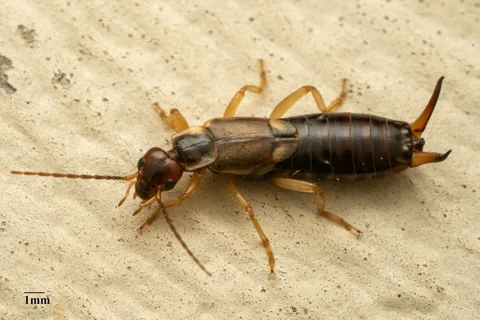 European Earwig
Forficula auricularia
The European earwig, introduced from Europe in the early 1900s, is a familiar garden insect that feeds at night and hides in dark, moist places by day; it damages seedlings and soft fruit but also eats aphids. Clemson says it is the most common earwig pest around homes, and Minnesota says it was first noticed there in the early 1990s.
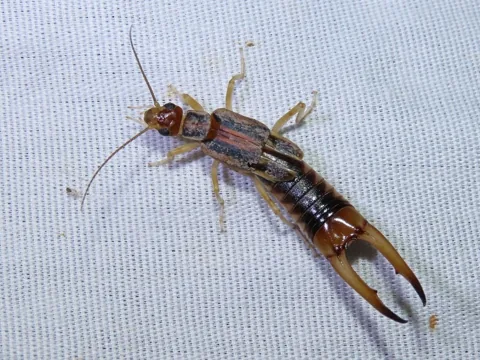 Striped earwig
Labidura riparia
The striped earwig, also called the shore earwig, is a predatory earwig of the South. It hunts small insects and doesn't damage plants, but it can annoy people when it is drawn to lights, and it smells very bad when crushed.
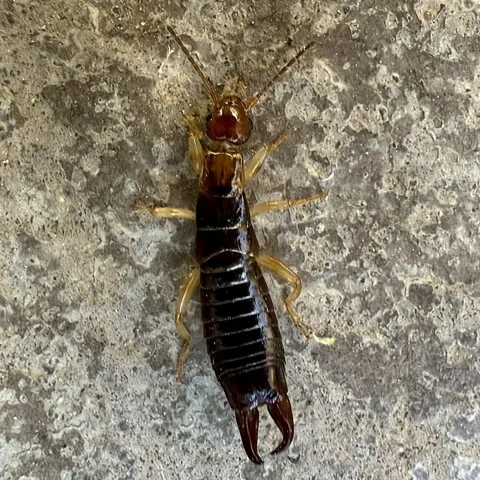 Ringlegged Earwig
Euborellia annulipes
The ringlegged earwig is a wingless earwig found in the South and well beyond. It is both a predator of garden pests and an occasional minor plant feeder, so it is mostly a nuisance.
What an earwig looks like (and males vs. females)
The insect most people find is the European earwig, Forficula auricularia. UC IPM says it was accidentally brought into North America from Europe in the early 1900s, and Colorado State says it was established in the eastern United States around 1907 and has been in Colorado since the 1950s. Clemson calls it the most common earwig pest around homes, and UC IPM the most common species in California gardens. Clemson counts 28 earwig species in the United States; the Missouri Department of Conservation says nearly 30 occur in North America and about half were introduced from elsewhere.[1][7][3][9]
- Size and color: a flat, reddish-brown body; Colorado State and NC State describe a reddish head. Sources give different lengths: about 3/4 inch (UC IPM), about 5/8 inch (Minnesota and Colorado State) or 1/2 to 3/4 inch (NC State).[1][2][7][8]
- Pincers: a pair of forceps-like appendages, called cerci, at the tip of the abdomen. Earwigs use them for defense and to grab and hold prey.[1][2][9][8]
- Male: stout, strongly curved pincers that are widely separated at the base. Colorado State says males use them to fight rival males and other insects, and Missouri says the shape and size of the male's pincers help tell species apart.[2][1][7][9]
- Female: slender, straighter pincers that sit close together.[2][1]
- Wings: most adults have fan-shaped wings folded under very short, hard wing covers, and some species are always wingless. UC IPM says they seldom fly and NC State that they rarely fly, but the Missouri Department of Conservation says the European earwig has working wings and can fly.[1][2][3][8][9]
- Nymphs: look like small, wingless adults with slender, straight pincers. Minnesota says they are generally lighter in color than adults, and NC State describes them as white to olive-green.[1][2][3][8]
- Smell: earwigs can give off a foul odor from a liquid released from the abdomen.[2]
Other earwigs you might see
A few other earwigs show up around homes, mostly in the South.[3][8]
- Striped earwig (Labidura riparia): found in the South and in Southern California, where it annoys people when it is drawn to lights. It has a very disagreeable odor when crushed, doesn't damage plants, and Clemson counts it as beneficial because it feeds on aphids, scales, mites and other small insects.[1][3]
- Ringlegged earwig (Euborellia annulipes): a southern species usually found outdoors, though Clemson says it can become a pest of moist, improperly stored grain products. NC State gives a length of 1/2 to 3/5 inch and describes dark crossbands on the legs; Missouri says it is dark brown with light yellow, dark-ringed legs, and that US members of the species lack wings. Colorado State says it shows up only in the far south of that state.[3][8][9][7]
- Some earwigs have yellow or tan stripes on the legs or body, and some species never grow wings.[3][8]
Do earwigs crawl into your ears?
No, not in the way the old story claims. The name comes from an ancient superstition that earwigs burrow through the ear canal of sleeping people and eat their brains; NC State calls it a European superstition, and the Missouri Department of Conservation traces the name to the Old English ēare wicga, "ear insect". Clemson calls it a false superstition and says earwigs cannot burrow into people, Missouri calls the belief completely incorrect, and Colorado State says the stories have little basis in fact.[6][8][9][3][7]
An earwig can still wander into an ear by accident. A 2021 case report from Korea describes a 24-year-old man woken by ear pain and ringing; doctors found an earwig crawling in his outer ear canal and lifted it out with ear forceps, and his eardrum, ear canal and hearing were normal. The authors conclude the superstition is unfounded but that earwigs sometimes do enter the ear.[6]
Do earwigs pinch or bite?
Rarely, and not hard. UC IPM says earwigs generally don't attack people, though they can bite if trapped in clothing or sat upon. Clemson says they can give you a little nip if you pick one up, and Colorado State that they have been known to cause a mildly painful bite when sat upon or handled. Minnesota Extension says they can't use their pincers to attack, can grab onto objects but can't squeeze very hard, and are harmless to people.[1][3][7][2]
They don't damage property or food in the house, and large numbers indoors are a nuisance rather than a health hazard.[2][1][9]
Why earwigs come indoors
Earwigs move inside when it gets too dry, too hot or too cold outdoors; NC State points to dry, hot weather. In Minnesota they come in mostly in July and August, sometimes in large numbers, and can keep coming in all summer. Colorado State says problems there run from mid-July through mid-September.[1][8][2][7]
Moisture is the common thread. Earwigs do poorly in hot, dry conditions, and indoors Clemson finds them around moisture problems at doors, windows and garages, under carpets that stay wet, and in plants brought in from outside.[3][8]
They don't set up house. Minnesota says earwigs don't reproduce indoors, UC IPM says they eventually die inside because there is little for them to eat, and NC State says they don't usually become established indoors except in areas of high moisture. So a steady trickle through the summer means more are still getting in from outside.[2][1][8]
- Hitchhiking: NC State says earwigs often ride in on laundry baskets, cut flowers, luggage, newspapers, cardboard boxes, lumber, baskets of fruit and vegetables, and cars.[8]
- Where to look: NC State says to check under sinks, dishwashers and tubs and around doors and windows where moisture might draw them, and that earwigs are usually found in damp places such as crawl spaces and basements. Colorado State lists rugs, potted plants and stacks of newspapers as typical indoor hiding places.[8][7]
Earwig life cycle and seasons
Sources describe the timing differently. Minnesota Extension says earwigs mate in the fall and spend the winter together in nests, and in early spring the female forces the male out and lays her eggs; Clemson says they mate in the spring. UC IPM says females dig cells in the soil in fall and winter to lay theirs, and NC State says the eggs go into a chamber in the upper 2-3 inches of soil in spring or autumn. Clutch sizes differ too: 30 or more eggs (UC IPM), 30 to 50 (Clemson) or 20 to 50 (NC State). UC IPM says females produce two broods and Clemson that they may produce several batches. Minnesota says the eggs hatch in about a week.[2][3][1][8]
The mother guards her eggs, cleans fungus and mold spores off them, and protects and feeds the young nymphs for a short time after they hatch, which is unusual for an insect. In Minnesota nymphs leave the nest from late May to early June and become adults by late June or early July. Clemson gives two to three months for the young to become adults and up to seven months of adult life. There is generally one generation a year. NC State says both eggs and adults spend the winter in the soil below the frost line, and Missouri says earwigs live for about a year.[3][2][1][8][9]
In the hottest parts of California earwigs may be fairly inactive in summer, and in milder climates some stay active all year.[1]
Garden damage, and when earwigs help
Earwigs eat dead and living plants and animals. Damaged seedlings may be missing leaves or stems, and older leaves get irregular holes or chewed edges. They chew holes in flowers such as zinnias, marigolds, dahlias, butterfly bush and hostas, eat corn silks (which prevents pollination and causes poor kernel development), and gouge soft fruit such as apricots, strawberries, raspberries and blackberries. They don't harm hard fruit such as apples.[1][2]
Earwig damage is easy to blame on something else. Slugs and snails leave slime trails and earwigs don't; caterpillars leave webbing, frass or pupae; Minnesota adds cutworms and rabbits as look-alikes. Go out at night with a flashlight to see who is feeding. The Missouri Department of Conservation gives the same advice: make sure earwigs are the real culprits before acting.[1][2][9]
- The good side: earwigs are voracious feeders on aphids and other soft-bodied insects and insect eggs, and UC IPM says they can give significant biological control under some circumstances.[1]
- Colorado State says the main food of earwigs is insects, that they only occasionally injure leafy plants such as lettuce and some flower blossoms, and that they are often found with damage caused by other insects, because leaves curled by aphids and holes in fruit are favorite hiding places. NC State notes that some earwigs prey on aphids while others feed on living plants.[7][8]
- In orchards: a study by Washington State University, Oregon State University and USDA researchers describes the European earwig as a minor pest of stone fruit but a key predator of pests in apple and pear orchards. Releasing earwigs trapped in stone fruit orchards into apples and pears was followed by fewer woolly apple aphids and pear psylla. Broad-spectrum spray programs leave many orchards with few or no earwigs, and they are slow to come back.[4]
- In a four-year trial in two organic apple orchards in Spain, releasing 30 earwigs per tree each season in corrugated cardboard shelters shortened woolly apple aphid colonies, but only from the second year on.[5]
- UC IPM's advice follows from this: keeping earwigs out of fruit trees isn't always a good idea unless the tree bears soft fruit.[1]
Do you need to do anything?
Often not. UC IPM says earwigs don't need managing in many situations. Act if you grow vegetables, annual or other herbaceous flowers, sweet corn, or soft fruit such as strawberries and apricots, or if they keep getting into the house. If your garden is mostly lawn, trees, native plants and woody ornamentals, earwig damage is unlikely to be a concern.[1]
Trapping earwigs
Trapping is the core of earwig control in the garden. Put out plenty of traps near shrubs, ground covers, fences and wherever you have seen earwigs, and keep at it every day until you stop catching earwigs. UC IPM says daily trapping brings numbers down to tolerable levels. Colorado State says trapping may help reduce numbers.[1][7]
- Rolled newspaper, corrugated cardboard, bamboo tubes or a short piece of hose: lay them on the soil near plants just before dark and shake the earwigs into a pail of soapy water in the morning. You can also drop them into a sturdy plastic bag and crush them.[1][2][7]
- Baited shelters: Colorado State says adding food such as wheat bran or wheat germ, both effective in its trials, can greatly improve how much earwigs use a trap, and suggests moistened newspaper; collect these traps every 2-3 days and bag the catch. NC State uses a cardboard box baited with oatmeal or bran, with pencil-size holes punched in the sides near the bottom.[7][8]
- Oil pit trap: UC IPM uses a low-sided can, such as a tuna or cat food can, with about 1/2 inch of oil in the bottom, sunk so the rim is at soil level. Fish oil such as tuna oil is very attractive to earwigs, or use vegetable oil with a drop of bacon grease. Colorado State uses a small cup of vegetable or fish oil sunk into the ground, with the oil kept at least an inch below the surface so earwigs have to crawl deep into the cup, where many drown. Dump the catch and refill with oil.[1][2][7]
- Burlap and covers: UC IPM uses folded newspaper or burlap bags at the base of fruit tree trunks to show how many earwigs are around, and NC State lays burlap bags, canvas or newspapers in mulch and shrubbery and collects the earwigs the next day.[1][8]
- Indoors: NC State suggests ordinary sticky traps set under sinks or in other damp spots where you have seen earwigs.[8]
- Set expectations: Minnesota warns that when numbers are high you may still have earwig problems after doing all this. In stone fruit orchards, mass trapping with rolled cardboard didn't reduce earwig numbers or substantially cut fruit damage, though it was an efficient way to collect earwigs to release elsewhere.[2][4]
Cut the moisture and the hiding places
Earwigs are moisture-loving insects; UC IPM notes they wouldn't normally thrive in California's dry climate without the shade and water of irrigated gardens. Clemson calls keeping things drier one of the best nonchemical controls and says removing, reducing or drying out their hiding places gives the best long-term control.[1][3][8]
- Water deeply and less often so the soil surface stays drier, use drip irrigation where you can, and make sure drainage and sprinklers are working properly.[2][1]
- Keep water away from the house: repair drain spouts and make sure gutters carry water away from the foundation, grade soil so water runs away from the foundation, and ventilate crawl spaces. NC State adds damp spots around outdoor faucets and air-conditioning units.[1][8]
- Watch the mulch. Mulches often harbor earwigs; reduce excess mulch and limit mulch and leaves next to buildings.[1][3][7][8]
- Make a dry border. NC State suggests a clean, dry border right against the foundation, such as a 12-18-inch gravel strip, and Colorado State says clearing mulch and debris next to the house, especially near doorways and window wells, works best when the area is also kept fairly dry.[8][7]
- Clear hiding places: leaves (including leaves in gutters), boards, bricks, lumber and woodpiles, boxes, trash, piles of newspapers, stepping stones and wet outdoor mats. Move flowerpots and other objects that shelter them.[1][2][3][9]
- Don't let dense ground covers such as ivy grow next to vegetable gardens or up walls, and keep weeds, brush and suckers away from the base of fruit trees.[1]
- Fix indoor moisture problems too, such as carpets that stay wet; Missouri also suggests reducing moisture in the basement.[3][9]
Keep them out of the house
Find how they are getting in and seal it. Caulk and repair cracks and gaps around the outside of the house at ground level, paying special attention to doors, windows, water faucets, vents and the line where siding meets the foundation. Weather stripping around doors and windows helps.[2][1][3][7][8][9]
If earwigs gather at outdoor lights, switch white bulbs to yellow or sodium vapor bulbs, which attract them less. NC State also suggests reducing lighting around doors, windows and other entry points.[1][8]
When a few still get in, sweep or vacuum them up and dispose of them promptly so they don't wander off again. Clemson says hand removal or vacuuming is usually all that's needed when only a few are inside.[1][3][2][8]
Protecting soft fruit and stone fruit trees
Earwigs climb trunks to reach ripening fruit. UC IPM suggests a band of sticky barrier material around the trunk, scraping loose bark off the lower trunk of older trees, keeping weeds and suckers away from the base, pruning properly, thinning heavy crops, and picking fruit as soon as it ripens. Colorado State adds a spot treatment on the ground around the base of the tree, which kills earwigs as they cross it. The sticky tree band guide covers how to put bands on safely.[1][7]
Baits and insecticides
Most sources put chemicals after moisture control, trapping and sealing, and see little point in spraying indoors: UC IPM says indoor treatments do little to prevent invasions, Minnesota says once earwigs are inside pesticides aren't effective, and Clemson says insecticides give only temporary control. NC State is less dismissive of indoor treatment. It says residual insecticides in cracks and crevices, along baseboards and beneath cabinets kill earwigs easily, but control is short-term because more keep coming in, so indoor treatment should only supplement outdoor work.[1][2][3][8]
Whatever you use, choose a product with earwigs and the site you're treating on the label, and follow the label directions.[3][1][2][8]
- Spinosad baits and sprays: UC IPM's first choice where insecticides are wanted. Scatter bait around susceptible plants before they're infested, or along the foundation where earwigs get in; dampening it after application can make it more attractive. Baits often fail where other food is plentiful, and once earwigs are already in plants or ripening fruit, baits are unlikely to control them.[1]
- Carbaryl: UC IPM calls it more toxic and usually unnecessary if the cultural steps are followed; since August 1, 2020 carbaryl products are restricted-use in California. Minnesota lists a carbaryl bait scattered around plants, and Colorado State says carbaryl baits broadcast around the base of plants are effective and generally have fewer effects on non-target organisms than sprays.[1][2][7]
- Foundation barrier: Minnesota suggests a residual insecticide such as permethrin or cyfluthrin around the foundation of the building. NC State describes treating the bottom 18-24 inches of the foundation wall and possibly a 3-6 foot band of ground next to it, and Colorado State says barrier treatments near entry points can supplement sealing and cleanup.[2][8][7]
- Granular baits: NC State says some granular baits for earwigs, crickets and cockroaches can be used outdoors, that they are not the same as granular insecticides used for grubs, and that if you use them you shouldn't treat the same areas with regular insecticides.[8]
- Mulch beds: Minnesota suggests a lambda-cyhalothrin drench on the mulch where earwigs hide, and Clemson suggests granules or liquid sprays worked down into the mulch or leaf litter.[2][3]
- Voids you can't caulk: Clemson suggests lightly puffing an insecticide dust into gaps around doors and walls to kill earwigs as they try to enter. Minnesota lists permethrin or deltamethrin dusts.[3][2]
- Timing: to protect bees and get the best effect, UC IPM says to apply at night and before the infestation is severe. Colorado State says applications later in the day may work best because earwigs are active at night.[1][7]
Common questions
- Are earwigs harmful?
- No. They can nip if picked up, trapped in clothing or sat upon, but they can't squeeze very hard and don't damage property or food. In gardens they can chew seedlings, flowers, corn silks and soft fruit.[1][3][2][7][9]
- Do earwigs go in your ears?
- The idea that they burrow into ears is an old superstition and they can't burrow into people. An earwig can occasionally crawl into an ear canal by accident, as one 2021 case report describes; it was removed without injury.[3][6][9]
- Why am I suddenly seeing earwigs in my house?
- Usually because it's hot, dry or cold outside and they are seeking shelter, often in midsummer. Look for damp spots near doors, windows and the foundation, heavy mulch against the house, or plants brought in from outdoors.[1][2][3][8]
- Do earwigs lay eggs in the house?
- No. Earwigs don't reproduce indoors; females lay their eggs in nests in the soil outdoors.[2][1][8]
- How do I tell a male from a female earwig?
- Look at the pincers. Males have stout, strongly curved pincers spread apart at the base; females have slender, straighter pincers close together.[2][1]
- What is the best homemade earwig trap?
- A rolled-up newspaper or piece of corrugated cardboard set near plants at dusk and emptied into soapy water in the morning, or a low can with about 1/2 inch of fish or vegetable oil sunk to soil level. Check them every day.[1][2]
- Are earwigs good for the garden?
- Partly. They eat aphids and other soft-bodied insects and are counted as key predators in apple and pear orchards, but they also damage seedlings, flowers, sweet corn and soft fruit.[1][4][7]
- Can earwigs fly?
- Some can. UC IPM says most species have wings but seldom fly, and NC State says earwigs rarely fly, while the Missouri Department of Conservation says the European earwig has working wings and can fly. Some species never have wings, and young earwigs are always wingless.[1][8][9][3]
Photo credits
- European Earwig: Jesse Rorabaugh, public domain (CC0), via iNaturalist
- Striped earwig: (c) Bob Miller, some rights reserved (CC BY) — via iNaturalist, CC BY 4.0
- Ringlegged Earwig: sealgyu, public domain (CC0), via iNaturalist
Sources
- University of California Statewide IPM Program, “Earwigs (Pest Notes 74102; M. L. Flint).” ipm.ucanr.edu/home-and-landscape/earwigs/ (accessed 2026-11-11)
- University of Minnesota Extension, “Earwigs.” extension.umn.edu/garden-and-home/yard-and-garden/yard-and-garden-insects/earwigs (accessed 2026-11-11)
- Clemson Cooperative Extension Home & Garden Information Center, “Earwigs (HGIC 2421).” hgic.clemson.edu/factsheet/earwigs/ (accessed 2026-11-11)
- Insects, via PubMed, “Hanel et al. (2023), Turning a pest into a natural enemy: removing earwigs from stone fruit and releasing them in pome fruit enhances pest control, Insects 14(12):906.” pubmed.ncbi.nlm.nih.gov/38132580/ (accessed 2026-11-11)
- Insects, via PubMed, “Alins et al. (2023), Earwig releases provide accumulative biological control of the woolly apple aphid over the years, Insects 14(11):890.” pubmed.ncbi.nlm.nih.gov/37999089/ (accessed 2026-11-11)
- Cureus, via PubMed, “Jeong, Shin and Kim (2021), Earwig crawling in the ear: myth or truth, Cureus 13(5):e14827.” pubmed.ncbi.nlm.nih.gov/34094780/ (accessed 2026-11-11)
- Colorado State University Extension, “European Earwigs (CSU Extension; based on Fact Sheet 5.533).” extension.colostate.edu/resource/european-earwig/ (accessed 2026-11-11)
- NC State Extension, “Earwigs (Household Pests; M. Waldvogel, P. Alder and C. Hayes; 2008, reviewed 2023).” content.ces.ncsu.edu/earwigs (accessed 2026-11-11)
- Missouri Department of Conservation, “Earwigs (Field Guide).” mdc.mo.gov/discover-nature/field-guide/earwigs (accessed 2026-11-11)