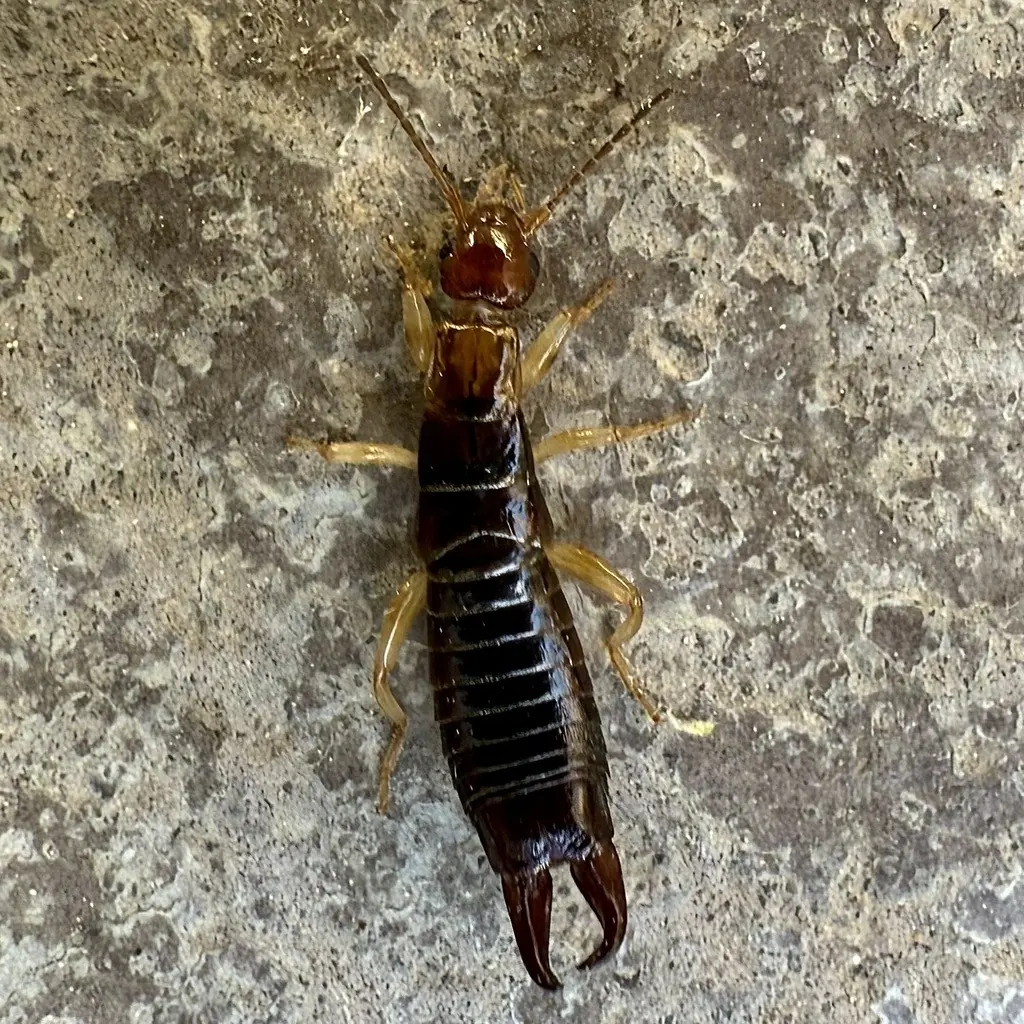
How to identify it
Look-alikes
| Look-alike | How to tell them apart |
|---|---|
| Winged earwigs | Florida's common Doru earwigs have wings; the ringlegged earwig has none.[1] |
Where it lives
First found in the U.S. in 1884, it's now widespread in the southern states and Hawaii and known from many northern states.[1]
Biology and life cycle
Earwigs are nocturnal; females lay eggs in a small soil cell and guard them until shortly after hatching.[1]
Adults are long-lived and can survive over 200 days.[1]
Damage and signs
Health risk
UF/IFAS describes it mainly as a nuisance and mentions no risk to people.[1]
Control
Biological control
It eats caterpillars, beetle larvae, leafhoppers and sowbugs, so control is rarely warranted.[1]
Pesticides
Most residual insecticides kill it, and it takes bran baits; baits sold for mole crickets also work.[1]
Common questions
Sources
- University of Florida IFAS Extension (Featured Creatures), “Ringlegged Earwig, Euborellia annulipes (EENY-088).” edis.ifas.ufl.edu/publication/IN245 (accessed 2026-10-06)
- iNaturalist, “Euborellia annulipes taxon page (order and family).” www.inaturalist.org/taxa/196419 (accessed 2026-10-06)