The short answer
- Never put sticky material directly on bark. Wrap the trunk with duct tape or another nonporous band first, with paper underneath on thin-barked trees, and coat the wrap.[2][4][7]
- Cankerworms: band just before the wingless females climb. NDSU's North Dakota timing is early to mid-September for fall cankerworm and mid-March for spring cankerworm; Penn State bands for fall cankerworm in late fall. NDSU says banding isn't an effective control but gives early warning, and UMass says it is useful for monitoring but may not give the control you want.[1][5][6]
- Spongy moth: the sources differ on timing. UW-Madison puts sticky bands on in late April, just after hatch, then switches to burlap collection bands in early June and scrapes the hiding caterpillars into soapy water. UMass waits until the caterpillars are about an inch long, roughly early to mid-June, and changes the bands often through July.[2][7]
- Ants: a sticky band keeps ants out of trees and shrubs, once branches touching buildings or other plants are trimmed so the trunk is the only way up.[4][10][11]
- Spotted lanternfly: Penn State recommends circle traps, and a USDA trap study recommended them too. If you use a sticky band, cover it with a window-screen guard and check it often: every day by Penn State's advice, at least once a week by Cornell's.[3][9][8]
Pests trunk bands catch
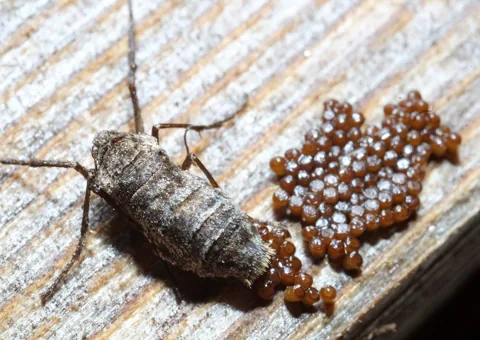 Cankerworms (fall cankerworm)
Alsophila pometaria
Cankerworms are small inchworm caterpillars that feed on tree leaves and buds each spring. They usually go unnoticed, but every few years outbreaks severely defoliate landscape and forest trees; the fall cankerworm, the more common species, is the focus here.
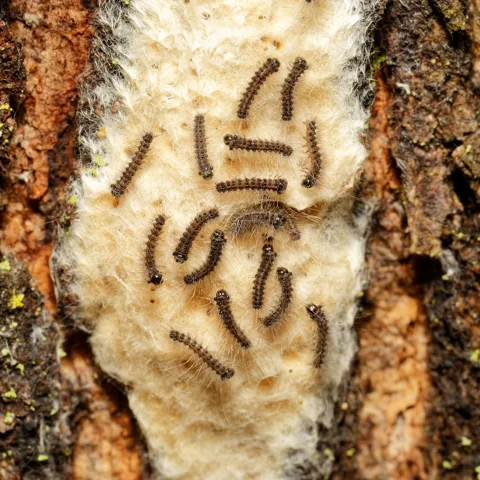 Spongy Moth
Lymantria dispar
The spongy moth, formerly called the gypsy moth, is an invasive defoliator from Europe whose caterpillars feed on the leaves of hundreds of kinds of trees and shrubs, oaks above all. Management changes with the season to target whichever life stage is present.
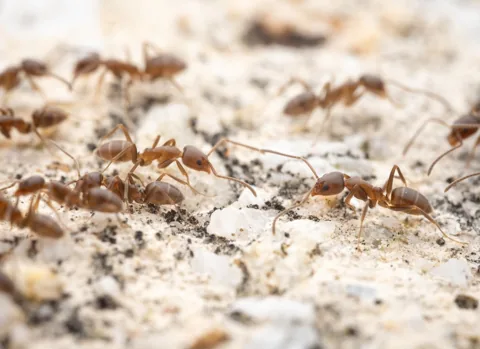 Argentine Ant
Linepithema humile
The Argentine ant is the most common ant in and around homes in California; its nests are linked into huge multi-queen supercolonies. It is native to Argentina and Brazil. Texas A&M says it was discovered in New Orleans in 1891, is now established in many places in the southern United States, and has been found in Arizona, California, Illinois, Maryland, Missouri, Oregon, Texas and Washington.
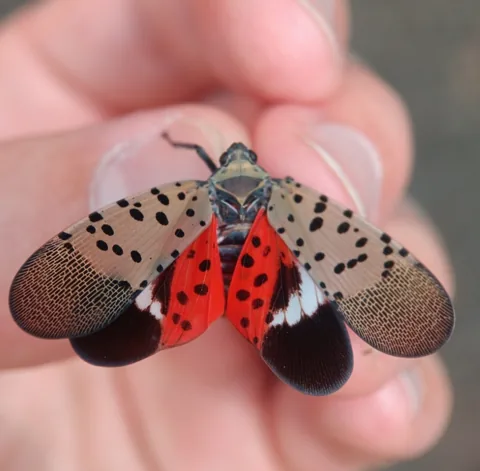 Spotted Lanternfly
Lycorma delicatula
The spotted lanternfly is an invasive planthopper from Asia that feeds on the sap of grapevines, hops, stone fruit trees, hardwoods and many landscape plants. It can't bite or sting, but it hitchhikes easily: females lay eggs on almost any hard outdoor surface, including vehicles, trailers, grills and firewood.
How trunk bands work
Bands catch insects that have to crawl up the trunk. Cankerworm females are wingless and must climb their host tree to lay eggs, so a band traps them before they reach the upper trunk and branches.[1][5][6]
Small spongy moth caterpillars climb back into trees after ballooning or falling, and a sticky band stops them on the way up.[2]
Ants climb trees and shrubs for honeydew from aphids or soft scales, for floral nectar, or for ripening or rotting sweet fruit.[4]
Spotted lanternflies get caught in sticky material as they move up the tree.[3][9][8]
A band only works if the trunk is the only route. Where the canopies of several trees touch, NDSU says every trunk must be banded, and Penn State notes that cankerworm bands don't always work, especially with unbanded infested trees nearby. UC IPM advises trimming branches that touch structures or other plants so ants are forced to climb the trunk.[1][5][4]
Bands don't stop anything that arrives through the air. UMass points out that newly hatched spongy moth caterpillars can balloon on the wind into tall trees and settle to feed, and Cornell notes that lanternfly egg masses may already be in the canopy above a trap and that adults can fly into the upper branches without climbing the trunk.[7][8]
A full band stops working. Once the sticky surface is covered, insects walk across on the bodies: UMass says living spongy moth caterpillars crawl over dead ones, Cornell says lanternfly nymphs and adults walk over a band covered in captured nymphs, and UC IPM says debris and dead ants clogging the coating let ants cross.[7][8][4]
Putting a band on without harming the tree
- Don't put sticky material directly on the trunk; UMass warns it can injure the tree or shrub. Wrap a band of duct tape or other nonporous material around the trunk and coat that instead.[2][7]
- On thin-barked, young or sensitive trees, tie butcher paper or paper bags around the trunk before the tape goes on, or use a collar of heavy paper, duct tape or fabric tree wrap under the sticky coating.[2][4]
- NDSU's cankerworm band is 3 to 4 inches wide, goes completely around the trunk, and sits about 5 feet above the ground.[1]
- Tree-banding adhesive comes as a paste, which spreads easily with a putty knife and suits a new band, and as an aerosol that's handy for refreshing an old band.[1]
- Reapply the sticky coating as needed: rain and weather wear it down, and it needs renewing when the band gets covered with caterpillars.[2]
- Keep the coating working. UC IPM says to check it every one or two weeks for ants and stir it with a stick so debris and dead ants don't clog it, and UMass says spongy moth bands need frequent cleaning and replacing, especially in June.[4][7]
- Homemade bands of duct tape, or petroleum jelly on water-resistant paper, lose their stickiness easily. Penn State says they're less effective than commercial sticky bands and can let lanternflies escape.[3]
Keeping birds and other animals off the band
Sticky material isn't selective. Penn State warns that bands can catch beneficial insects, pollinators, butterflies, small birds, bats, squirrels and lizards, and it doesn't recommend sticky bands at all without a wildlife barrier.[3][8]
Cornell IPM agrees that a band for lanternflies needs a barrier against beneficial insects and birds, and adds that stronger glue, which holds the bigger lanternflies, is also more likely to catch pollinators, squirrels, bats and birds. A narrower band gives larger animals less sticky surface to touch.[8]
- Build a guard over the band from mesh netting such as window screening; Penn State and Cornell both describe vinyl window screening. Penn State says chicken wire doesn't work because small birds and pollinators pass through it, although Cornell lists a chicken-wire cage as one way to limit unwanted catches.[3][8]
- Pin the screening to the tree at the top, pleating it to fit, and leave the bottom open so insects can walk in. It should reach several inches above and below the band and stay close to the trunk all the way around, so larger animals can't fly or climb underneath.[3][8]
- Some commercial bands use a fibrous batting that holds the inward-facing sticky side away from the trunk, protecting the sticky surface and reducing the chance of catching birds and other animals.[3]
- Check sticky bands often. Penn State says every day; Cornell's minimum is at least once a week, and regular checks also let you deal with anything caught by mistake.[3][8]
- If an animal gets stuck, don't try to free it yourself; you could hurt it and yourself. Cover any exposed sticky material with plastic wrap or tissue paper, take the band off the tree as carefully as you can, and bring the animal to a wildlife rehabilitation center.[3][8]
Cankerworms
In North Dakota, NDSU bands trees in early to mid-September to catch fall cankerworm females and again in mid-March for spring cankerworm. In shelterbelts, it bands three or four trees along the row as soon as the snow melts and checks them weekly.[1]
Timing follows the moths, so it shifts with region. NDSU's adult fall cankerworms emerge from late September through October, and spring cankerworm moths usually come out in the last week of March in North Dakota. UMass's insect guide gives spring cankerworm adults as active from February into March and fall cankerworm adults from late November into early December, sometimes January, and says bands put up just before each species' females become active can be used for monitoring. Penn State says to band in late fall to catch fall cankerworm females before they lay eggs.[1][6][5]
The band traps climbing females and keeps them from laying eggs higher in the tree, but NDSU says banding isn't an effective control of cankerworms; use it for early detection. If large numbers are trapped, serious defoliation is likely, and management may be warranted when the larvae begin feeding.[1]
The other sources are just as cautious. UMass says banding may be useful for monitoring but may not give the level of control you want, and Penn State says it doesn't always work, especially with unbanded infested trees nearby.[6][5]
Spongy moth
Expect some feeding anyway. UMass says a sticky barrier won't keep every caterpillar off the tree or guarantee no leaves are eaten, and that traps and bands may help with monitoring but don't give effective control of spongy moth, especially in high-population years.[7]
- Late April: put sticky barrier bands on trunks just after the eggs hatch, while the caterpillars are small. Sticky barriers can keep trapping caterpillars from April into the summer.[2]
- UMass times it differently: put bands up once the caterpillars are about an inch long, roughly early to mid-June, and leave them up, changing them often, through July until the caterpillars pupate. It says the method works best for an owner who can check and change the bands frequently.[7]
- Early June: replace the sticky bands with collection bands. Take a strip of medium-weight, neutral-colored cloth or burlap about 12 to 18 inches wide and long enough to wrap the tree, tie the middle of it to the trunk at chest height with cord or twine, and fold the top half down over the bottom half.[2]
- Older caterpillars hide in these skirts during the day. Check them daily in mid to late afternoon and scrape the caterpillars into a container of soapy water.[2]
- Don't touch the caterpillars bare-handed. Their fine hairs can irritate skin and airways and can stay in clothing, so wash clothes that touched them separately.[2]
Ants in trees and shrubs
Lots of ants on a plant probably means they're after honeydew from aphids or soft scales. Banding the trunk with a sticky substance keeps them out of the tree or shrub.[4][11]
First trim branches so they don't touch structures or other plants, which forces the ants to climb the trunk. On young or sensitive trees, put the sticky material on a collar of heavy paper, duct tape or fabric tree wrap rather than on the bark.[4]
Other extension programs give the same advice. New Mexico State says a sticky barrier product or sticky tape on the base of a tree keeps ants away from aphids and scale insects they protect, and Minnesota Extension lists sticky barriers, or moats of soapy water, for keeping ants off plants. UC IPM adds that ant stakes with bait can also be used around trees.[11][10][4]
Spotted lanternfly: use a circle trap instead
Penn State recommends a funnel-style trap called a circle trap, bought or homemade, for spotted lanternfly. It doesn't recommend sticky bands, because they catch other animals, and it isn't known how much sticky bands reduce lanternfly damage.[3]
A USDA APHIS trap study found glue bands messy, needing frequent replacement as they fill with lanternflies, other insects and debris, and found that fourth-stage nymphs and adults can escape or avoid them. Circle traps caught more third and fourth instars and adults than an inward-facing commercial band, and the authors recommended circle traps for their catch, ease of use and reusability.[9]
Cornell IPM is more open to bands. Where lanternflies are absent or few, it says bands, especially on tree of heaven, work as both a monitoring and a management tool, because the first three nymph stages move up and down trunks. Where the insect is established, bands can't be the only tool, since full bands stop catching and older nymphs and adults walk over, jump or fly past them.[8]
Cornell cites Pennsylvania work in which bands about 4 feet from the base of the tree caught lanternflies going both up and down, and says traps are best set by early May to catch nymphs as they hatch. Less sticky bands catch young nymphs but let older ones walk over.[8]
If you band for lanternflies anyway, put a wildlife guard over the band and check it every day.[3]
Common questions
- Can I put tree-banding glue straight on the bark?
- No. Put the sticky material on a band of duct tape or other nonporous material wrapped around the trunk, with butcher paper or a paper collar underneath on thin-barked or young trees.[2][4][7]
- When should I band trees for cankerworms?
- Just before the wingless females climb, which depends on where you live. NDSU's North Dakota timing is early to mid-September for fall cankerworm and mid-March for spring cankerworm; UMass says to band just before the females are active, and Penn State bands in late fall for fall cankerworm. If the canopies of several trees intermingle, band all of their trunks.[1][6][5]
- A bird got stuck on my sticky band. What should I do?
- Don't try to free it yourself. Cover exposed sticky material with plastic wrap or tissue paper, remove the band carefully, and take the bird to a wildlife rehabilitation center. Guard any band you keep with window screening and check it daily.[3][8]
- Does petroleum jelly work as well as a commercial band?
- UW-Madison's spongy moth guide lists petroleum jelly as one coating for duct-tape bands, but Penn State says homemade duct tape or petroleum-jelly bands lose their stickiness easily and are less effective than commercial sticky bands against lanternflies.[2][3]
- Will a sticky band keep spongy moth caterpillars off my tree?
- Not completely. UMass says newly hatched caterpillars can balloon into the canopy, living caterpillars crawl over dead ones on a full band, and bands help more with monitoring than control, especially in outbreak years. Keep the bands clean and combine them with egg-mass removal and burlap collection bands.[7][2]
- Why are insects walking over my sticky band?
- The band is probably full or dirty. Insects cross on the bodies of earlier catches and on debris, so clean or replace the band. Older lanternfly nymphs and adults can also walk over less sticky bands.[7][8][4]
Photo credits
- Cankerworms (fall cankerworm): (c) Chris Baer, some rights reserved (CC BY) — via iNaturalist, CC BY 4.0
- Spongy Moth: (c) Patrick Hanly, some rights reserved (CC BY) — via iNaturalist, CC BY 4.0
- Argentine Ant: Philipp Hoenle, public domain (CC0), via iNaturalist
- Spotted Lanternfly: (c) Tyler Ekholm, some rights reserved (CC BY) — via iNaturalist, CC BY 4.0
Sources
- NDSU Extension, “Cankerworms in North Dakota (E999).” www.ndsu.edu/agriculture/extension/publications/cankerworms-north-dakota (accessed 2026-11-10)
- University of Wisconsin-Madison Extension, “Management Guide for Homeowners (Spongy Moth in Wisconsin).” fyi.extension.wisc.edu/spongymothinwisconsin/pest-management-2/management-guide-for-homeowners/ (accessed 2026-11-10)
- Penn State Extension, “Spotted Lanternfly Management Guide.” extension.psu.edu/spotted-lanternfly-management-guide (accessed 2026-11-10)
- University of California Statewide IPM Program, “Pest Notes: Ants (Publication 7411).” ipm.ucanr.edu/legacy_assets/PDF/PESTNOTES/pnants.pdf (accessed 2026-11-10)
- Penn State Extension, “Fall Cankerworm.” extension.psu.edu/fall-cankerworm (accessed 2026-11-10)
- UMass Extension Landscape, Nursery and Urban Forestry Program, “Paleacrita vernata (Spring), Alsophila pometaria (Fall): Insect & Mite Guide.” www.umass.edu/agriculture-food-environment/landscape/publications-resources/insect-mite-guide/paleacrita-vernata-spring-alsophila-pometaria-fall (accessed 2026-11-10)
- UMass Extension Landscape, Nursery and Urban Forestry Program, “Spongy Moth (fact sheet).” www.umass.edu/agriculture-food-environment/landscape/fact-sheets/spongy-moth (accessed 2026-11-10)
- Cornell University New York State IPM Program, “Spotted Lanternfly Management.” cals.cornell.edu/integrated-pest-management/outreach-education/whats-bugging-you/spotted-lanternfly/spotted-lanternfly-management (accessed 2026-11-10)
- Environmental Entomology (Entomological Society of America), “Developing Traps for the Spotted Lanternfly, Lycorma delicatula (Francese et al., Environmental Entomology 2020; PubMed abstract).” pubmed.ncbi.nlm.nih.gov/31990325/ (accessed 2026-11-10)
- University of Minnesota Extension, “Ants.” extension.umn.edu/insects-infest-homes/ants (accessed 2026-11-10)
- New Mexico State University Cooperative Extension Service, “Integrated Pest Management (IPM) Strategies for Common Insect Pests of Trees in New Mexico (Guide H-174).” pubs.nmsu.edu/_h/H174/index.html (accessed 2026-11-10)