The short answer
- Check whether you're in a quarantine area and follow your state's rules. Before you drive out of one, look over your vehicle and anything stored outdoors for egg masses, nymphs and adults.[4][8][1]
- From fall to spring, scrape egg masses you can reach into a bag or jar of rubbing alcohol or hand sanitizer, or smash them thoroughly.[1][4][11]
- From late April through June, put a circle trap on infested trees. Penn State doesn't recommend sticky bands; if you use one anyway, cover it with window screening and check it every day.[1][2]
- Swat, step on or vacuum lanternflies you can reach. New York tells residents of its infested counties to kill them on sight.[10][11][8]
- If you have tree-of-heaven, Penn State and New Jersey recommend removing it where practical, but only with a herbicide that kills the roots. Cutting alone brings back a thicket of sprouts.[1][8][3]
- Insecticides kill lanternflies easily but don't stop more from arriving. Use only registered products labeled for the site, never spray plants in bloom, and save systemic treatments for trees adults return to every year.[1][11]
- Outside the known range, photograph the insect, collect it if you can, and report it to your state agriculture department or call 1-888-4BAD-FLY.[1][6]
Spotted lanternfly and its predators
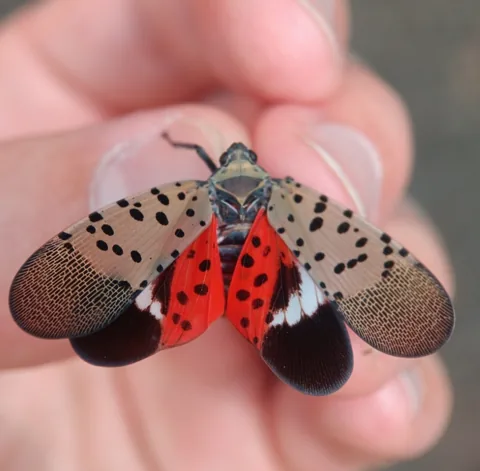 Spotted Lanternfly
Lycorma delicatula
The spotted lanternfly is an invasive planthopper from Asia that feeds on the sap of grapevines, hops, stone fruit trees, hardwoods and many landscape plants. It can't bite or sting, but it hitchhikes easily: females lay eggs on almost any hard outdoor surface, including vehicles, trailers, grills and firewood.
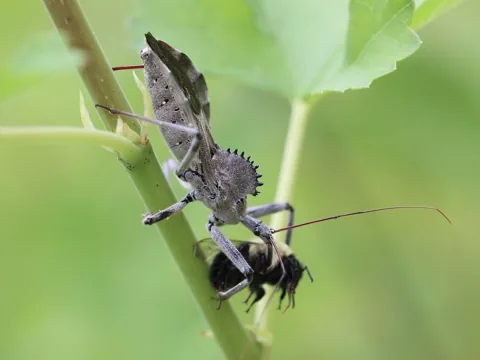 Wheel Bug
Arilus cristatus
The wheel bug is the largest assassin bug in North America, named for the toothed crest on its back. It hunts caterpillars and other insects, but it gives an immediately painful bite if handled carelessly.
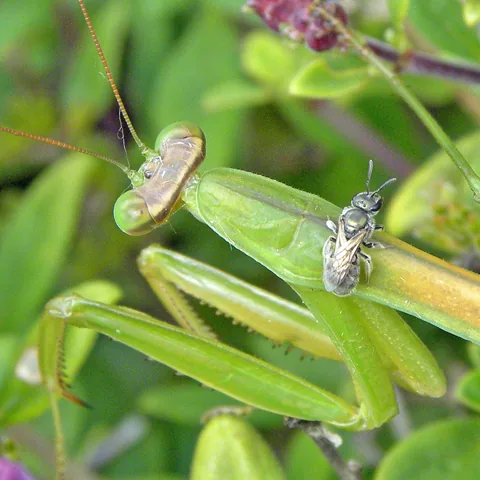 Praying Mantids
Mantidae (e.g., Tenodera sinensis, Mantis religiosa, Stagmomantis carolina)
Mantids are generalist predators. They catch pests, but they also eat bees, butterflies and other beneficial insects, and UC IPM says they're of no benefit for biological pest control.
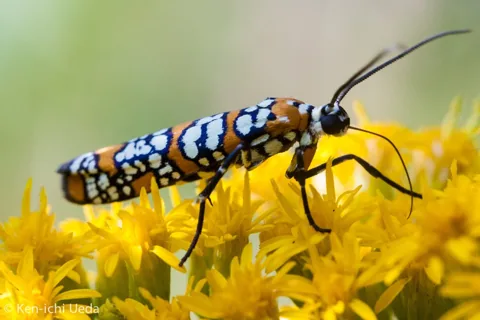 Ailanthus Webworm
Atteva aurea
The ailanthus webworm is a small, narrow orange moth with white black-ringed spots that visits flowers by day; its caterpillars live together in flimsy webs on tree-of-heaven (ailanthus). It is rarely numerous enough to defoliate its host.
Confirm it's a spotted lanternfly, and know what stage you're seeing
Spotted lanternfly (Lycorma delicatula) is a planthopper from Asia, first found in the United States in Berks County, Pennsylvania, in 2014. In Pennsylvania there is one generation a year, so what you find depends on the month. Our spotted lanternfly profile has photos and look-alikes.[1][6][9]
- Egg masses (September to June): flat, gray-brown patches like a smear of mud or putty, about 1 inch long according to APHIS and New Jersey; Cornell says they're typically about 1 1/2 inches long and 3/4 inch wide. APHIS, New Jersey and Cornell put 30 to 50 eggs in a mass, Penn State gives an average of about 35, and Cornell says a mass may contain up to about 60.[4][9][11][1]
- Young nymphs (hatch late April to June): black with white spots and no wings, about 1/8 inch when they hatch. Penn State says they can be mistaken for small ticks or spiders. Both nymphs and adults are strong jumpers.[1][9]
- Fourth-stage nymphs (July through September in New Jersey): bright red with black stripes and white spots, roughly 1/2 inch long.[9][1]
- Adults (July until hard freezes): about 1 inch long and 1/2 inch wide. The gray or light brown forewings have black spots; the hind wings, which show when they jump or fly, are red, black and white. At rest with wings closed they blend into bark.[4][1][9]
- Other clues: shiny, sticky honeydew dripping from trees, black sooty mold growing on it, a vinegar-like smell as it ferments, and wasps and bees drawn to it.[4][1][6]
How much harm they do, and whether you need to act
Penn State considers spotted lanternfly mainly a nuisance pest in residential landscapes. Heavy feeding has contributed to the death of grapevines, tree-of-heaven and black walnut saplings, but the insect isn't known to directly kill other plants; it stresses them, which matters more when a tree is already weakened by drought, disease or other insects. Cornell says lanternflies rarely damage landscape trees, so treatment isn't needed for the tree's health; people treat because of the mess and the numbers.[1][11]
A Penn State study caged lanternflies on young silver maples, weeping willows, river birches and tree-of-heaven for four straight seasons. Diameter growth and root starch dropped as feeding pressure rose. The authors called it a worst case: free lanternflies move between hosts and their numbers change from year to year, so they didn't expect effects that strong on forest or ornamental trees in natural settings.[18]
- A few on a large, healthy tree are unlikely to cause permanent damage, according to Penn State. Thousands might weaken a tree, though nobody has measured how many it takes.[1]
- Scout before you treat. Penn State says not every tree in an infested area needs treatment, and numbers can drop or rebound from one season to the next.[1]
- Watch for 'hot' trees. Adults often gather in large numbers for weeks on one favorite tree, and tend to return to it in later years. Those trees are where control efforts pay off most.[1]
- Vegetable and flower gardens: nymphs feed on plants such as cucumber, basil, rose, peony and Russian sage, but usually for less than a week before moving on. Penn State and New Jersey say damage shows up mainly when populations are high.[1][8]
- Honeydew and sooty mold under trees: pruning branches that hang over patios or pools cuts down on lanternflies and honeydew dropping onto them, according to New Jersey.[8][1]
Quarantine rules and reporting: what state agencies ask
Lanternflies spread farthest by hitchhiking. Females lay eggs on almost any hard outdoor surface, including vehicles, trailers, grills, firewood, outdoor furniture, bikes and toys, and nymphs and adults ride in cars. APHIS lists populations in 19 states and the District of Columbia, and several states have quarantines that restrict moving items out of infested areas. Quarantine maps change as new infestations are found, so check your state agriculture department for current rules.[4][1][8]
- Pennsylvania: the quarantine covers most counties. Businesses working in a quarantined county need a spotted lanternfly permit, which Penn State says carries no fee. Residents are asked to 'Look Before You Leave' and use the state's checklist to inspect vehicles, trailers and outdoor items before moving them.[1][6]
- New Jersey: all counties are quarantined, and businesses moving within or out of the zone need permits from the state agriculture department. Regulated items include firewood, logs and other plant parts, landscaping and construction waste, pallets and crates, and outdoor household items such as RVs, boats, mowers, grills and chairs.[8]
- New York: on October 2, 2018, the state set an external quarantine restricting goods and vehicles that could carry lanternflies from certain counties in Delaware, Maryland, New Jersey, Pennsylvania and Virginia.[10]
- Everyday habits that help: keep car windows closed when parked, park about 15 feet from trees in a quarantine zone if you can, check doors, bumpers, wheel wells, grills and roofs before leaving a parking lot, don't park or store things under infested trees, and don't move firewood. Our firewood guide covers storing it without bringing pests along.[4][8][1]
- Reporting outside the known range: take a photo, collect the insect if you can (freeze it in a bag, or drop it in a jar of rubbing alcohol or hand sanitizer), and report it to your state agriculture department or by calling 1-888-4BAD-FLY.[1][6][12][10]
- Where it's already established, reporting may not be wanted. New York asks residents of Dutchess, Nassau, Orange, Putnam, Rockland, Suffolk, Sullivan, Ulster and Westchester counties and New York City not to report sightings but to kill lanternflies by stepping on or crushing them; elsewhere in the state it still wants reports. APHIS says to destroy any you find in a known quarantine area.[10][5]
Destroying egg masses
Egg masses are the stage you can find and kill at leisure. Cornell suggests late fall, after freezes have killed the adults, through spring before hatch. Destroying them won't eliminate lanternflies from an area, but Penn State says each mass destroyed removes about 35 insects from next year's generation, and Cornell says scraping helps most early in the season.[11][1]
- Where to look: on and near trees where females fed in fall; Penn State names red maple, silver maple and willows as good places to start. Also check rocks, fences, decks, lawn furniture, rusty metal, vehicles, and the undersides of branches and objects.[1][11][4]
- How to kill them: scrape each mass with a scraper card or anything hard and flat into a bag or jar of rubbing alcohol or hand sanitizer and leave it there for good, or smash the eggs thoroughly. APHIS says to zip the bag shut and throw it in the trash. Cornell also lists doubled bags and burning.[1][4][11]
- Most are out of reach. Penn State cites research finding that less than 2 percent of egg masses on trees were within reach (up to 10 feet), and New Jersey says 80 to 90 percent of egg masses on trees are 10 feet or more above the ground. Penn State doesn't recommend climbing trees or using ladders to get the rest.[1][9]
- When Pennsylvania researchers cut down infested trees to count egg masses, they found them from 0.30 to 12.92 meters up on tree-of-heaven and from 0.70 to 17.00 meters up on black walnut, where 96.5% were on branches rather than the trunk.[15]
- Oil sprays on egg masses: Penn State reports that horticultural or dormant oil applied directly to egg masses at 3 percent or more killed up to 75 percent of treated eggs, with inconsistent results, and fall applications weren't better than February to April ones. For masses you can reach, scraping or smashing works better. Some plants are damaged by oil, so follow the label.[1][8]
Circle traps versus sticky bands
Nymphs are often knocked or blown out of the canopy, walk back to the trunk and climb it again. Trunk traps catch them on the way up. Penn State's recommended trap is a funnel-style circle trap made of screening, which steers climbing lanternflies into a bag or jar at the top. It uses no glue. Our sticky tree bands guide covers banding for other pests.[2][1][11]
- Why not sticky bands: Penn State doesn't recommend them because the glue catches pollinators, butterflies, birds, bats, squirrels and lizards, and it isn't known whether banding reduces lanternfly damage. Cornell says bands work only with a barrier, and they fill up: once covered in nymphs, more lanternflies walk across, and fourth-stage nymphs and adults often walk over or jump past them.[1][11]
- Research comparison: in a USDA study, circle trunk traps caught more third- and fourth-stage nymphs and adults than an inward-facing tree band, and the authors recommended them for effectiveness, ease of use and reuse. In a later multistate study, circle traps caught more adults than sticky bands at low-density sites in 2021, with no difference where populations were high.[13][14]
- When to set them: as soon as eggs hatch, late April through June (Penn State), or by early May (Cornell). Traps catch large numbers of nymphs; adults may avoid them, so they work less well later in the season.[1][11]
- Placement: about four feet up on a smooth-barked tree, snug to the trunk, with no gaps for lanternflies to crawl under. Deeply furrowed bark lets them slip beneath the trap, and bushes and most vines are too thin to hold one. Attach with staples, push pins or by wrapping tightly, not nails, and only on trees you own or have permission to use. Take every part down at the end of the season.[1][11][2]
- Homemade circle trap: Penn State's build uses a rectangle of window screen about 30 by 23 inches (plastic-coated works better than wire), two strips of wood, a length of coat-hanger wire to hold the skirt open, and a one-gallon zip bag on top. A clear bag lets in daylight, which draws lanternflies upward, and can be swapped out when full.[2]
- If you band anyway: Penn State says to build a guard of window screening pinned to the tree above the band, extending several inches above and below it and open at the bottom, and to check the band every day; chicken wire doesn't work because small birds and pollinators pass through it. Cornell describes a chicken-wire cage as one option and says to check bands at least once a week. Duct tape or petroleum jelly bands lose their stickiness and let lanternflies escape.[1][11]
- If an animal is stuck: don't try to free it yourself. Cover the exposed glue with plastic wrap or tissue paper, take down the band carefully and bring the animal to a wildlife rehabilitation center. Our page on glue traps explains why they're hard on animals.[1][11]
- Traps don't clear a tree. Egg masses in the canopy hatch above the trap, and adults can fly straight into the branches.[11]
Swatting, crushing and vacuuming
Physical removal at any life stage is one of the three tools Pennsylvania's agriculture department lists, along with tree-of-heaven removal and pesticides. New York and New Jersey tell residents to step on or crush lanternflies, and Penn State suggests swatting or trapping on individual trees instead of using insecticides.[6][10][8][1]
- Vacuums: Cornell suggests handheld, backpack or shop vacuums where pesticides would be a problem. Most lanternflies don't survive, but to be safe leave them in the vacuum a day or two before emptying it; they live only about two days away from plants, and longer than a few days brings a putrid smell. Vacuum gently around tender plants.[11][12]
- Skip homemade sprays. Penn State warns that recipes made from cleaning, automotive or cooking products can harm plants and the environment more than people realize.[1]
Tree-of-heaven: remove it, keep a few as trap trees, or leave it?
Tree-of-heaven (Ailanthus altissima) is the lanternfly's preferred host, and an invasive tree in its own right. New Jersey calls it the preferred, possibly required host; Penn State says lanternflies don't need it to complete their life cycle. Late-season adults also gather on other trees such as silver maple and willow.[4][9][1]
- How to recognize it: leaves 1 to 4 feet long with 10 to 40 smooth-edged leaflets, each with one or two small glandular bumps at the base, and a strong, foul smell when leaves or twigs are crushed. Bark is light brown to gray, like a cantaloupe rind. Staghorn sumac, black walnut and hickory look similar but have toothed leaflet edges.[3][4]
- Sources differ on removal. Penn State and New Jersey recommend removing tree-of-heaven where possible and practical, though Penn State notes removal hasn't been specifically tested as a way to manage lanternflies. Cornell, as of April 2019, did not recommend removal as a management tool: the trees help detect low populations, removal may push lanternflies onto more desirable plants, and a badly removed tree turns into a grove of root sprouts.[1][8][11]
- Trap trees: Pennsylvania's IPM approach removes most tree-of-heaven, including every female tree (females can produce more than 300,000 seeds a year), and leaves a few of the most attractive male trees treated with a systemic insecticide so lanternflies that feed on them die. A 2017 Pennsylvania calendar suggested leaving about 10% and warned that destroying all of them may shift lanternflies onto surrounding plants.[7][1][11][3]
- Cutting alone backfires: a cut tree sends up dozens of stump and root sprouts, root suckers can come up as far as 50 feet away, and Penn State says cut-stump herbicide treatments don't stop root suckering.[3][7]
- What works: a systemic herbicide applied in mid- to late summer (July until fall color), when the tree is moving sugars to its roots. Penn State recommends glyphosate or triclopyr for most jobs as foliar sprays on small growth, basal bark sprays on stems under 6 inches across (lower 12 to 18 inches of the stem), or hack-and-squirt on larger stems, with one cut per inch of diameter (at least two) and bark left intact between cuts.[3]
- If a tree has to come down, treat it first, wait about 30 days for symptoms, then cut. Expect follow-up treatment the next year. Pull seedlings by hand when the soil is moist and the whole root comes out.[3]
- Protect yourself: wear gloves and protective clothing. The sap can irritate skin, and Penn State notes rare reports of heart muscle inflammation (myocarditis) after sap got into broken skin; Pennsylvania's calendar also mentions headaches and nausea.[3][7]
Insecticides: when they make sense
Nymphs and adults are fairly easy to kill; Penn State says even soaps and oils work well. But killing the ones on your trees won't stop more from arriving later. Penn State suggests weighing the number of lanternflies, whether they're on a host they'll stay on, the plant's size and health, and the life stage before treating, and choosing the least toxic product that works. Cornell notes some people hire a certified applicator for injections, bark sprays or soil drenches.[1][11]
- Contact sprays (for nymphs and adults): insecticidal soap and horticultural oil are the lower-toxicity options. They need thorough coverage and last a short time; Penn State gives residual activity of 0 to 14 days for contact products. Never spray plants in bloom.[1][8]
- Systemic insecticides (mainly for adults): dinotefuran and imidacloprid, applied by trunk injection, trunk spray, soil drench or soil injection, usually by licensed applicators. Penn State reports lanternflies dying within 24 hours of a dinotefuran injection; imidacloprid takes longer. For drenches it suggests imidacloprid in spring after bloom and dinotefuran from midsummer through September. Don't treat trees in late fall or winter, or trees lanternflies don't feed on. Our systemic insecticides guide covers drenches and injections in detail.[1]
- Sources disagree on systemics for homeowners. Penn State's guide still includes them for hot trees. New Jersey's agriculture department says it no longer recommends the systemic insecticides it once did.[1][8]
- Bees and water: many lanternfly host trees, such as maples, are bee-pollinated, and residues can show up in their flowers the next spring. In one Penn State study, neonicotinoid residues in the flowers of treated red maple and tree-of-heaven pointed to a possible acute risk to a solitary bee for several treatments, though risk to honey bees passed the level of concern only at twice the maximum label rate. Another found no dinotefuran in honey, wax or worker bees near treated trap trees, but did find it in lanternfly honeydew. Penn State says not to drench sandy soils or sites with a shallow water table.[1][16][17]
- Foliar dinotefuran in a large Penn State field trial cut nymph numbers by 84% (ground spraying) to 91% (helicopter) 19 days after one application shortly after hatch, with little apparent effect on other insects. The fungus Beauveria bassiana didn't reduce numbers even after three applications, and Penn State doesn't currently recommend it.[19][1]
- Read the label: in Pennsylvania the site you're treating must be listed on it, and New York lists products labeled for lanternflies under special state labels. Rotate insecticide groups if you spray repeatedly; resistance hasn't been seen in lanternflies, but rotation lowers the risk.[1][11]
A year of spotted lanternfly control
Timing below follows Pennsylvania; it can shift farther north or south.[1][7]
- Fall through spring (September to June): find and destroy egg masses; check anything you store outdoors or move.[1][9][11]
- Late April through June: eggs hatch. Put up circle traps and watch high-value plants.[1][11]
- July through September: red nymphs, then adults. Spot hot trees; systemic treatments for adults, if you use them, go on after bloom.[9][1]
- July until fall color: herbicide treatment for tree-of-heaven.[3]
- September through hard freeze: adults gather and lay eggs. Keep checking vehicles and outdoor items before travel.[1][9][4]
Natural enemies
Spiders, praying mantises, wheel bugs, birds and some parasitoids and fungi attack spotted lanternflies, but Penn State, New Jersey and Cornell say they aren't expected to reduce populations enough to rely on. New Jersey says no biological control is commercially available for it. Cornell reports that a parasitoid introduced long ago against spongy moth attacks lanternfly egg masses at about 7%, and USDA researchers are evaluating natural enemies from the lanternfly's native range.[1][8][11]
Common questions
- What kills spotted lanternflies best?
- For a homeowner: destroying reachable egg masses, circle traps in spring and early summer, and swatting or vacuuming. Insecticides kill them easily, including soaps and oils, but more will arrive afterward, so save sprays for high-value plants with heavy numbers.[1][11]
- Do spotted lanternflies bite or harm people or pets?
- No. They feed only on plant sap and can't bite or sting. New Jersey says they don't harm humans or animals; the problems are plant stress, honeydew and sooty mold.[1][9][12]
- Will spotted lanternflies kill my trees?
- Usually not. Heavy feeding has contributed to the death of grapevines, tree-of-heaven and black walnut saplings, but Penn State and Cornell say they rarely kill or seriously damage landscape trees.[1][11]
- Are sticky bands a good idea?
- Penn State doesn't recommend them because they catch birds, bats, squirrels and pollinators. A circle trap catches lanternflies without glue. If you band, cover it with window screening and check it daily.[1][2]
- Do I have to report a spotted lanternfly?
- It depends on where you are. Outside the known range, take a photo, collect it if you can and report it. In New York's established counties the state asks you to kill it instead. Check your state agriculture department.[1][10]
- Should I cut down my tree-of-heaven?
- Not by cutting alone, which makes it resprout. Penn State and New Jersey recommend removing it with a herbicide applied in mid- to late summer; Cornell has advised against removal as a lanternfly tool.[3][8][11]
Photo credits
- Spotted Lanternfly: (c) Tyler Ekholm, some rights reserved (CC BY) — via iNaturalist, CC BY 4.0
- Wheel Bug: Andy Wilson, public domain (CC0), via iNaturalist
- Praying Mantids: (c) M. Whitson, some rights reserved (CC BY) — via iNaturalist, CC BY 4.0
- Ailanthus Webworm: (c) Ken-ichi Ueda, some rights reserved (CC BY) — via iNaturalist, CC BY 4.0
Sources
- Penn State Extension, “Spotted Lanternfly Management Guide (H. Leach, E. Swackhamer, A. Korman, B. Walsh).” extension.psu.edu/spotted-lanternfly-management-guide (accessed 2026-11-10)
- Penn State Extension, “How to Build a Spotted Lanternfly Circle Trap.” extension.psu.edu/how-to-build-a-spotted-lanternfly-circle-trap (accessed 2026-11-10)
- Penn State Extension, “Tree-of-Heaven (D. Jackson, A. Gover, S. Wurzbacher).” extension.psu.edu/tree-of-heaven (accessed 2026-11-10)
- USDA Animal and Plant Health Inspection Service, “Spotted Lanternfly.” www.aphis.usda.gov/plant-pests-diseases/slf (accessed 2026-11-10)
- USDA Animal and Plant Health Inspection Service, “Pest Alert: Spotted Lanternfly (APHIS 81-35-024, revised July 2024).” www.aphis.usda.gov/publications/plant_health/alert-spotted-lanternfly.pdf (accessed 2026-11-10)
- Pennsylvania Department of Agriculture, “Spotted Lanternfly.” www.pa.gov/agencies/pda/plants-land-water/spotted-lanternfly (accessed 2026-11-10)
- Pennsylvania Department of Agriculture, “Spotted Lanternfly Management Calendar and IPM Strategy (E. Swackhamer, Penn State Extension, 2017).” www.pa.gov/content/dam/copapwp-pagov/en/pda/documents/plants_land_water/plantindustry/entomology/spotted_lanternfly/documents/Time%20of%20year%20management%20chart.pdf (accessed 2026-11-10)
- New Jersey Department of Agriculture, “Spotted Lanternfly: Homeowner Resources.” www.nj.gov/agriculture/divisions/pi/prog/pests-diseases/spotted-lanternfly/homeowner-resources/ (accessed 2026-11-10)
- New Jersey Department of Agriculture, “About the Spotted Lanternfly.” www.nj.gov/agriculture/divisions/pi/prog/pests-diseases/spotted-lanternfly/about/ (accessed 2026-11-10)
- New York State Department of Agriculture and Markets, “Spotted Lanternfly.” agriculture.ny.gov/spotted-lanternfly (accessed 2026-11-10)
- Cornell Integrated Pest Management, “Spotted Lanternfly Management.” cals.cornell.edu/integrated-pest-management/outreach-education/whats-bugging-you/spotted-lanternfly/spotted-lanternfly-management (accessed 2026-11-10)
- Cornell Integrated Pest Management, “Spotted Lanternfly.” cals.cornell.edu/integrated-pest-management/outreach-education/whats-bugging-you/spotted-lanternfly (accessed 2026-11-10)
- Environmental Entomology (PubMed 31990325), “Francese JA et al. Developing traps for the spotted lanternfly, Lycorma delicatula. Environ Entomol 2020;49(2):269-276.” pubmed.ncbi.nlm.nih.gov/31990325/ (accessed 2026-11-10)
- Journal of Economic Entomology (PubMed 36881709), “Nixon LJ et al. Evaluating deployment strategies for spotted lanternfly traps. J Econ Entomol 2023;116(2):426-434.” pubmed.ncbi.nlm.nih.gov/36881709/ (accessed 2026-11-10)
- Journal of Economic Entomology (PubMed 31880303), “Liu H, Hartlieb RJ. Spatial distribution of Lycorma delicatula egg masses on tree-of-heaven, black walnut, and Siberian elm in North America. J Econ Entomol 2020;113(2):1028-1032.” pubmed.ncbi.nlm.nih.gov/31880303/ (accessed 2026-11-10)
- Journal of Economic Entomology (PubMed 36881675), “Elmquist J et al. Potential risk to pollinators from neonicotinoid applications to host trees for management of spotted lanternfly. J Econ Entomol 2023;116(2):368-378.” pubmed.ncbi.nlm.nih.gov/36881675/ (accessed 2026-11-10)
- Journal of Economic Entomology (PubMed 31237942), “Underwood R et al. Are non-target honey bees exposed to dinotefuran from spotted lanternfly trap trees? J Econ Entomol 2019;112(6):2993-2996.” pubmed.ncbi.nlm.nih.gov/31237942/ (accessed 2026-11-10)
- Environmental Entomology (PubMed 37643187), “Hoover K et al. Effects of long-term feeding by spotted lanternfly on ecophysiology of common hardwood host trees. Environ Entomol 2023;52(5):888-899.” pubmed.ncbi.nlm.nih.gov/37643187/ (accessed 2026-11-10)
- Journal of Economic Entomology (PubMed 37364245), “Keller JA et al. Efficacy and nontarget effects of broadcast treatments to manage spotted lanternfly nymphs. J Econ Entomol 2023;116(4):1211-1224.” pubmed.ncbi.nlm.nih.gov/37364245/ (accessed 2026-11-10)