On this page
How to identify it
Look-alikes
| Look-alike | How to tell them apart |
|---|---|
| Webbing caterpillars | Other caterpillars also live in webs or tents, but the host (usually ailanthus) and mixed life stages in one web point to this species.[2] |
Where it lives
Native from southern Florida to Central America on paradise trees, it spread north with the invasive tree-of-heaven and is now found widely, including North Carolina and Missouri.[1][2]
Biology and life cycle
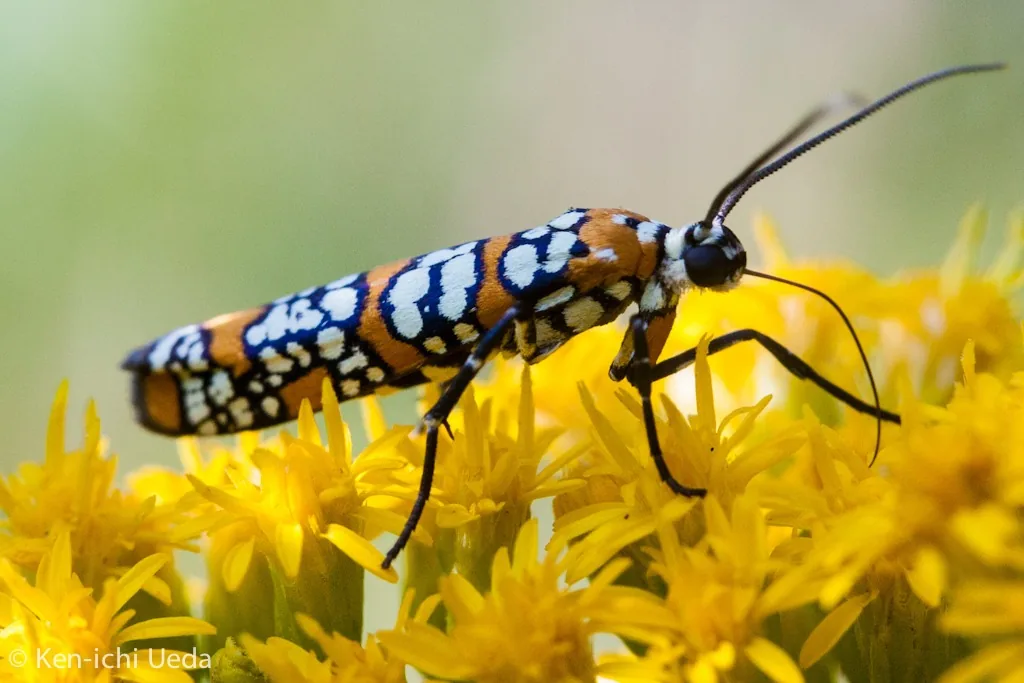
Adults fly by day and visit many flowers, and they also come to lights at night.[1][2]
Damage and signs
Health risk
Control
Pesticides
Rarely needed; NC State says most landscape-labeled insecticides control it if necessary.[1]
Common questions
- What is the bright orange moth with white spots on my flowers?
- Likely an ailanthus webworm moth.[1][2]
- What are the webs on my tree-of-heaven?
- Ailanthus webworm caterpillars live together in flimsy webs on its leaves.[1][2]
- Is it native?
- It is native farther south and spread north with invasive tree-of-heaven.[2]
Sources
- NC State Extension, “Ailanthus Webworm (PDIC Factsheet).” content.ces.ncsu.edu/ailanthus-webworm (accessed 2026-10-15)
- Missouri Department of Conservation, “Ailanthus Webworm Moth (Field Guide).” mdc.mo.gov/discover-nature/field-guide/ailanthus-webworm-moth (accessed 2026-10-15)
- iNaturalist, “Atteva aurea taxon page (order and family).” www.inaturalist.org/taxa/116681 (accessed 2026-10-06)