The first-instar spotted lanternfly nymphs of the 2026 season are now hatching in eastern Long Island vineyards, according to a regional update from Cornell Cooperative Extension's Suffolk County office. As of early May, growing degree-day accumulations in Riverhead, New York had reached 184 GDD (base 50.7°F) — past the 164–173 GDD threshold at which roughly five percent of overwintered egg masses begin to hatch.
For homeowners, vineyard managers, and orchardists in the SLF quarantine zone, this is the data point that starts the management calendar.
What just happened
Spotted lanternfly is an invasive planthopper from Asia, first detected in Berks County, Pennsylvania in 2014 and now established in multiple Mid-Atlantic and Northeastern states. It feeds on more than 70 plant species — most notably tree of heaven, grapevine, black walnut, and maple — by piercing plant tissue and drawing sap.
The species overwinters as egg masses, deposited on trees, equipment, vehicles, and any reasonably smooth surface during the previous fall. Each egg mass contains roughly 30 to 50 eggs and is covered with a putty-like coating that weathers gray. Hatch timing is temperature-driven, which is why university extension programs track growing degree-days rather than calendar dates.
According to research from Penn State and Virginia Tech cited by Cornell, five percent of eggs hatch at 164 GDD in Pennsylvania and 173 GDD in Virginia. The broader rule of thumb among extension entomologists is that 200 GDD is the threshold for visible emergence. Eastern Long Island has now passed the early-hatch mark, with the Mid-Atlantic and Southeast trailing slightly behind.
What the 1st instar looks like
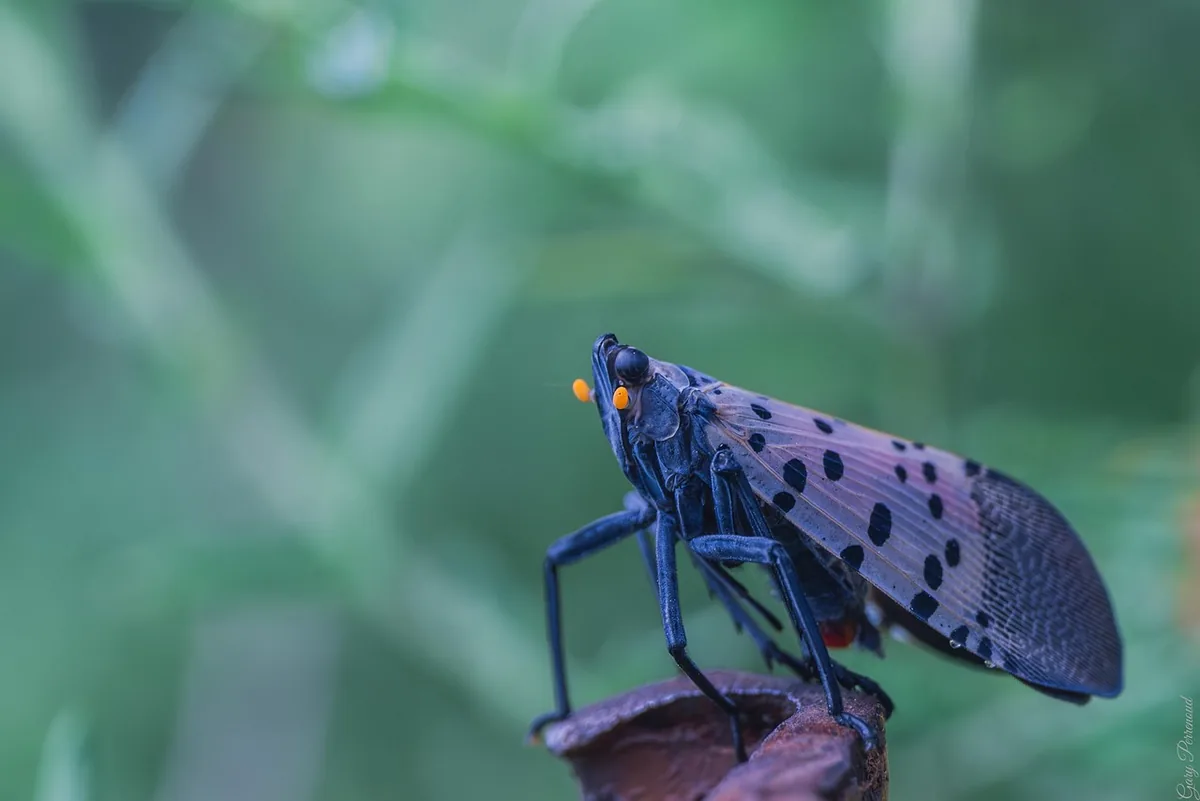
This is the identification problem that catches most homeowners off guard. The adult spotted lanternfly is the photogenic version of the species — gray forewings with black spots, brilliant red hindwings exposed during flight, roughly an inch long. The 1st instar nymph looks nothing like that.
First-instar nymphs are wingless, jet black, and dotted with bright white spots. They are about the size of a small ant or a tick — some homeowners do, in fact, initially mistake them for ticks. They cycle through four instar stages (commonly called 1st through 4th) between May and July. The first three instars remain black with white spots. By the 4th instar, the nymph develops the distinctive red coloration that telegraphs the species. Adults emerge starting in mid- to late July.
The behavioral cue is also useful: nymphs are extremely mobile when not feeding. They climb whatever they encounter, then drop or launch themselves to the next plant. They often move in groups. If you brush a low shrub and a cloud of small dotted black insects scatters by jumping, you are almost certainly looking at SLF nymphs, not ticks.
Why this hatch matters
Nymphs feed on a wider host plant range than adults do. Adults concentrate on woody plants — particularly grapevine and tree of heaven. Nymphs will feed on virtually any tender herbaceous or woody growth in their path. This is why the May through July window is the period during which residential gardens and ornamental landscapes see the most direct damage.
The volume of damage per individual nymph is small. A 1st instar takes a tiny sip relative to an adult. The problem is that aggregations grow with each life stage, and a property that hosts a large early-season nymph population almost always hosts a larger late-season adult population. The window for cost-effective control is now — not in August when the adults appear.
What to do this week
For homeowners in the quarantine zone, the right actions are inspection and physical removal. Walk your property and look at tree of heaven (if you have it), grapevines, and the stems of any soft-tissue plants you've been growing. A focused 15-minute walk this week is worth more than any treatment decision made in panic later in the season.
If you find nymphs, the simplest approach is mechanical: a strong stream of water knocks them off, and they can be vacuumed or swept into a container of soapy water. Sticky band traps wrapped around tree trunks (with mesh covers to prevent bird and small-mammal bycatch) catch nymphs as they climb. Penn State and Cornell extension both maintain current lists of approved insecticides for residential and agricultural use; both lists are species-specific and updated regularly. We'd recommend going to your state's extension site for the current product list rather than relying on general advice — chemical recommendations for SLF have changed multiple times since 2014.
The destructive instinct — stomp every nymph you see — is fine and even encouraged by most state agriculture departments. SLF is a regulated invasive pest, and state agriculture departments in infested areas ask residents to destroy it at any life stage.
Source: Alice Wise, Cornell Cooperative Extension, Suffolk County, via American Vineyard Magazine, "Long Island Grape Update: Spotted Lanternfly Nymphs" ↗, May 12, 2026. Hatch threshold research originally published by Erica Smyers (Penn State / Virginia Tech).