On this page
How to identify it
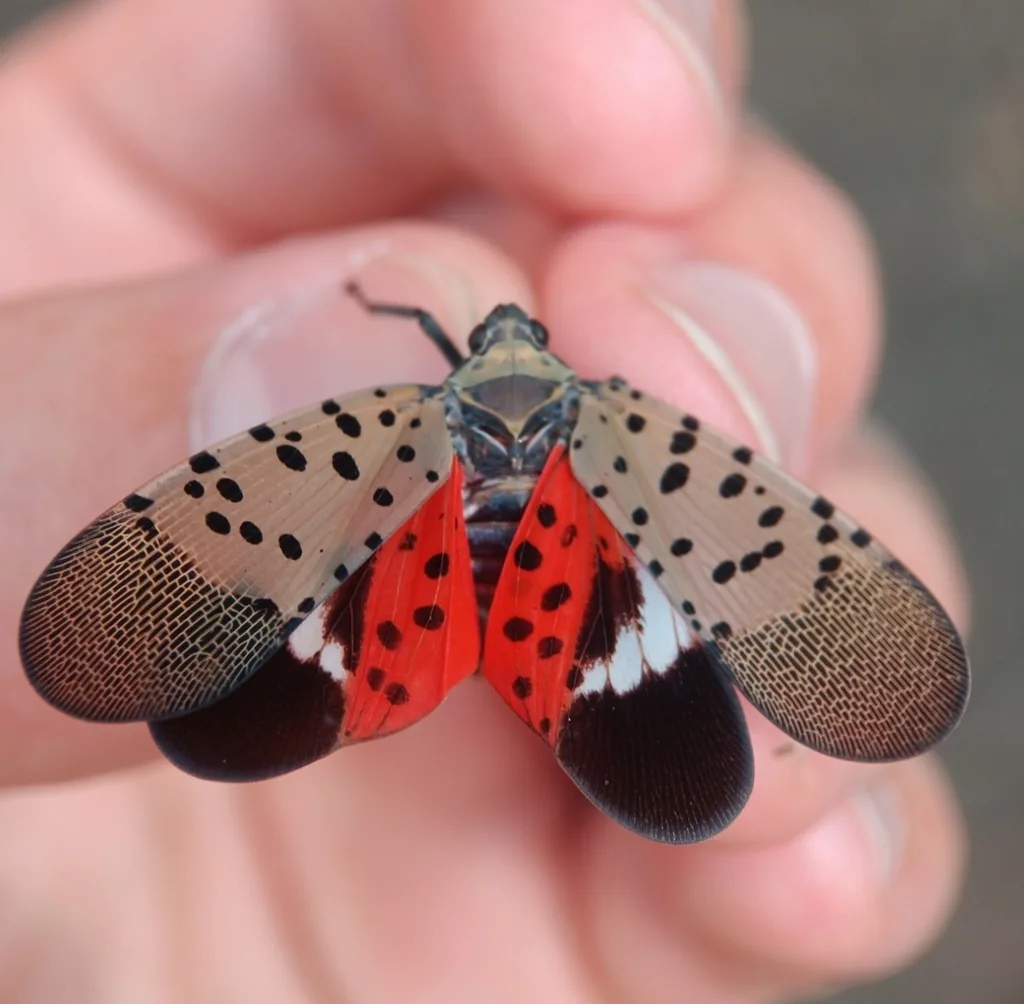
- Adults are about 1 inch long and 1/2 inch wide. The forewings are spotted with black, and the hind wings are red with black spots and a band of white; the abdomen is yellow with black bands. At rest only the forewings show, which camouflage them against bark.[2][1][7]
- The first three nymph stages are black with white spots; the fourth is red with black stripes and white spots and about 1/2 inch long.[1][7]
- Newly hatched nymphs are only about 1/8 inch and can be mistaken for small ticks or spiders.[1]
- Fresh egg masses look like a smear of wet gray putty or mud and turn tan to brown and cracked with age, about 1 inch long. Hatched masses lose the coating and show the empty eggs, which look like seeds.[2][7][1]
- Nymphs and adults are strong jumpers and often hop away when approached. Adults can fly but usually hop and glide, flashing the red hind wings.[1][7]
Where it lives
Native to Asia and first found in the United States in Berks County, Pennsylvania, in 2014. APHIS counts populations in 19 states and the District of Columbia, and Penn State says it spreads both by natural population growth and by hitchhiking, often along rail lines and highways. Most Pennsylvania counties are under quarantine, as are areas of several other states.[2][3][6][1]
Biology and life cycle
One generation a year in Pennsylvania: eggs are laid September to December and hatch late April to June, followed by four wingless nymph stages. Adults appear in July and stay active until a hard freeze kills them; only the eggs survive winter.[1][7]
Nymphs feed on tender new growth of herbaceous and woody plants; adults feed mostly on the woody stems of trees and vines and often pick a favorite 'hot' tree where they gather in large numbers for weeks.[1]
It has been recorded feeding on more than 70 plant species, and its preferred host is the invasive tree-of-heaven, though it doesn't need that tree to complete its life cycle. Conifers are poor hosts.[1][6][2]
Cornell IPM says lanternflies feed only on plants outdoors and survive only about 48 hours without feeding on one.[8]
Penn State researchers note its wide host range and mobility let it infest farms, cities, suburbs and forests.[9]
Damage and signs
- Heavy feeding has contributed to the death of grapevines, tree-of-heaven and black walnut saplings; on other plants it acts as a stressor and isn't known to kill them on its own.[1]
- Feeding produces sticky honeydew that falls from trees like light rain, attracts ants, wasps and bees, and grows black sooty mold on whatever is underneath. Fermenting honeydew can smell like vinegar.[1][2]
- A few lanternflies on a large, healthy tree are unlikely to cause permanent damage; thousands might weaken a tree, though no one has measured how many it takes.[1]
Health risk
Spotted lanternflies can't bite or sting; they feed on plant sap through a straw-like mouthpart. Their honeydew can draw stinging insects such as wasps and bees, so watch for those under heavily infested trees.[1][8]
Control
Prevention
Before leaving a parking lot or work site in an infested area, check doors, sides, bumpers, wheel wells, grills and roofs of vehicles, plus outdoor items such as furniture, mowers and firewood. Keep car windows closed and, where possible, park 15 feet away from trees in a quarantine zone.[2][1]
Removing tree-of-heaven may help reduce local populations; herbicides are usually needed to kill the root system.[1][3]
Traps and physical control
Scrape egg masses into rubbing alcohol or hand sanitizer and leave them there, or smash them thoroughly. APHIS suggests a zippered plastic bag of sanitizer or alcohol, sealed and thrown in the trash.[1][2]
Circle traps, funnel traps fixed to trunks, catch nymphs and adults climbing trees. If you use sticky bands, cover them with wildlife screening and check them every day; unguarded bands catch birds, squirrels and pollinators.[1]
Pesticides
Nymphs and adults are fairly easy to kill; even registered soaps and oils work. Spraying won't stop more from arriving later in the season, so treat only when the numbers or the plant's value justify it, and skip homemade sprays made from household products, which may harm plants or the environment.[1]
Quarantines and reporting
APHIS lists spotted lanternfly populations in 19 states and the District of Columbia: Connecticut, Delaware, Georgia, Illinois, Indiana, Kentucky, Maryland, Massachusetts, Michigan, New Jersey, New York, North Carolina, Ohio, Pennsylvania, Rhode Island, South Carolina, Tennessee, Virginia and West Virginia. Quarantines are set by the states, and zones may grow when new infestations are confirmed.[2][1]
Pennsylvania's quarantine covered 52 counties in 2024, and the state added Bradford, Sullivan, Venango and Wyoming counties in April 2025. The order bans moving any living stage of the insect or infested items such as firewood and brush, and regulates other articles that could carry it.[5][4]
Pennsylvania residents comply by inspecting vehicles and outdoor items with the state's compliance checklist before traveling within or out of the quarantine; businesses working in quarantined counties need a permit.[3][1]
New York has enforced an external quarantine since October 2, 2018 that restricts goods and vehicles coming in from certain counties of Delaware, Maryland, New Jersey, Pennsylvania and Virginia.[6]
Rules differ by state, so check your own state agriculture department's map or contact list; APHIS links state contacts for infested states and asks people elsewhere to contact their State plant regulatory official.[2][4]
Where sources disagree
Forewing color: Penn State and New Jersey describe gray forewings with black spots; APHIS describes them as brown.[1][7][2]
Eggs per mass: Penn State gives an average of about 35; APHIS says 30 to 50.[1][2]
How many egg masses you can reach: Penn State cites research finding under 2 percent of egg masses on trees within 10 feet of the ground; New Jersey says 80 to 90 percent are 10 feet up or higher. Either way, most are out of reach, and Penn State advises against ladders or climbing.[1][7]
Common questions
- I found a spotted lanternfly. Should I report it?
- If you're outside the known range, take a photo or collect a sample (frozen, or in rubbing alcohol or hand sanitizer), destroy any others you can, and report it to your state agriculture department; in Pennsylvania you can also call 1-888-4BAD-FLY. New York says people in New York City counties don't need to report them and should simply kill any they see.[1][8][6][3]
- Will spotted lanternflies kill my trees?
- Usually not. Apart from grapevines, tree-of-heaven and black walnut saplings, they aren't known to kill plants, though heavy feeding adds stress.[1]
- Am I in a quarantine area?
- Check your state agriculture department's spotted lanternfly page or map. Pennsylvania has an interactive quarantine map, and APHIS lists state contacts.[4][2]
Sources
- Penn State Extension, “Spotted Lanternfly Management Guide.” extension.psu.edu/spotted-lanternfly-management-guide (accessed 2026-11-11)
- USDA Animal and Plant Health Inspection Service, “Spotted Lanternfly (last modified August 26, 2025).” www.aphis.usda.gov/plant-pests-diseases/slf (accessed 2026-11-11)
- Pennsylvania Department of Agriculture, “Spotted Lanternfly.” www.pa.gov/agencies/pda/plants-land-water/spotted-lanternfly (accessed 2026-11-11)
- Pennsylvania Department of Agriculture, “Spotted Lanternfly Quarantine and Permitting.” www.pa.gov/agencies/pda/plants-land-water/spotted-lanternfly/spotted-lanternfly-quarantine-and-permitting (accessed 2026-11-11)
- Pennsylvania Department of Agriculture, “Pennsylvania Expands Spotted Lanternfly Quarantine to Four Northeast and Northwest Counties (April 4, 2025).” www.pa.gov/agencies/pda/newsroom/pa-expands-spotted-lanternfly-quarantine-to-four-ne-and-nw-count (accessed 2026-11-11)
- New York State Department of Agriculture and Markets, “Spotted Lanternfly.” agriculture.ny.gov/spotted-lanternfly (accessed 2026-11-11)
- New Jersey Department of Agriculture, “About the Spotted Lanternfly.” www.nj.gov/agriculture/divisions/pi/prog/pests-diseases/spotted-lanternfly/about/ (accessed 2026-11-11)
- Cornell Integrated Pest Management, “Spotted Lanternfly.” cals.cornell.edu/integrated-pest-management/outreach-education/whats-bugging-you/spotted-lanternfly (accessed 2026-11-11)
- Annual Review of Entomology, via PubMed, “Biology and management of the spotted lanternfly, Lycorma delicatula, in the United States (Urban and Leach 2023).” pubmed.ncbi.nlm.nih.gov/36206772/ (accessed 2026-11-11)
- iNaturalist, “Lycorma delicatula taxon page (order and family).” www.inaturalist.org/taxa/324726 (accessed 2026-11-11)