The short answer
- Systemics such as imidacloprid and dinotefuran move up in the plant's sap to the whole canopy. One application can protect a plant for a long time, which reduces the need for foliar sprays.[4][1][3]
- Homeowner products go on as a soil drench or as granules watered in, and are limited to one application a year. Soil and trunk injections take special equipment or know-how.[1][2][5]
- Allow time for uptake: imidacloprid in the soil generally needs four to six weeks to spread through a tree. Dinotefuran moves faster.[1]
- Protect bees: treat after bloom where that still works on the pest, keep soil and bark treatments away from nearby flowering plants, and don't use systemics on lindens or plants grown for pollinators.[4][1][8]
- For emerald ash borer, treat valuable ash while the canopy is still mostly intact. If more than 50 to 60 percent of it is dead, it's probably too late.[1][2][5][6][7]
Pests systemics are used against
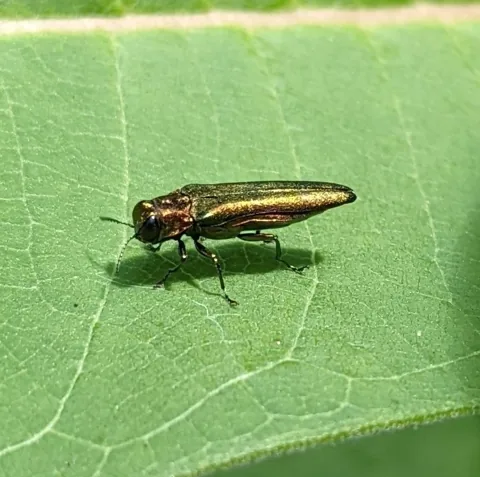 Emerald Ash Borer
Agrilus planipennis
The emerald ash borer is an invasive wood-boring beetle from Asia that has killed tens of millions of North American ash trees. Its larvae feed just under the bark, cutting off the flow of water and nutrients until the tree dies.
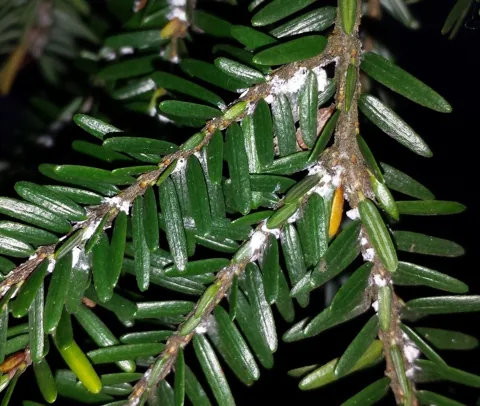 Hemlock Woolly Adelgid
Adelges tsugae
The hemlock woolly adelgid is a tiny, sap-feeding relative of aphids from Asia that lives on hemlock twigs at the base of the needles. It has killed millions of eastern and Carolina hemlocks, but landscape trees can be saved when it is found early and treated.
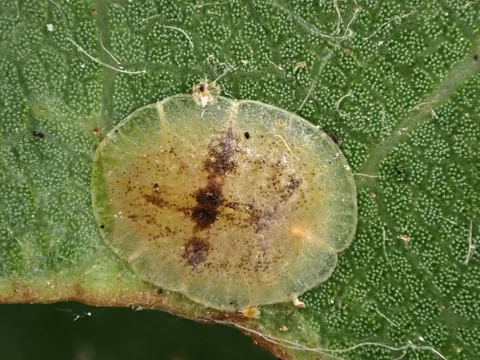 Scale Insects
Superfamily Coccoidea (representative: brown soft scale, Coccus hesperidum)
Scales are small sap-sucking insects that settle on the bark, leaves or fruit of trees, shrubs and houseplants and rarely look like insects at all. Most plants tolerate low to moderate numbers, but heavy infestations cause yellowing, leaf drop and dieback, and the soft scales drip sticky honeydew.
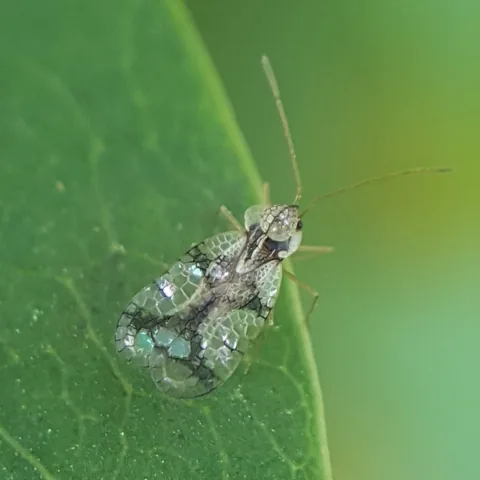 Lace Bugs
Stephanitis pyrioides
Lace bugs are small sap-feeding bugs with lacy wings that live under the leaves of trees and shrubs. Their feeding bleaches and stipples leaves, but the damage is mostly cosmetic and rarely threatens plant health.
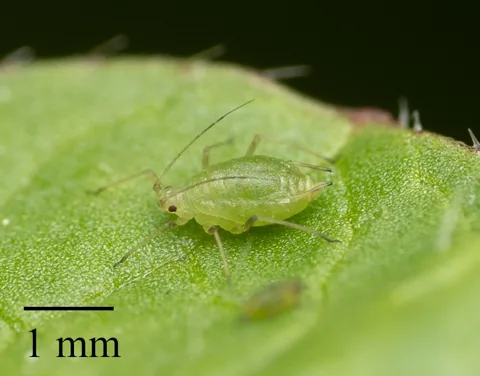 Aphids
Myzus persicae
Aphids are small, soft-bodied insects that pierce tender stems and leaves and suck out plant sap. Almost every plant hosts at least one aphid species, but established plants usually tolerate them, treating aphids for the plant's health is usually unnecessary, and natural enemies often bring numbers down.
How systemic insecticides work
A systemic insecticide is taken up by a plant from the soil or through its leaves and spreads through its stems, leaves, fruit and flowers. Neonicotinoids such as imidacloprid and dinotefuran move upward in the xylem sap to reach the whole plant above ground.[3][4]
That's why one application can protect a plant from various insect pests for a long time, reducing the need for foliar sprays that can be more disruptive. Delivered from inside the plant, the insecticide also spares beneficial insects better than a foliar spray of the same product.[4]
Neonicotinoids are much more toxic to insects than to people, pets and birds, but imidacloprid is very toxic to honey bees and other beneficial insects. It can last for months or years in soil and may leach into groundwater under some conditions.[4][3][6]
Pests that are especially sensitive to these insecticides include scale insects, aphids, lace bugs, leaf beetles and certain sawfly larvae.[4]
Landscape rates are far higher than the amounts used to treat crop seed. A University of Minnesota study found that soil-applied imidacloprid moved into the flowers of a milkweed (Asclepias curassavica) at high levels and reduced survival of three lady beetle species and of monarch and painted lady larvae.[12]
Four ways to apply insecticides to trees
The multistate emerald ash borer insecticide guide groups tree treatments into four categories:[1][2]
- Soil drench or granules: the product is mixed with water and poured on the soil around the base of the trunk, or granules are watered in. It needs nothing more than a bucket or watering can, and homeowner products are made only for these methods.[1][2]
- Soil injection: the solution is injected 2 to 4 inches deep at several spots within 18 inches of the trunk. It takes specialized equipment, but places the insecticide under mulch or turf, right in the root zone. Homeowner products can't be applied this way.[1]
- Trunk injection: the insecticide goes directly into the tree. It works on sites where soil treatments aren't practical, such as excessively wet, sandy, compacted or restricted soils, and uptake is excellent, but it takes some know-how, and drilling wounds can cause long-term damage, especially if the tree is injected every year.[1][2][6]
- Basal trunk spray: dinotefuran is sprayed on the lower trunk and moves through the bark into the tree. It's quick, needs only a garden sprayer calibrated to put the right amount on each tree, doesn't wound the tree, and when done correctly puts little insecticide into the soil.[1][9]
- Cover spray: insecticide on the bark, branches and leaves kills adult borers as they feed and newly hatched larvae as they chew in, but not borers already in the tree, and it needs thorough coverage of the whole tree. Because of drift, coverage and effects on other species, the EAB guide doesn't recommend it.[1][2]
Doing a soil drench
The label sets the rate, usually from the size of the trunk. If label directions differ from any guide, including this one, follow the label.[2]
- Measure the trunk diameter at breast height: measure around the trunk 4.5 feet above the ground and divide by 3.14 (the University of Minnesota rounds this to dividing by 3).[2][6]
- Rake away mulch, leaf litter and grass within 1 to 2 feet of the trunk so the solution goes straight onto mineral soil. Imidacloprid binds to surface organic matter such as mulch, which cuts uptake.[2][1]
- Put on the personal protective equipment the label requires, dilute the product in water as the label directs, and mix until it's completely dissolved.[2]
- Pour the solution at the base of the trunk, where fine roots are densest; uptake is higher and the treatment works better there.[1]
- Check soil moisture. Uptake is limited in excessively dry soil, so water during a drought; waterlogged soil can also give poor uptake.[1][2]
- Homeowner products are limited to one application per year.[1]
Timing
Give the tree time to take up and spread the insecticide so it's in place when the pest feeds. Imidacloprid soil treatments generally take four to six weeks. Dinotefuran is much more soluble, so it moves through the tree faster, and faster still as a basal trunk spray.[1]
In university studies on emerald ash borer, spring treatments were consistently more effective than the same treatments in fall. The EAB guide's timing for homeowner products is early to mid spring for imidacloprid drenches, and mid to late spring, after the trees leaf out, for dinotefuran granules.[1][5]
Iowa State gives mid-April to mid-May as the best window for EAB treatments. A few products also work when applied from early August to mid-September, but spring applications give better control.[5]
Trunk injections work best after trees leaf out in spring but before adult ash borers start laying eggs.[1]
The University of Minnesota sets a wider window for professional trunk injections in Minnesota, from May through late September, when the canopy is full. It says late-summer and fall injections give effective but somewhat lower control for the next two years.[6]
Protecting bees
Because systemics reach every part of a plant above ground, they can end up in nectar and pollen. Landscape labels allow relatively high doses, so nectar and pollen of treated landscape plants may carry more insecticide than crops do, and the Connecticut Agricultural Experiment Station says special care is needed to protect pollinators.[4]
Applying these insecticides to crops in bloom is prohibited by the label because it gives bees a nearly immediately lethal exposure, and labels for lawn products prohibit applying them to flowers bees are visiting.[4]
- Plants that don't offer nectar or pollen pose no exposure risk to pollinators and can be treated by the label without that concern. Eastern hemlocks treated for hemlock woolly adelgid and armored scales are an example.[4]
- Keep soil and basal bark treatments from reaching nearby flowering plants such as rhododendrons. The EAB guide says to make no soil application where bees can visit flowering plants whose roots share that soil, such as flowers planted around the base of a tree: remove those plants or use a trunk injection instead.[4][1]
- For plants bees visit, apply after bloom if the product still targets the pest then, choose a shorter-residual product such as dinotefuran or acetamiprid, and use the one least toxic to bees. Acetamiprid is about 3,000 times less toxic to honey bees than imidacloprid or dinotefuran, but it's labeled as a foliar or bark spray, not a soil drench.[4][8]
- Don't count on dinotefuran clearing out quickly. In a University of Kentucky study on a broadleaf evergreen tree (Ilex × attenuata) and a deciduous shrub (Clethra alnifolia), soil applications of imidacloprid or dinotefuran in autumn after bloom or in spring before bloom left nectar residues above levels shown to harm bees. A summer application soon after bloom lowered imidacloprid in nectar but not dinotefuran, and the authors suggest dinotefuran may be more persistent than generally believed.[11]
- Don't use systemics on lindens or on plants grown for insects, such as butterfly garden plants, bee forage plants and especially milkweeds. European lindens have nectar that's toxic to bees, and systemic treatments on them have proven especially harmful.[4][12]
- Honey bees sometimes collect pollen from male ash trees; female trees don't produce nectar. CAES considers the risk from imidacloprid or dinotefuran on ash unlikely to be significant, partly because bees favor other blooming plants; the EAB guide still suggests applying soil systemics just after ash trees flower, which lasts a few days in spring just before the buds break.[4][1]
- On lawns, mow blooming weeds before applying a neonicotinoid for white grubs. Spraying liquid products over weeds in bloom can harm bees, while granular grub products don't expose bees to hazardous amounts.[4]
Worked example: protecting an ash tree from emerald ash borer
Is the tree at risk? Sources set different distances. The multistate EAB guide says ash trees within 30 miles of trees with noticeable EAB damage are probably at risk. The NC Forest Service recommends starting treatment when emerald ash borer is known to be within 10 to 15 miles, and the University of Minnesota says trees within 15 miles of a known infestation are at higher risk and those farther away don't need treatment until EAB is confirmed in the area.[1][2][6]
The Minnesota Department of Agriculture adds that treatment doesn't have to start before EAB reaches an area or even a tree. Insecticides can be used once a tree is infested, as long as the trunk isn't so damaged that the tree can no longer move the insecticide up into the canopy.[7]
Can it still be saved? By the time most people notice canopy thinning or dieback, EAB has already badly injured the tree's vascular system. If more than 50 to 60 percent of the canopy has been killed, or the canopy carries less than half the foliage it should, it's probably too late. Iowa State says a tree is a candidate only with less than 50 percent canopy thinning or less than 30 percent of branches dead.[1][2][5][6]
Recovery is slow. The multistate guide says a tree that's already declining may keep getting worse during the first year of treatment and, if treatment works, usually starts to improve in the second year. The NC Forest Service says it may take several years to notice improvement. Branches EAB has already killed don't recover.[1][2][7]
Which treatment? Soil drenches and injections of imidacloprid and dinotefuran have given mixed results, protecting trees in some studies and failing in others, but they remain the only option for many homeowners who choose not to hire a professional. The guide's advice for anyone trying them is to use the highest labeled rate; some imidacloprid products allow a higher rate on trees more than 15 inches in diameter.[1][2]
In the guide's studies, a single trunk injection of emamectin benzoate in mid-May or early June gave excellent control for up to three years, even at peak beetle numbers, and annual basal trunk sprays of dinotefuran gave similarly high control. Imidacloprid trunk injections were less effective, even when applied every year.[1][10][9]
A six-year Michigan State University and USDA Forest Service study followed the same treatments through an EAB outbreak. Trees injected with emamectin benzoate had few or no EAB galleries even three years after treatment, annual basal sprays of dinotefuran kept larvae below damaging levels, and trees injected with imidacloprid didn't differ from untreated trees no matter how often they were treated.[10]
When nearby untreated ash have died, pausing treatment or stretching the interval may lower costs, but only alongside regular checks on the tree's condition so treatment can resume as soon as local EAB activity picks up.[1]
When to call a professional
- For soil or trunk injections. They need specialized equipment or application know-how, and homeowner products can't be applied this way.[1][2][5]
- For an ash with flowering plants growing over its roots, where a trunk injection keeps insecticide out of the soil bees forage from.[1]
- For trees on excessively wet, sandy, compacted or restricted soil, where soil treatments may not work.[1]
- For a large ash. The University of Minnesota says homeowners should treat only ash smaller than 15 inches in diameter at breast height and leave larger trees to a professional arborist.[6]
- For a valuable ash, since homeowner drenches have given mixed results. The longest-lasting protection in the EAB guide's trials came from trunk injections of emamectin benzoate, a product sold to professional applicators.[1][10]
Common questions
- How long does a systemic soil drench take to work?
- Imidacloprid applied to the soil generally takes four to six weeks to be taken up and spread through a tree. Dinotefuran is more soluble and moves through the tree faster.[1]
- Are systemic insecticides safe for bees?
- Not automatically. Imidacloprid is very toxic to honey bees, and systemics can reach the nectar and pollen of treated plants. Apply after bloom where that works, keep soil treatments away from nearby flowers, and don't treat lindens or pollinator plants.[3][4][8]
- Can I treat my own ash tree for emerald ash borer?
- Yes, with a homeowner soil drench or granules at the highest labeled rate, once a year, but results in studies have been mixed. The University of Minnesota advises homeowners to treat only ash under 15 inches in diameter. A single professional trunk injection of emamectin benzoate controlled EAB for up to three years in the guide's studies.[1][6]
- Is it too late to treat my ash tree?
- Probably, if more than 50 to 60 percent of the canopy is dead or the tree carries less than half its normal foliage. Iowa State treats only trees with less than 50 percent canopy thinning or less than 30 percent of branches dead.[1][5]
- Is dinotefuran safer for bees than imidacloprid?
- Not necessarily. The Connecticut Agricultural Experiment Station lists dinotefuran, with acetamiprid, as a shorter-residual choice that moves quickly to where it's needed. A University of Kentucky study, though, found dinotefuran in the nectar of a treated tree and shrub above levels shown to harm bees after autumn and spring soil applications, and a summer application right after bloom didn't lower it. Applying after bloom and keeping systemics off plants bees visit heavily remain the safer steps.[4][11][8]
Photo credits
- Emerald Ash Borer: Christine Stone, public domain (CC0), via iNaturalist
- Hemlock Woolly Adelgid: (c) Even Dankowicz, some rights reserved (CC BY) — via iNaturalist, CC BY 4.0
- Scale Insects: (c) Grey Smith, some rights reserved (CC BY) — via iNaturalist, CC BY 4.0
- Lace Bugs: (c) giantcicada, some rights reserved (CC BY) — via iNaturalist, CC BY 4.0
- Aphids: Jesse Rorabaugh, public domain (CC0), via iNaturalist
Sources
- North Central IPM Center (copy hosted by the New Jersey Department of Agriculture), “Insecticide Options for Protecting Ash Trees from Emerald Ash Borer, Third Edition (Herms, McCullough, Sadof, Smitley, Miller and Cranshaw; North Central IPM Center bulletin).” nj.gov/agriculture/divisions/pi/pdf/eabinsecticidefactsheet.pdf (accessed 2026-11-10)
- N.C. Forest Service, Forest Health Branch, “Emerald Ash Borer Insecticide Guide (September 2015).” ncagr.gov/divisions/nc-forest-service/EAB_InsecticideGuide/download (accessed 2026-11-10)
- National Pesticide Information Center, “Imidacloprid General Fact Sheet.” npic.orst.edu/factsheets/imidagen.html (accessed 2026-11-10)
- The Connecticut Agricultural Experiment Station, “Use of Neonicotinoids in the Home Landscape (fact sheet, March 2015).” portal.ct.gov/-/media/caes/documents/publications/fact_sheets/valley_laboratory/useofneonicotinoidsinthehomelandscapecowlesmarch2015pdf.pdf (accessed 2026-11-10)
- Iowa State University Extension and Outreach, “Emerald Ash Borer (Yard and Garden).” yardandgarden.extension.iastate.edu/encyclopedia/emerald-ash-borer (accessed 2026-11-10)
- University of Minnesota Extension, “Emerald ash borer in Minnesota (reviewed 2026).” extension.umn.edu/garden-and-home/yard-and-garden/yard-and-garden-insects/emerald-ash-borer (accessed 2026-11-10)
- Minnesota Department of Agriculture, “Guidelines to Slow the Growth and Spread of Emerald Ash Borer (EAB Management Guidelines).” www.mda.state.mn.us/sites/default/files/inline-files/eabmgmtguidelines.pdf (accessed 2026-11-10)
- University of California Statewide IPM Program, “Bee Precaution Pesticide Ratings: Frequently Asked Questions.” ipm.ucanr.edu/bee-precaution-pesticide-ratings/frequently-asked-questions-faqs/ (accessed 2026-11-10)
- Journal of Economic Entomology, abstract via PubMed, “McCullough and others 2011, Evaluation of Agrilus planipennis control provided by emamectin benzoate and two neonicotinoid insecticides, one and two seasons after treatment.” pubmed.ncbi.nlm.nih.gov/22066190/ (accessed 2026-11-10)
- Journal of Economic Entomology, abstract via PubMed, “McCullough and others 2019, Emerald ash borer densities over a 6-yr period on untreated trees and trees treated with systemic insecticides at 1-, 2-, and 3-yr intervals in a central Michigan forest.” pubmed.ncbi.nlm.nih.gov/30252066/ (accessed 2026-11-10)
- Environmental Toxicology and Chemistry, abstract via PubMed, “Mach, Bondarenko and Potter 2018, Uptake and dissipation of neonicotinoid residues in nectar and foliage of systemically treated woody landscape plants.” pubmed.ncbi.nlm.nih.gov/29080359/ (accessed 2026-11-10)
- PLoS ONE, abstract via PubMed, “Krischik and others 2015, Soil-applied imidacloprid translocates to ornamental flowers and reduces survival of adult lady beetles and larval monarch and painted lady butterflies.” pubmed.ncbi.nlm.nih.gov/25799432/ (accessed 2026-11-10)