The short answer
- Figure out whether it's armored scale (small, flat, no sticky honeydew, cover lifts off the body) or soft scale (larger, rounded, drips honeydew, the cover is the body). Products that work on one type often fail on the other.[1][5][3]
- On small plants, prune out badly infested twigs or scrub scales off by hand. On houseplants, wipe them off with soapy water.[1][8][7]
- Spray horticultural oil while the plant is dormant, or spray oil or insecticidal soap in the growing season right after the crawlers hatch. Wrap a twig with double-sided tape to see when that happens.[1][5][3][6]
- If ants are running up the trunk to collect honeydew, stop them. Ants protect scales from the lady beetles and tiny wasps that would otherwise keep them down.[1][3]
- Save systemic insecticides for large or valuable plants, pick one that works on your type of scale, and apply it after the plant flowers to protect bees.[1][5][4]
- Avoid long-lasting broad-spectrum sprays. They kill the natural enemies that control scale and can set off spider mite outbreaks.[1][3]
Scale insect profiles
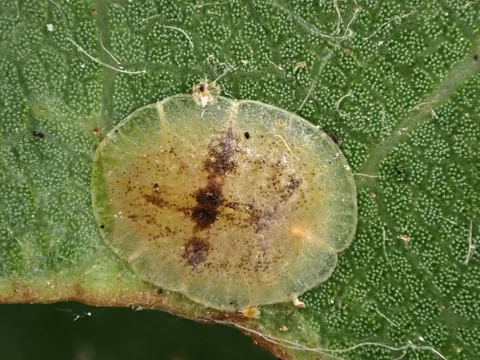 Scale Insects
Superfamily Coccoidea (representative: brown soft scale, Coccus hesperidum)
Scales are small sap-sucking insects that settle on the bark, leaves or fruit of trees, shrubs and houseplants and rarely look like insects at all. Most plants tolerate low to moderate numbers, but heavy infestations cause yellowing, leaf drop and dieback, and the soft scales drip sticky honeydew.
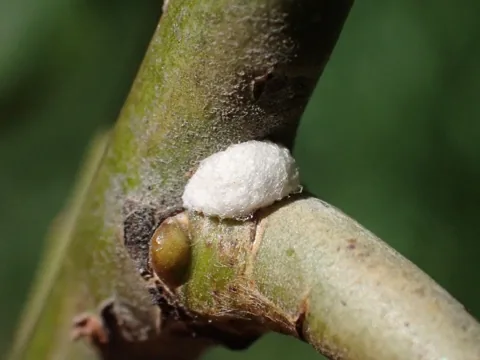 Azalea Bark Scale
Acanthococcus azaleae (formerly Eriococcus azaleae)
Azalea bark scale is a soft scale that forms white cottony sacs on the twigs of azaleas, rhododendrons and other shrubs, often in branch forks.
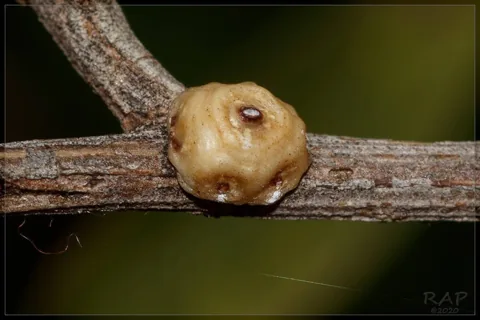 Barnacle scale
Ceroplastes cirripediformis
Barnacle scale is a soft scale insect that hides under a thick, pearly-gray cap of wax on the stems of gardenias, citrus and many other plants; heavy infestations drip honeydew that grows black sooty mold.
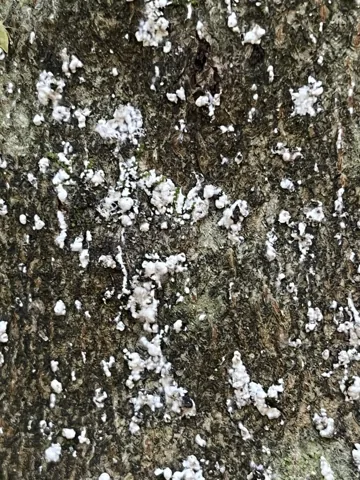 Beech Scale
Cryptococcus fagisuga
Beech scale is a tiny non-native scale insect whose feeding opens beech bark to Neonectria fungi; together they cause beech bark disease.
No photo yet
Bermudagrass Scale
Odonaspis ruthae
Bermudagrass scale is a tiny armored scale that feeds on the stolons, crowns and stems of warm-season lawn grasses.
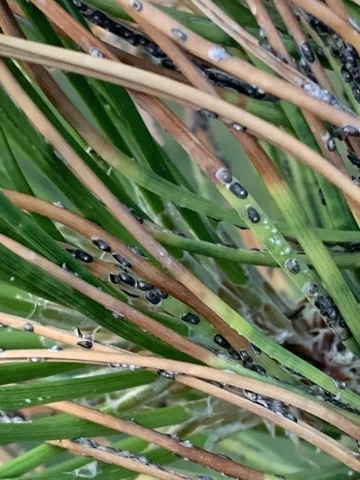 Black Pineleaf Scale
Dynaspidiotus californicus (formerly Nuculaspis californica)
Black pineleaf scale is a small native armored scale insect that feeds on the needles of pines and Douglas-fir.
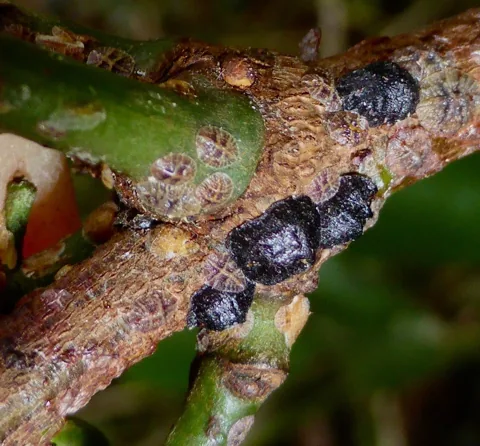 Black Scale
Saissetia oleae
Black scale is one of California's most damaging soft scales, and its honeydew coats olive, citrus and many shrubs with black sooty mold.
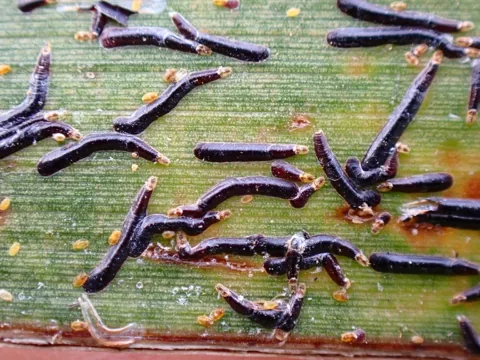 Black Thread Scale
Ischnaspis longirostris
Black thread scale is an armored scale insect whose long, thread-thin black covers line up on the leaves of palms, Swiss cheese plants and many other tropical plants. In large numbers the dark threads are conspicuous.
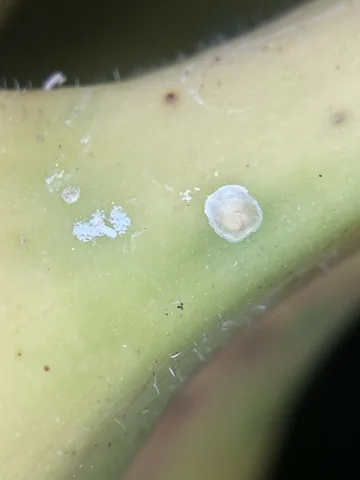 Boisduval scale
Diaspis boisduvalii
Boisduval scale is an armored scale insect and the most common armored scale pest of orchids in North Carolina; ScaleNet cites it as the most important insect pest of orchids in Florida and a serious pest of greenhouse orchids in California. It also lives on palms, banana and cacti, and a few scales are enough to damage a plant.
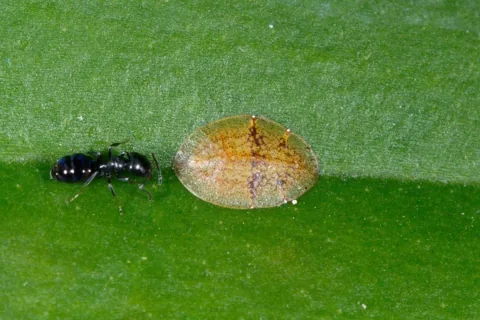 Brown Soft Scale
Coccus hesperidum
Brown soft scale is a small, oval, yellowish-brown scale insect that settles on stems and leaf veins of houseplants such as ficus, schefflera, English ivy and citrus, coating leaves with sticky honeydew.
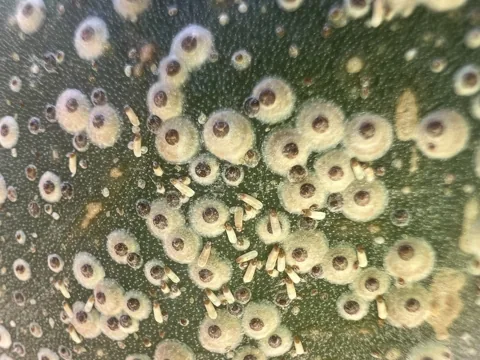 Cactus scale
Diaspis echinocacti
The cactus scale is an armored scale of cacti and succulents, probably native to the New World and now found wherever cacti are grown, under glass in cold climates. Its whitish to tan, slightly convex covers, each with a brown off-center dot, speckle the smooth surfaces of prickly pear pads, columnar cacti, orchid and holiday cacti and dozens of other genera. Feeding reduces photosynthesis and can wither entire pads or whole plants, and it is a particularly serious pest in greenhouses; in the United States it has been reported from most states and is widespread in California.
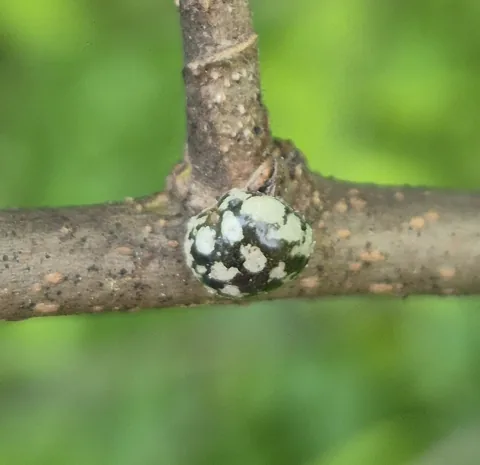 Calico Scale
Eulecanium cerasorum
Calico scale's most obvious sign is heavy sticky honeydew and black sooty mold on trees and anything beneath them.
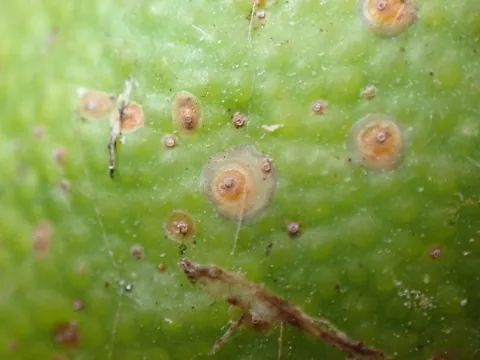 California Red Scale
Aonidiella aurantii
California red scale is an armored scale of citrus that is difficult to control with insecticides. It can infest every above-ground part of the tree, and in California it remains a key citrus pest.
No photo yet
Chaff scale
Parlatoria pergandii
Chaff scale is a small, flat, grayish-tan armored scale found on the bark, leaves and fruit of citrus. It is one of the most important armored scales in Florida citrus and a citrus pest across the Gulf Coast states, and it favors older trees with plenty of shade. It also feeds on camellia, boxwood, oleander, ficus and dozens of other plants.
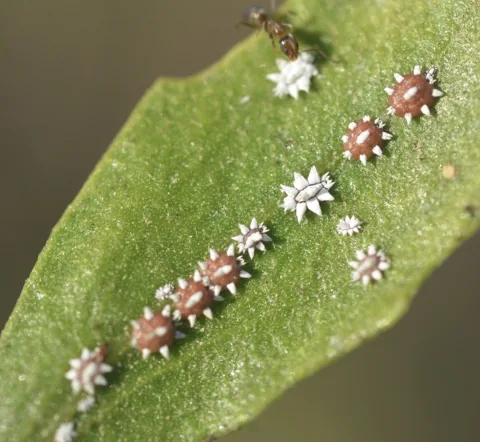 Chinese wax scale
Ceroplastes sinensis
Chinese wax scale is a soft scale insect that hides under a domed cap of white wax. Despite its name, it probably comes from Central or South America. It is a citrus pest in Australia, Italy and Spain, and in California it is one of the wax scales that sometimes build up on landscape shrubs.
No photo yet
Citricola scale
Coccus pseudomagnoliarum
Citricola scale is a soft scale of citrus with a single generation a year and no males. Parasitic wasps control it so completely in Southern California that it is almost never seen there, but in the San Joaquin Valley it can be a serious pest whose honeydew and sooty mold cut yield and fruit quality.
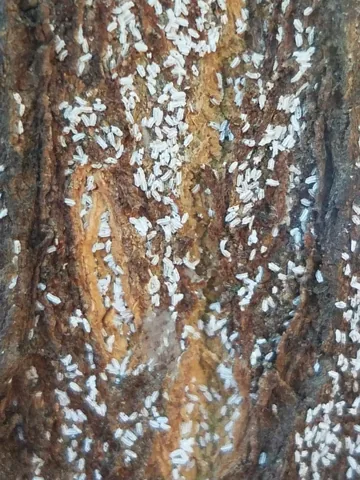 Citrus snow scale
Unaspis citri
Citrus snow scale is an armored scale insect of citrus trunks and limbs. Its name comes from the white covers of the young males, which can coat the bark like snow, while the dark females blend in. Heavy, long-lasting infestations stop the bark from expanding so that it splits, opening the tree to fungi and borers. It is common in Florida groves but today rarely causes economic damage there.
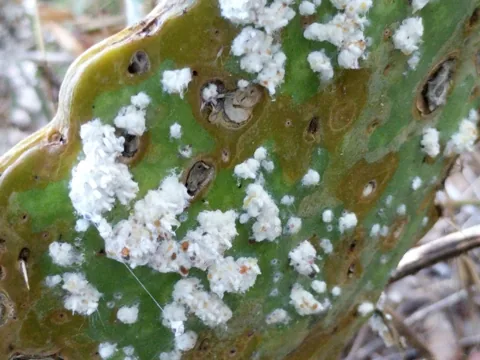 Cochineal Scale
Dactylopius spp. (including D. coccus)
Cochineal scales are small sap-sucking insects that hide inside cottony masses of wax on prickly pear pads. Crush one on paper and it leaves a deep red stain; the same insect is the source of carmine dye.
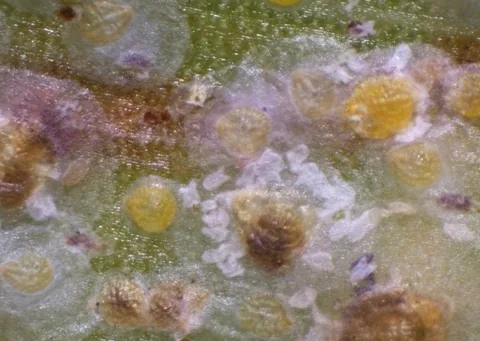 Coconut scale
Aspidiotus destructor
Coconut scale is an armored scale insect that feeds on several hundred kinds of plants in tropical and subtropical regions and is a major threat to coconut palms worldwide. Its flat, translucent covers crowd the undersides of leaves like miniature fried eggs, and the toxic saliva it injects turns leaves yellow. In the United States it has been recorded from Florida and Hawaii north to Connecticut and Pennsylvania, though in northern regions it lives only in greenhouses and other enclosed spaces.
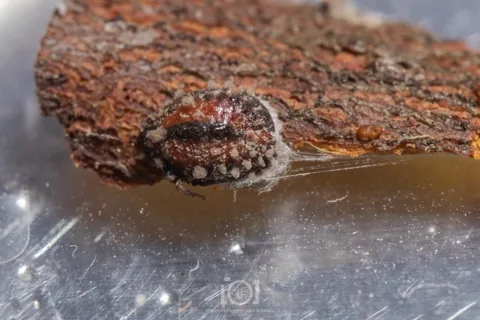 Cottony azalea scale
Pulvinaria ericicola
Cottony azalea scale is a soft scale insect of azaleas, rhododendrons, blueberries and other heath-family shrubs in the eastern United States. It is easiest to spot in late spring, when each female sits at the end of a flat, fluffy white egg sac. The scales feed on stems and also on roots, where they are sheltered from parasites and sprays.
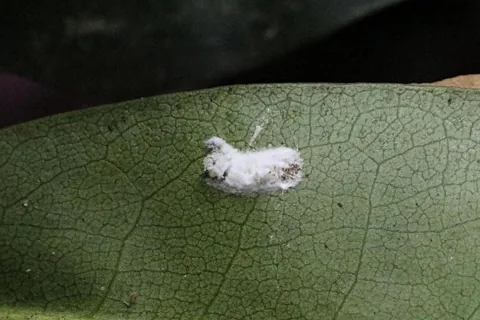 Cottony Camellia Scale
Pulvinaria floccifera
Cottony camellia scale, also called cottony taxus scale, is a soft scale insect whose females lay eggs in long, fluffy white sacs on camellia, yew, holly and other shrubs.
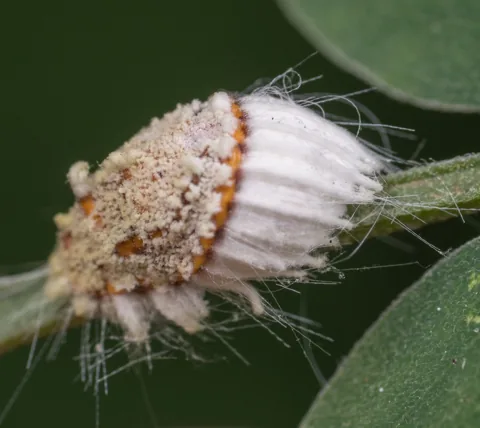 Cottony Cushion Scale
Icerya purchasi
Cottony cushion scale is usually kept in check by the vedalia beetle and a parasitic fly; outbreaks mostly follow insecticide use, dust or ants that disrupt them.
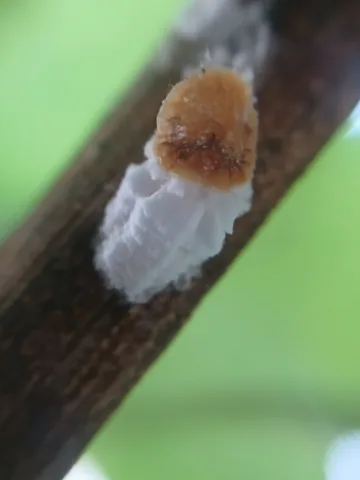 Cottony grape scale
Pulvinaria vitis
The cottony grape scale is a soft scale insect of grapevines. In late spring the mature females are easy to spot by the white, cottony egg sacs that stick out behind them, two to three times as long as the scale itself. It can weaken vines, kill twigs and transmit grapevine viruses.
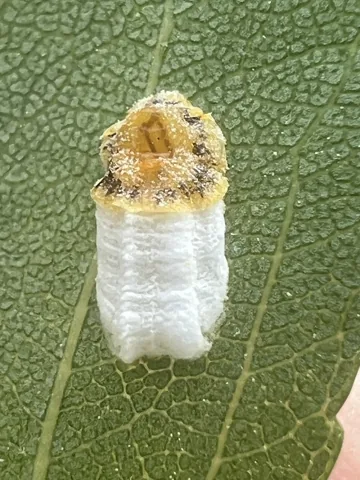 Cottony maple leaf scale
Pulvinaria acericola
The cottony maple leaf scale is a soft scale easily confused with the cottony maple scale; the two were treated as one species until 1898. The giveaway is where the white cottony egg sacs sit: this species lays on the leaves, while the cottony maple scale lays along twigs and small branches. It feeds on maples, hollies, dogwood, sourgum and several other broadleaf plants, produces one generation a year, and is usually worth treating only when populations are high and the plant is showing damage.
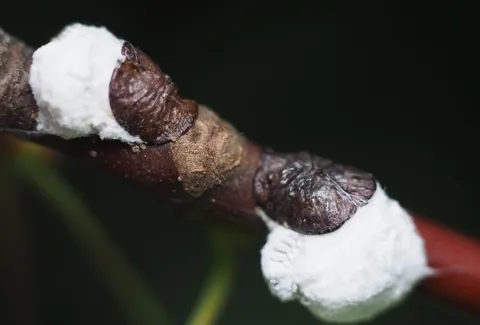 Cottony Maple Scale
Pulvinaria innumerabilis (iNaturalist: Neopulvinaria innumerabilis)
The white cotton balls on silver maple twigs in June are cottony maple scale egg sacs; natural enemies usually keep it in check.
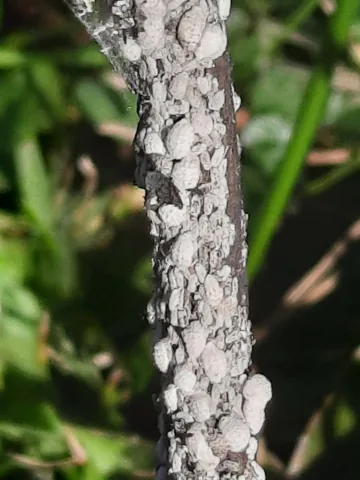 Crapemyrtle Bark Scale
Acanthococcus lagerstroemiae (formerly Eriococcus lagerstroemiae)
Crapemyrtle bark scale is an invasive scale insect, native to Asia, that feeds through the bark of crape myrtles. Heavy infestations coat trunks and branches with white felted sacs and black sooty mold, and the trees grow and bloom poorly.
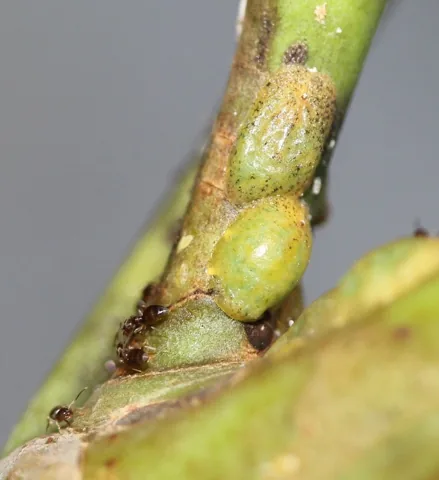 Croton Scale
Phalacrococcus howertoni
Croton scale (Phalacrococcus howertoni), first found in Florida in 2008, is a soft scale that feeds on croton and dozens of other plants and coats them in honeydew and sooty mold.
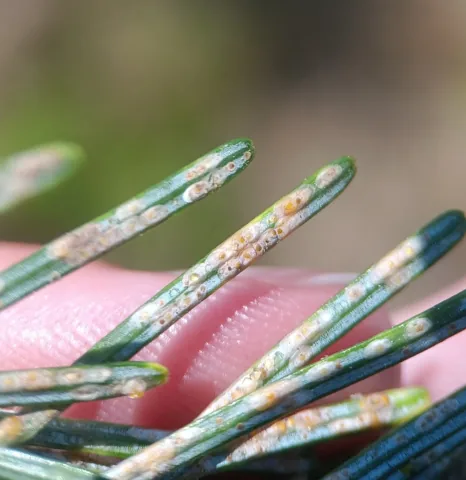 Cryptomeria scale
Aspidiotus cryptomeriae
Cryptomeria scale is an armored scale insect from Asia that has become a serious conifer pest from southern New England to the Southeast, above all on Christmas tree farms. It settles on the undersides of needles, mostly on true firs and hemlocks, and causes yellow mottling and early needle drop on the lower and inner branches. Damage can start suddenly and spread quickly through a planting.
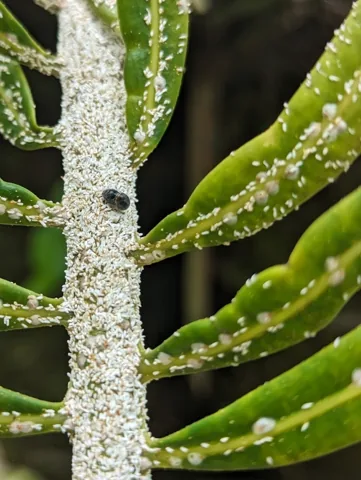 Cycad Aulacaspis Scale
Aulacaspis yasumatsui
Cycad aulacaspis scale, also called Asian cycad scale, can coat a sago palm in a white crust, and heavily infested fronds turn yellow, then brown, and die. It attacks only cycads, which despite names like sago palm are not true palms.
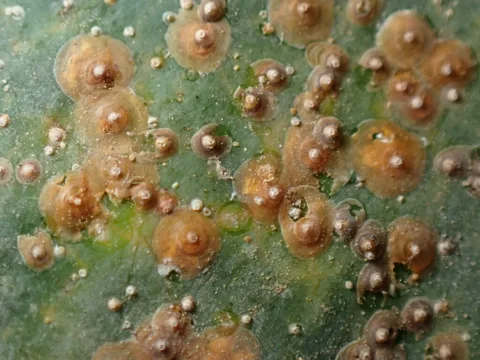 Dictyospermum scale
Chrysomphalus dictyospermi
Dictyospermum scale is an armored scale insect with a flat, round, grayish to reddish-brown cover, often with a coppery sheen. It feeds on plants in more than 70 families, favoring palms, dracaena and citrus, and it has been a serious citrus pest in Florida and the western Mediterranean. It also infests mango in Florida and lives in greenhouses and indoors in cooler areas.
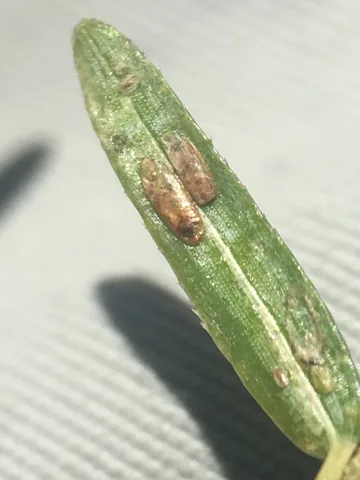 Elongate Hemlock Scale
Fiorinia externa
Elongate hemlock scale is an invasive armored scale from Japan that yellows evergreen needles, causes needle loss and dieback, and can kill heavily infested trees. Penn State calls it a serious pest of ornamental and forest hemlocks.
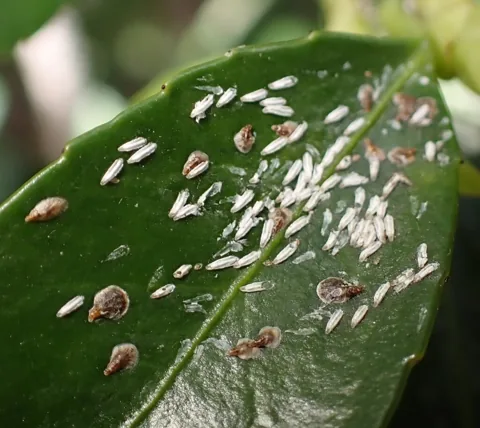 Euonymus Scale
Unaspis euonymi
Euonymus scale is a key pest of euonymus, pachysandra and bittersweet; vine-type euonymus are extremely susceptible.
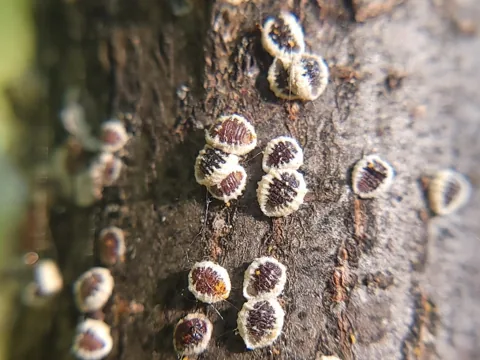 European Elm Scale
Gossyparia spuria
European elm scale is a soft scale ringed with white wax that feeds on elm twigs, branches and leaves, dripping honeydew and killing twigs in heavy infestations.
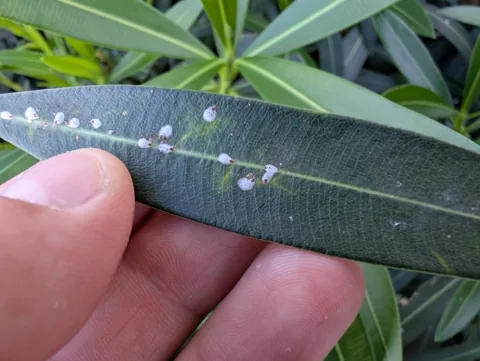 False Oleander Scale
Pseudaulacaspis cockerelli
False oleander scale is a non-native armored scale that dots the leaves of magnolia, sago palm, oleander and many other ornamentals with white covers and yellow spots. Heavy infestations make plants unsightly, drop leaves and slow growth.
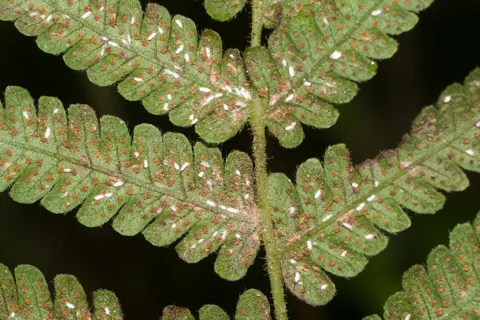 Fern scale
Pinnaspis aspidistrae
Fern scale is a small armored scale insect of ferns, liriope, palms and many foliage plants. The snow-white, ridged covers of the males stand out against dark green leaves, while the brown, oyster-shaped females are easy to overlook, and feeding can leave yellow spots.
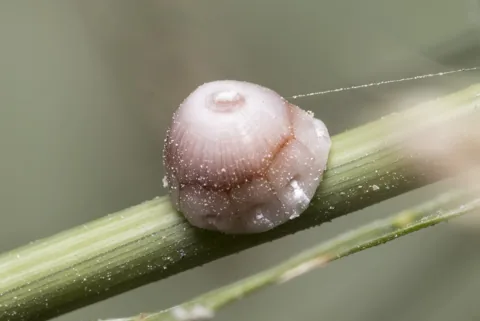 Fig wax scale
Ceroplastes rusci
Fig wax scale is a soft scale insect hidden under a thick, domed cap of pinkish to white wax. A pest of figs and citrus in the Mediterranean region, it was first found in Florida nurseries in 1994 and 1995, mostly on ixora, and in 2024 it turned up outdoors in a small fig orchard in San Diego County, California.
No photo yet
Fire bush scale
Lepidosaphes yanagicola
The fire bush scale is a small brown armored scale that lives on winged euonymus (burning bush) and a range of other deciduous trees and shrubs. On burning bush it tucks itself between the corky ridges that give the twigs their wings, where it is easy to miss until leaves turn off-color or drop early. It is a different insect from the familiar euonymus scale, is never found on evergreen euonymus, and has one generation a year. Heavy infestations have caused leaf drop and dieback in Maryland and in Ohio and northeastern nurseries, while in Pennsylvania it often builds up without doing much harm.
No photo yet
Fletcher Scale
Parthenolecanium fletcheri
Fletcher scale, also called arborvitae soft scale, is a native soft scale that sucks sap from twigs and needles of yew, arborvitae and juniper, coating them with sticky honeydew and black sooty mold.
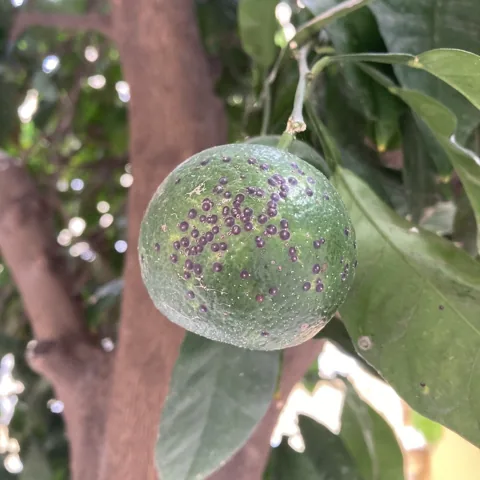 Florida red scale
Chrysomphalus aonidum
Florida red scale is an armored scale insect, apparently native to tropical Asia, and one of the most damaging scale pests of citrus. It dots leaves and fruit with small, round, dark scales, and heavy infestations yellow the leaves and can defoliate trees. It also attacks palms, orchids and many ornamentals, including plants kept in greenhouses.
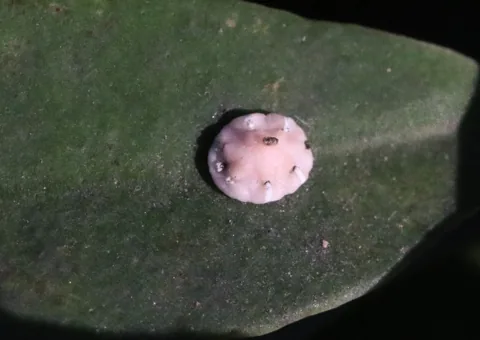 Florida Wax Scale
Ceroplastes floridensis
Pinkish-white waxy domes on holly, citrus or other shrubs are likely Florida wax scale. CDFA calls it one of the most commonly encountered soft scales in the southern United States and a serious pest of citrus and several ornamentals.
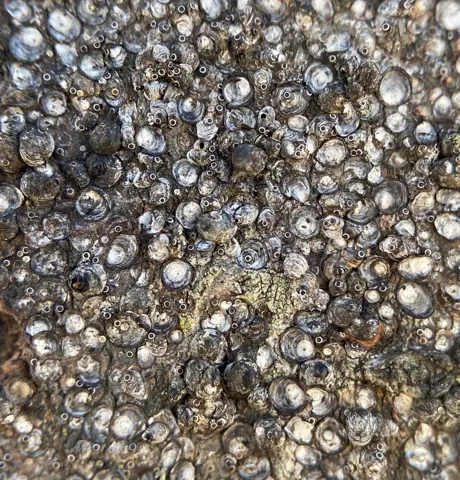 Gloomy Scale
Melanaspis tenebricosa
Gloomy scale is a native armored scale insect that encrusts the bark of red maples and other trees; heavy infestations cause branch dieback, a thinning canopy and eventually death, mostly on trees in hot, paved urban sites.
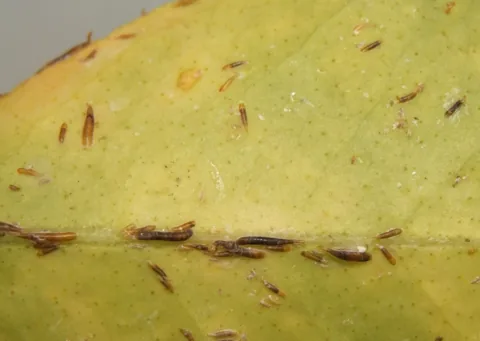 Glover's scale
Lepidosaphes gloverii
Glover's scale is a long, narrow, brown armored scale that lives on the bark, leaves and fruit of citrus wherever citrus grows in the tropics and subtropics. It is one of the most important armored scales in Florida citrus, though introduced parasitic wasps have made it much less of a problem than it once was. Heavy infestations leave green spots on ripening fruit and can yellow and drop leaves.
No photo yet
Greedy scale
Hemiberlesia rapax
Greedy scale is a tiny armored scale insect that infests hundreds of kinds of woody ornamentals, fruit trees and weeds around the world. Its small gray to white covers crowd the bark of trunks and limbs, and heavy infestations yellow leaves and kill back stems. Tiny parasitic wasps usually keep it in check, and horticultural oil is the low-risk spray when they don't.
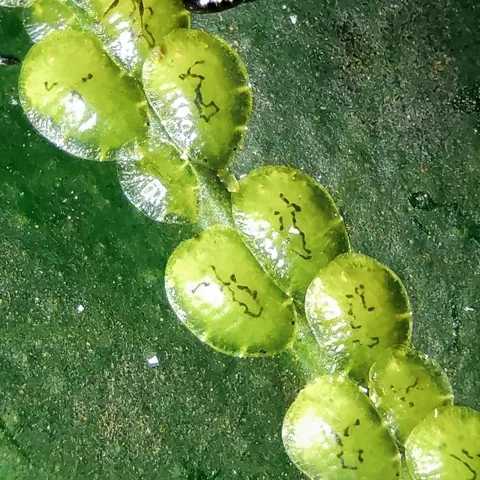 Green scale
Coccus viridis
Green scale, also called green coffee scale, is a soft scale of tropical and subtropical regions that feeds on more than 200 plant species, from coffee, guava and citrus to ornamentals such as gardenia and ixora. The scales settle along the leaf veins and on young stems, and their honeydew blackens plants with sooty mold.
No photo yet
Green shield scale
Pulvinaria psidii
Green shield scale is a soft scale insect of tropical and subtropical plants, from hibiscus and gardenia in landscapes to guava, mango and citrus in orchards. The females surround themselves with white cottony egg sacs, and heavy infestations leave honeydew, black sooty mold and wax that lingers long after the scales die.
No photo yet
Hemlock scale
Hemiberlesia ithacae
The hemlock scale is a native armored scale with a round, dark cover about 2 mm across. It feeds on the undersides of needles, hemlock first of all but also spruce, fir, Douglas-fir and pine, and the first sign is often a small yellow spot on the upper side of the needle. Four to six scales on a needle are enough to yellow it and make it drop. It is easy to confuse with the elongate hemlock scale and the introduced shortneedle evergreen scale, which share its hosts.
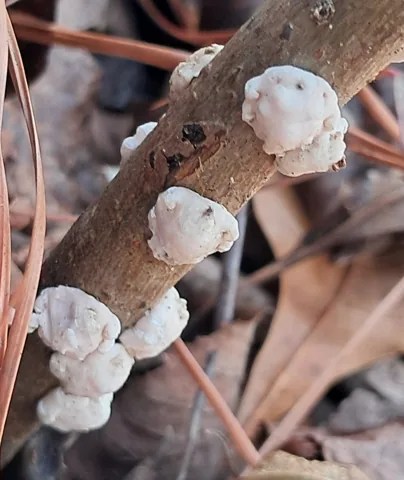 Indian Wax Scale
Ceroplastes ceriferus
Indian wax scale is a non-native soft scale whose mature females are white, rounded wax lumps up to 1/4 inch across that look like wads of gum on the twigs of hollies and other shrubs.
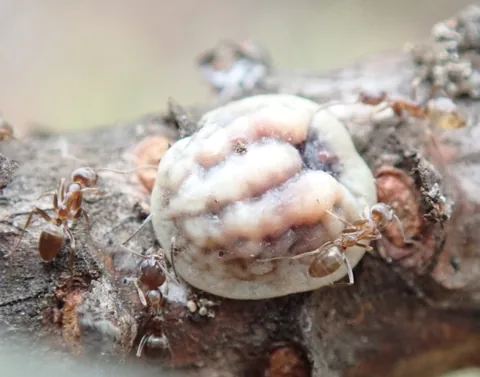 Irregular pine scale
Toumeyella pinicola
Irregular pine scale is a soft scale insect known only from California, where it is a serious pest of pines, especially Monterey pine. The females form lumpy, mottled bumps on young shoots that are often blackened by sooty mold, while the males' white cocoons line the needles like grains of rice. Heavy, prolonged infestations can stop new shoot growth and kill young pines.
No photo yet
Italian pear scale
Epidiaspis leperii
Italian pear scale is a small armored scale that lives on the bark of fruit and nut trees, hidden under moss and lichens. It is rarely a pest in commercial pear and apple orchards in California, but heavy infestations can pit, deform and kill branches, especially on pear and plum.
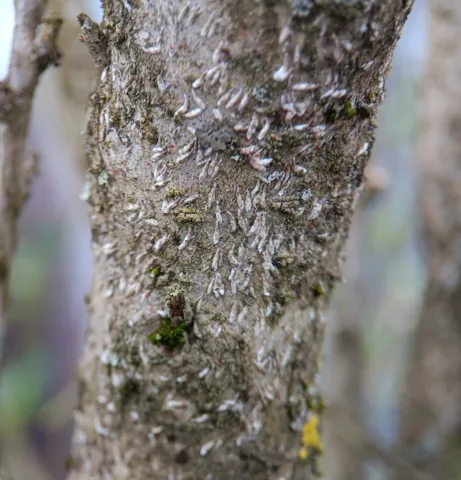 Japanese Maple Scale
Lopholeucaspis japonica
Japanese maple scale is an invasive armored scale that can cause leaf drop, branch dieback and even death of small trees.
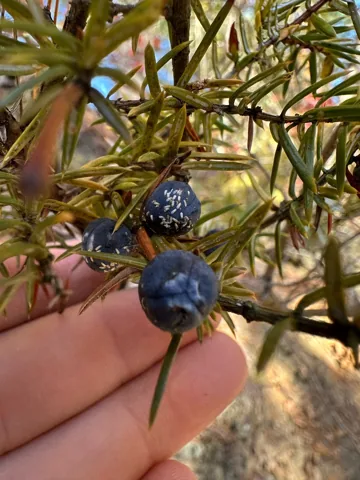 Juniper Scale
Carulaspis juniperi and C. minima
Juniper and minute cypress scales are armored scales of junipers, cypresses and arborvitae; light infestations are harmless, but heavy ones can kill branches or whole plants.
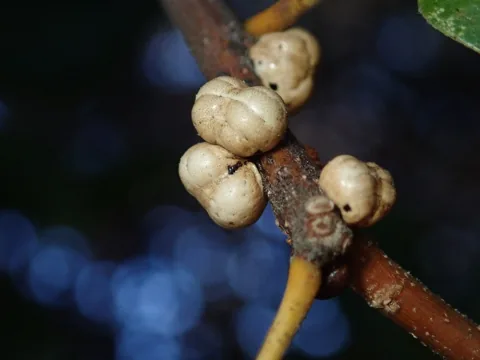 Kermes Scales
Kermesidae (e.g., Allokermes and Nanokermes species)
Kermes scales are round, smooth scale insects on oak twigs and leaves that look like buds or small galls; heavy infestations deform and stunt new growth.
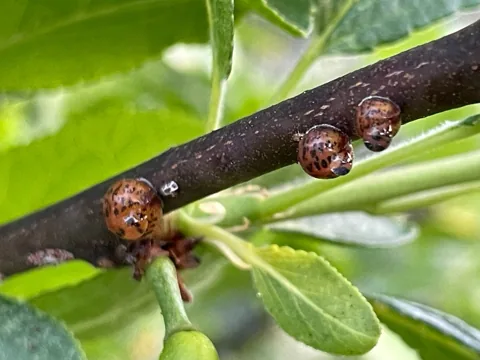 Kuno scale
Eulecanium kunoense
Kuno scale is a soft scale whose mature females are almost spherical, dark and shiny brown, about 1/6 inch (3 to 5 mm) across, and sit along twigs like beads on a string. It is most abundant on plum trees in California gardens and landscapes, where it can build up quickly and rain honeydew that turns to sooty mold and draws ants. It has one generation a year, is not a pest of commercial fruit and nut crops, and only rarely damages its other hosts such as cotoneaster, pyracantha, rose and walnut.
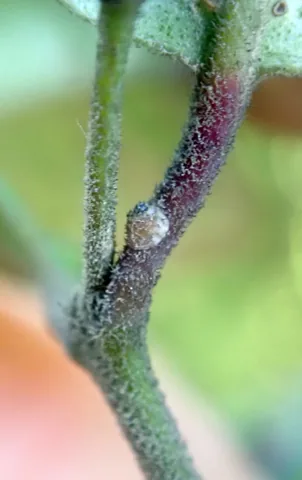 Latania scale
Hemiberlesia lataniae
Latania scale is a tiny armored scale insect that feeds under a round, gray to tan cover on the twigs, leaves and fruit of hundreds of kinds of plants; heavy infestations make plants look crusty and can kill small branches.
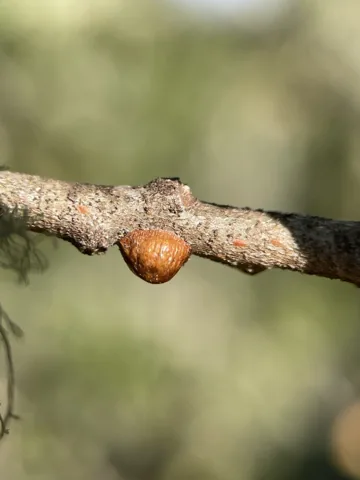 Lecanium Scale
Parthenolecanium species (e.g., P. corni)
Shiny brown bumps along oak, maple or crabapple twigs are often lecanium scales; heavy infestations kill twigs and branches.
No photo yet
Lesser snow scale
Pinnaspis strachani
Lesser snow scale is an armored scale insect that coats twigs, branches and trunks with snow-white male covers and grayish, mussel-shaped females. It feeds on more than 170 plant genera and is an occasional pest of citrus, hibiscus, palms, mango and banana. In the United States it is widespread in Florida and Hawaii and recorded from Texas east to Georgia.
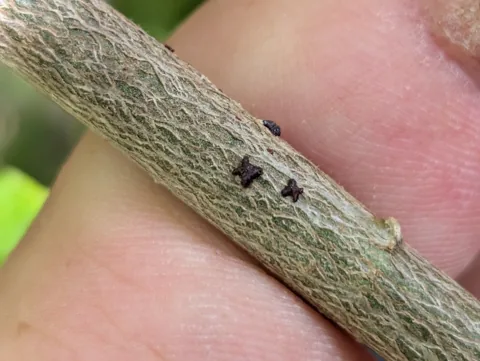 Lobate Lac Scale
Paratachardina pseudolobata (earlier reported as P. lobata lobata)
The lobate lac scale is an invasive scale insect first found in the US in Florida in 1999. It forms dark crusts on the young twigs of a very wide range of woody plants, is now a common landscape pest in South Florida, and heavy infestations can kill shrubs such as wax myrtle.
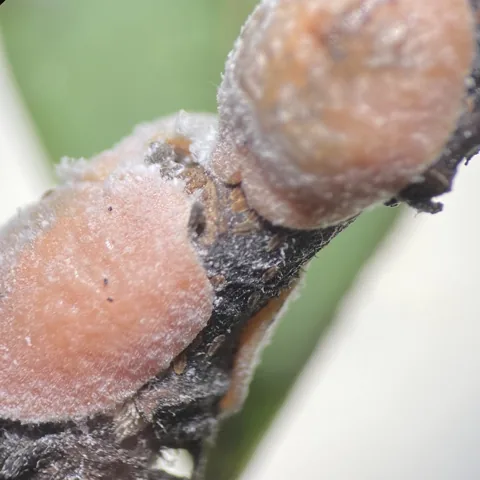 Magnolia Scale
Neolecanium cornuparvum
Magnolia scale females grow to about 1/2 inch across; heavy infestations weaken and can kill magnolia branches.
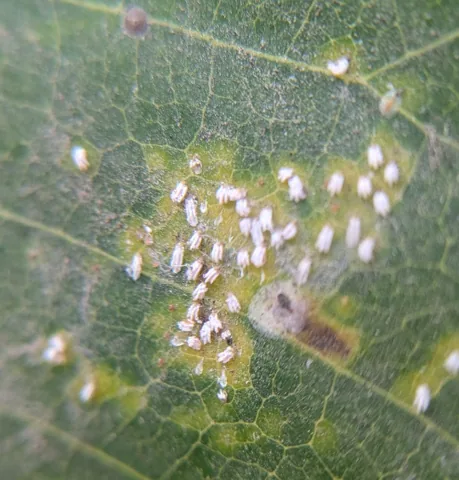 Mango scale
Aulacaspis tubercularis
Mango scale, also called white mango scale, is an invasive armored scale insect that infests mango in Florida. Its small white covers cluster on leaves, young stems and fruit, where feeding turns patches of leaf yellow and leaves conspicuous pink blemishes on the fruit skin. It has spread with infested plants to many mango-growing countries.
No photo yet
Mango shield scale
Milviscutulus mangiferae
Mango shield scale is a soft scale insect with a flat, shiny, pale-green body shaped almost like a triangle. It occurs widely in tropical and warmer subtropical regions, including Florida and Texas, and it can be a serious pest of mango. It also feeds on citrus, avocado, hibiscus and other ornamentals.
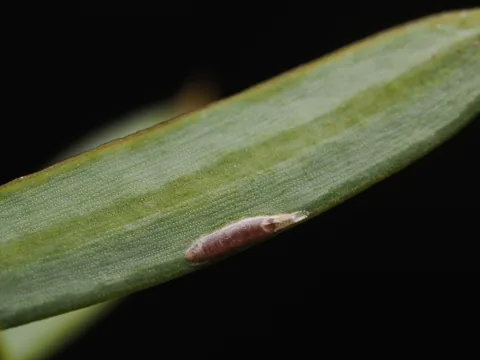 Maskell Scale
Lepidosaphes pallida (NC State lists it as L. maskelli)
Maskell scale is a tiny brown armored scale shaped like an oyster shell that settles on the needles of junipers, Japanese cedar (Cryptomeria) and other conifers and can cause browning and twig dieback.
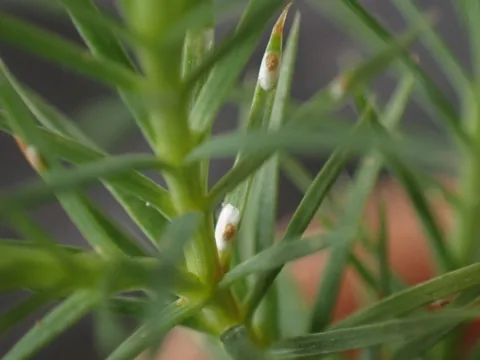 Minute Cypress Scale
Carulaspis minima
Minute cypress scale is a tiny armored scale insect that infests junipers, cypresses and Leyland cypress.
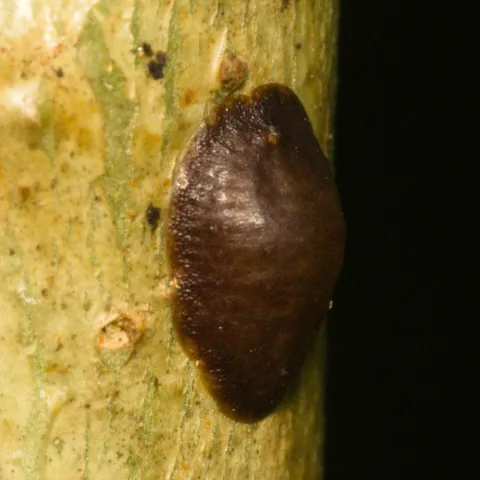 Nigra scale
Parasaissetia nigra
Nigra scale is a soft scale with a very long host list: ScaleNet records it on plants from 101 families, including hibiscus, ficus, oleander, avocado, mango, schefflera and ixora, and it is also called hibiscus scale and pomegranate scale. The adult female is elongate-oval, shiny and dark brown, 3 to 4 mm long, broad and flat on leaves but longer and more humped on stems. It reproduces without males, and genetic work shows what is called one species is at least two ecologically distinct lineages. In the United States it is recorded from the Gulf and Atlantic states to California and Hawaii. Like other soft scales it excretes honeydew that feeds sooty mold, and it is managed as soft scales generally are: conserve natural enemies, control ants, and use well-timed oil sprays.
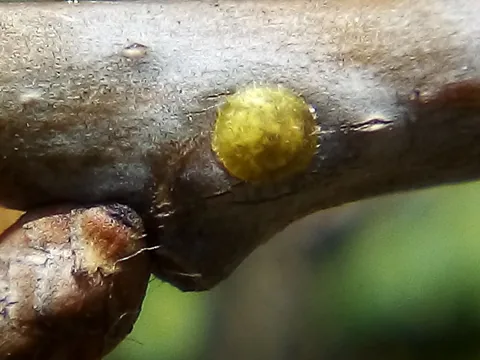 Oak Pit Scales
Asterodiaspis species
Pit scales suck juices from oak twigs, causing dieback that shows from mid- to late summer, especially on valley oak.
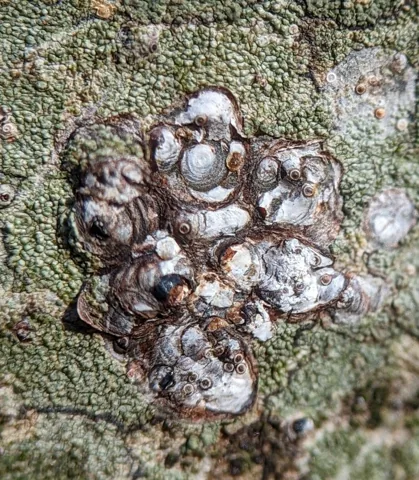 Obscure Scale
Melanaspis obscura
Obscure scale is named for being hard to see; it can cause branch dieback and sunken, disfigured bark.
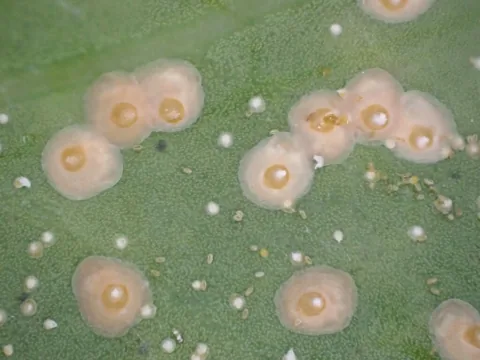 Oleander scale
Aspidiotus nerii
Oleander scale is a tiny armored scale insect that forms small, round, whitish covers on leaves, stems and fruit. It feeds on hundreds of plants but favors oleander, ivy, sago palm, aucuba and olive. In California landscapes it is generally not damaging, but heavy infestations cause wilting, yellowing and misshapen growth, and its hard cover makes it difficult to control.
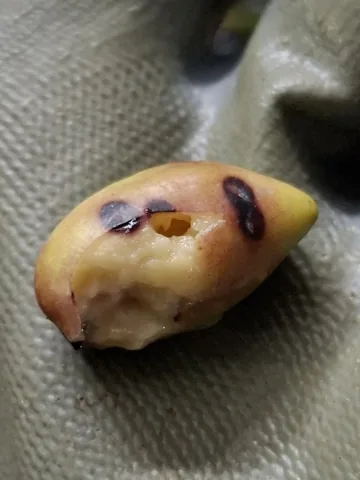 Olive scale
Parlatoria oleae
Olive scale is an armored scale insect that looks like a small gray crust on twigs, leaves and fruit. Its feeding leaves purple spots on olives and can leave red spots on fruits such as apples and peaches. It was once a very serious pest of olives and deciduous fruit in California, until introduced parasites brought it under control.
No photo yet
Oriental scale
Aonidiella orientalis
Oriental scale is a small armored scale insect, probably East Asian in origin, that has spread with plant shipments through the tropics and subtropics. In the United States it is established only in Florida, where it turns up most often on coconut palm and other landscape palms, and heavy infestations yellow the leaves and weaken the plant.
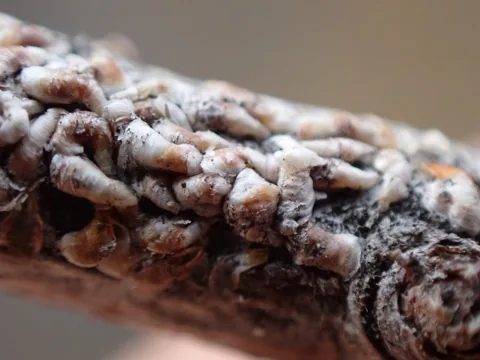 Oystershell Scale
Lepidosaphes ulmi
Oystershell scales blend into the bark until branches are crusted with them; heavy infestations can kill shrubs and trees.
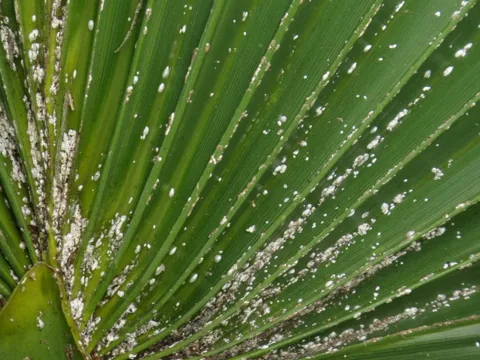 Palmetto Scale
Comstockiella sabalis
Palmetto scale is a tiny armored scale insect that speckles palm leaves with white, roughly round armor, often in large numbers. It is not particularly damaging where its parasites are present, and the Florida Department of Agriculture notes that cabbage palms are mainly at risk when stressed, for example after transplanting.
No photo yet
Peony scale
Pseudaonidia paeoniae
Peony scale is a tiny armored scale that burrows partly under the bark of azaleas and camellias; it is hard to see alive, but heavy infestations make plants unthrifty and cause dieback.
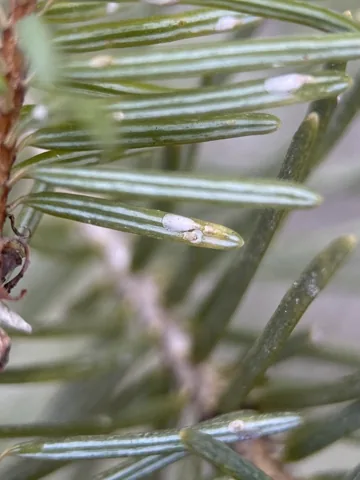 Pine Needle Scale
Chionaspis pinifoliae
White flecks lined up on pine or spruce needles are usually pine needle scale; light infestations are mostly cosmetic.
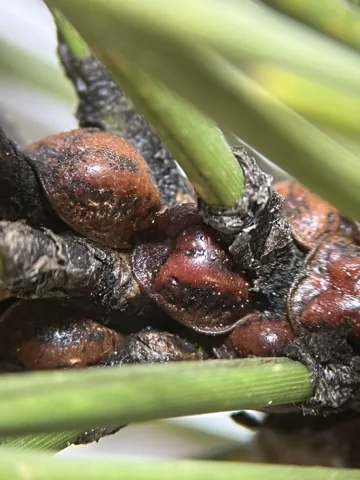 Pine Tortoise Scale
Toumeyella parvicornis
Pine tortoise scale is a soft scale insect native to North America that feeds on pine twigs and needles. Its honeydew grows black sooty mold, and it is one of the harder pests for Christmas tree growers to control.
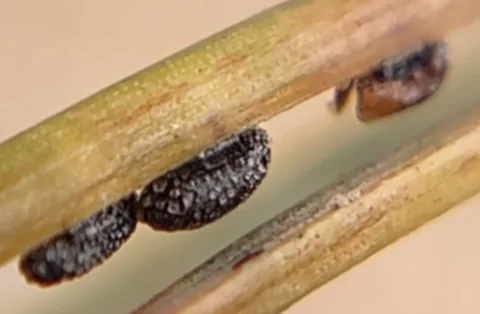 Pinyon Needle Scale
Matsucoccus acalyptus
Pinyon needle scale is a tiny native sucking insect of pinyon pines in the Southwest that thins the foliage until only tufts of needles remain at the branch tips.
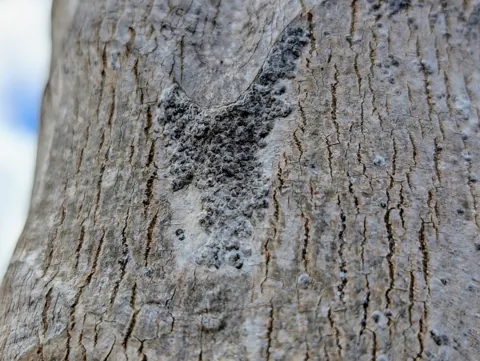 Plumose scale
Morganella longispina
Plumose scale, also called Maskell scale, is a tiny armored scale with a round, almost black cover that lives on the bark of branches. It feeds on plants in more than 80 genera, and in Florida it is a pest of ornamental plants and has damaged mango and fig.
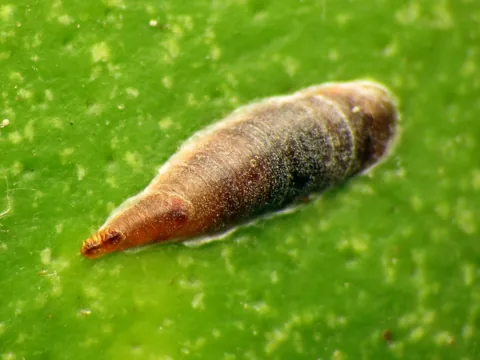 Purple Scale
Lepidosaphes beckii
Purple scale is a serious armored scale pest of citrus that infests leaves, fruit and stems.
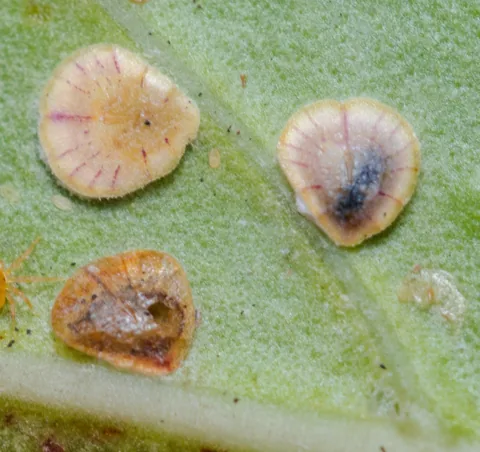 Pyriform scale
Protopulvinaria pyriformis
Pyriform scale is a flat soft scale named for its pear-like (pyriform) or heart-shaped outline. It spends its whole life on the undersides of leaves and is a serious pest of fruit trees and ornamentals in several tropical and subtropical countries. In Florida it is one of the scales that infest mango.
No photo yet
Red date scale
Phoenicococcus marlatti
Red date scale is a small, pinkish scale insect that lives out of the light in the soft, white tissue at the base of date palm leaves and fruit stalks, hidden in fluffy white wax. It came from the Middle East and North Africa on infested date palms and ScaleNet's catalog calls it a serious pest of date palms, but in California's desert date groves it is uncommon, stays in small colonies and needs no treatment.
No photo yet
Red pine scale
Matsucoccus matsumurae
The red pine scale is a tiny bast scale that feeds through the bark of red pine and a few Asian pines. It was discovered in 1946 killing 30-year-old red pine plantations at Easton, Connecticut, and became one of the most important insect pests of red pine in the Northeast, killing thousands of trees from nursery stock to mature timber. The American population was described as Matsucoccus resinosae; ScaleNet now treats that name as a synonym of the Asian species Matsucoccus matsumurae.
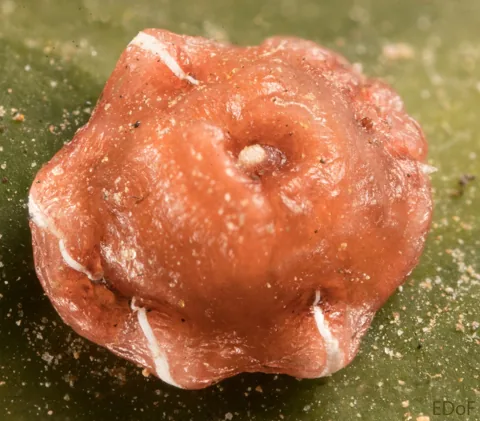 Red wax scale
Ceroplastes rubens
Red wax scale, also called pink wax scale, is a soft scale insect covered by a convex cap of pinkish-red wax. It feeds on plants in more than 190 genera and is a major citrus pest in Australia, Hawaii and Japan. In the continental United States it was first found in November 1955 at an Orange County, Florida, nursery on greenhouse-grown aglaonema, apparently brought in on imported foliage plants.
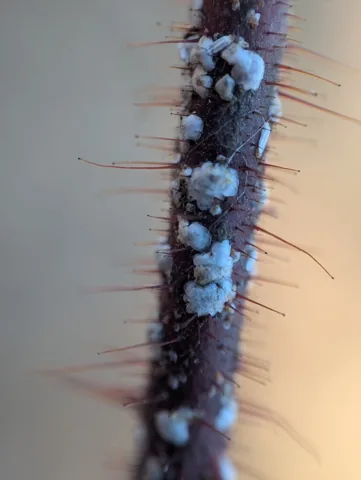 Rose scale
Aulacaspis rosae
The rose scale is an armored scale of roses and their relatives. Its flat, white, nearly circular covers coat the canes of roses, raspberries, blackberries and currants, and a heavy infestation can cause rose canes to decline and die back or kill the plant. Mississippi State calls it one of the more common armored scales on roses. Crawlers spread it along the plant and on the wind; settled scales and eggs travel on infested plants. On roses, winter pruning of the worst canes plus an oil spray usually gives sufficient control, and parasitic wasps attack it.
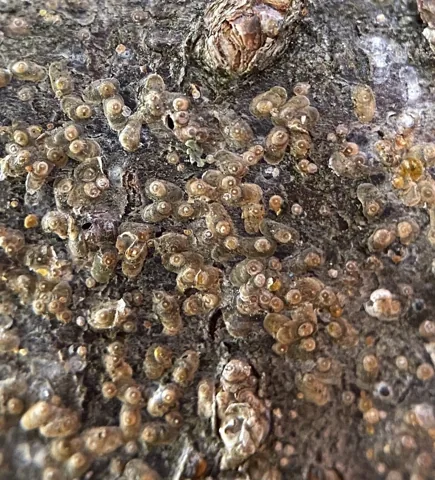 San Jose Scale
Comstockaspis perniciosa
Left uncontrolled, San Jose scale can kill limbs or even entire fruit trees in just a few years.
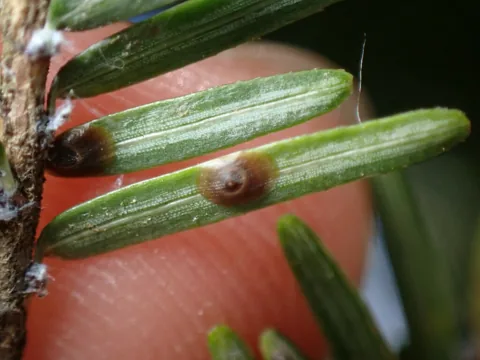 Shortneedle evergreen scale
Dynaspidiotus tsugae
The shortneedle evergreen scale, also called the shortneedle conifer scale, is a non-native armored scale first noticed in New Jersey in 1910 on Japanese hemlocks shipped from Japan. It has since been reported from Connecticut, Maryland, New York and Rhode Island, and a white spruce sample from Cape Cod confirmed it in Massachusetts in 2017. It settles on the undersides of hemlock, spruce, fir and yew needles, and in Connecticut it has historically been a serious pest of native eastern hemlock, yellowing needles, dropping them early and sometimes killing trees.
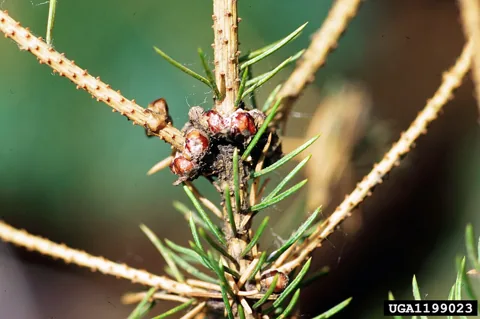 Spruce Bud Scale
Physokermes piceae
Spruce bud scale is a soft scale insect that clusters at the base of new spruce shoots, where the females look like buds.
No photo yet
Striped Pine Scale
Toumeyella pini
Striped pine scale is a soft scale (family Coccidae) that has greatly increased along Colorado's Front Range. It mainly damages Scotch pine, coating twigs and needles with sticky honeydew and sooty mold.
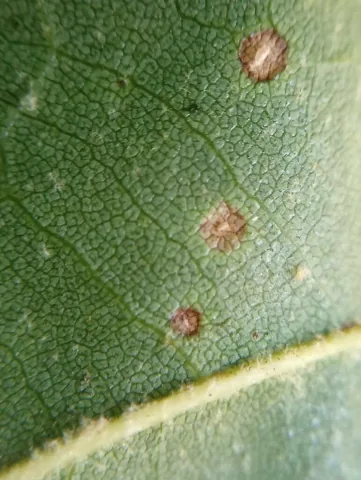 Sycamore Scale
Stomacoccus platani
Sycamore scale is the most damaging insect pest of sycamores in California, yet it's so small most people never see it.
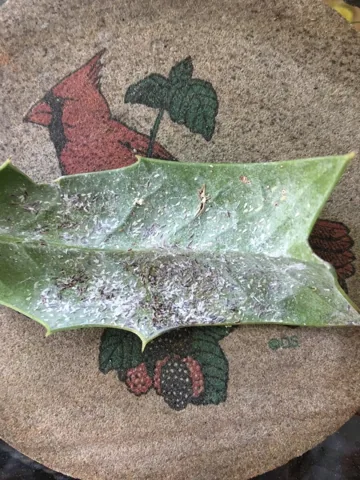 Tea Scale
Fiorinia theae
Tea scale is the most common insect pest of camellias in the Southeast and also attacks Chinese, Japanese and other hollies. It lives on the undersides of the leaves, and its feeding shows as yellow blotches on the upper surface.
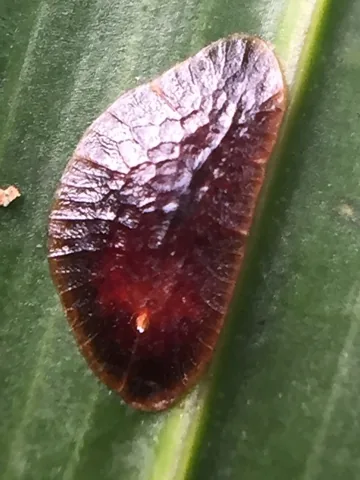 Tessellated scale
Eucalymnatus tessellatus
Tessellated scale is a soft scale insect named for the checkered, tile-like pattern on the adult female's back. It is probably South American in origin and has been carried around the world on cultivated plants. It is mainly a leaf-feeding greenhouse pest, and in south Florida it is often found outdoors on palms, crape-jasmine and mango.
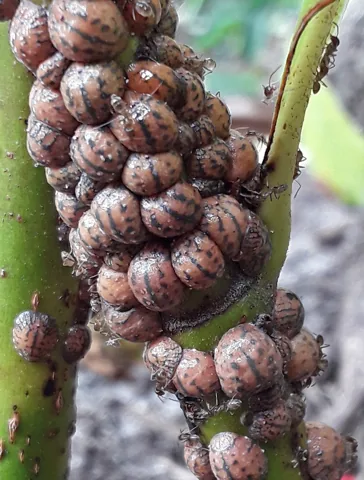 Tuliptree Scale
Toumeyella liriodendri
Tuliptree scale is a large soft scale that infests tulip poplar (yellow poplar), magnolia, linden and a few other trees. Heavy infestations make twigs look warty, coat branches in sticky honeydew and black sooty mold, and can weaken young trees.
No photo yet
Walnut Scale
Diaspidiotus juglansregiae
Walnut scales are gray armored scales that feed on walnut, red maple, boxwood, holly and other plants, causing branch dieback.
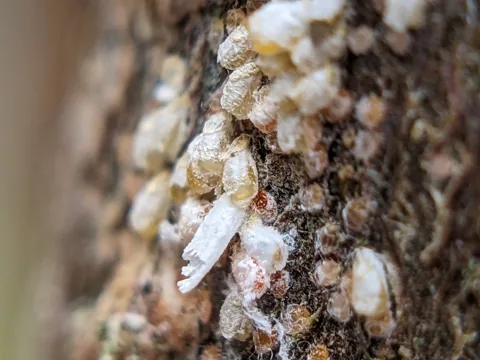 White Peach Scale
Pseudaulacaspis pentagona
White peach scale is one of the most commonly seen scales on peaches, and it can kill limbs and whole trees.
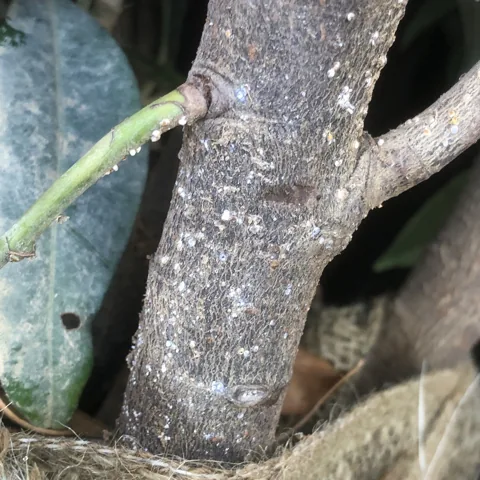 White Prunicola Scale
Pseudaulacaspis prunicola
White prunicola scale is a non-native armored scale that coats the twigs and branches of cherry laurel, flowering cherry, lilac and privet with tiny white covers, giving stems a snowy look and causing decline and dieback.
No photo yet
Woolly pine scale
Pseudophilippia quaintancii
The woolly pine scale is a soft scale insect of pines in the eastern and southeastern United States. In most pine forests it stays at harmless levels, and it becomes a pest mainly where insecticides sprayed for other pests have killed off its natural enemies: seed orchards, Christmas tree plantations and ornamental plantings. Its calling card is fluffy, snow-white wax, first on the new shoots in spring and later on the older needles, which can make a whole tree look flocked.
No photo yet
Yellow scale
Aonidiella citrina
Yellow scale is a small armored scale insect whose round, flat, see-through cover looks yellow because the female's body shows through it. It is best known as a citrus pest but also infests dogwood, euonymus, ligustrum (privet) and many other woody plants, and heavy infestations cause leaf drop and twig dieback.
Armored scale or soft scale?
Most scale problems on landscape plants are one of two families, and the difference decides almost every treatment choice that follows. UC IPM puts it plainly: you need to know the family, and often the species, to know whether control is warranted and which methods and timing will work.[1][5]
- Armored scales (family Diaspididae) are small and flat. UC IPM gives a cover under 1/8 inch across, UMN about 1/16 to 1/8 inch long, and the Connecticut Agricultural Experiment Station (CAES) 2 to 3 mm. The waxy cover is separate from the insect: pry it off and the body stays on the plant. They don't make honeydew. Many match the bark color and go unnoticed until branches start dying. Examples: San Jose, euonymus, oystershell, pine needle and elongate hemlock scale.[1][5][3]
- Soft scales (family Coccidae) are bigger and more humped, up to 1/4 inch long per UC IPM (CAES gives 5 to 10 mm). Their smooth, waxy or cottony surface is the insect's own body wall, so flipping one over takes the whole insect with it. They feed on phloem sap and drip sticky honeydew. Examples: brown soft, lecanium, calico, cottony maple, Fletcher and tuliptree scale.[1][3][8][6][5]
- Some other families matter too: UC IPM lists scales that attack cactus, elm, oak, sycamore and various conifers. Cottony cushion scale and European elm scale make honeydew; oak pit scales and sycamore scale don't.[1]
- Not every scale-like spot is a scale. Mealybugs stay mobile and are coated in cottony wax, and UC IPM notes that whitefly nymphs, psyllids and a few aphids can look scale-like.[3][1]
Signs of scale and how much damage to expect
Most plants tolerate low to moderate numbers of scale, and a few scales do no harm. UC IPM notes that even very high numbers of some species, such as oleander scale on most plants, cause no apparent damage, while others like cycad scale can kill the plant.[1]
- Honeydew: wet, sticky spots on leaves, pavement, cars or patio furniture under the plant point to soft scale (or aphids, which also make honeydew). Ants, wasps and flies come to feed on it.[1][5][6][8]
- Sooty mold: a black, soot-like fungus that grows on honeydew. It doesn't infect the plant, but heavy coatings block light and can stunt growth.[2][3]
- Yellowing, early leaf drop and a water-stressed look. Heavily infested twigs and branches may die and keep their dead brown leaves, giving a scorched appearance.[1]
- Branch dieback with no obvious cause. UMN says armored scales are usually more damaging than soft scales because their feeding kills plant cells in the branch, and dying limbs are often the first sign of a problem.[5][3]
- Check whether the scales are alive before treating. UC IPM suggests squishing some: live scales exude fluid, dead ones don't. Ragged scale remnants mean predators have been feeding, and neat round holes in the covers mean parasitic wasps have emerged.[1][3]
- If many scales are dead or parasitized, hold off. Both UC IPM and CAES advise delaying insecticide and checking again to see whether natural enemies bring the infestation down.[1][3]
Find the crawlers: the stage you can kill
Adult scales are shielded by their covers. Their newly hatched young, called crawlers, are tiny, usually yellow to orange, and have legs. They walk over the plant or get carried by wind, birds and people, then settle and start feeding within a day or two, and soon begin building their own cover. That short window is when sprays work best.[1][5][3][6]
Crawler timing depends on the species, so identify the scale first. UMN notes that some soft scales overwinter as nymphs or adults and armored scales as eggs under the mother's shell, while UC IPM says most armored scales overwinter mainly as young nymphs and adult females; both agree that knowing your species tells you when crawlers will appear. Most soft scales have one generation a year; most armored scales have several. CAES says crawler emergence usually lasts 2 to 4 weeks, and species with several generations have repeated hatches in warm weather.[5][1][3]
- Tape traps: before crawlers are expected in spring, wrap a few infested twigs tightly with double-sided tape (UC IPM) or black electrical tape with the sticky side out (CAES). Crawlers stick to it and show up as yellow or orange specks. A hand lens helps tell them from pollen and dust.[1][3][8]
- Change or check the tapes at least weekly. UC IPM suggests replacing them each week and comparing tapes over time.[1][3][5]
- Beat or shake infested branches over white paper or a white paper plate and look for moving reddish or yellowish specks.[5][3]
- When to spray: UMN says the best time for most scales is after eggs hatch, while crawlers are active and searching for feeding sites, before they produce shells. UC IPM, unless a species calls for other timing, sprays after crawler catches have peaked and begun to drop, soon after most crawlers have settled.[5][1]
- Expect a long window for some species. Calico scale crawlers in Kentucky spread out over June and July, which is one reason it's hard to control.[8]
Steps that don't need a sprayer
Several of the most useful moves are cultural ones, and on small plants they may be all you need.[1][8][7]
- Prune out heavily infested twigs and branches when the scales are limited to a few parts of a small plant. Cornell Cooperative Extension also suggests pruning for small oystershell scale infestations.[1][6]
- Scrub them off. On smaller trees, Kentucky Extension reports success removing calico scale with scrub brushes; it may take repeated attempts and elbow grease.[8]
- Keep the plant healthy, especially with appropriate watering, so it holds up better to scale feeding. In hot-summer areas, UC IPM says opening up the canopy by pruning can cut black, citricola and cottony cushion scale by exposing them to heat and parasites.[1]
- Rinse dusty plants. Dust interferes with the natural enemies that attack scales.[1]
- Replace plants that keep getting hit. Most scales are highly specific to certain plants, so a resistant species or cultivar may end the problem.[1]
- Look plants over closely, new ones included. Crawlers ride to other plants on wind, birds and people, and UMN warns a plant can be covered with scales before the problem is noticed.[1][5]
Deal with the ants
Ants that collect honeydew guard soft scales from lady beetles and parasitic wasps, and CAES notes they will even move scales to uninfested plants. CAES calls eliminating the ants the first step in managing honeydew-producing scales. UC IPM adds that controlling ants alone can let natural enemies gradually bring some scales under control.[3][1]
- Look for ant trails on the trunk. UC IPM says descending ants with swollen, almost translucent abdomens are probably carrying honeydew; follow their trail up to find the scales.[1]
- Cut off ant bridges: prune branches or weeds that touch buildings or the ground.[1]
- Band the trunk with a sticky barrier over a protective wrap of fabric tree wrap, heavy paper or masking tape, not directly on the bark. UC IPM says a band 2 to 6 inches wide is enough in most situations. Inspect it several times a year, stir the sticky material so debris doesn't form a bridge, and move the wrap at least once a year to avoid bark injury.[1]
- Put enclosed ant bait stations on trails or near nests under the plant. Slow-acting baits are shared through the colony, and UC IPM says they can be much more effective than sprays.[1]
Horticultural oil: dormant and growing-season sprays
Horticultural oil is the main spray for scale. It's a refined petroleum oil (also sold as narrow-range, superior or supreme oil) that kills by smothering the insect, and UC IPM says a well-timed, thorough spray gives good control of most scale species with relatively little harm to pollinators and natural enemies. Cornell Cooperative Extension calls oil a control common to all scales, with timing that differs by species.[1][3][6]
Coverage is everything. Thoroughly wet the infested twigs, branches and leaf undersides. UC IPM stresses this most for armored scales, which are generally less susceptible to pesticides than soft scales, and CAES notes some armored scales aren't adequately controlled by oil, possibly because an air gap under the cover protects the insect.[1][3]
- Dormant spray: in late winter or early spring before buds open, spray the bark of the shoots on deciduous plants. UMN says a dormant spray works only on species that overwinter as crawlers or adults, not on those that overwinter as eggs. UC IPM likewise says not to spray oystershell or olive scale in winter, since no susceptible stage is present then.[1][3][5]
- Delayed-dormant spray: for harder-to-control scales such as oak pit and sycamore scale, UC IPM sprays after buds swell but before they open.[1]
- Growing-season spray: oil applied soon after most crawlers have emerged, while scales are young, works on deciduous plants and broadleaf evergreens. More than one spray a season may be needed for species with several generations.[1][5]
- Rates: Cornell Cooperative Extension's examples use 2 to 4% oil at the dormant rate and 1 to 2% at the summer rate. Follow the label for your product.[6]
- Temperature: both CAES and Cornell Cooperative Extension say dormant sprays need temperatures above 40 degrees F, so pick a warm, sunny morning. For summer sprays, Cornell says not above 80 degrees F (spray on a cool evening), while UC IPM's cutoff is 90 degrees F. UC IPM also says not to spray in fog, below freezing, in humidity above 90%, or when rain is expected within 24 hours, and to water plants well first in hot weather. Don't spray in wind.[3][6][1]
- Plant safety: oil removes the blue tint from blue spruce (the tree stays healthy), and CAES says dormant oil can discolor some evergreens. Don't mix oil with sulfur or chlorothalonil, and don't apply it within 3 weeks of a sulfur spray. Read the label for plants it says not to spray.[1][3]
Insecticidal soap, neem and growth regulators
Insecticidal soap, neem oil and other plant oils are also short-lived contact sprays that UC IPM rates as low in toxicity to people and pets. Like oil, they only kill what they wet and leave no residue, so crawlers that hatch later need another spray; UMN notes scales with a long hatch may need repeat applications. CAES says soap may only work on scales that aren't well protected by a developed cover.[1][5][8][3]
Systemic insecticides: when and which
Systemic insecticides are taken up by the roots or trunk and moved through the plant. UC IPM says certain scale problems on large plants, or on hosts that suffer badly from scale, may warrant one, and a single effective application can control scale for the season. Trunk applications act fairly quickly; soil applications take longer. Some products and methods are for licensed professionals only.[1][5]
Match the product to the scale: the neonicotinoids differ in which scales they control.[1][5][3]
- Imidacloprid (soil drench) controls most soft scales but not armored scales or cottony cushion scale, according to UC IPM and UMN. CAES explains why: imidacloprid moves only a limited distance in plants, so it should be used only against honeydew-producing scales. UC IPM also warns it may cause cottony cushion scale outbreaks.[1][5][3]
- Dinotefuran is more mobile in plants and controls both soft and armored scales. CAES adds that it can penetrate bark after a bark spray, which helps on scales in hidden spots and on trees too big to spray.[5][1][3]
- Acetamiprid controls soft scales but is not very effective on armored scales per UC IPM, and is applied only as a spray. CAES groups it with dinotefuran as more soluble and usable against armored scales. The two sources disagree here; for armored scale, dinotefuran is the option both support.[1][3]
- Results vary by species. Kentucky Extension reports variable results from systemics against calico scale in university trials, so control there focuses on crawlers.[8]
- In North Carolina State University trials on landscape plants, systemic neonicotinoids and spirotetramat prevented cottony cushion scale infestation 133 days after treatment, while plants sprayed with bifenthrin or horticultural oil were readily reinfested.[10]
Cautions with systemics: bees, mites and soil
Systemics reach flowers, nectar and pollen. NPIC calls imidacloprid very toxic to honeybees and other beneficial insects, and CAES notes landscape label rates can put more insecticide in nectar and pollen than farm uses.[1][9][4]
- Apply after the plant finishes flowering, not during or shortly before bloom, unless the label says otherwise. UMN says if that timing doesn't line up with the crawlers, use another method.[1][5][4]
- Be careful with trees and shrubs bees love, such as linden, crabapple, sugar maple, serviceberry and viburnum, and don't drench soil where bee-attractive flowers grow next to the tree.[5][4]
- To lower bee risk, CAES points to shorter-residual products (dinotefuran or acetamiprid) and notes acetamiprid is roughly 3,000 times less toxic to honey bees than imidacloprid or dinotefuran.[4]
- Watch for spider mites afterward. UC IPM says some systemics can cause spider mite outbreaks, and CAES warns that a pyrethroid mixed with imidacloprid is likely to cause rust mite and spider mite outbreaks.[1][3]
- Imidacloprid can last months or years in soil and may leach to groundwater under some conditions, NPIC says. It also moves into fruit and leaves, so follow the label closely on food plants.[9]
- Prefer soil application or a trunk spray to injections or implants, which wound the tree and can spread disease. UC IPM says not to inject or implant more than once a year.[1]
Broad-spectrum sprays: where sources differ
UC IPM does not recommend foliar sprays of persistent broad-spectrum insecticides (carbaryl, malathion and pyrethroids such as bifenthrin and permethrin) for scale in gardens and landscapes. They are highly toxic to natural enemies and pollinators, can trigger spider mite outbreaks, and wash into storm drains and surface water. CAES likewise says these products don't fit integrated scale management and that low scale populations held in check by natural enemies can flare out of control when they are misused.[1][3]
Not every source rules them out. UMN lists pyrethroids and carbaryl as residual crawler sprays lasting one to two weeks, and CAES notes long-residual pyrethroids can cover a season of crawler activity with one spray. In the NC State trial, bifenthrin residue killed 90-100% of two natural enemies within 24 hours. If you choose one, time it to crawlers and expect to watch for mites.[5][3][10]
Scale on houseplants
Kentucky Extension says scales on houseplants make honeydew that gives leaves a shiny, sticky look, and infested plants grow poorly.[7]
- Wash broadleaved plants with soapy water and a soft brush or cloth. A thorough washing often holds scale at bay for several months.[7]
- Keep new plants apart from your others for 30 days so you can be sure they aren't carrying pests, and inspect plants regularly. The houseplant pests guide linked below covers swabbing and soap sprays step by step.[7]
- Buy plants from reputable sources; Kentucky Extension notes infested plants can look healthy when you buy them.[7]
Common questions
- What kills scale insects fast?
- A thorough spray of horticultural oil or insecticidal soap kills the crawlers it wets. Adults under their covers are harder to kill, so time sprays to the crawler stage or use a dormant oil spray in late winter.[1][5][3]
- Does dish soap kill scale?
- Washing houseplants with a mild soapy solution and a soft cloth removes and kills scales, Kentucky Extension says. Outdoors, use a product labeled as an insecticidal soap, and know it only works on crawlers and weakly covered scales.[7][3][5]
- Will scale insects kill my tree?
- Usually not with light infestations, but heavy armored scale infestations can kill branches and even whole plants. Soft scales cause honeydew and sooty mold first and can lead to dieback in severe cases.[1][5]
- Why didn't the systemic insecticide work?
- The usual reason is a mismatch: imidacloprid doesn't control armored scales or cottony cushion scale. Soil applications also take time to act, and some species, like calico scale, respond unevenly.[1][5][3][8]
- When should I spray dormant oil for scale?
- In late winter or early spring before buds open, on a day above 40 degrees F. It only helps against species that overwinter as nymphs or adults, not those overwintering as eggs.[3][6][5][1]
Photo credits
- Scale Insects: (c) Grey Smith, some rights reserved (CC BY) — via iNaturalist, CC BY 4.0
- Azalea Bark Scale: (c) Daniel S., some rights reserved (CC BY) — via iNaturalist, CC BY 4.0
- Barnacle scale: (c) RAP, some rights reserved (CC BY) — via iNaturalist, CC BY 4.0
- Beech Scale: Logan Stecker, public domain (CC0), via iNaturalist
- Black Pineleaf Scale: (c) Hunter Hickok, some rights reserved (CC BY) — via iNaturalist, CC BY 4.0
- Black Scale: (c) Mike Bowie, some rights reserved (CC BY) — via iNaturalist, CC BY 4.0
- Black Thread Scale: (c) Ben Jobson, some rights reserved (CC BY) — via iNaturalist, CC BY 4.0
- Boisduval scale: Collier Sparks, public domain (CC0), via iNaturalist
- Brown Soft Scale: (c) Lek Khauv, some rights reserved (CC BY) — via iNaturalist, CC BY 4.0
- Cactus scale: (c) Jared Shorma, some rights reserved (CC BY) — via iNaturalist, CC BY 4.0
- Calico Scale: (c) Brendan O'Loughlin, some rights reserved (CC BY) — via iNaturalist, CC BY 4.0
- California Red Scale: (c) Ben Jobson, some rights reserved (CC BY) — via iNaturalist, CC BY 4.0
- Chinese wax scale: (c) Cricket Raspet, some rights reserved (CC BY) — via iNaturalist, CC BY 4.0
- Citrus snow scale: geralg, public domain (CC0), via iNaturalist
- Cochineal Scale: (c) Alison Northup, some rights reserved (CC BY) — via iNaturalist, CC BY 4.0
- Coconut scale: (c) Mike Bowie, some rights reserved (CC BY) — via iNaturalist, CC BY 4.0
- Cottony azalea scale: Lyn Roueche, public domain (CC0), via iNaturalist
- Cottony Camellia Scale: Stephen James McWilliam, public domain (CC0), via iNaturalist
- Cottony Cushion Scale: Jesse Rorabaugh, public domain (CC0), via iNaturalist
- Cottony grape scale: (c) Oleksii Vasyliuk, some rights reserved (CC BY) — via iNaturalist, CC BY 4.0
- Cottony maple leaf scale: (c) Mark Richman, some rights reserved (CC BY) — via iNaturalist, CC BY 4.0
- Cottony Maple Scale: Adam Kranz, public domain (CC0), via iNaturalist
- Crapemyrtle Bark Scale: Jeff Davis, public domain (CC0), via iNaturalist
- Croton Scale: (c) Even Dankowicz, some rights reserved (CC BY) — via iNaturalist, CC BY 4.0
- Cryptomeria scale: (c) Tyler Ekholm, some rights reserved (CC BY) — via iNaturalist, CC BY 4.0
- Cycad Aulacaspis Scale: (c) Ken Puliafico, some rights reserved (CC BY) — via iNaturalist, CC BY 4.0
- Dictyospermum scale: (c) W Rao, some rights reserved (CC BY) — via iNaturalist, CC BY 4.0
- Elongate Hemlock Scale: (c) Sean Grasing, some rights reserved (CC BY) — via iNaturalist, CC BY 4.0
- Euonymus Scale: (c) Jon Mortin, some rights reserved (CC BY) — via iNaturalist, CC BY 4.0
- European Elm Scale: (c) Daniel S., some rights reserved (CC BY) — via iNaturalist, CC BY 4.0
- False Oleander Scale: Damien Wallace, public domain (CC0), via iNaturalist
- Fern scale: (c) Kevin Faccenda, some rights reserved (CC BY) — via iNaturalist, CC BY 4.0
- Fig wax scale: (c) Eleftherios Katsillis, some rights reserved (CC BY) — via iNaturalist, CC BY 4.0
- Florida red scale: no_goodny, public domain (CC0), via iNaturalist
- Florida Wax Scale: Agnes Trekker, public domain (CC0), via iNaturalist
- Gloomy Scale: (c) Zihao Wang, some rights reserved (CC BY) — via iNaturalist, CC BY 4.0
- Glover's scale: (c) Mike Bowie, some rights reserved (CC BY) — via iNaturalist, CC BY 4.0
- Green scale: (c) Jhonatan Matheus, some rights reserved (CC BY) — via iNaturalist, CC BY 4.0
- Indian Wax Scale: (c) Steven Joyner, some rights reserved (CC BY) — via iNaturalist, CC BY 4.0
- Irregular pine scale: (c) Henrik Kibak, some rights reserved (CC BY) — via iNaturalist, CC BY 4.0
- Japanese Maple Scale: (c) Tyler Ekholm, some rights reserved (CC BY) — via iNaturalist, CC BY 4.0
- Juniper Scale: Jacob Mullin, public domain (CC0), via iNaturalist
- Kermes Scales: (c) Cricket Raspet, some rights reserved (CC BY) — via iNaturalist, CC BY 4.0
- Kuno scale: Emily Heaton, public domain (CC0), via iNaturalist
- Latania scale: Peter de Lange, public domain (CC0), via iNaturalist
- Lecanium Scale: Emily Langdon-Lassagne, public domain (CC0), via iNaturalist
- Lobate Lac Scale: Damien Wallace, public domain (CC0), via iNaturalist
- Magnolia Scale: (c) Jody, some rights reserved (CC BY) — via iNaturalist, CC BY 4.0
- Mango scale: (c) Shikha Sreenivas, some rights reserved (CC BY) — via iNaturalist, CC BY 4.0
- Maskell Scale: (c) Angus Campbell, some rights reserved (CC BY) — via iNaturalist, CC BY 4.0
- Minute Cypress Scale: (c) Alison Copeland, some rights reserved (CC BY) — via iNaturalist, CC BY 4.0
- Nigra scale: Fernando Sessegolo, public domain (CC0), via iNaturalist
- Oak Pit Scales: (c) Stephen Thorpe, some rights reserved (CC BY) — via iNaturalist, CC BY 4.0
- Obscure Scale: (c) Zihao Wang, some rights reserved (CC BY) — via iNaturalist, CC BY 4.0
- Oleander scale: (c) Grey Smith, some rights reserved (CC BY) — via iNaturalist, CC BY 4.0
- Olive scale: Athan, public domain (CC0), via iNaturalist
- Oystershell Scale: Randal, public domain (CC0), via iNaturalist
- Palmetto Scale: Adam Kranz, public domain (CC0), via iNaturalist
- Pine Needle Scale: (c) Z, some rights reserved (CC BY) — via iNaturalist, CC BY 4.0
- Pine Tortoise Scale: (c) Jody, some rights reserved (CC BY) — via iNaturalist, CC BY 4.0
- Pinyon Needle Scale: Christian Pietzsch, public domain (CC0), via iNaturalist
- Plumose scale: Damien Wallace, public domain (CC0), via iNaturalist
- Purple Scale: (c) Katja Schulz, some rights reserved (CC BY) — via iNaturalist, CC BY 4.0
- Pyriform scale: (c) portioid, some rights reserved (CC BY) — via iNaturalist, CC BY 4.0
- Red wax scale: (c) portioid, some rights reserved (CC BY) — via iNaturalist, CC BY 4.0
- Rose scale: (c) Zihao Wang, some rights reserved (CC BY) — via iNaturalist, CC BY 4.0
- San Jose Scale: (c) Zihao Wang, some rights reserved (CC BY) — via iNaturalist, CC BY 4.0
- Shortneedle evergreen scale: (c) W Rao, some rights reserved (CC BY) — via iNaturalist, CC BY 4.0
- Spruce Bud Scale: Physokermes piceae by Steven Katovich, Bugwood.org — via Wikimedia Commons, CC BY 3.0
- Sycamore Scale: (c) Michele Jones, some rights reserved (CC BY) — via iNaturalist, CC BY 4.0
- Tea Scale: (c) dburger88, some rights reserved (CC BY) — via iNaturalist, CC BY 4.0
- Tessellated scale: (c) Stephen Thorpe, some rights reserved (CC BY) — via iNaturalist, CC BY 4.0
- Tuliptree Scale: (c) Celeste Ray, some rights reserved (CC BY) — via iNaturalist, CC BY 4.0
- White Peach Scale: (c) ncb1221, some rights reserved (CC BY) — via iNaturalist, CC BY 4.0
- White Prunicola Scale: (c) Andrew Conboy, some rights reserved (CC BY) — via iNaturalist, CC BY 4.0
Sources
- University of California Statewide IPM Program, “Pest Notes: Scales (Publication 7408).” ipm.ucanr.edu/home-and-landscape/scales/ (accessed 2026-11-10)
- University of California Statewide IPM Program, “Sooty Mold (Home and Landscape).” ipm.ucanr.edu/home-and-landscape/sooty-mold/ (accessed 2026-11-10)
- The Connecticut Agricultural Experiment Station, “Scale Insect Pests of Connecticut Trees and Ornamentals.” portal.ct.gov/-/media/caes/documents/publications/fact_sheets/entomology/scaleinsectpestsofconnecticuttreesandornamentalspdf.pdf (accessed 2026-11-10)
- The Connecticut Agricultural Experiment Station, “Use of Neonicotinoids in the Home Landscape.” portal.ct.gov/-/media/caes/documents/publications/fact_sheets/valley_laboratory/useofneonicotinoidsinthehomelandscapecowlesmarch2015pdf.pdf (accessed 2026-11-10)
- University of Minnesota Extension, “Scale insects on Minnesota trees and shrubs.” extension.umn.edu/garden-and-home/yard-and-garden/yard-and-garden-insects/scale-insects (accessed 2026-11-10)
- Cornell Cooperative Extension, Nassau County, “Scale Insects (Home Grounds Fact Sheet E-1-31).” ccenassau.org/resources/scale-insects (accessed 2026-11-10)
- University of Kentucky Entomology, “Houseplant Insect Control (ENTFACT-406).” entomology.mgcafe.uky.edu/ef406 (accessed 2026-11-10)
- University of Kentucky Entomology, “The Challenges of Calico Scale Control (ENTFACT-466).” entomology.mgcafe.uky.edu/ef466 (accessed 2026-11-10)
- National Pesticide Information Center, “Imidacloprid General Fact Sheet.” npic.orst.edu/factsheets/imidagen.html (accessed 2026-11-10)
- Environmental Entomology (PubMed 22507012), “Frank SD. Reduced risk insecticides to control scale insects and protect natural enemies in the production and maintenance of urban landscape plants. Environ Entomol 2012;41(2):377-86.” pubmed.ncbi.nlm.nih.gov/22507012/ (accessed 2026-11-10)