On this page
How to identify it
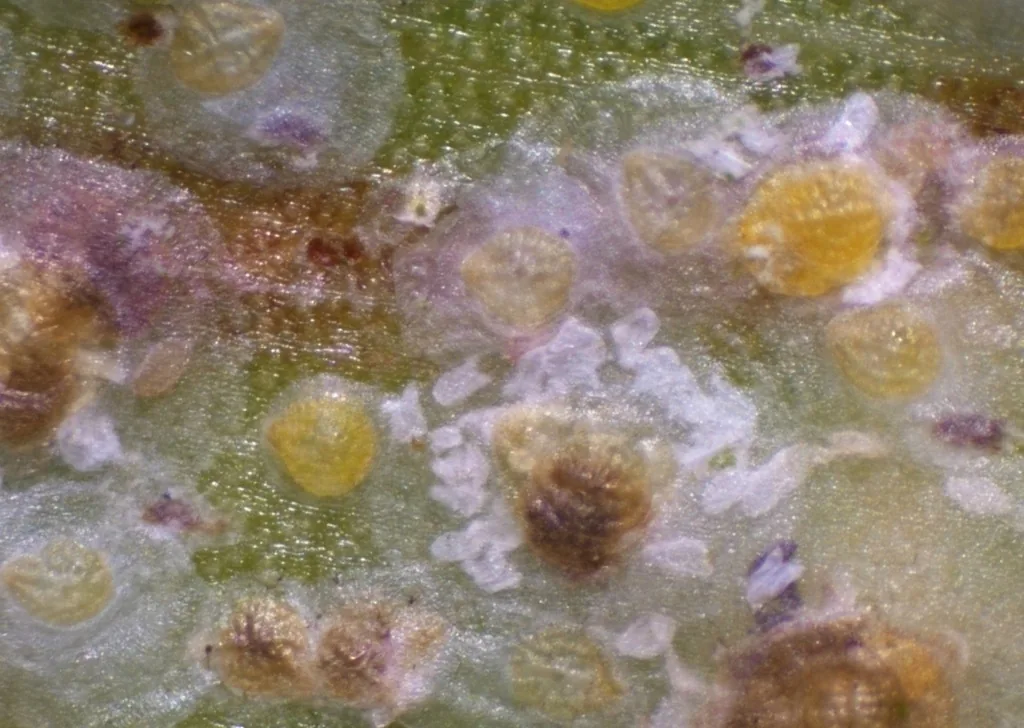
- The female's cover is round to broadly oval, 1.5 to 2.0 mm across, flat, very thin and translucent, with a pale yellow spot near the center.[1][2]
- Through the cover you can see the yellow, pear-shaped body of the female; whitish to pale yellow eggs are laid around her under the cover.[1][2]
- Male covers are smaller, oval and turn reddish brown. Adult males are tiny, reddish, two-winged, gnat-like insects that do not feed.[1][2]
- Dense colonies on the undersides of leaves look like rows of miniature fried eggs, often over yellow or brown patches of leaf.[1][2]
Look-alikes
| Look-alike | How to tell them apart |
|---|---|
| Aspidiotus excisus | A closely related armored scale also recorded in Florida that looks very similar in life; telling the two apart takes a slide-mounted adult female under a microscope.[2] |
| Other armored scales | Coconut scale has a waxy cover like other armored scales, and a positive identification requires slide-mounting an adult female and examining it at high magnification.[1] |
Where it lives
Coconut scale is found in tropical and subtropical areas around the world and appears to be native to South Asia. U.S. records include Connecticut, Florida, Georgia, Hawaii and Pennsylvania, plus Puerto Rico; in more northern regions it is found only in greenhouses and other enclosed areas.[1]
Biology and life cycle
Females lay about 20 to 65 eggs under their covers in batches over a week or two. The crawlers that hatch wander for a few hours to two days before settling, and the females never move again.[1][2]
Crawlers can walk up to about a meter, and they are carried much farther by wind, birds, bats, insects and the movement of infested plants.[1][2]
Development takes about a month: at 30 C (86 F) females reached adulthood in about 35 days and males in about 29. Generations overlap; it breeds continuously in tropical Trinidad, has three generations a year in China and only one on tea in Japan.[1][2]
Its hosts span more than 60 plant families, including coconut and other palms, banana, mango, papaya, avocado, guava, citrus, plumeria, bird of paradise, ginger and ficus.[1]
Damage and signs
- It feeds mostly on the undersides of leaves but also on frond stalks, flower clusters and young fruit. Yellow spots form under the scales, and whole leaves may yellow, brown and drop; badly affected coconut palms turn bright yellow.[1][2]
- In extreme cases on coconut, fronds drop off and the crown dies. Older palms and trees on well-drained soil are seldom seriously infested.[2]
- On mango it favors older leaves and blemishes the fruit skin, and on many fruits it is a cosmetic pest that lowers quality.[1][2]
Health risk
The sources treat it only as a plant pest; none mentions bites or any risk to people or pets.[1][2]
Control
Prevention
Check leaf undersides with a hand lens for flat, translucent scales over yellow or brown patches, and avoid moving infested plants, which spreads the scale to new areas.[2]
Sanitation
Prune infested leaves, branches and twigs and dispose of them, and avoid overfertilizing, which contributes to scale outbreaks.[1]
Biological control
More than 40 kinds of parasitic wasps and predators attack coconut scale, including Aphytis and Comperiella wasps and Chilocorus lady beetles, and outbreaks can explode when these natural enemies are missing. Consider their sensitivity before spraying.[1]
Pesticides
Crawlers are the most vulnerable stage. Contact insecticides, including horticultural oils, work less well once the waxy cover forms, and a heavy infestation may need several sprays 15 to 20 days apart.[1]
Common questions
- What are the tiny see-through scales under my palm leaves?
- Coconut scale forms flat, translucent covers about 1.5 to 2 mm across with a yellowish center, often in crowded colonies on leaf undersides that look like miniature fried eggs.[1][2]
- Why are my palm's leaves turning yellow?
- Coconut scale injects toxic saliva as it feeds, causing yellow spots beneath the scales and, in heavy infestations, whole leaves that yellow, brown and drop.[2]
- Does coconut scale only attack coconut?
- No. It feeds on several hundred hosts in more than 60 plant families, including banana, mango, papaya, avocado, citrus and many ornamentals.[1]
Sources
- University of Florida IFAS Extension (EDIS Featured Creatures), “Coconut Scale, Aspidiotus destructor Signoret (EENY622, 2015).” journals.flvc.org/edis/article/view/138250 (accessed 2026-11-09)
- Naturalis Biodiversity Center (Diaspididae of the World, with USDA scale insect data), “Diaspididae of the World 2.0: Aspidiotus destructor.” diaspididae.linnaeus.naturalis.nl/linnaeus_ng/app/views/species/taxon.php?id=113049 (accessed 2026-11-09)
- iNaturalist, “Aspidiotus destructor taxon page (order and family).” www.inaturalist.org/taxa/330219 (accessed 2026-11-09)