On this page
How to identify it
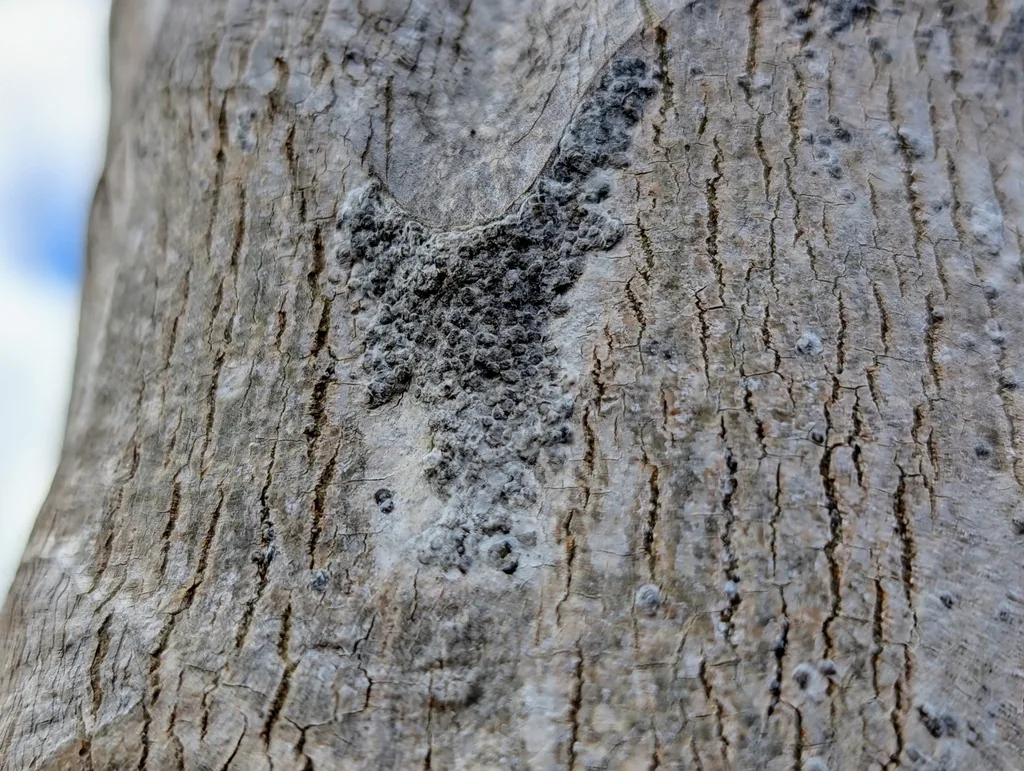
- The female's cover is circular, strongly domed and almost black, only about 0.6 mm across, with the dark shed skins of earlier stages at the center.[1][2]
- Male covers are the same color but smaller and longer than wide, with the shed skin near one end.[1][2]
- Under the cover, the adult female's body is creamy white, and a thick wax layer lies beneath the body against the bark.[1]
Look-alikes
| Look-alike | How to tell them apart |
|---|---|
| Clavate scale (Clavaspis herculeana) | Another small tropical armored scale that can be mistaken for plumose scale; the two differ in the shape of the rear end of the female's body, which can only be seen on a microscope slide.[1] |
Where it lives
Its origin is uncertain, possibly South America or eastern Asia, and it now occurs in Africa, the Americas, Asia and Oceania. In the United States it is recorded from Florida and Hawaii.[3][2][1]
Biology and life cycle
Females give birth to live crawlers instead of laying eggs, and the species has several generations a year in Algeria. Females pass through two nymphal stages; males have two nymphal stages, a prepupa and a pupa.[2][3]
Crawlers are the stage that spreads, walking to new parts of the plant or being carried by wind or animals, and many die from weather. Settled scales spread when people move infested plant material.[1]
It lives mostly on branches and occasionally on fruit. Recorded hosts include avocado, carambola, citrus, coffee, fig, hibiscus, jasmine, crape myrtle (Lagerstroemia), loquat, macadamia, mango, oleander, olive, guava and pomegranate.[1][3]
Damage and signs
- On fig, its feeding causes tumor-like cankers on twigs, and the branches dry out and break off.[1]
- It has damaged grapefruit, lemon, fig, papaya and mango in French Polynesia and has sometimes killed Bauhinia and jasmine in New Caledonia. It is a minor pest of citrus in Brazil and China and of mango in Florida.[1][2]
- European plant-health experts consider that it could cause significant damage to crops such as avocado, citrus, fig, peach, plum, olive and walnut, though how much yield it costs is uncertain.[3]
Health risk
The sources treat it only as a plant pest; none mentions bites or any risk to people or pets.[1][2]
Control
Prevention
Check the bark of host plants for small, round, almost black, strongly domed covers with dark centers.[1]
Traps and physical control
On small plants, prune off heavily infested twigs and branches if the scales are limited to a few parts of the plant.[5]
Biological control
Small parasitic wasps frequently attack scales on mango in Florida, and two parasitic wasps, Encarsia koebelei and Pteroptrix perkinsi, attack plumose scale in Hawaii. Before treating, check whether many scales are already dead or parasitized.[4][1][5]
Pesticides
A well-timed, thorough horticultural oil spray during the dormant season or when crawlers are active controls most scales. Soil-applied imidacloprid is not effective against armored scales.[5]
Common questions
- What are the tiny black bumps crusting my fig branches?
- They could be plumose scale, an armored scale with round, almost black, domed covers about 0.6 mm across. On fig it can cause cankers on twigs and make branches dry out and break.[1][2]
- Does plumose scale make honeydew?
- No. Armored scales like plumose scale don't produce sticky honeydew.[5]
Sources
- Naturalis Biodiversity Center (Diaspididae of the World 2.0, Linnaeus NG), “Diaspididae of the World 2.0: Morganella longispina.” diaspididae.linnaeus.naturalis.nl/linnaeus_ng/app/views/species/taxon.php?id=113107 (accessed 2026-11-09)
- ScaleNet (scale insect database begun at the USDA ARS Systematic Entomology Laboratory), “ScaleNet catalogue: Morganella longispina (Morgan).” scalenet.info/catalogue/Morganella%20longispina/ (accessed 2026-11-09)
- European Food Safety Authority (EFSA Journal), “Pest categorisation of Morganella longispina (EFSA Panel on Plant Health 2025, EFSA Journal 23:e9151).” doi.org/10.2903/j.efsa.2025.9151 (accessed 2026-11-09)
- University of Florida IFAS Extension (EDIS), “Mango Pests and Beneficial Insects (ENY-413/IG073, 2017).” journals.flvc.org/edis/article/view/138135 (accessed 2026-11-09)
- University of California Statewide IPM Program, “Pest Notes: Scales (UC ANR Publication 7408).” ipm.ucanr.edu/home-and-landscape/scales/ (accessed 2026-11-09)
- iNaturalist, “Morganella longispina taxon page (order and family).” www.inaturalist.org/taxa/1621164 (accessed 2026-11-09)