On this page
How to identify it
- The female's cover is roughly circular, white and translucent, with a dark oval spot (the shed skins of earlier stages); under it, an egg-laying female is brownish and 1.5 to 2.0 mm long.[2]
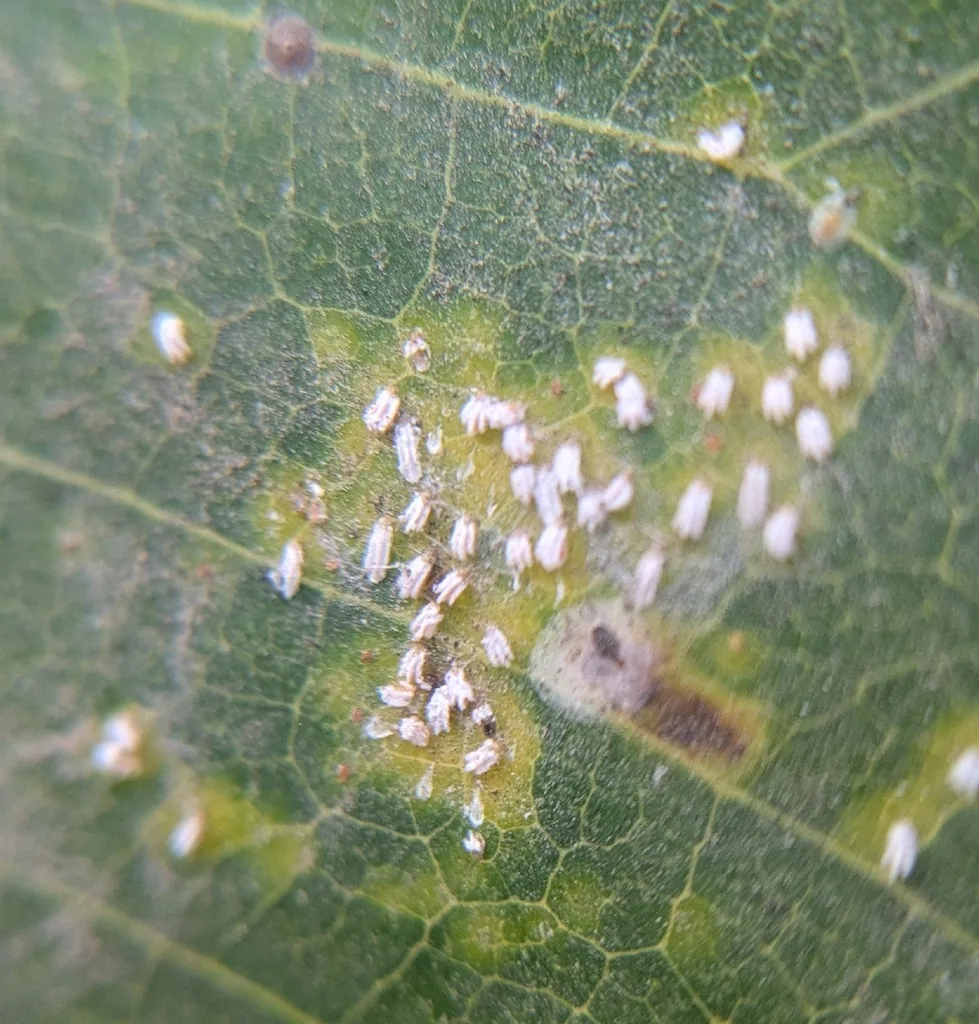
- Male covers are smaller, rectangular and white, with three raised ridges running lengthwise. Adult males have wings.[2]
- Male crawlers settle in groups of 10 to 80, often near females, and their white covers make these groups easy to spot.[2]
- Lifting a female's cover with a pin may reveal a mass of pink eggs and crawlers; dead scales release no body fluid when pricked.[2]
Look-alikes
| Look-alike | How to tell them apart |
|---|---|
| Other armored scales on mango | Several other scales also infest Florida mango, on the upper or lower surfaces of leaves and on fruit. An authoritative identification to species requires a slide-mounted adult female under a microscope.[1][2] |
Where it lives
A tropical species that may have originated in Asia, mango scale has spread on infested plant material and is now widespread in many mango-growing countries. UF/IFAS lists it among the scales infesting mango in Florida.[2][1]
Biology and life cycle
Each female lays roughly 50 eggs in one Australian survey, and 80 to 200 in Ghana, where breeding continues through both wet and dry seasons. Males develop from egg to adult in 23 to 28 days.[2]
Males can far outnumber females; a ratio of 11 males to each female has been observed, which is unusual among scale insects.[2]
Crawlers spread the infestation, either crawling a few centimeters before settling or blowing on the wind.[2]
It feeds mainly on palms and on plants in the laurel, citrus and cashew families, especially mango, coconut and cinnamon; other hosts include avocado, bay laurel, citrus, pittosporum and ginger. It does not feed on grasses.[2]
Damage and signs
- Infested parts of mango leaves turn pale green or yellow and eventually die.[2]
- Infested mango fruits get conspicuous pink blemishes around the feeding sites, which lowers their market and export value.[2]
- In nurseries, severe early infestations slow growth, and young trees are especially prone to heavy leaf loss and twig death during hot, dry weather.[2]
Health risk
The sources treat it only as a plant pest; none mentions bites or any risk to people or pets.[2][1]
Control
Prevention
Check new mango and other host plants for white scale covers on leaves and twigs with a magnifying lens in good light; the scale spreads mainly through the movement of infested plants and fruit.[2]
Biological control
Scales on mango are frequently parasitized by small wasps. In South Africa, an Encarsia wasp parasitized on average about 18 percent of female mango scales.[1][2]
Lady beetles such as Rhyzobius lophanthae and Chilocorus nigrita feed on mango scale, but on their own they generally do not keep it below damaging levels.[2]
Common questions
- What are the pink spots on my mangoes?
- Mango scale leaves conspicuous pink blemishes around its feeding sites on the fruit; look for small white scale covers on the fruit and nearby leaves.[2]
- Is mango scale the same as mango shield scale?
- No. They are different species: mango scale is Aulacaspis tubercularis and mango shield scale is Milviscutulus mangiferae. UF/IFAS lists both among the scales that infest mango in Florida.[1]
- Are the white specks on my mango leaves male scales?
- Possibly. Male mango scales settle in conspicuous groups of 10 to 80 small, white, ridged covers, often near the round females.[2]
Sources
- University of Florida IFAS Extension (EDIS), “Mango Pests and Beneficial Insects (ENY-413/IG073, 2017).” journals.flvc.org/edis/article/view/138135 (accessed 2026-11-09)
- Naturalis Biodiversity Center (Diaspididae of the World, with USDA scale insect data), “Diaspididae of the World 2.0: Aulacaspis tubercularis.” diaspididae.linnaeus.naturalis.nl/linnaeus_ng/app/views/species/taxon.php?id=113054 (accessed 2026-11-09)
- iNaturalist, “Aulacaspis tubercularis taxon page (order and family).” www.inaturalist.org/taxa/716086 (accessed 2026-11-09)