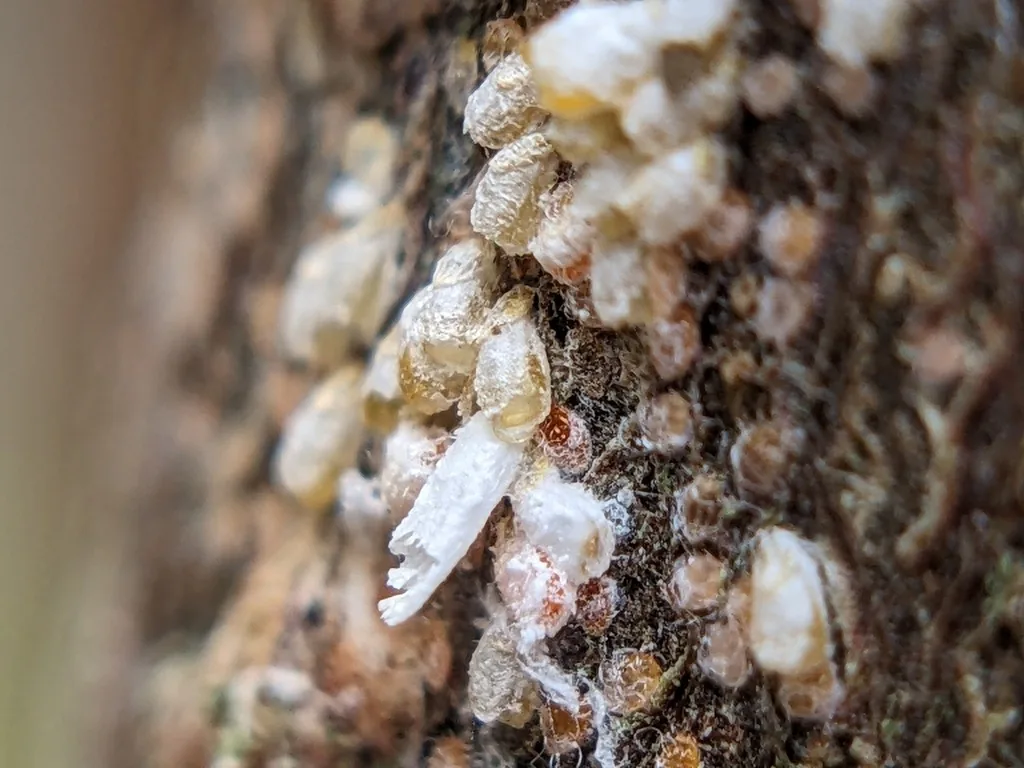
How to identify it
Look-alikes
| Look-alike | How to tell them apart |
|---|---|
| San Jose scale | Gives birth to live crawlers and has four to six generations a year rather than three.[1] |
| Japanese maple scale | A white look-alike armored scale with a purple insect underneath.[2] |
Where it lives
HGIC covers it on peach trees in South Carolina.[1]
Biology and life cycle
It overwinters as adult females, which start laying eggs in early April; males live about a day.[1]
Crawlers spread along branches for a few days before settling; there are three generations a year.[1]
Damage and signs
- Infestations cause stunting, leaf drop and death of branches and potentially entire trees.[1]
Health risk
It feeds on plants; Clemson HGIC mentions no risk to people.[1]
Control
Pesticides
Horticultural oil applied before budbreak, above 40 degrees F, smothers overwintering females.[1]
Common questions
Sources
- Clemson Cooperative Extension, Home & Garden Information Center, “Peach Insect Pests (HGIC 2210).” hgic.clemson.edu/factsheet/peach-insect-pests/ (accessed 2026-10-06)
- University of Kentucky Entomology (ENTFACT), “Managing Japanese Maple Scale in Kentucky Nurseries (ENTFACT-463).” entomology.mgcafe.uky.edu/ef463 (accessed 2026-10-06)
- iNaturalist, “Pseudaulacaspis pentagona taxon page (order and family).” www.inaturalist.org/taxa/716067 (accessed 2026-10-06)