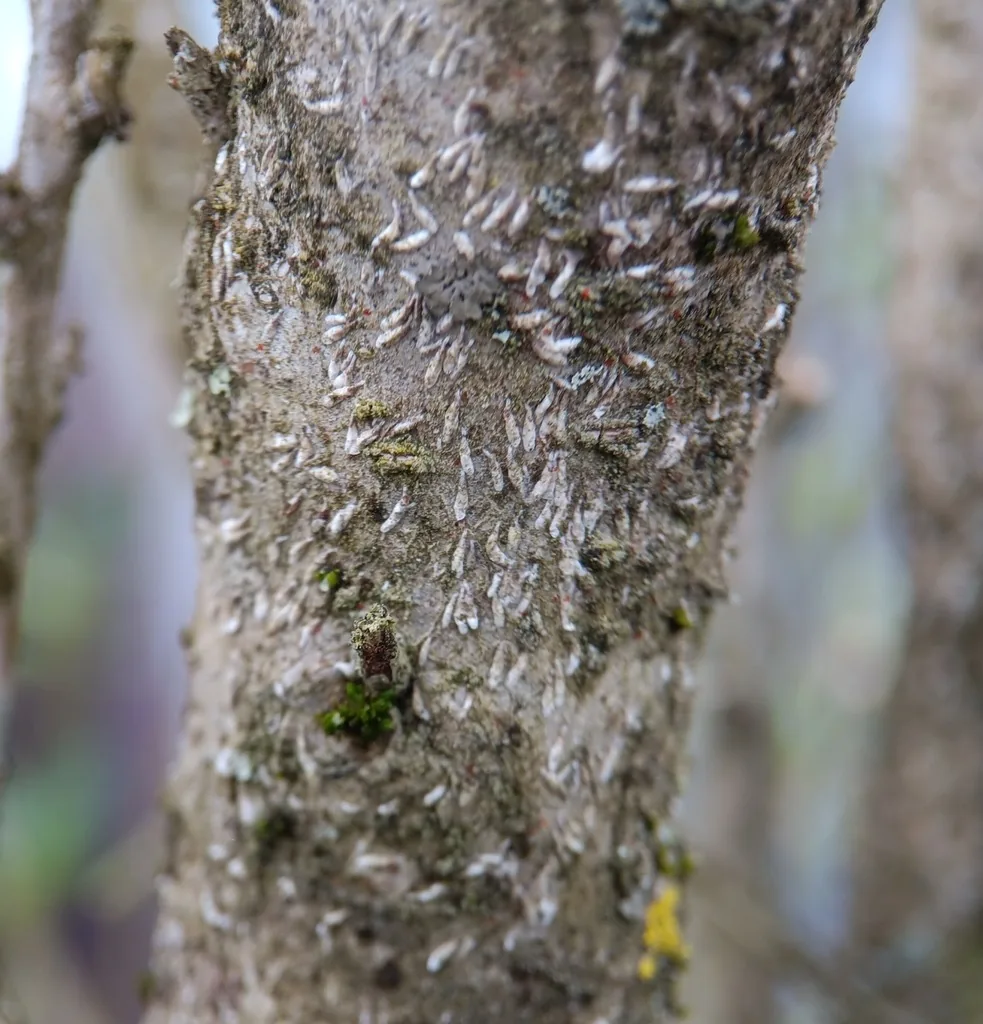
How to identify it
Look-alikes
| Look-alike | How to tell them apart |
|---|---|
| Oystershell scale | Japanese maple scale superficially resembles it; look for the white wax coat and the purple insect underneath.[1] |
| White peach scale | Another look-alike UK Extension names; the purple body and eggs point to Japanese maple scale.[1] |
Where it lives
In Kentucky it's mostly found in production nurseries; NC State reports it on 45 plant genera in 27 families.[1]
Biology and life cycle
Central Kentucky has two generations a year, Pennsylvania one; females lay about 25 purple eggs under the cover in May.[1]
Crawlers can start forming wax within three days of hatching, and egg hatch is drawn out, so crawlers appear over a long period.[1]
Damage and signs
- Infested plants lose vigor, may look water-stressed, and show yellow leaves and twig dieback.[1]
Health risk
It feeds on plants; UK Extension mentions no risk to people.[1]
Control
Traps and physical control
Watch for tiny purple crawlers on twigs, or wrap twigs with sticky-side-out tape from May and replace it every 2 to 3 weeks.[1]
Pesticides
Dormant oil in early spring or fall helps suppress it; crawler sprays and systemic imidacloprid or dinotefuran are nursery options.[1]
Common questions
Sources
- University of Kentucky Entomology (ENTFACT), “Managing Japanese Maple Scale in Kentucky Nurseries (ENTFACT-463).” entomology.mgcafe.uky.edu/ef463 (accessed 2026-10-06)
- iNaturalist, “Lopholeucaspis japonica taxon page (order and family).” www.inaturalist.org/taxa/63511 (accessed 2026-10-06)