On this page
How to identify it
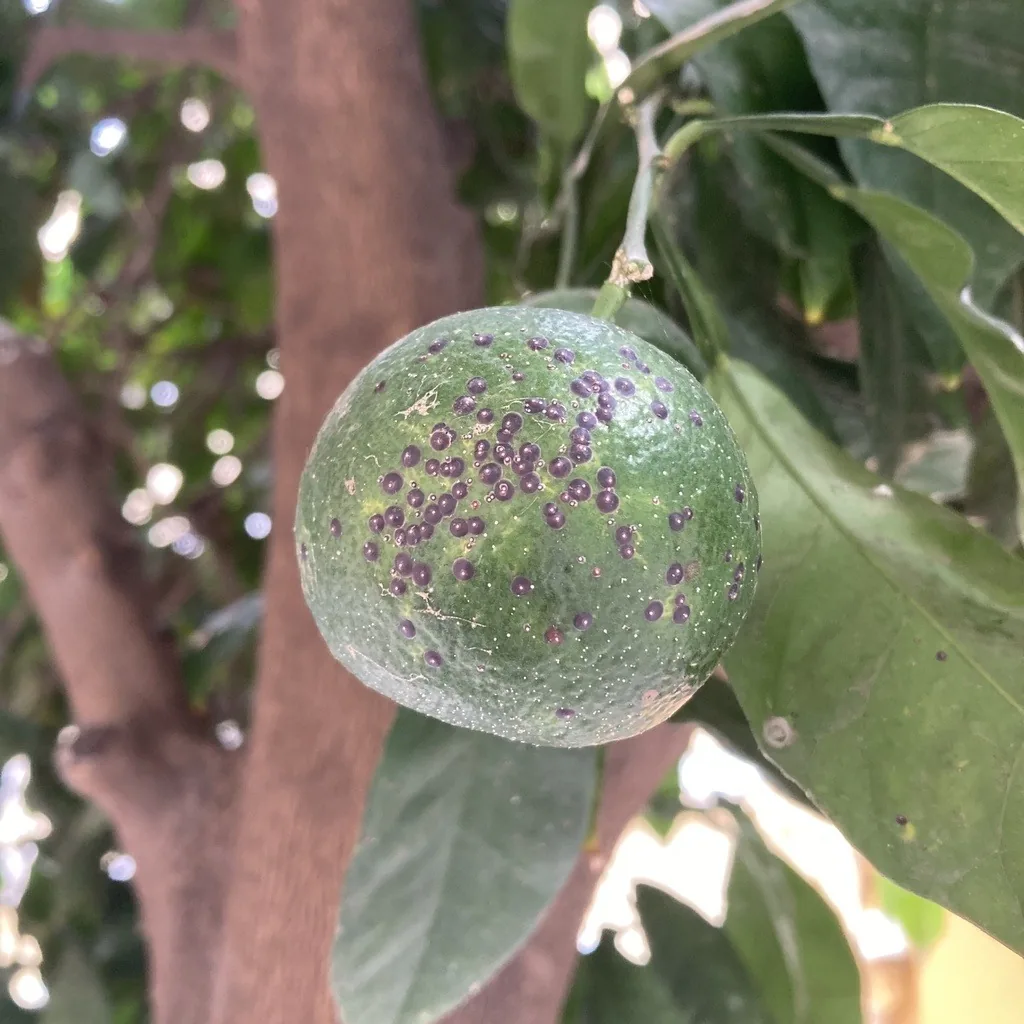
- The female's cover is circular, 1.5 to 2.5 mm across (Clemson gives about 1/12 inch), flat to slightly domed, and dark brown or bluish-black with a reddish-brown center, sometimes with a small pale point near the middle.[1][3]
- Clemson describes the cover as three concentric rings with a conspicuous light brown center, a bullseye look.[3]
- Male covers look similar but are more oval and sometimes paler.[1]
- On a leaf an infestation shows as circular dark-purple, reddish-brown or black spots with paler edges, on both surfaces of shaded leaves; Clemson notes yellow spots on infested leaves and fruit.[1][3]
- Like other armored scales it makes no honeydew. The crawlers are bright lemon yellow, and the body of a living female is yellow.[3][1]
Look-alikes
| Look-alike | How to tell them apart |
|---|---|
| California red scale | California red scale also forms reddish-brown spots, about 1/10 inch, on fruit, stems and leaves. Field identification of dark armored scales is unreliable; Diaspididae of the World says authoritative identification needs slide-mounted adult females under a microscope.[3][1] |
| Citrus snow scale | Snow scale starts on limbs and twigs and can coat the bark white with its snow-white males; the females are brownish-purple and shaped like oyster shells. Florida red scale is round and dark and mainly on leaves and fruit.[3][1] |
Where it lives
Apparently native to tropical Asia, it has spread through the tropics and subtropics, mostly with the citrus trade, and has damaged citrus in Florida and Texas. It can't tolerate freezing, so in colder places it lives under glass; Diaspididae of the World lists it from most U.S. states that way, but with no known California infestations as of 1997. GBIF holds only 61 U.S. records since 1990 (7 states on the map), most from Mississippi and New York, too few to show its range.[1][7]
Biology and life cycle
It has been recorded on plants in 77 families, with a preference for citrus (especially navel and Valencia oranges and grapefruit); hosts include palms, cycads, camellias, aloes, aspidistra, dracaena and orchids.[1][3]
Sources differ on where it settles first. Diaspididae of the World calls it a leaf-infesting species that spreads to fruit, stems and trunks only at high density, preferring shade and the lower and central canopy; Clemson says it infests fruit first and moves onto foliage in late summer and early fall.[1][3]
Males tend to settle on upper leaf surfaces and females on the undersides. Each female lays about 50 to 150 eggs under her cover; the crawlers that hatch walk to a feeding spot and settle for good, and development to adult takes 7 to 16 weeks depending on temperature.[1]
Generations vary with climate: up to six a year have been reported, Clemson says several, and in southern Italy it completed four generations on leaves and shoots and three on fruit, overwintering as second-stage nymphs and adults.[1][3][6]
Populations climb in dry weather, and heavy rain kills many scales.[1]
Crawlers are the only stage that moves. Air currents can carry them tens of kilometres, animals and people carry them too, and moving infested plants or produce is the main way it has reached new countries.[1]
Damage and signs
- Heavy infestations yellow the leaves and can strip part or all of a tree; dense populations spread onto fruit, stems and trunks and cause early leaf and fruit drop and twig dieback.[1][3]
- In unsprayed citrus orchards in South Africa it once caused almost complete defoliation of trees, which then bore hardly any crop the next season; heavily infested fruit could be entirely culled at the packhouse.[1]
- It also turns up in newer growing systems: in screened citrus houses in Florida it infested 11% to 12% of in-ground grapefruit trees from 2020 to 2022, while nearby open-air trees were not infested.[5]
Health risk
It is a plant pest. None of these sources mentions bites or any other risk to people or pets.[1][3]
Control
Prevention
Inspect new plants and fruit before bringing them home, since infested plant material is how the scale has spread between countries.[1]
Traps and physical control
Check shaded, lower leaves closely in good light for round dark spots with paler margins; a hand lens helps with the small young scales. If only a few leaves are infested, trim them off and throw them away.[1][3]
Biological control
Natural enemies matter. Parasitic wasps such as Aphytis holoxanthus have been introduced against it in Florida, Texas and California, Clemson notes that wasp parasites and lady beetles help, and in lab tests the metallic blue lady beetle ate most of the scales offered, though the armor slowed its larvae.[1][3][4]
Pesticides
Hard covers make adult scales hard to kill with contact insecticides. Clemson recommends horticultural oil, which smothers all stages present and spares beneficial insects because it leaves little residue; spray between 45 and 85 degrees F, not in direct sun or before rain.[3]
Common questions
- What are the round dark spots on my citrus or palm leaves?
- Small, circular dark scales with a reddish-brown or light brown center, clustered on leaves and fruit, are typical of Florida red scale. The cover of an armored scale can be lifted off, showing the yellow body underneath.[1][3]
- Can Florida red scale live indoors?
- Yes. It can't survive freezing outdoors, but in colder regions it lives on plants under glass, and in Poland it seriously damages ornamentals in glasshouses.[1]
- Does Florida red scale make plants sticky?
- No. Like most armored scales it produces no honeydew, so you won't see the stickiness and sooty mold that soft scales cause.[3]
Sources
- Naturalis Biodiversity Center (Diaspididae of the World, with USDA scale insect data), “Chrysomphalus aonidum (species account).” diaspididae.linnaeus.naturalis.nl/linnaeus_ng/app/views/species/taxon.php?id=113061 (accessed 2026-11-11)
- iNaturalist, “Chrysomphalus aonidum taxon page (order and family).” www.inaturalist.org/taxa/473018 (accessed 2026-11-11)
- Clemson Cooperative Extension, Home & Garden Information Center, “Citrus Insects & Related Pests (HGIC 2211).” hgic.clemson.edu/factsheet/citrus-insects-related-pests/ (accessed 2026-11-11)
- Bulletin of Entomological Research, via PubMed, “Al-Shami S, Qureshi JA (2022), Predation of Florida red scale Chrysomphalus aonidum (L.) by the metallic blue ladybeetle Curinus coeruleus (Mulsant), Bulletin of Entomological Research 112(3):370-377.” pubmed.ncbi.nlm.nih.gov/34743772/ (accessed 2026-11-11). Cited from the PubMed abstract.
- Journal of Economic Entomology, via PubMed, “Al-Shami SA, van Santen E, Qureshi JA (2025), Florida red scale Chrysomphalus aonidum and parasitoid Aphytis melinus colonization of Citrus Under Protective Screen, Journal of Economic Entomology 118(5):2218-2230.” pubmed.ncbi.nlm.nih.gov/40925045/ (accessed 2026-11-11). Cited from the PubMed abstract.
- Neotropical Entomology, via PubMed, “Campolo O, Malacrino A, Laudani F, Maione V, Zappala L, Palmeri V (2014), Population dynamics and temperature-dependent development of Chrysomphalus aonidum (L.) to aid sustainable pest management decisions, Neotropical Entomology 43(5):453-464.” pubmed.ncbi.nlm.nih.gov/27193956/ (accessed 2026-11-11). Cited from the PubMed abstract.
- Global Biodiversity Information Facility (GBIF), “Chrysomphalus aonidum (Florida red scale): occurrence records in the U.S., 1990-2026 (GBIF occurrence search).” api.gbif.org/v1/occurrence/search?taxonKey=8026254&country=US&hasGeospatialIssue=false&occurrenceStatus=PRESENT&year=1990%2C2026&facet=stateProvince&facetLimit=400&limit=0 (accessed 2026-11-11). Only 61 U.S. records: too few to show the range; scale insects are rarely photographed or reported.