On this page
How to identify it
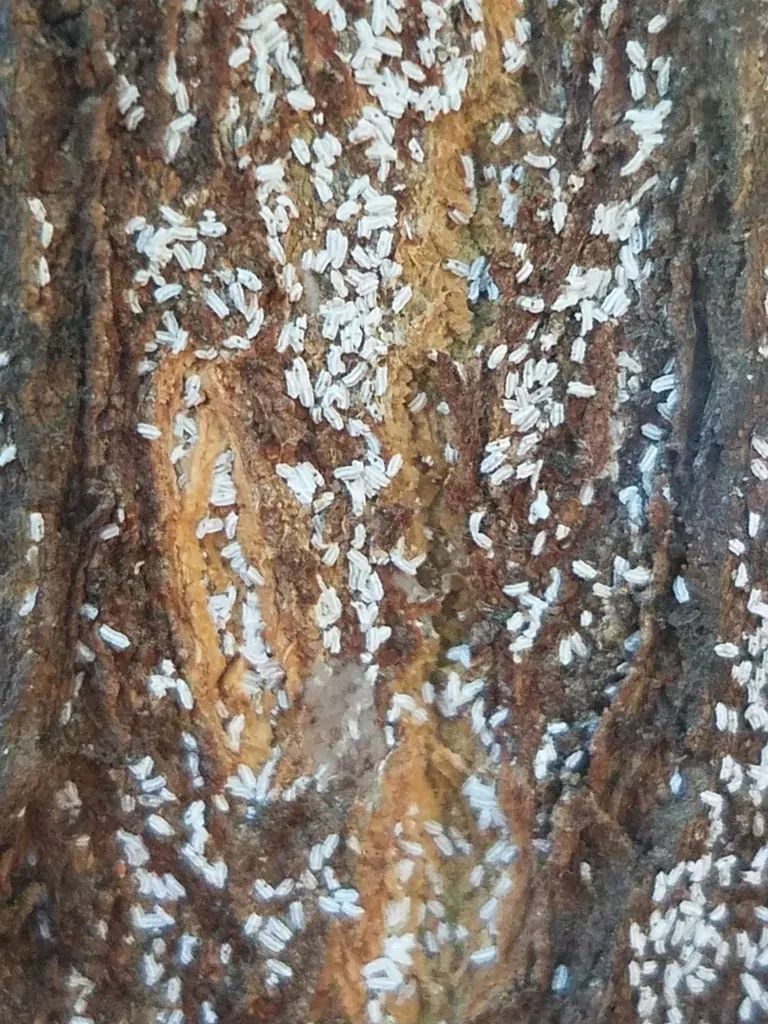
- Male scale covers are white, elongated ovals with three lengthwise ridges, about 1 mm long. They often cluster in conspicuous patches on bark, giving the snow effect.[1][2]
- Female covers are larger, up to about 2.5 mm, shaped like an oyster or mussel shell, brownish-purple to black with a paler gray edge, and often with a ridge down the middle. They are hard to spot against bark.[1][2]
- Under the female's cover the body is creamy to bright orange. The tiny crawlers are bright yellow, and the winged adult males are bright orange with four dark purple eye spots.[1]
- Look mainly on the trunk and main limbs. Leaves and fruit are hit only in heavy infestations.[1][2]
Look-alikes
| Look-alike | How to tell them apart |
|---|---|
| Oystershell and other Lepidosaphes scales | On citrus fruit, female snow scales can be confused with Lepidosaphes scales, which lack the lengthwise ridge on the cover. Lepidosaphes males also lack the white, three-ridged covers; theirs are purplish or brown and shaped like small versions of the female.[2] |
| Euonymus scale | Euonymus scale, a close relative in the same genus, can be mistaken for citrus snow scale; telling them apart for certain requires examining slide-mounted females under a microscope.[2] |
Where it lives
Thought to have come from Asia, it now occurs in citrus regions around the world. In the United States it has been recorded in California, Florida, Georgia, Louisiana, Mississippi and Virginia. It thrives in humid tropical conditions. In Florida it spread widely in the 1960s, especially after the 1962 freeze, when growers replanted with infested nursery trees.[1][2]
Biology and life cycle
Citrus, especially orange, is its main host, and it has been reported on all citrus varieties, with mandarins least favored. Elsewhere it also attacks plants such as pineapple, banana, coconut, guava, mango, hibiscus and euonymus.[1][2]
Once a female crawler settles and inserts her mouthparts, she never moves again. Males stay fixed until they emerge as winged adults without mouthparts, whose only job is to mate.[1]
Each female lays eggs one at a time under her cover, up to about 150 over two to three months. The eggs hatch within hours.[1]
There are several overlapping generations a year. The life cycle takes 10 to 12 weeks in summer and longer in cool weather, populations peak in late autumn, and crawlers can appear year-round.[1][2]
Crawlers are the only stage that spreads on its own. Wind, animals, farm equipment and workers carry them, and infested plants and fruit move the scale over long distances.[1][2]
Damage and signs
- Early signs are reduced vigor and lower fruit production. On trees under about ten years old, heavily infested bark turns dark, dull and hard, then splits, and the weakened limbs are invaded by fungi and wood-boring insects.[1][2]
- Its saliva is toxic to the plant, so even fairly small numbers can do damage. Heavy infestations cause yellow spots and dead areas on leaves, leaf drop, twig dieback and dead branches.[2]
- Scales on the fruit skin make the fruit unsellable on the fresh market.[1]
Health risk
The sources treat it only as a plant pest; neither mentions bites, stings or any risk to people or pets.[1][2]
Control
Prevention
Infested nursery trees spread this scale across Florida, and infested plant material carries it long distances, so check new trees before planting. Clean pruners and other equipment before moving to a new grove, and brush off clothing before entering a new area, since crawlers ride on people and equipment.[1][2]
Traps and physical control
To check for active crawlers, brush a section of trunk clean and look at the same spot a week later. Many crawlers on the cleaned patch signal that a treatment may be needed.[1]
Biological control
The parasitic wasp Aphytis lingnanensis helps control citrus snow scale where it is established, and the introduced lady beetle Chilocorus circumdatus has also been successful. Other parasitoids and a fungus, Myriangium duriaei, also attack it.[1][2]
Pesticides
Sprays used against other pests and diseases can undercut biological control; sulfur applied for fungal diseases, for example, harms Aphytis lingnanensis. Base any insecticide decision on scouting.[1]
Common questions
- What is the white crust on my citrus tree's trunk?
- Patches of small white, ridged scales on the trunk and main limbs are typical of citrus snow scale; the white ones are immature males. Look closely for the darker, shell-shaped females among them.[1][2]
- Can citrus snow scale kill a tree?
- Heavy, long-lasting infestations can split the bark and let fungi and borers in, and the Diaspididae of the World account lists the eventual death of branches among the symptoms. In Florida groves today, populations rarely reach economically damaging levels.[1][2]
- Why are there scales on my lemons or oranges?
- Citrus snow scale moves onto leaves and fruit when trunk populations are large. Scale on the rind makes fruit unsuitable for the fresh market.[1][2]
Sources
- University of Florida IFAS Extension (EDIS), “Citrus snow scale Unaspis citri (Featured Creatures EENY573, C.R. Buckley and A. Hodges, 2013).” journals.flvc.org/edis/article/view/138215 (accessed 2026-11-09)
- Naturalis Biodiversity Center (Diaspididae of the World, with USDA scale insect data), “Unaspis citri (species account).” diaspididae.linnaeus.naturalis.nl/linnaeus_ng/app/views/species/taxon.php?id=113132 (accessed 2026-11-09)
- iNaturalist, “Unaspis citri taxon page (order and family).” www.inaturalist.org/taxa/330214 (accessed 2026-11-09)