On this page
How to identify it
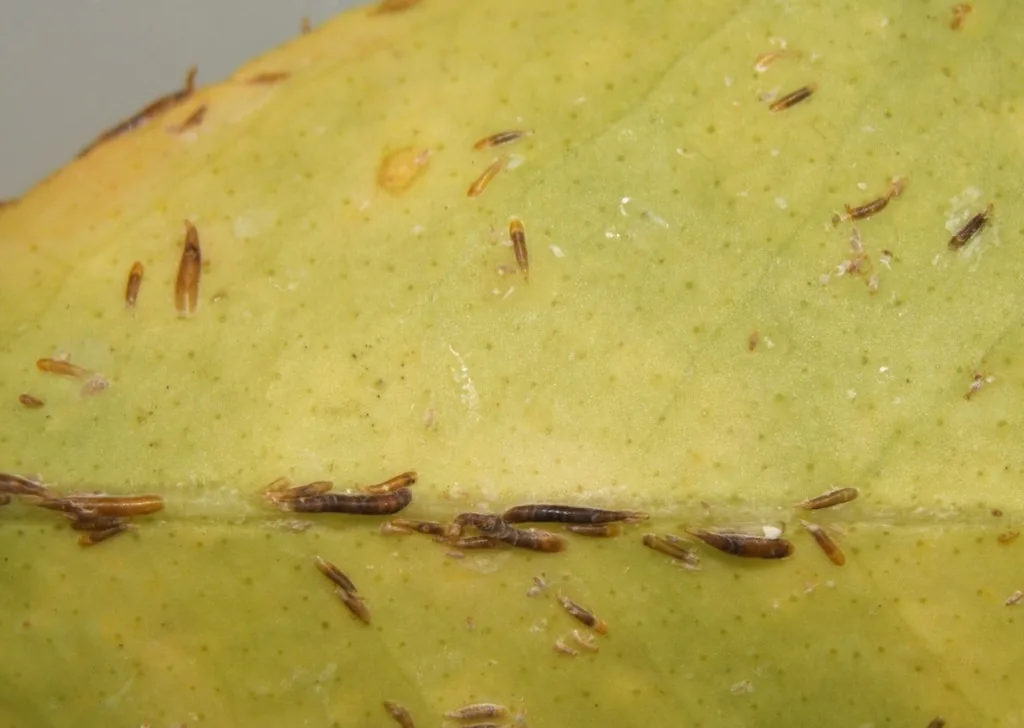
- The female's cover is 2.5 to 3.5 mm long (about 1/8 inch), long and narrow with nearly parallel sides, and only slightly tapered toward the end that holds the yellowish-brown cast skins.[1]
- Young covers are brownish-yellow and old ones dark brown; the female's second cast skin has a distinctive reddish-brown spot at its rear end.[1]
- Male covers look similar but are smaller, with a yellow cast skin at the end.[1]
- Lift a female's cover and the body underneath is white; like other armored scales it makes no honeydew.[1][2]
Look-alikes
| Look-alike | How to tell them apart |
|---|---|
| Purple scale | Purple scale, a close relative, often lives alongside Glover's scale on citrus. Glover's scale has a longer, narrower cover with nearly parallel sides.[1] |
| Citrus snow scale | Snow scale's male covers are white and ridged, while Glover's scale males are brown, and snow scale females have a ridge down the middle of the cover that Glover's scale lacks.[1] |
Where it lives
Probably native to the Far East, it now occurs throughout the tropical and subtropical regions where citrus is grown, and only in greenhouses in colder countries. U.S. records come from Florida, Alabama, Louisiana, Hawaii and California, where it is uncommon, and from greenhouses in Oklahoma.[1][2]
Biology and life cycle
Citrus and its relatives, such as kumquat and trifoliate orange, are the favored hosts, but it also feeds on boxwood, croton, coconut and other palms, mango, magnolia, Japanese euonymus, Eugenia, poplar, willow and umbrella pine.[1]
Each female lays about 200 eggs in two rows under her cover; they turn from white to purple just before hatching. The crawlers settle on twigs, leaves or fruit within 12 hours of hatching.[1]
In warm lab conditions eggs hatch in about two weeks, and winged males emerge about six weeks after the crawlers settle. There are two generations a year in Japan, three or four in California, and four in South Africa.[1]
It prefers the shaded interior of the canopy, and in California it seems unable to survive hot, dry summers.[1]
Wind and animals carry crawlers to new plants, and people spread the scale on infested plant material.[1]
Damage and signs
- On ripening citrus the fruit around each scale stays green, and spotted fruit can lose market value or become unmarketable.[1]
- Heavy infestations turn leaves completely yellow, followed by leaf drop and twig dieback that weakens the tree and cuts production.[1]
- Because scales stay in one place, numbers can build for several generations before anyone notices.[2]
Health risk
The sources treat it only as a plant pest; none mentions bites or other risk to people or pets.[1][2]
Control
Prevention
Keep ants off infested trees: ant control is the key to biological control of citrus scales, because ants can easily upset the balance between scales and their natural enemies. Avoid repeated broad-spectrum insecticide sprays, which are a common cause of scale outbreaks.[1][2]
Traps and physical control
In good light, check bark, leaves and fruit in the inner canopy for elongate brown covers. Dead scales from earlier generations stay on the plant for months, so make sure the scales you find are alive before treating.[1][2]
Biological control
Natural enemies do most of the work. Parasitic wasps introduced to many countries have made Glover's scale far less important than it once was; Aphytis lingnanensis was introduced to California, and several Encarsia wasps attack it in the United States. Lady beetles, parasitic wasps and fungi are the basis of scale management in Florida citrus.[1][2]
Pesticides
Florida's citrus guide treats scales as occasional pests: it reserves sprays for cases where natural enemies have failed, times them for the crawler stage, and lists products by active ingredient. Double-sided tape wrapped around a branch shows when crawlers are moving.[2]
Common questions
- Why do my ripe oranges have green blotches with tiny brown scales?
- Glover's scale delays the color change of ripening citrus around each scale, leaving green spots on the rind. The long, narrow brown covers sit in the middle of the spots.[1]
- How do I tell Glover's scale from purple scale?
- The two often share the same tree. Glover's scale is longer and narrower with nearly parallel sides; a sure identification needs a slide-mounted specimen examined under a microscope.[1]
- Does Glover's scale make leaves sticky?
- No. It is an armored scale, and armored scales produce no honeydew or sooty mold.[2]
Sources
- Naturalis Biodiversity Center (Diaspididae of the World, with USDA scale insect data), “Lepidosaphes gloverii (species account).” diaspididae.linnaeus.naturalis.nl/linnaeus_ng/app/views/species/taxon.php?id=113092 (accessed 2026-11-09)
- University of Florida IFAS Extension (EDIS), “2026-2029 Florida Citrus Production Guide: Soft-Bodied Insects Attacking Foliage and Fruit (CPG vol. 1 ch. 24).” journals.flvc.org/edis/article/view/133504 (accessed 2026-11-09)
- iNaturalist, “Lepidosaphes gloverii taxon page (order and family).” www.inaturalist.org/taxa/917304 (accessed 2026-11-09)