On this page
How to identify it
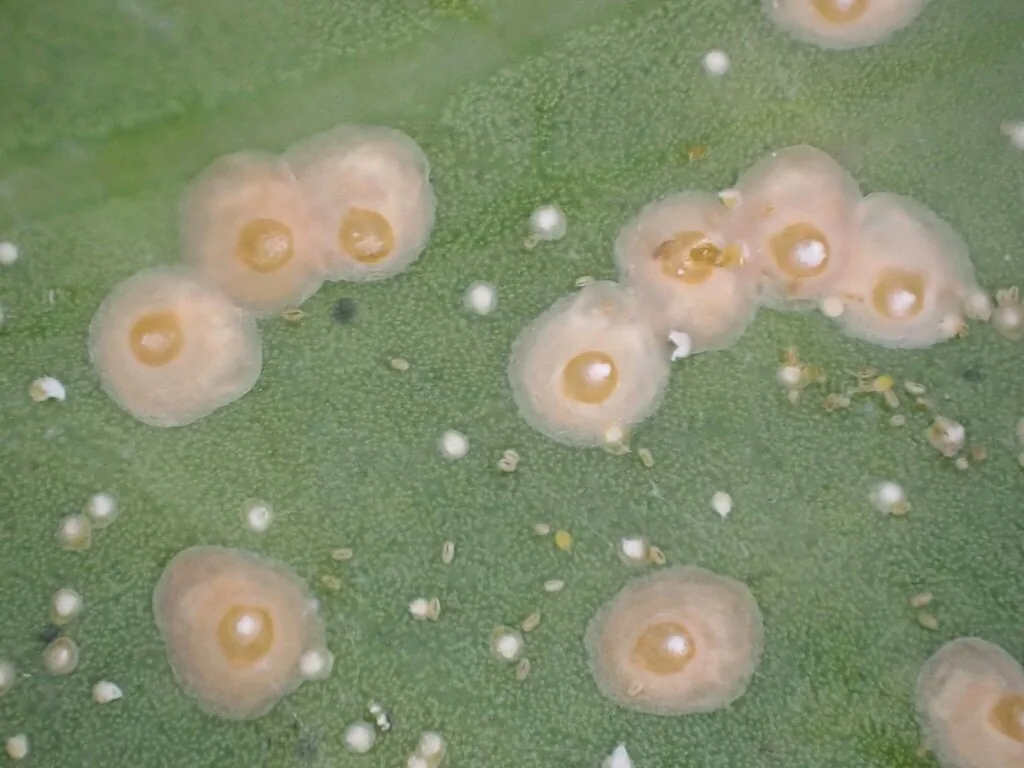
- The female's cover is about 1.5 to 2 mm across, nearly round and flat to slightly domed, and semi-translucent whitish to light tan.[1][2]
- A yellow or gold spot, the shed skins of earlier stages, sits at or near the center of the cover.[1]
- Lift the cover and the female underneath is bright yellow; as with other armored scales, the cover comes off and the insect stays on the plant.[1][3]
- Male covers are smaller, white, oval and translucent.[1]
- The scales sit on either the upper or lower surfaces of leaves, and also on bark and fruit.[2][1]
Look-alikes
| Look-alike | How to tell them apart |
|---|---|
| Greedy scale | Also a small, round, gray to white armored scale that looks similar on the plant, but its cover is not as flat as the oleander scale's.[4] |
| Soft scales | Soft scales are larger and more humped and produce sticky honeydew; armored scales like this one are flatter and do not.[3] |
Where it lives
A worldwide pest of crops, palms, cut flowers and ornamentals, recorded on hundreds of host species. In the United States it is a scale of landscape plants in California and of oleander in Florida.[1][3][2]
Biology and life cycle
Each female lays eggs for one to two weeks, about 100 to 150 in all. A generation takes about five weeks, and there are two to three generations a year depending on climate.[1]
Some populations, including some in California, reproduce without males.[1]
Crawlers, the newly hatched young, are the main stage that spreads, moving over the plant or carried by wind and animals. Settled scales cannot move, so they travel long distances on infested plants carried by people.[1][2]
UC IPM lists aucuba, cycads such as sago palm, ivy, oleander and olive as favorite hosts, and bay, boxwood, holly, laurel, magnolia, manzanita, maple, mulberry, pepper tree, redbud, yew and yucca as other hosts.[3]
Damage and signs
- Damage depends on how heavy the infestation is. Scales on leaves and stems can cause wilting; heavy infestations bring yellowing, malformed or shriveled leaves and shoots, and can kill plants.[1][2]
- On fruit, heavy infestations cause spotting and deformity; on olives the scales leave green spots on purple fruit.[1]
- In California landscapes it is generally not damaging, and it matters most where looks count, such as ornamentals, palms and cut flowers.[3][1]
Health risk
It is a plant pest; none of the sources describe any risk to people or pets from the scale itself.[1][2][3]
Control
Prevention
The scales travel on infested plant material, so examine leaves, bark and fruit closely for the small covers, and space plants apart to keep scales from spreading.[1][2]
Traps and physical control
On small infestations, scrape or scrub the scales off the plant.[2]
Biological control
Lady beetles and parasitic wasps, especially Aphytis and Encarsia species, attack oleander scale. Parasitic wasps are often the most important natural enemies of armored scales.[2][1][3]
Pesticides
The armor protects every stage except the crawlers, so sprays must be timed and chosen with care. Horticultural oil with thorough coverage of infested leaves and stems controls most scales and has low toxicity to people and pets; armored scales need especially complete coverage.[2][3]
Among systemics, imidacloprid does not control most armored scales and acetamiprid is not very effective on them; dinotefuran controls most types of scales. Do not apply systemic insecticides during or shortly before bloom.[3]
Common questions
- What are the small white dots on my oleander leaves?
- They may be oleander scale: tiny, round, whitish armored scales 1 to 2 mm across with a yellowish center, found on either side of the leaves.[2][1]
- Does oleander scale leave sticky honeydew?
- No. Armored scales such as oleander scale do not excrete honeydew; sticky leaves point to other insects, such as soft scales.[3]
- Why don't my sprays kill oleander scale?
- Its hard cover protects every stage except the crawlers, and armored scales are less susceptible to pesticides than soft scales, so timing and thorough coverage matter.[2][3]
Sources
- Naturalis Biodiversity Center (Diaspididae of the World, with USDA scale insect data), “Diaspididae of the World 2.0: Aspidiotus nerii.” diaspididae.linnaeus.naturalis.nl/linnaeus_ng/app/views/species/taxon.php?id=113050 (accessed 2026-11-09)
- University of Florida IFAS Extension (EDIS), “Key Plant, Key Pests: Oleander (Nerium oleander) (ENH310/EP574).” journals.flvc.org/edis/article/view/106823 (accessed 2026-11-09)
- University of California Statewide IPM Program, “Pest Notes: Scales (UC ANR Publication 7408).” ipm.ucanr.edu/home-and-landscape/scales/ (accessed 2026-11-09)
- Naturalis Biodiversity Center (Diaspididae of the World, with USDA scale insect data), “Diaspididae of the World 2.0: Hemiberlesia rapax.” diaspididae.linnaeus.naturalis.nl/linnaeus_ng/app/views/species/taxon.php?id=113086 (accessed 2026-11-09)
- iNaturalist, “Aspidiotus nerii taxon page (order and family).” www.inaturalist.org/taxa/317910 (accessed 2026-11-09)