On this page
How to identify it
- The adult female's cover is grayish white, oval to round, with a darker shed skin near the center or at one end.[1][2]
- The male cover is smaller and longer, with a dark spot at one end.[1][2]
- Lift a cover and the body underneath is reddish purple to deep purple. Eggs and young scales are pink to violet.[1][2]
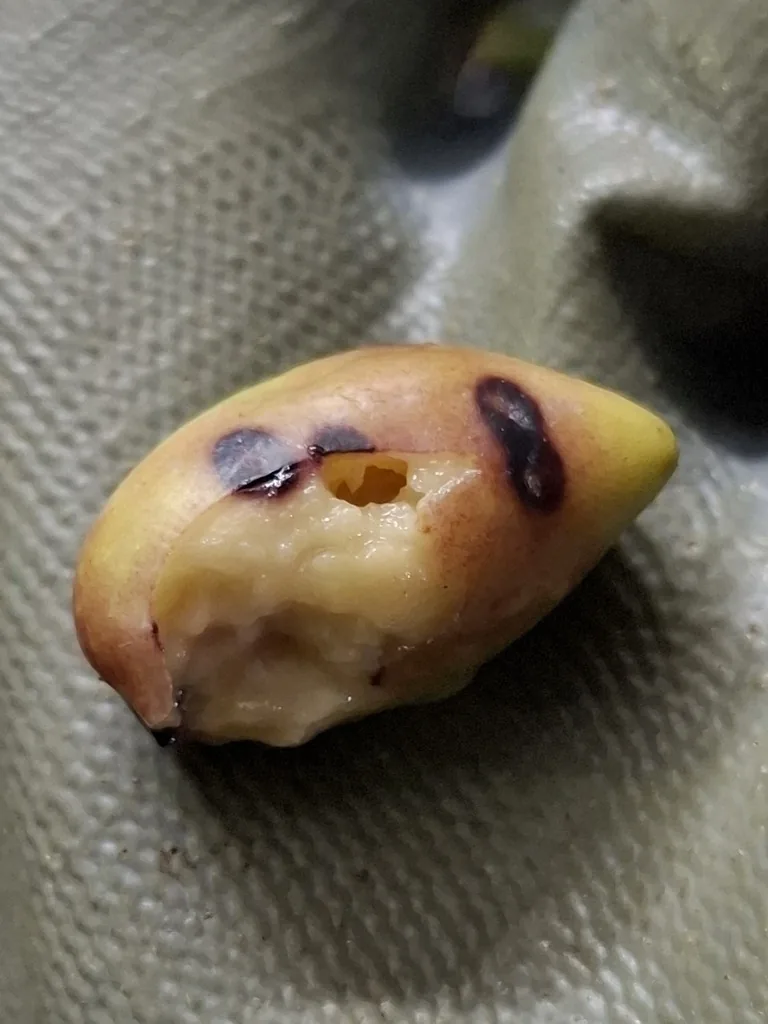
- On olives it is most often noticed at harvest, as dark purple spots on otherwise green to yellowish fruit.[1]
Look-alikes
| Look-alike | How to tell them apart |
|---|---|
| San Jose scale | Very similar in life and often found on the same hosts.[2] |
| Oleander scale | Has a tan shed skin in the center of the cover and a yellow body; olive scale has a purple body.[2] |
| Greedy scale | Similar in form, but olive scale's body is purple.[2] |
Where it lives
Widespread in Mediterranean and subtropical regions of the world. In the United States it is recorded as quite widespread in California and from restricted areas of Arizona, Texas, Maryland and Delaware.[2]
Biology and life cycle
It is highly polyphagous, recorded from more than 200 host species in 39 plant families. Rose-family plants, legumes and the olive family, especially olive, are its favored hosts.[2]
It overwinters on the bark as mated adult females or second-stage females. Each female lays about 90 eggs on average.[2]
It has more than one generation a year. Scales first gather on leaf midribs, stems and the blossom end of fruit, and later generations settle on the fruit rather than the leaves.[1][2]
Newly hatched crawlers are the stage that spreads the scale, but they cannot walk far. Wind, animals and people moving infested plants carry them longer distances.[2]
Damage and signs
- On olives, the first brood in late May and June feeds on and deforms young fruit. A later brood in July and August causes purple spotting that leaves green fruit worthless for most markets.[1]
- Heavy infestations on branches, twigs and leaves substantially reduce a tree's productivity and can encrust twigs and limbs.[1][2]
- Heavy infestations can also cause leaf wilting, yellowing and dieback, distorted fruit, early fruit drop, lower oil content in olives, and weakened or killed branches. Apples and peaches may show a dark red spot around each feeding site.[2]
Health risk
The sources describe it only as a plant pest; none mentions any risk to people or pets.[1][2]
Control
Prevention
If olive scale was found the season before, or disruptive insecticides are in use, watch for crawlers moving onto fruit in spring and summer. Double-sided sticky tape wrapped around branches helps show when crawlers are active.[1]
Sanitation
Control ants in the orchard, because they interfere with biological control.[1]
Biological control
Two parasitic wasps, Aphytis maculicornis and Coccophagoides utilis, control olive scale effectively, and it does not usually cause economic damage. Carbamate, organophosphate and pyrethroid insecticides used for other pests disrupt this control.[1]
Pesticides
If treatment is needed, UC IPM times it for the first brood in late May and June, as crawlers move onto the fruit, or for the second brood in late July and August, and advises against treating in early July between broods. A postharvest treatment is also effective, and one treatment is usually all that is needed. Certain oil sprays are acceptable in organic production.[1]
Common questions
- What causes purple spots on my olives?
- Olive scale is one cause: where the scale settles on green to yellowish fruit it leaves dark purple spots, and it is most often noticed at harvest.[1]
- Does olive scale attack trees other than olive?
- Yes. It has been recorded from more than 200 host species and is a pest of apple, pear, peach, plum and ornamental plants as well as olive.[2]
- Do I need to spray for olive scale?
- Often not. Two introduced parasitic wasps usually keep it below damaging levels, as long as broad-spectrum insecticides and ants do not disrupt them.[1][2]
Sources
- University of California Statewide IPM Program, “Olive Scale, UC IPM Pest Management Guidelines: Olive.” ipm.ucanr.edu/agriculture/olive/olive-scale/ (accessed 2026-11-09)
- Naturalis Biodiversity Center (Diaspididae of the World), “Parlatoria oleae, Diaspididae of the World 2.0.” diaspididae.linnaeus.naturalis.nl/linnaeus_ng/app/views/species/taxon.php?id=113115 (accessed 2026-11-09)
- iNaturalist, “Parlatoria oleae taxon page (order and family).” www.inaturalist.org/taxa/716065 (accessed 2026-11-09)