On this page
How to identify it
- Adults are light tan, about 2.5 mm long and strong jumpers, with a few small dark spots on the forewings.[1]
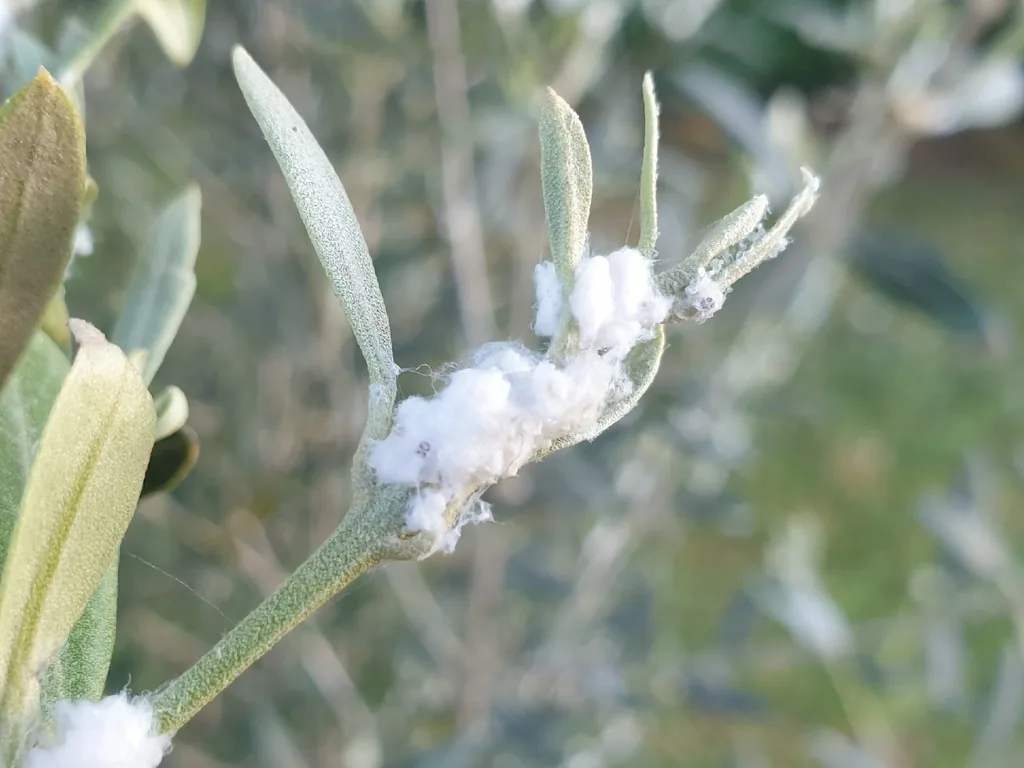
- Nymphs are flat and green to tan. They secrete a white waxy coating that covers the whole colony.[1]
- There are five nymphal stages, from about 0.4 mm to 1.5 mm long.[1]
- Eggs are elliptical, about 0.3 mm long and pale yellow, attached to the plant by a short stalk.[1]
Where it lives
Newly invasive in California. It is widespread in San Diego County, mainly coastal in Orange County, found from Temecula to Wildomar in Riverside County, and recorded at one site in Carmel Valley in Monterey County. Surveys have found it only along the coast between Monterey and San Diego, with no reports from the main olive-growing areas of central and northern California.[1][2]
Biology and life cycle
It feeds on olive, Russian olive (Elaeagnus angustifolia) and mock privet (Phillyrea latifolia).[1]
Females lay eggs on new shoots and buds, and a single female can lay 1,000 eggs or more.[1]
There are three generations a year. Development from egg to adult takes about three months, fastest at 68 to 77 degrees F; the psyllids slow down above 81 degrees F and die off faster above 90 degrees F.[1]
The second generation develops on buds and flowers in May and June, and the third, in September and October, often goes unnoticed. Adults spend the winter in sheltered spots on the trunk.[1]
In Southern California numbers drop after June, most likely because of the heat, and stay low until buds appear the next spring.[1]
Damage and signs
- It feeds directly on buds, flowers, tender shoots and small fruit, and its honeydew encourages sooty mold.[1]
- During flowering and fruiting, the waxy secretions cause flowers and small fruit to drop. Heavily infested trees can lose 30% to 60% of their yield.[1]
- Large populations can slow the growth of young trees.[1]
- Researchers warn it could become an economic pest if it reaches the olive-growing regions of California's Central Valley.[2]
Health risk
The sources describe it only as a pest of olive trees; neither mentions any risk to people or pets.[1][2]
Control
Prevention
Monitor from March to May. Olive trees seem to tolerate low numbers: UC IPM's guidelines say more than 6 to 8 psyllids per flower cluster may cause some loss in light-set years, while fewer than 10 per cluster in heavy-set years causes little or no loss.[1]
Traps and physical control
In hot areas, pruning out center limbs to improve air circulation may reduce psyllid numbers.[1]
Biological control
Natural enemies of the olive psyllid in California have not been studied yet. Researchers have collected the parasitic wasp Psyllaephagus euphyllurae abroad as a candidate, and in early tests it did not develop on three native North American psyllids.[1][2]
Pesticides
The second generation does the most damage, so knocking down the first generation keeps it small. Any treatment needs to go on before the psyllids build up their heavy wax coating, which shields them from pesticides.[1]
Common questions
- What is the white fluffy wax on my olive tree's flower buds?
- In coastal Southern California it may be olive psyllid nymphs, which cover their colonies with white wax on buds, flowers and new shoots.[1]
- Can olive psyllid reduce my olive crop?
- Yes. Feeding and wax cause flowers and small fruit to drop, and heavily infested trees can lose 30% to 60% of their yield.[1]
- When should I check for olive psyllid?
- From March to May, while the trees are budding and flowering. Numbers usually fall after June in Southern California's heat.[1]
Sources
- University of California Statewide IPM Program, “Olive Psyllid, UC IPM Pest Management Guidelines: Olive.” ipm.ucanr.edu/agriculture/olive/olive-psyllid (accessed 2026-11-09)
- MDPI (Insects), “Hougardy E, Wang X, Hogg BN, Johnson MW, Daane KM, Pickett CH. Current distribution of the olive psyllid, Euphyllura olivina, in California and initial evaluation of the Mediterranean parasitoid Psyllaephagus euphyllurae as a biological control candidate. Insects 11(3):146 (2020) (abstract).” doi.org/10.3390/insects11030146 (accessed 2026-11-09)
- iNaturalist, “Euphyllura olivina taxon page (order and family).” www.inaturalist.org/taxa/537501 (accessed 2026-11-09)