On this page
How to identify it
- Infested eucalyptus shoots carry fluffy white wax on the leaves and growing tips.[2]
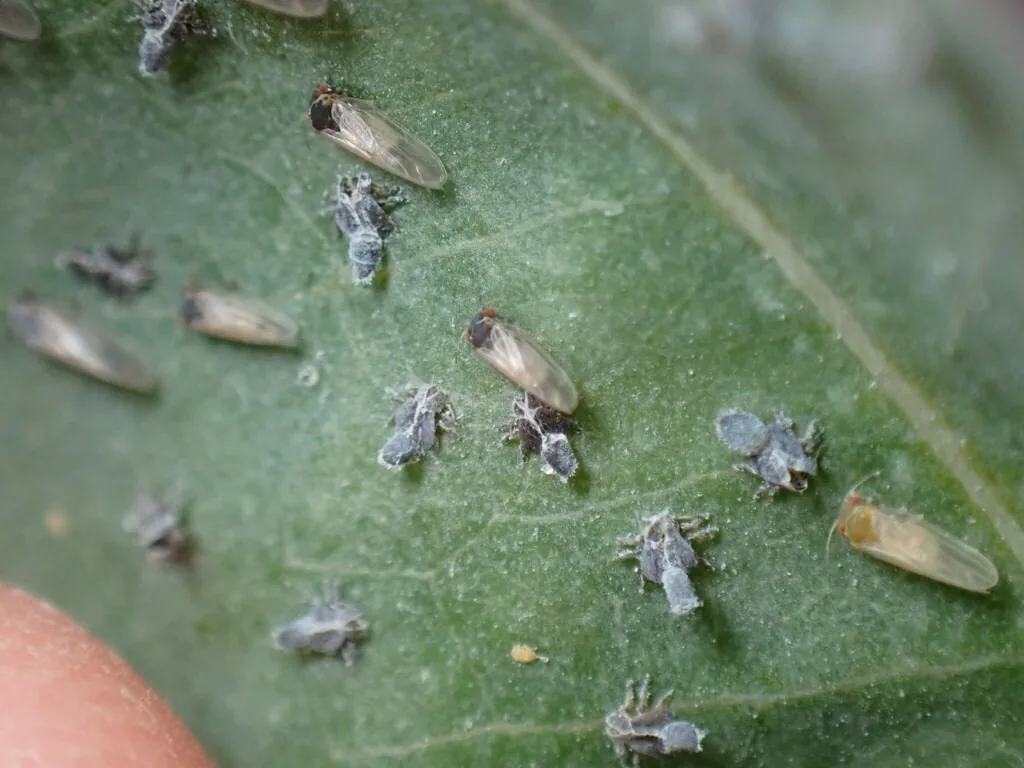
- Adults are tiny, cicada-like insects 1/12 to 1/5 inch long that hold their wings like a roof over the body and jump when disturbed. Mating pairs joined tail to tail look like small moths.[2]
- Nymphs are flattened and cluster inside the developing buds at the shoot tips; they are rarely found more than a few leaf pairs back and never on older, fully expanded leaves.[2][3]
- Parasitized nymphs turn into crusty, puffy mummies, each with a round exit hole once the wasp has emerged.[1]
Look-alikes
| Look-alike | How to tell them apart |
|---|---|
| Redgum lerp psyllid | Another introduced eucalyptus psyllid, but it feeds on river red gum and related red gums and leaves pale, hemispherical caps (lerps) on the leaves instead of fluffy wax on blue gum shoot tips.[2] |
| Psocids (barklice) | Look similar to psyllid adults but run or fly away instead of jumping, have a narrower neck and chewing mouthparts, and feed on fungi such as sooty mold.[2] |
Where it lives
Native to Australia and New Zealand. It was introduced accidentally into California in 1991 and has also turned up in eucalyptus plantations in southern Brazil and in apple orchards in northern Spain.[1][5][4]
Biology and life cycle
It feeds mainly on blue gum (Eucalyptus globulus), especially the juvenile foliage, and on baby blue gum (E. pulverulenta).[1][2]
Nymphs are most numerous inside developing apical buds, where the humid shelter of the bud is thought to protect eggs and nymphs from drying out.[3]
Adults also appear to feed on apple: in Spanish orchards, catches of adult Ctenarytaina psyllids peaked at sprouting and leaf drop, and one bluegum psyllid carried the apple proliferation phytoplasma, which can only be picked up by feeding on an infected apple tree.[4]
Damage and signs
- In California it caused severe defoliation and honeydew fouling of baby blue gum grown for cut foliage in flower arrangements, making the plants unmarketable.[1]
- Like all psyllids it excretes sticky honeydew, on which dark sooty mold grows.[2]
- In Brazil it is considered the most harmful psyllid in blue gum plantations.[5]
Health risk
The sources describe it only as a plant pest; none mentions any risk to people or pets.[1][2]
Control
Prevention
UC IPM says bluegum psyllid is biologically controlled except sporadically in commercial foliage production when natural enemies are disrupted, and that in most situations it needs no management beyond conserving natural enemies.[2]
Biological control
The parasitic wasp Psyllaephagus pilosus, collected in the psyllid's native range and released in California in 1993, spread statewide. Within six months, baby blue gum growers who had been spraying often stopped, and the psyllid is now hard to find and no longer a pest there.[1]
The same wasp is highly efficient in Brazilian plantations, where it has made other control methods unnecessary.[5]
Common questions
- What is the white fluff on my eucalyptus tips?
- On blue gum or baby blue gum it may be bluegum psyllid, which leaves flocculent wax on leaves and shoot tips.[2]
- Should I spray eucalyptus for bluegum psyllid?
- Usually not. An introduced parasitic wasp keeps it under control in California, and UC IPM advises conserving natural enemies rather than treating.[1][2]
- What are the puffy, crusty psyllids with holes in them?
- They are nymphs killed by the parasitic wasp Psyllaephagus pilosus; the round hole is where the adult wasp chewed its way out.[1]
Sources
- University of California Statewide IPM Program, “Bluegum Psyllid Psyllaephagus Parasitoid, UC IPM Natural Enemies Gallery.” ipm.ucanr.edu/natural-enemies/bluegum-psyllid-psyllaephagus-parasitoid/ (accessed 2026-11-09)
- University of California Statewide IPM Program, “Pest Notes: Psyllids (UC IPM).” ipm.ucanr.edu/PMG/PESTNOTES/pn7423.html (accessed 2026-11-09)
- PLOS (PLoS One), “Shoot feeding as a nutrient acquisition strategy in free-living psylloids (Steinbauer 2013).” doi.org/10.1371/journal.pone.0077990 (accessed 2026-11-09)
- Society of Chemical Industry (Pest Management Science), “The occurrence and abundance of two alien eucalypt psyllids in apple orchards (Rosa Garcia et al. 2014).” doi.org/10.1002/ps.3701 (accessed 2026-11-09)
- Sociedade Entomologica do Brasil (Neotropical Entomology), “Occurrence of Ctenarytaina eucalypti and its natural enemy Psyllaephagus pilosus in Eucalyptus globulus in Rio Grande do Sul, Brazil (Kurylo et al. 2010).” doi.org/10.1590/s1519-566x2010000400031 (accessed 2026-11-09)
- iNaturalist, “Ctenarytaina eucalypti taxon page (order and family).” www.inaturalist.org/taxa/48186 (accessed 2026-11-09)